 ◄ BACK
(H.P. Blavatsky, From the Caves and Jungles of Hindostan, pp. 251-259, 1883-6.)



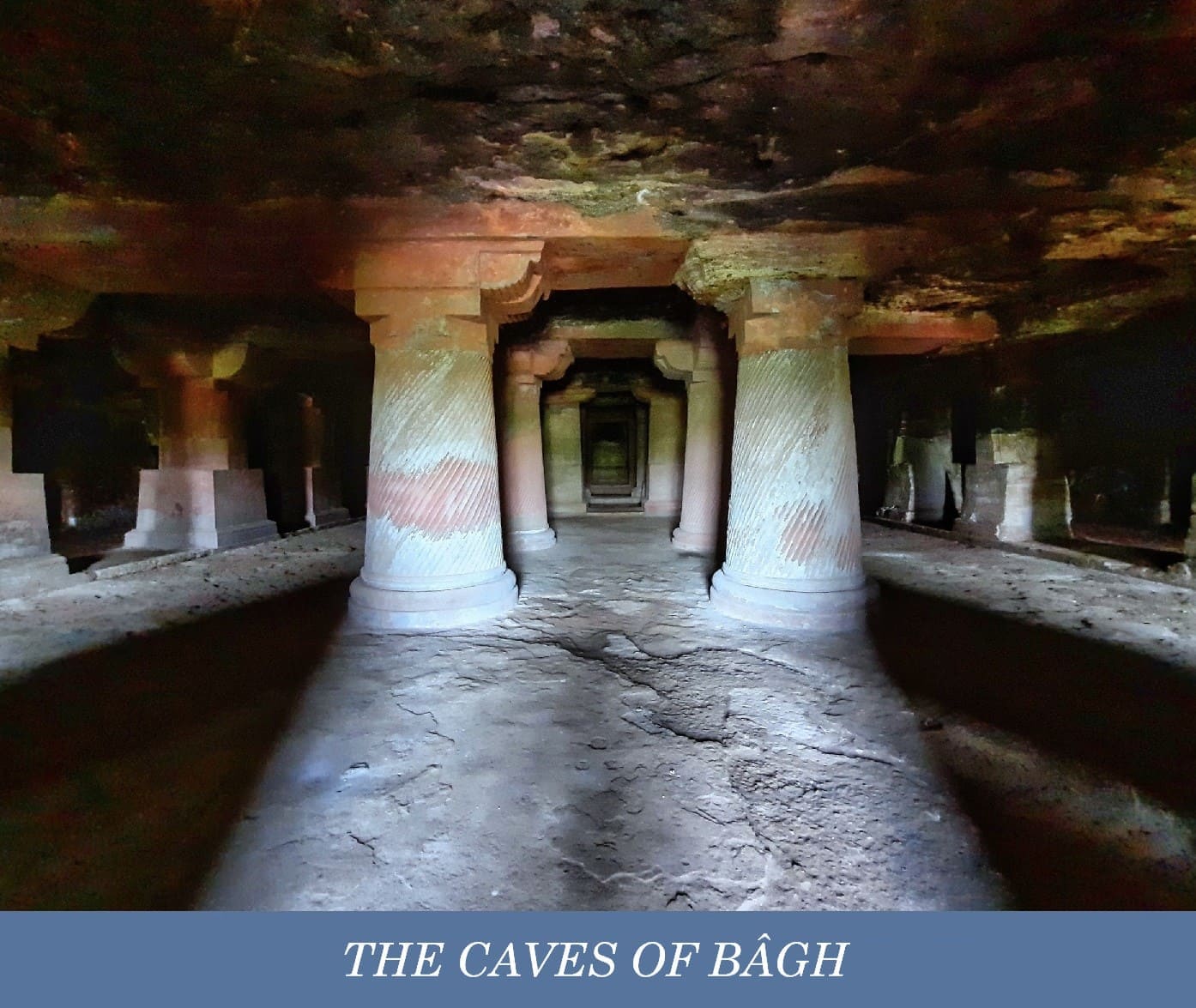
... Directly opposite the entrance, a door leads to another hall which is oblong, with two hexagonal columns and with niches on the sides, containing statues, in a fair state of preservation, of goddesses ten feet and gods nine feet high. Behind, a doorway leads into a room with an altar, which is a regular hexagon, having sides three feet long, and protected by a cupola cut in the rock. No one ever has gained admittance here, nor is admitted now, except those initiated into the mysteries of the adytum. Cells of former priests surround it; there are about twenty of them. Having examined the altar, we were about to proceed further, when the Colonel, taking a torch from the hand of one of the servants, went with two others to look into the side-rooms. A few minutes later we heard his voice, loudly calling us from the second cell. He had found a secret passage and was shouting: "Let's go further!... We must find out where it leads to!"
"Maybe into the den of one of the werewolves!... Look out, Colonel, beware of tigers!" shouted the Bâbû.
But once started on the road to "discoveries," our President was not to be stopped. We responded to his call.
He had actually made a discovery, and upon entering the cell we beheld a most unexpected sight... Against the wall opposite to the entrance, two torchbearers stood motionless, as if transformed into stone caryatides, and from the wall itself, about five feet above the ground, protruded two legs clad in white trousers. There appeared to be no body attached to them for it had disappeared. Were it not for the fact that the legs were jerking we might have thought that the wicked "devi" inhabiting the cave had cut the Colonel into two halves and, having caused the upper part instantly to evaporate, had stuck the lower half to the wall as a token of her might.
"What have you gotten into, Mr. President?" was our unanimous outcry.
Instead of an answer, the legs became more agitated than ever and finally disappeared inside the wall; after this we heard his voice, as if it were coming through a long pipe:
"A room... a secret cell!... Come up, all of you!... There is a whole row of rooms... Here goes my torch!... Bring in some matches and another torch!..."
This was, however, easier said than done. The torch-bearers refused point-blank to climb up there, and very nearly ran away in fright. Miss B. glanced with squeamishness at the wall covered with soot and then at her dress. Mr. W. sat down on a stone which had broken off a pillar and decided he would go no further, but would wait for us, while having a cigar in the company of the timid torch bearers. There were several vertical steps cut in the wall at a later date than the cave itself, and on the floor there lay a large stone cut in an irregular shape which corresponded to the hole in the wall. The Bâbû explained in his picturesque language that this was the "stopper" of the secret passage. Examining it most carefully, we came to the conclusion that the mason-builders had intended to make it similar to, and even indistinguishable from, the unevenness of the rudely cut wall. We also found on it a sort of rod which was probably used to turn the stone around when there was occasion to open this entrance.
The first to climb into the hole, which measured about three feet in height and not over two feet in width was our muscular "God's warrior." As the hole came to about the middle of his chest when he stood on the broken piece of the column, our Pañjâbi Yeruslan Lazarevich had no special difficulty in climbing up. He was followed by the Bâbû, who jumped with the agility of a monkey and, carrying a torch with him, lighted the whole room. Then, with the help of the Akâli pulling from above, and Nârâyaṇa pushing from below, I was safely made to negotiate the passage, though I got stuck in it for a while and badly scraped my hands against the wall. However trying archaeological explorations may be for a person of my weight, I felt confident that with two such Hercules-like fellows as Râm-Ranjît-Das and Nârâyaṇa, I could safely set out even for the summit of the Himâlayas. The last to climb up were Miss B., who nearly swallowed a heap of little stones and dust which fell into her invariably open mouth, and, after her, Mûljî. As to W., he remained behind, preferring, this time, the cleanliness of his white trousers to the inspection of the sacred places of immemorial antiquity.
The secret cell proved to be a room of twelve feet square. Straight above the hole on the floor, on the opposite wall, and under the very ceiling, there was another similar opening, though this time we did not find any "stopper." The cell was entirely empty except for black spiders as big as crabs. Our appearance, and especially the light which probably blinded them, produced a regular panic among them; they scrambled in hundreds over the walls, hung in mid-air, then fell on our heads. Miss B.'s impulse was to kill them, but this time the four Hindus strongly and unanimously protested against such an intention. The English lady was peeved and irked at this:
"I thought you were a reformer," she sneeringly remarked, addressing Mûljî, "but you are as superstitious as any idol-worshipper."
"Above all else I am a Hindu," replied the "silent general." "The Hindus consider it sinful before nature and before their own conscience to deprive of life any creatures instinctively running away from the strength of man, be it even a dangerous animal, let alone such a harmless one as is the spider."
"You are probably afraid of having to transmigrate into a black spider!" she retorted angrily.
"Hardly, but in case of necessity I would rather transmigrate into a black spider than into an Englishman," sharply replied Mûljî.
We laughed, all except the patriotic old maid. This time she was really angry and, under the pretense of being dizzy, she made her descent through the hole. We were getting tired of her, and so no one pressed her to stay.
As to us, we climbed through the second opening, this time under the leadership of Nârâyaṇa. He had been here before and told us, in this connection, a very curious story. He assured us quite seriously that such rooms, one on top of the other, continue to the very summit of the mountain. Then they take a sudden turn and gradually descend to a huge underground dwelling—a regular cave-palace inhabited at times by râja-yogins. Wishing to leave the world for a time, and to spend a few days in isolation, the râja-yogins find these in this underground dwelling. Our president looked askance at Nârâyaṇa through his spectacles, but remained silent. The Hindus did not contradict him.
The second cell was exactly like the first and had a similar opening in it. Through it we reached the third and sat for a while to rest. Here I felt that breathing was becoming difficult for me, but I decided that I was merely out of breath and tired, so did not mention it to my companions, and we started to climb into the fourth cell. The passage into this one was about two-thirds filled with earth and small stones, and we spent some twenty minutes clearing it, before being able to crawl through it. As Nârâyaṇa had told us, the cells were each one higher than the other, and the floor of the one above was on the level of the ceiling of the last. The fourth cell was in ruins, but two broken pillars formed stepping-stones at the entrance of the fifth cell and seemed to present but little difficulty. Here, however, the Colonel stopped Nârâyaṇa, who had already started climbing, and declared that the time had come to hold a council, or to "smoke the pipe of peace," as the red Indians say.
"If Nârâyaṇa is telling us the truth," he said, "our going up and up in this fashion, from one opening to the next, may continue until tomorrow morning."
"I told you the truth," said Nârâyaṇa almost solemnly. "But since my previous visit here, I have heard that several of the passages are now clogged, and this is the case with the one in the next cell."
"Well, then there is no use trying to go any further. But who has filled the passages? Or have they been crumbled by the hand of time?"
"No... they have been filled on purpose. They...
"Who are they? Or do you mean the werewolves?"
"Colonel!" said the Hindu with some effort — and one could see by the gradually diminishing light of the torches that his lips were trembling and that his face grew pale — "Colonel... I am serious, I am not joking."
"I am not joking either. But who are they?"
"The Brothers... The Râja-Yogins. Some of them live not far from here..."
The Colonel coughed, rearranged his spectacles, remained silent for awhile, and finally remarked with a noticeable displeasure in his voice:
"Look here, my dear Nârâyaṇa, I do not think that your intention is to mystify us... But do you really want to make us believe, or believe yourself, that anyone in this world, be it even an ascetic intent on finding salvation in the jungles, could live in a place that even the tigers do not frequent, and where even the bats are absent, on account of lack of air? Just look at our torches... Another couple of rooms like this — and we will suffocate!"
Sure enough, our torches were about to go out, and I found it more and more difficult to breathe. The men were breathing heavily, and the Akâli was loudly snorting.
"Nevertheless, I speak holy truth; They live further up — I have been there myself."
The Colonel grew thoughtful and stood near the opening, evidently undecided.
"Let's go back!" suddenly shouted the Akâli, "my nose is bleeding."
At this very moment, something happened to me that was quite unexpected and very strange. I felt all at once very dizzy and fell, rather than sank, half-conscious on the fragment of the pillar, right in front of the opening to the fifth cell. Another moment, and I felt an indescribably delicious, wonderful sense of rest, in spite of a dull pain beating in my temples. I vaguely realized that this was no mere threat of a faint, but that I had actually fainted, and that in a few moments I would die, if not taken out into the open air. And yet, even though I could not move a finger, nor utter a sound, there was no sense of agony and not a particle of fear in my soul — merely an apathetic, but unutterably pleasant feeling of rest, a complete quiescence of all the senses except hearing. For a moment I must have lost consciousness completely, and I remember how, just before, I had intently listened to the dead silence around me. Is this death? — was the thought that flashed vaguely through my mind. Then I felt as if mighty wings were fanning me from above. "Kind wings, kind, caressing, lovely wings," were the recurring words in my brain, beating like the regular movements of a pendulum, and for no reason I laughed inwardly at these words. Then I began to detach myself from the pillar and knew rather than felt that I was falling down and down into some kind of abyss, amidst the hollow rumblings of distant thunder. Suddenly a loud voice resounded near me, and I rather felt it than heard it with my ear... There was something tangible in it, something that instantly stopped my helpless descent, and kept me from falling any further. This was a voice I had known for a long time, a now familiar voice, but I had no strength at the time to recognize to whom it belonged. Amidst the thunder, this voice resounded rather angrily from a far distance, as if from under the sky itself, and shouted in Hindî:
"Tumâre yûṃ ânekâ kyâ kâm thâ?"—"What business had you to come like this?" and all was silence again...
How they dragged me through five narrow holes will forever remain a mystery to me... I came to on the verandah below, where the wind was blowing from all sides, and as suddenly as I had collapsed in the foul air of the upper cell. When I recovered completely, the first thing I saw was a tall, powerful figure, clad from head to foot in white, with a raven black Râjput beard, leaning over me. As soon as I recognized the owner of the beard, I could not help expressing my feeling of sincere joy by exclaiming: "Where did you come from?" It was our friend, Ṭhâkur Gulâb-Lal-Singh, who, having promised to join us in the North-West Provinces, now appeared to us in Bâgh, as if falling from the sky or growing out of the ground.
Indeed one could have expressed curiosity and have asked how it was that he happened amongst us, and where he came from, especially as I was not the only one surprised at his presence. But my unfortunate fainting spell, and the pitiable condition of the rest of the underground explorers, were enough to discourage any immediate questioning. On one side of me, Miss B. forcibly used my nose as a cork for her bottle of sal ammoniac; on the other, the "God's warrior" covered with blood as if actually having fought the Afghâns; further on, Mûljî with a dreadful headache. Only the Colonel and Nârâyaṇa escaped with merely slight dizziness. As for the Bâbû, no carbonic acid gas, it would seem, could put an end to him, no more than the fierce rays of the sun which were killing others on the spot; they both somehow or other glanced off his invulnerable Bengalî coat of skin. He was merely hungry... At long last, after a variety of confused exclamations, interjections and explanations, I was able to learn the following:
At the moment when Nârâyaṇa, being the first to notice that I had fainted, rushed to me and dragged me back towards the passage, the voice of the Ṭhâkur suddenly resounded from the upper cell and struck them with amazement. Even before they recovered from their surprise, Gulâb-Singh had jumped out of the upper passage, lantern in hand, and leaping down the next opening called to them to "hand him the bâi" (sister). This "handing down" of such a heavy object as my ponderous body, and the whole of the proceedings as then pictured in my imagination, made me laugh heartily. Miss B., however, considered it her sacred duty to be hurt by this, even though nobody paid any attention to her. Passing their half-dead load from hand to hand, they hurried to join the Ṭhâkur, but the latter, according to their story, was able to act without their help, despite the difficulty presented by such a burden. By the time they succeeded in getting through one passage, Gulâb-Singh was already at the next; descending into one cell, they were just in time to see his waving white sadra disappearing in the passage leading to the next.
The Colonel, who is accurate to the point of pedantism and meticulous in all his observations, could not conceive how the Ṭhâkur could have managed to pass my almost lifeless body so dexterously from one end to the other of all these narrow openings! "He could not have thrown her down the passage before going in himself, or she would have broken her bones," he mused. "And it is still less possible to imagine that, descending first himself, he dragged her after him. Inconceivable!..." This idea harassed the Colonel for a long time, until it became something like the puzzle of which came first, the egg or the bird? As to the Ṭhâkur, he simply shrugged his shoulders when questioned closely, and replied that he did not remember. He said that he simply carried me out of the cells as fast as he could and did so the best way he could, that all the others were following him and therefore surely must have seen him, and that in moments when every second counts "people do not think, but act," and so forth.
All these considerations, however, and the difficulty of explaining the method of my removal, were questions that arose when there was time to think over what had occurred. As for the present moment, nobody could understand how Gulâb-Lal-Singh appeared at that particular moment and whence he came. When they all were down, they saw me lying on the carpet of the verandah. The Ṭhâkur was giving orders to two servants who had arrived on horseback from around the mountain, while Miss B., in an attitude of "graceful despair," her mouth wide open, stared with bulging eyes at Gulâb-Lal-Singh, whom she probably regarded quite seriously as being a "materialized spirit."
However, the explanation our friend gave us seemed at first quite simple and natural. He was at Hardvâr when Svâmi Dayânanda sent us a letter which postponed for a while our going to meet him. On arriving from Jubbulpore in Khandwâ by the Indore Railway, he had visited the Holkar on business, and, learning we were here, he decided to join us sooner than he had expected. Reaching Bâgh late the night before, he did not want to disturb us then, and learning that we would start for the caves in the morning, he went there quite early in order to meet us. And that was the whole mystery...
"The whole mystery?" exclaimed the Colonel. "Did you know beforehand that we would climb up into the cells, and so went there to wait for us?"
Nârâyaṇa was hardly breathing and was looking with almost insane eyes at the Ṭhâkur. But the latter did not even move a brow.
"No, I did not. But while waiting for you, I went to look at the cells which I had not seen for some time. I spent more time there than I expected and so missed meeting you..."
"The Ṭhâkur-Sâhib was most likely enjoying the fresh air of the cells," suggested the Bâbû mischievously, showing his white teeth in a grin.
Our president slapped himself on the forehead and jumped up.
"Exactly! And how could you have stood it for so long? How did you reach the fifth cell when the passage into the fourth was nearly closed and we had to dig it out?"
"There are other passages leading to them. I came by an inner passage long known to me," calmly replied Gulâb-Singh, smoking his gargarî. "Not everyone follows the same pathway," he added slowly and somewhat strangely, looking fixedly at Nârâyaṇa, who almost cowered under his fiery glance. "However, let us go and have lunch in the next cave, where everything should be ready for us. Fresh air will do all of you good..." ...


Energy Follows Thought