 ◄ BACK
(H.P. Blavatsky, The Secret Doctrine III, p. 431, 1897.)



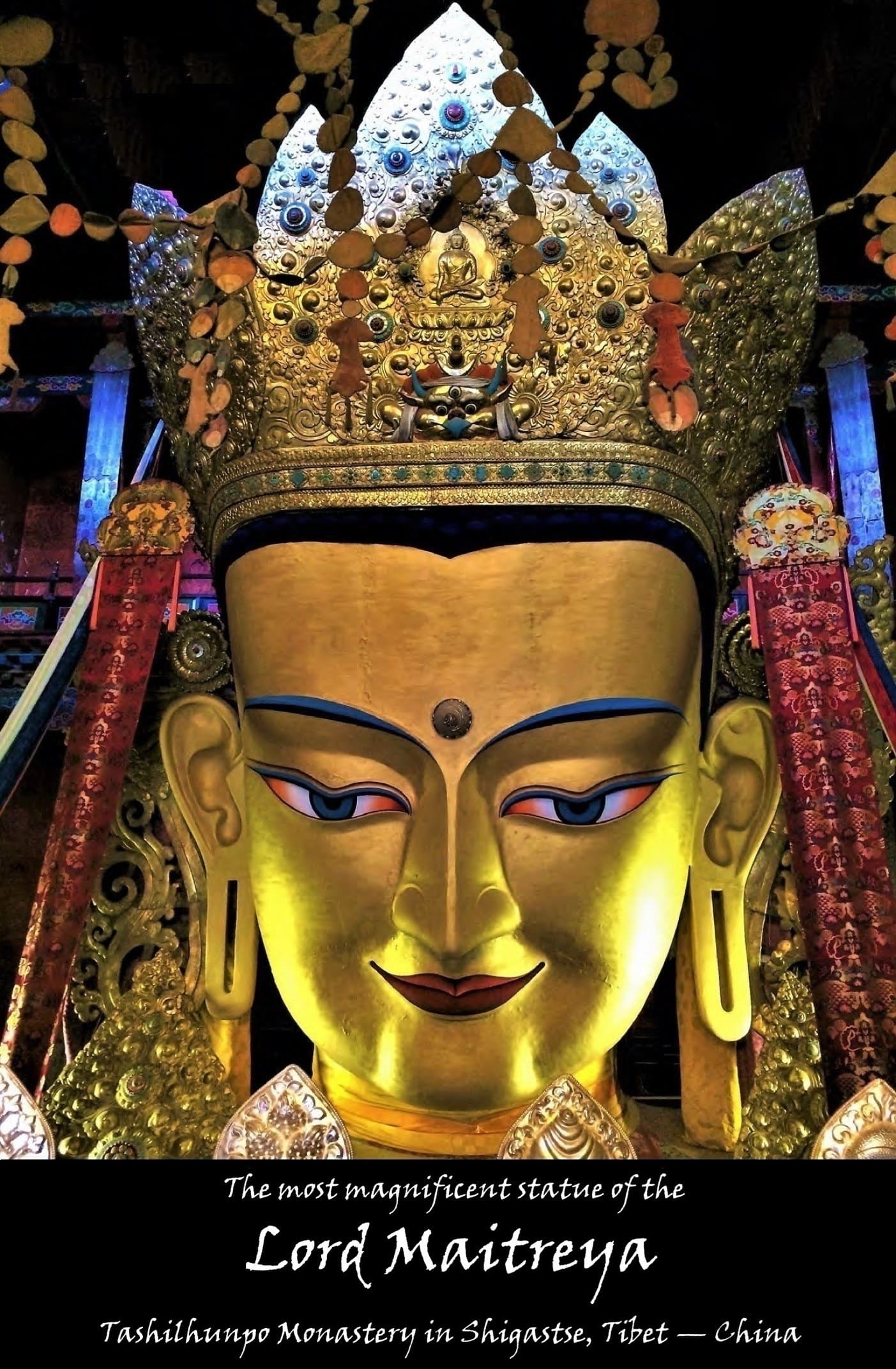
"{762} Chagpa-Thog-mad is the Tibetan name of Âryâsanga, the founder of the Yogâchârya or Naljorchodpa School. This Sage and Initiate is said to have been taught "Wisdom" by Maitreya Buddha Himself, the Buddha of the Sixth Race, at Tushita (a celestial region presided over by Him), and as having received from Him the five books of Champaitehos-nga. The Secret Doctrine teaches, however, that he came from Dejung, or Shambhalla, called the "source of happiness" ("wisdomacquired") and declared by some Orientalists to be a "fabulous" place."

The Works of Maitreya
(Eastern Tradition Research Institute’s Bibliographic Guides are compiled and annotated by David Reigle, in collaboration with Nancy Reigle, pp. 3-4, 2007.)
Maitreya is the coming Buddha. If he has not yet come, how can we have any of his works? According to traditional accounts, the Indian teacher Asaṅga was able to ascend to the Tuṣita Heaven where Maitreya dwells, and receive teachings from him. These teachings were then written down by Asaṅga. Here is this story as told in Geshe Wangyal’s book, The Door of Liberation (1973 ed., pp. 52-54; 1995 ed., pp. 31-33):
Nine hundred years after the parinirvāṇa of Gautama Buddha, Ārya Asaṅga was born. In his youth he completed intensive studies in a monastery and in middle life withdrew to a cave to meditate. He determined not to give up his meditation until Maitreya, the bodhisattva of love and compassion and buddha-to-come, manifested himself openly before him.
When, after three years, he had no results, Asaṅga became discouraged and left his cave. Nearby, he met a man who was making a needle from an iron spike by rubbing it with a piece of cotton. Seeing this, Asaṅga’s patience returned and he went back to his cave and meditated unceasingly for six more years. Still Maitreya did not manifest himself. Disheartened that he had meditated for nine years without even a sign of success, Asaṅga again left his cave. Outside he saw how a rock had been completely worn down by single drops of water and the beating wings of passing birds. Again his patience returned and he resumed his meditation; this time for another three years. But finally, Asaṅga despaired completely of realizing his aim and set out on the journey to return to his monastery.
On the outskirts of Acinta he saw an old she-dog whose hindquarters were raw and crawling with maggots. He felt great pity for her and wanted to relieve her suffering, but he could not bear to harm the maggots. Instead, he cut a piece of flesh from his own thigh and placed it near the dog. He then put out his tongue and prepared to transfer the larvae one by one, but the sight of the wound was so disgusting that he had to close his eyes. Suddenly, there was a great ringing in his ears, and he opened his eyes. Standing before him, in a magnificent, radiant light, was Maitreya. Despite his joy, Ārya Asaṅga exclaimed without thinking, “Why did you never come to me during the twelve years I earnestly meditated?”
Maitreya answered, “I was with you all the time, but you could not see me, because you did not yet have great compassion. If you do not believe me, carry me through the town on your shoulders and try to show me to the people.”
Then Ārya Asaṅga raised Maitreya on his shoulder and carried him through the town, hoping to let everyone see the wonderful buddha. But no one in the town saw Maitreya, and only one old woman saw a dog on his shoulder.
After this, Maitreya magically transported Ārya Asaṅga to Tuṣita heaven, where he stayed for fifty earth-years studying the Dharma. When he returned to India, he brought with him the five treatises of Maitreya, the central teachings of the lineage of compassion, used in the Tibetan tradition as root texts for the study of abhidharma and the prajñāpāramitā.
The five treatises of Maitreya, written down by Asaṅga, are listed below. They are written in verse.
1. Mahāyāna-sūtrālaṃkāra
“Ornament to the Scriptures of the Great Vehicle”
2. Abhisamayālaṃkāra
“Ornament to the Realizations”
3. Madhyānta-vibhāga
“Analysis of the Middle and the Extremes”
4. Dharma-dharmatā-vibhāga
“Analysis of Phenomena and Their True Nature”
5. Ratna-gotra-vibhāga (or Mahāyāna Uttara-tantra Śāstra)
“Analysis of the Lineage of the [Three] Jewels” (or “Treatise on the Later Doctrine of the Great Vehicle.”) ...


Energy Follows Thought