 ◄ BACK
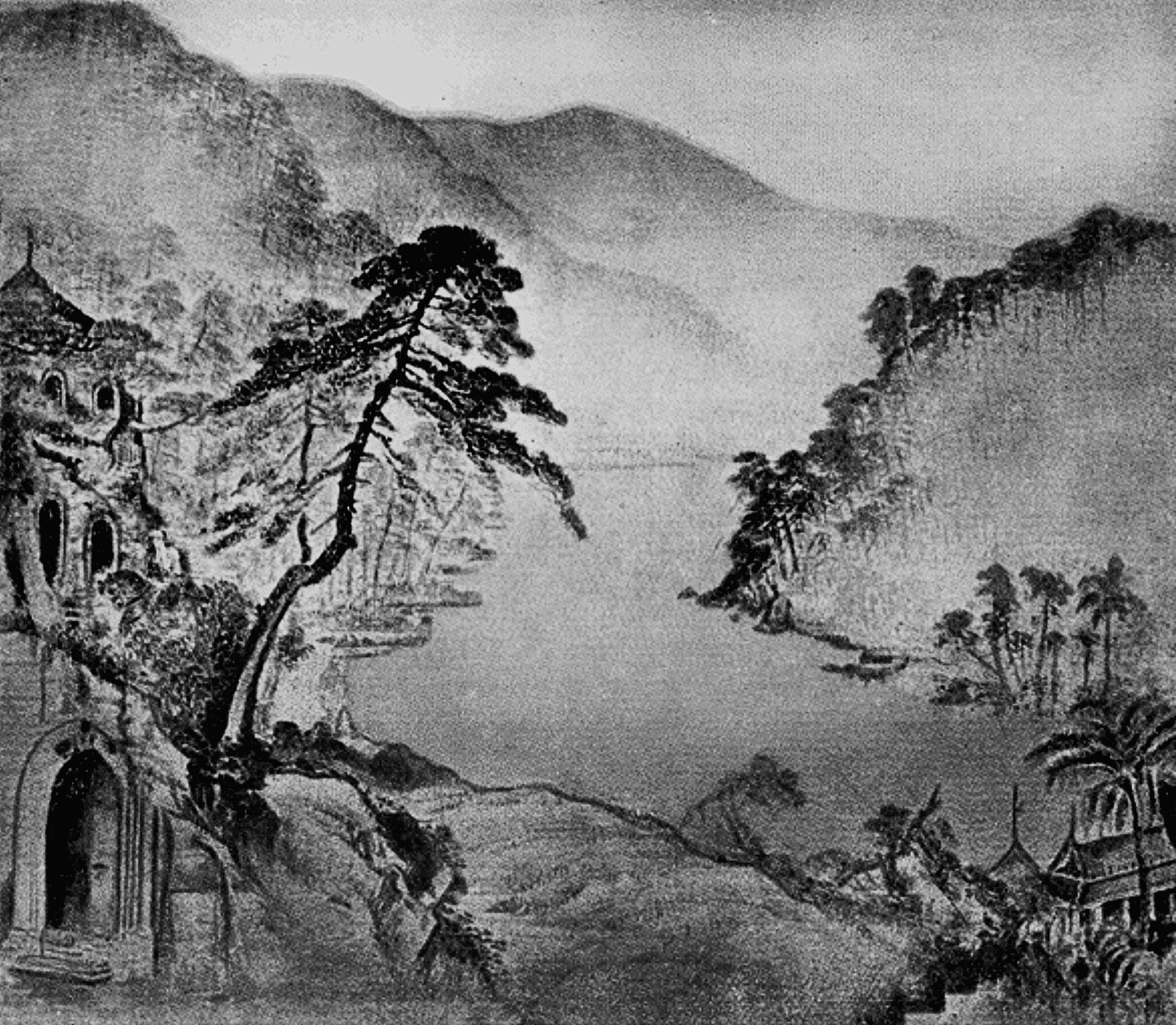
[cover: A Ravine in Tibet, painting by Gai Ben-Jamin.]
(C.W. Leadbeater, The Masters and the Path, pp. 27-31, 1927.)



There is a certain valley, or rather ravine, in Tibet, where three of these Great Ones, the Master Morya, the Master Kuthumi and the Master Djwal Kul are living at the present time.
The Master Djwal Kul, at Madame Blavatsky’s request, once made for her a precipitated picture of the mouth of that ravine, and the illustration given herewith is a reproduction of a photograph of that. The original, which is precipitated on silk, is preserved in the shrineroom of the Headquarters of The Theosophical Society at Adyar. On the left of the picture the Master Morya is seen on horse-back near the door of his house. The dwelling of the Master Kuthumi does not appear in the picture, being higher up the valley, round the bend on the right. Madame Blavatsky begged the Master Djwal Kul to put himself into the picture; he at first refused, but eventually added himself as a small figure standing in the water and grasping a pole, but with his back to the spectator! This original is faintly tinted, the colours being blue, green and black. It bears the signature of the artist—the nickname Gai Ben-Jamin, which he bore in his youth in the early days of the Society, long before he reached Adeptship. The scene is evidently taken early in the day, as the morning mists are still clinging to the hillsides.
The Masters Morya and Kuthumi occupy houses on opposite sides of this narrow ravine, the slopes of which are covered with pine trees. Paths run down the ravine past their houses, and meet at the bottom, where there is a little bridge. Close to the bridge a narrow door, which may be seen on the left at the bottom of the picture, leads to a system of vast subterranean halls containing an occult museum of which the Master Kuthumi is the Guardian on behalf of the Great White Brotherhood.
The contents of this museum are of the most varied character. They appear to be intended as a kind of illustration of the whole process of evolution. For example, there are here the most life-like images of every type of man which has existed on this planet from the commencement—from gigantic loose-jointed Lemurians to pigmy remains of even earlier and less human races. Models in alto relievo show all the variations of the surface of the earth—the conditions before and after the great cataclysms which have changed it so much. Huge diagrams illustrate the migrations of the different races of the world, and show exactly how far they spread from their respective sources. Other similar diagrams are devoted to the influence of the various religions of the world, showing where each was practised in its original purity, and where it became mingled with and distorted by the remains of other religions.
Amazingly life-like statues perpetuate the physical appearance of certain of the great leaders and teachers of long-forgotten races; and various objects of interest connected with important and even unnoticed advancements in civilization are preserved for the examination of posterity. Original manuscripts of incredible antiquity and of priceless value are here to be seen—a manuscript, for example, written by the hand of the Lord Buddha himself in his final life as Prince Siddartha, and another written by the Lord Christ during his birth in Palestine. Here is kept that marvellous original of the Book of Dzyan, which Madame Blavatsky describes in the opening of The Secret Doctrine. Here too are strange scripts from other worlds than ours. Animal and vegetable forms are also depicted, some few of which are known to us as fossils, though most of them are unimagined by our modern science. Actual models of some of the great cities of remote and forgotten antiquity are here for the study of the pupils.
All statues and models are vividly coloured exactly as were the originals; and we may note that the collection here was intentionally put together at the time, in order to represent to posterity the exact stages through which the evolution or civilization of the time was passing, so that instead of mere incomplete fragments, such as our museums so often present to us, we have in all cases an intentionally educative series of presentations. There we find models of all the kinds of machinery which the different civilizations have evolved, and also there are elaborate and abundant illustrations of the types of magic in use at the various periods of history.
In the vestibule leading to these vast halls are kept the living images of those pupils of the Masters Morya and Kuthumi who happen at the time to be on probation, which I will describe later. These images are ranged round the walls like statues, and are perfect representations of the pupils concerned. It is not probable, however, that they are visible to physical eyes, for the lowest matter entering into their composition is etheric.
Near the bridge there is also a small Temple with turrets of somewhat Burmese form, to which a few villagers go to make offerings of fruit and flowers, and to burn camphor and recite the Pancha Sila. A rough and uneven track leads down the valley by the side of the stream. From either of the two houses of the Masters the other house can be seen; they are both above the bridge, but both cannot be seen from it, since the ravine bends round. If we follow the path up the valley past the house of the Master Kuthumi it will lead us to a large pillar of rock, beyond which, the ravine bending round again, it passes out of sight. Some distance further on the ravine opens out into a plateau on which there is a lake, in which, tradition tells us, Madame Blavatsky used to bathe; and it is said that she found it very cold. The valley is sheltered and faces south, and though the surrounding country is under snow during the winter, I do not remember having seen any near the Masters’ houses. These houses are of stone, very heavily and strongly built.

Energy Follows Thought