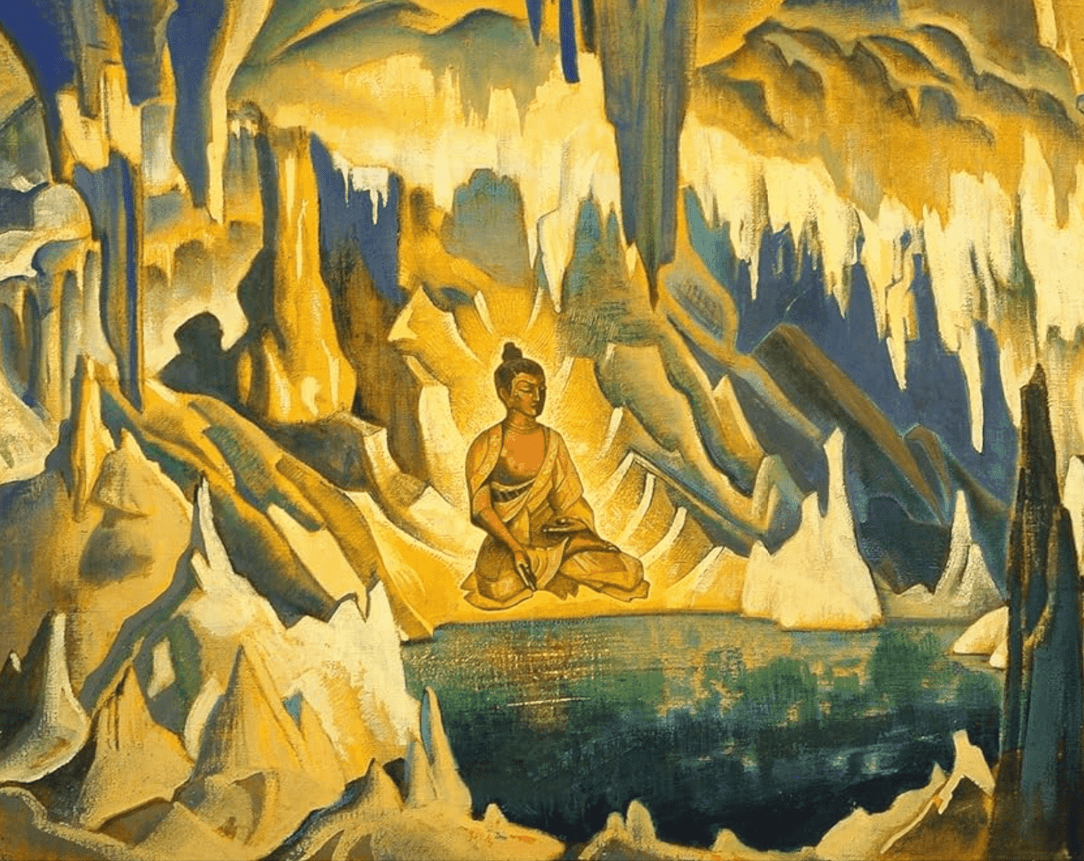
[cover: Buddha the Winner, part of painting by Nikolas Roerich, 1925.]
(Agni Yoga Society, On Eastern Crossroads, 1930.)



The Beginning of the Path
The Lord Buddha verily left the town of His birth. Verily He meditated beneath the tree of wisdom. Verily He taught in Benares. Verily He concluded his teaching in Kushinagar. But the centuries have added their many tales.
The Lord departed from His native place on horseback accompanied by a servant-courier. The road lay northwest, along the valley of the river. The hurried journey lasted for two weeks. Beyond the mountain passes, the trail for horses ended. Further on, the hunter’s path continued.
Here the courier left him, but in farewell said, “Prince, Brother, when you will reach the hunter’s hut, give him this chip of wood.” And he gave him a piece of wood with three signs.
For seven days the Lord traveled the path. Upon the eighth day he reached a hut. The door stood open and a tall old man dressed in a dirty old surplice chipped some wood.
The Lord approached him in greeting, as is the custom of India. But the hunter laughed and pointed to the tree. The Lord remembered the piece of wood and handed it to him. The old man carefully examined the signs and then pointed kindly to the table inside the hut. The Lord understood the invitation and partook of the venison and honey. Then the old man, by gestures, bade the Lord rest.
When Lord Buddha awoke, the sun had just illumined the snow. The hunter was not in the hut, but from the courtyard the strokes of his ax resounded. Soon, however, his figure appeared at the door and he offered to the Lord a drink of honey. Then the old man took a sack and a spear and pointed to the sun. The Lord understood it was time to depart and taking His staff left the hut. The old man bowed thrice before Him and indicated that He should follow.
Approaching the brush he pushed aside the branches and disclosed a narrow path. He beckoned to the Lord to follow him and quickly strode forward, pointing to the sun. Thus they walked until midday. The forest became less dense and the rumble of the river could be heard. They emerged at the river’s shore.
The old man arched his bow and shot an arrow. They awaited in silence. The Lord took off His remaining adornments and offered them to the old man. But the latter indicated to cast them in the river.
On the opposite shore a tall man appeared, pushed out his bark and set out in their direction. His garment was edged with fur. And his face was quite dark and broad. Reaching the shore the stranger bowed to the Lord and invited Him into the bark.
The Lord wished to bid farewell to the hunter but he had disappeared unnoticed. The stranger also preserved his silence. Reaching the shore they mounted horses and began to ascend the mountain.
During the night they reached the boundary of snows and at dawn descended into the Abode.
The Predestined Maitreya
The eyes of the child Prince opened early to the miracles of the world. Naught escaped his penetrative attention.
The King said, “Perception is the crown of the Lord, but the strength of His arm is His shield. Let Him strengthen His arm with the bow. Let the children of the noble Kshatriyas compete with the Prince.”
The Queen Mother added, “If penetration is the crown of the Lord, and the strength of His arm is His shield, then the glory of the Lord is His mercy and His wisdom. I would that my near one should be surrounded by the Devas of Wisdom who created the Vedas.”
Then an old sage turned to the King saying, “Reverend Mother, and thou, Lord, command me to combine your wishes. Command me to bring unto you her whom we call the daughter of the Great Nag, whom we have sheltered in our house. And for seven years have we marveled at her wisdom and the strength of her bow. Verily she is worthy of the hand which has inscribed the wisdom of the Vedas.”
“Let her be brought here,” commanded the King.
The wise councilor brought a young being, saying, “Maitri, send the worthiest greeting to our King.”
Unheard of was it to see a seven-year-old girl in a white garment, her bow and arrow in hand and a dagger in her girdle. The crown of heavy dark hair was not restrained by the fillet of the Nag and the eyes peered out sadly and sternly.
The King said, “Maitri, if you can send the arrow, transfix yonder peacock.”
Maitri bowed to the King and said, “I may not take life from an animal; but permit me, King, to pierce an apple on the top of the apple tree.”
The King commanded Maitri to be companion to the Prince and greatly admired the wisdom of her who was found on the shores of the lake.
Many years did the Prince spend with Maitri, calling her at times Stern One, or Glowing One, or Warrior, or Seeress of the Wisdom of Nagi.
Maitri opened before him the door of the Path.
When the powerful Lion returned and with the roar of Truth mantled the mountains, Maitri guarded for Him his best pupil and pronounced, “She shall glorify the sight of Thy labors.”
The Lord of Truth answered, “Maitri, manifested Councilor and Keeper. Thou who hast hidden thy wisdom from the crowd. Thou shalst assume My place as the Lord of Compassion and Labor. Maitreya shall lead the nations towards Light. And the arrow of achievement shall bestow the apple of Knowledge.”
What has been said is as true as that the Temple of Knowledge shall be erected near the site of the glorification of the Teacher.
What has been said is as true as that the pupil of the Blessed One shall give her name to the Temple of Knowledge.
The base of the manifestation of Truth is affirmed by the labors of life.
Given in Chorten-Karpo.
Departure
When the time came for departing, the Blessed One said to His Wife, “Let us go.”
And thrice he said, “Through the darkness of night, in the midday heat and in the ray of dawn.”
But at night the tigers roared and in the heat the snakes crawled forth and towards morning the monkeys came in hordes.
“I am still afraid now,” said the wife.
“This is also for the good,” said the Blessed One. “Without a call, by your own steps will you be bearer of the Teaching.”
And the elephant trumpeted seven times, proclaiming the date of the next meeting.
Commands
Well I praise thee, Ananda. Because without call walks She who affirms.”
And the Blessed One perceived in the Heaven upon a veil the destiny of the Light of the Mother of the World.
Here the Blessed One says, “All for everything forever.”
“Observe four laws: The Law of Containment, the Law of Fearlessness, the Law of Approach and the Law of Benevolence.”
The Elected for Achievement
How did Buddha elect disciples for achievement? During work, when fatigue already possessed the disciples, Buddha asked the most unexpected question, awaiting the promptest reply.
Or placing the simplest object before them, He suggested that they describe it in not more than three words or not less than one hundred pages.
Or setting a pupil before a sealed door, He asked, “How will you open it?”
Or ordering musicians beneath the window, He made them simultaneously sing hymns of entirely dissimilar contents.
Or noticing an annoying fly, He asked the pupil to repeat words unexpectedly pronounced.
Or passing in front of the pupils, He would ask them how many times He had done so.
Or noticing fear of animals or of natural phenomena, He set them the condition to master it.
Thus the powerful Lion tempered the blade of the spirit.
Buddha’s Favorite Pastime With His Disciples
And one should not forget the favorite pastime of Buddha with His disciples during moments of rest.
The Teacher cast into space one word, on the base of which the disciples built an entire thought.
There is no wiser test of the condition of consciousness.
The Foundation of the Teaching
People do not comprehend the foundation of the Teaching of the Blessed One—the foundation is discipline. Spiritually and physically the monk of the community strove to remain on the path. The first years he endured a severe probation. He was forbidden to kill himself with ascetic practices. But he was ordained to lead the battle by the one origin of the spirit.
Thus austerely did Buddha instruct His disciples.
Verily they knew joy only in the spiritual battle. Hence are the thorns of the path spoken of.
Only when the will of the disciple was engendered as a lion and the silvery rein of spirit held its glow over the feelings of the pupil, then only did the Lord cautiously open the curtain and assign a task.
And gradually the pupil was initiated into the Mysteries of Knowledge.
The Renunciation of Possession
Once a pupil asked the Blessed One:
“How shall one understand the fulfilment of the Covenant regarding the renunciation of property? One disciple renounced all things but the Teacher continued to reproach him for possession. Another one remained surrounded with objects but did not merit reproach.”
“The feeling of possession is measured not by objects but by thought. One may have objects and still not be a possessor.”
Buddha always advised to have as few objects as possible in order not to expend too much time upon them.
The Condemnation of Fanatics
Buddha addressed the Brahmins: “To what has your isolation brought you? In order to procure bread you go to the general market and you value the coins from the bag of a Sudra. Your isolation may be termed simply plunder. And your sacred objects are simply instruments of deception.
“Are not the possessions of the rich Brahmins a desecration of the Divine Law? You consider the south as light and the north as darkness. A time shall come when I will come from the midnight and your light shall be extinguished. Even the birds fly north to bear their young. Even the gray geese know the merit of earthly possession. But the Brahmin tries to fill his girdle with gold and to hoard his treasures under his hearth and under his threshold.
“Brahmin, you lead a contemptible life and your end shall be pitiable. You shall be the first to be visited with destruction.
“If I go northward, then shall I also return from there.”
Three Arhats
Three Arhats persistently besought Buddha to permit them to test the power of miracle. Buddha assigned each of them to a dark room and locked them in. After a considerable time the Blessed One called them out and asked them what they had seen. Each related his different visions.
But Buddha said, “Now one must agree that miracles are useless because the supreme miracle you have not perceived. Because you could have sensed existence beyond the visible. And this sensation could have brought you beyond the limits of earth.
“But you continued to realize yourselves as seated on earth and your thought attracted waves of the elements to earth. The inflation of the elemental images evoked cataclysms in various lands. You shattered rocks and destroyed ships in the gale.
“You, for instance, have seen a red beast with a flaming crest. But the fire evoked by you from the abyss demolished the houses of the defenseless ones. Go and help!
“You saw the lizard with the face of a maiden. You impelled the waves to wash away the boats of the fishermen. Hurry to bring help!
“And you have seen the eagles in flight and the whirlwind has destroyed the harvest of the toilers. Go and repay them!
“Then where, Arhats, is your usefulness? The owl in the hollow of the tree has spent its time to greater use. Either you labor on earth with the perspiration of your brow or at the moment of seclusion exalt yourself above the earth. But let not senseless invocation of the elements be the occupation of a sage!”
Verily, the feather which falls from the wing of a tiny bird creates thunder in the far-off worlds.
Shepherd and Sannyasin
A shepherd beheld a man seated in meditation beneath a tree. Seating himself beside the man, he tried in emulation also to think.
He began to count his goats and mentally to figure out the profit from the sale of the wool.
Both sat silent. Finally the shepherd said, “Lord, of what are you thinking?” “Of God,” answered the man.
The shepherd asked, “Do you know of what I was thinking?”
“Also of God.”
“You are mistaken. I thought of the profit from the sale of my wool.”
“Verily, also of God. But my God has nothing to barter. Yours must first go to the market. Perhaps on the way He may meet a robber who will help him to turn to this tree.”
Thus spoke Gautama.
Go to the bazaar. Think quicker in order to return.
The Trader of Monkeys
On a ship traveled a trader of monkeys. In his leisure he taught them to imitate the sailors in spreading their sails.
But a storm arose and the sailors hastened to lower their sails. The monkeys, knowing only how to spread the sails, followed the sailors and hoisted them again.
The ship was lost because the trainer foresaw only clear weather.
Thus related Buddha, the Restorer of the Lotus of Life.
A Parable About the One Who Questioned
Dgulnor was considered the wisest one. He had the happiness to find a Teacher who came from the Sacred Subterranean Land, but who was bereft of his tongue and right hand.
The pupil, constantly aspiring, asked a question and the Teacher nodded.
The pupil asked two questions and the Teacher nodded twice.
Soon the pupil asked incessant questions and the Teacher unceasingly nodded. Three years the questions continued and for three years the Teacher nodded.
“Then according to thy experience everything can happen?”
And the Teacher not only nodded but bowed to the ground and opening his garment at the breast, revealed on his bosom the image of the Blessed One bestowing with both hands.
Thus was affirmed wisdom. And the creation of life was exalted.
The Wheel of the Law
The Blessed One told the Parable about the Wheel of the Law. To a skilful copyist came a revered man who gave him the task of copying an appeal to the Lord for which he brought sufficient parchment.
Immediately after, a man came with the request to copy a letter full of threats and also gave a parchment urging that the work be finished quickly.
In order to give the latter preference the copyist changed the rotation and hurried with the second order, taking the parchment of the first one in his haste.
He of the threats was highly pleased and hastened to pour out his venom.
Then came the first customer and looking at the parchment said, “Where is the parchment which I gave?” On hearing what had occurred he said, “The parchment for the prayers bore the blessing of fulfilment whereas the parchment of threats was devoid of effect.
“Unfaithful man. In violating the law of dates you have bereft prayer of its power which could have aided the sick. But above this, you have brought into action threats which are full of unparalleled consequences.
“The labor of the Arhat in blessing my parchment is wasted. Wasted is the labor of the Arhat who stripped evil of its power. You liberated a malicious curse into the world. It will inevitably react upon yourself. You have pushed from the way the Wheel of Law and it will not lead you but will break your way.”
Do not write laws upon a dead parchment which will be carried away by the first thief who approaches.
Carry the Laws in spirit and the breath of Benevolence will carry before you the Wheel of the Law illumining your path.
The unreliability of the copyist may bring catastrophe upon the whole world.
The Sense of Necessity
Whence originated the controversy between Buddha and Devadatta?
Devadatta asked, “Wherefrom to begin each action?”
The Blessed One answered, “From the most necessary. Because each moment contains its necessity and this is called the justice of action.”
Devadatta persisted, “How is the evidence of necessity ascertained?”
The Blessed One answered, “The thread of necessity crosses all worlds but whoever has failed to realize it will remain within a dangerous chasm unsheltered from the stones.”
Thus Devadatta could not distinguish the line of necessity and this darkness impeded his way.
The Seeker for Buddha
One pure man wished to see Buddha. By keeping his attention upon a wide variety of objects his hands did not embrace wise images and his eyes did not penetrate objects of reverence —the manifestation did not come.
Finally, the seeker, bending low in prayer, felt how the thread of a web descended on his forehead. He cast it away. Then a clear voice rang out, “Why dost thou reject My hand? My Ray hast followed thee. Permit Me to embrace thee.”
Then the sun-serpent became atremble in the man, and he sought the rejected thread. And in his hands it turned into forty pearls. And each bore the Image of Buddha. In their center was a stone and upon it the inscription, “Valor— despair—joy.”
The follower of Buddha received joy because he knew the path to it.
To the Great Illumined
To Him of the great Illumination came a pupil, seeking a miracle, “After the miracle, I shall have faith.”
The Teacher smiled sadly and revealed to him a great miracle.
“Now,” exclaimed the pupil, “I am ready to pass through the steps of the Teaching under thy guidance.”
But the Teacher, pointing to the door, said: “Go! I no longer need you.”
The Rescue of Man
The Blessed One sat above the waters of a deep lake. In the depths one could discern an entire world of fish and seaweed.
The Blessed One noticed how this world resembled kingly palaces. “If man would sink there, with the soles of his feet he would destroy these ephemeral palaces but he himself would choke. Out of such depths the spirit of man does not rise.
“But,” smiled the Teacher, “for everything there is a remedy. One can break through the rock and drain the lake. The snails will have either to dry up or find another place of existence. But man will not perish.”
The cradle of an infant is like the shell of a snail. Give the children air. Do not permit them to crave objects of their kin, but let each child meet the sun without a trail of tatters.
Parable of the King of Maragor
Thus spoke the Blessed One to Narada.
The Lord of Jataka said to his favorite Councilor, “Know you the work of the King of Maragor? Have you heard his name? Are his deeds familiar to you?”
The Councilor, peering about, whispered, “Lord, this evil name is unutterable! All Darkness conceals the traces of his deeds.”
“I give you a mission. Gather a hundred trusty men and find means resourcefully to traverse the Lands of Maragor. Describe to me minutely all his customs. And if you encounter the King himself, tell him I do not fear to pronounce his name.”
Ten years passed. The Councilor returned, wiser in countenance but filled with confusion. By now not one hundred but a thousand accompanied him.
“Lord, much labor did I spend, to which a thousand witnesses are before you. But the task is unfulfilled. Endlessly we questioned the people; numberless were the countries we traversed. I say to you, Lord, the most startling—the King of Maragor does not exist nor do his evil customs!”
“Good,” said the Lord. “Can you take an oath by your words?” — “Before you are a thousand and one oaths.”
“Then take your witnesses and walk through all squares and temples. Proclaim and inscribe on the pillars that which you pronounce.
“My son, you fulfilled the mission. By your labors you smote the beast of darkness. The phantom of fright vanished, for no one fears that which is known.
“Maragor is revealed as the fear of mankind and is annihilated by the labors of valor and devotion. Be my son; you have destroyed the darkness!”
Precepts to the Ruler of Rajagriha
Once the Blessed One visited the Ruler of Rajagriha. The Ruler called attention to the immaculateness of his reception room. But the Blessed One said, “Better show the cleanliness of your sleeping chamber, of your bath and your hearth. The reception room is contaminated by many unworthy ones. But there where your consciousness is created, let it be spotless.”
And the Blessed One said, “Distinguish between those who understand and those who agree. He who understands the Teaching shall not tarry in applying it to life. He who agrees will nod and extol the teaching as remarkable wisdom but will not apply this wisdom to life.
“Many have agreed but like a withered forest they are fruitless and without shade. Only decay awaits them. Those who understood are few but like a sponge they drink in the precious knowledge and are ready to cleanse the horrors of the world with the sacred liquid.
“He who understands cannot but apply the Teaching, because realizing goal-fitness he accepts it as a solution of life.
“Do not waste time with the agreeing ones; let them first demonstrate the application of the first call.”
Thus is attributed to the Blessed One the goal-fitting attitude to the newcomers.

The full text is available to read online free of charge on the Agni Yoga Society website: 


Energy Follows Thought