 ◄ BACK
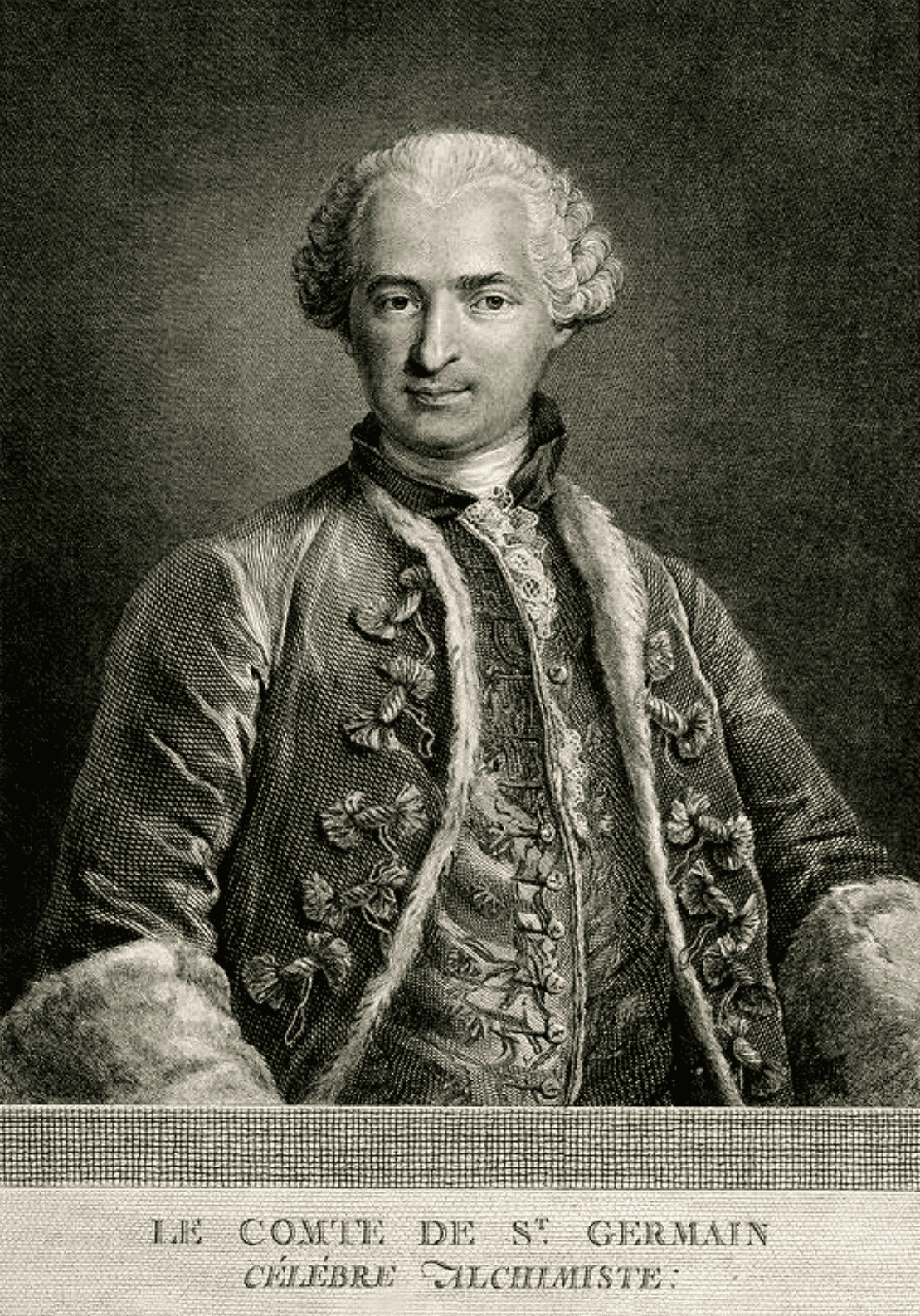
[cover: An engraving of the Count of St. Germain by Nicolas Thomas made in 1783. Contained at the Louvre in France.]
(Compiled by B.M. de Zirkoff, H.P. Blavatsky Collected Writings - Vol. VI, pp. 15-20.)



By Chhabigram Dolatram (Dikshita)
[The Theosophist, Vol. V, No. 3(51), December, 1883, pp. 79-80.]
"The perusal of an article headed “The Adepts in America in 1776,” published in the October number of The Theosophist, has suggested the following doubts, which, on account of the extraordinary felicities of personal communication, which you seem to claim with the Adepts, you are specially fitted to solve. The article is no doubt written on his own responsibility by the writer, who is particularly careful to inform his readers that his statements have been made “without the knowledge and consent—as far as he knows—of the Adepts.” The views advanced, however, fall in entirely with those held in general by the Theosophical Society, and the Editor of The Theosophist is the sole authority on a subject of this sort.
The gist of the article referred to above is contained in the concluding paragraph. It seems to create the impression that the Adepts, as a natural consequence of their universal sympathy for the well-being of the human race, participated in the great American Revolution and brought about its happy results through, as it were, the medium of Washington and others. In short, it is intended to say that Thomas Paine, Brother (?) Benjamin (by the by, history has kept us entirely in the dark about his connection with Theosophy) and a host of other leaders of this Revolution worked in the particular manner, they are said to have done, simply because they were moving under the guiding inspiration of the Adepts. In fact the article means that the necessity of a Revolution in America, and, for the matter of that, a rough plan of all the subsequent operations, were preconceived in the minds of these Mahatmas long before the so-called Freemason brothers had an earthly existence. The principle involved, evidently, seems to be that the first conception of all such Revolutions, as are, in the opinion of the writer, in their ultimate results, beneficial to humanity, and the subsequent selection of human agency for working them out, have invariably had their first origin in the laudable solicitude of the Adepts for the progress of humanity.
Will the writer, therefore, or the Editor, undergo a little trouble to satisfy our curiosity, which a perusal of the article very naturally raised as to the part which the Adepts took in the English Revolution of 1649? Was President Bradshaw, who, in a self-constituted Court of Justice, tried and condemned to death, his lawful sovereign Charles I, under the celestial influence of the Mahatmas, as Citizen Paine subsequently was?
Was Cromwell then no more than a mere puppet dancing to the pulls of the string, which the Adepts, of course, kept in their own hands? Why were they, poor souls, who did everything but in strict obedience to the inward dictates of superior spirits, allowed, then, by the all-powerful Adepts to suffer the indignity of having their dead remains (may they rest in peace!) disinterred and hanged by the public executioner ?
The French Revolution of 1789, too, which has been fruitful of such vast consequences, could, by no means, be conceived to have taken place without the Adepts having lent a powerful helping hand to it Citizen Paine had no doubt long since been prepared for the work; but it was to Danton, Robespierre and Marat, who have acquired so world-wide a notoriety by their deeds, and to whose influence the French Revolution is chiefly indebted for the turn it subsequently took, that the Mahatmas must have turned with a peculiar feeling of gratification as a set of instruments incomparably superior to Paine, Washington and all the other American Revolutionists. Will you, then, enlighten us how much of this rare inspiration, under which they acted, they owed to the Mahatmas?
Were Victor Emmanuel and Garibaldi, while working out the revolution in Italy, doing no more than carrying out the wishes of the Tibetan Brothers? It cannot, I think, adopting the line of arguments the writer has adopted, be denied that all these revolutions have been brought about by, and the agents employed in them have been mere instruments in the hands of, these Mahatmas. It is said, of course, as a proof of the actual share the Mahatmas had in the work, that Thomas Paine saw or at least thought he saw “a vast scene opening before him,” and in another place that “some thoughts bolt into the mind of their own accord.” If these simple things are sufficient to entitle Paine to a claim to supernatural visitations, is it unreasonable to argue that Lord Byron was also actuated by the same benign influence when he, with a self-abandonment of worldly comforts and conveniences, and a voluntary submission to physical hardships and privations which merit the highest praise, repaired to Greece to take an active part in the work of its liberation and at last died amidst the swamps of Missolonghi? How far this is correct you alone are in a position to say, as you alone enjoy a familiar intimacy with the Mahatmas.
To prevent misapprehension, I should conclude with the remark that as an orthodox Hindu I do believe in the existence of Mahatmas, though I must candidly confess that such arguments as have from time to time appeared in your very interesting journal in proof of the existence of the Mahatmas, have failed to bring convictions home to me.
BROACH
27th October, 1883.
EDITOR’S NOTE.—Our Journal is open to the personal views of every Theosophist “in good standing,” provided he is a tolerably good writer, and forcing his opinions upon no one, holds himself alone responsible for his utterances. This is clearly shown in the policy, hitherto pursued by the Magazine. But why should our correspondent make so sure that “the views advanced fall in entirely with those held in general by the Theosophical Society?” The Editor of this periodical for one disagrees entirely with the said views, as understood by our critic. Neither the Tibetan nor the modern Hindu Mahatmas for the matter of that, ever meddle with politics, though they may bring their influence to bear upon more than one momentous question in the history of a nation—their mother country especially.
If any Adepts have influenced Washington or brought about the great American Revolution, it was not the “Tibetan Mahatmas” at any rate; for these have never shown much sympathy with the Pelings of whatever Western race, except as forming a part of Humanity in general. Yet it is as certain, though this conviction is merely a personal one, that several Brothers of the Rosie Cross—or “Rosicrucians,” so called—did take a prominent part in the American struggle for independence, as much as in the French Revolution during the whole of the past century. We have documents to that effect, and the proofs of it are in our possession. But these Rosicrucians were Europeans and American settlers, who acted quite independently of the Indian or Tibetan Initiates. And the “Ex-Asiatic” who premises by saying that his statements are made entirely upon his own personal responsibility settles this question from the first. He refers to Adepts in general and not to Tibetan or Hindu Mahatmas necessarily, as our correspondent seems to think.
No Occult theosophist has ever thought of connecting Benjamin Franklin, or “Brother Benjamin” as he is called in America, with theosophy; with this exception, however, that the great philosopher and electrician seems to be one more proof of the mysterious influence of numbers and figures connected with the dates of the birth, death and other events in the life of certain remarkable individuals. Franklin was born on the 17th of the month (January, 1706), died on the 17th (April, 1790) and was the youngest of the 17 children of his parents. Beyond this, there is certainly nothing to connect him with modern theosophy or even with the theosophists of the 18th century—as the great body of alchemists and Rosicrucians called themselves.
Again neither the editor nor any member of the Society acquainted even superficially with the rules of the Adepts—[the former individual named, disclaiming emphatically the rather sarcastic charge of the writer to her being “alone to enjoy or claim the extraordinary felicities of personal communication with the Adepts”]—would believe for one moment that any of the cruel, blood-thirsty heroes the––regicides and others of English and French history—could have ever been inspired by any Adept—let alone a Hindu or Buddhist Mahatma. The inferences drawn from the article “The Adepts in America in 1776,” are a little too far-fetched by our imaginative correspondent. President Bradshaw—if such a cold, hard and impassive man can be suspected of having ever been influenced by any power outside of, and foreign to, his own soulless entity—must have been inspired by the “lower Jehovah” of the Old Testament—the Mahatma and Paramatma, or the “personal” god of Calvin and those Puritans who burnt to the greater glory of their deity—“ever ready for a bribe of blood to aid the foulest cause” alleged witches and heretics by hundreds of thousands. Surely it is not the living Mahatmas but “the Biblical one living God,” he who, thousands of years ago, had inspired Jephthah to murder his daughter, and the weak David to hang the seven sons and grandsons of Saul “in the hill before the Lord”; and who again in our own age had moved Guiteau to shoot President Garfield that must have also inspired Danton and Robespierre, Marat and the Russian Nihilists to open eras of Terror and turn Churches into slaughter-houses.
Nevertheless, it is our firm conviction based on historical evidence and direct inferences from many of the Memoirs of those days that the French Revolution is due to one Adept. It is that mysterious personage, now conveniently classed with other “historical charlatans” (i. e. great men whose occult knowledge and powers shoot over the heads of the imbecile majority), namely, the Count de St. Germain—who brought about the just outbreak among the paupers, and put an end to the selfish tyranny of the French kings—the “elect, and the Lord’s anointed.” And we know also that among the Carbonari—the precursors and pioneers of Garibaldi there was more than one Freemason deeply versed in occult sciences and Rosicrucianism. To infer from the article that a claim is laid down for Paine “to supernatural visitors” is to misconstrue the entire meaning of its author; and it shows very little knowledge of theosophy itself. There may be Theosophists who are also Spiritualists, in England and America, who firmly believe in disembodied visitors; but neither they nor we, Eastern Theosophists, have ever believed in the existence of supernatural visitors. We leave this to the orthodox followers of their respective religions. It is quite possible that certain arguments adduced in this journal in proof of the existence of our Mahatmas, “have failed to bring conviction home” to our correspondent; nor does it much matter if they have not. But whether we refer to the Mahatmas he believes in, or to those whom we personally know—once that a man has raised himself to the eminence of one, unless he be a sorcerer, or a Dugpa, he can never be an inspirer of sinful acts. To the Hebrew saying, “I, the Lord create evil,” the Mahatma answers—“I, the Initiate try to counteract and destroy it.”
[William Quan Judge published a brief answer to C. Dolatram’s letter in The Theosophist, Vol. V, No. 9(57), June, 1884, p. 223. It is signed with his pseudonym “Ex-Asiatic.”—Comp.]"
Count St. Germain
(H.P. Blavatsky, A Moden Panarion, pp. 371-374, 1895.)
[The Theosophist, Vol. II, No. 8, May, 1881.]
AT long intervals have appeared in Europe certain men whose rare intellectual endowments, brilliant conversation, and mysterious modes of life have astounded and dazzled the public mind. The article now copied from All the Year Round relates to one of these men—the Count St. Germain. In Hargrave Jennings’ curious work, The Rosicrucians, is described another, a certain Signor Gualdi, who was once the talk of Venetian society. A third was the historical personage known as Alessandro di Cagliostro, whose name has been made the synonym of infamy by a forged Catholic biography. It is not now intended to compare these three individuals with each other or with the common run of men. We copy the article of our London contemporary for quite another object. We wish to show how basely personal character is traduced without the slightest provocation—unless the fact of one’s being brighter in mind, and more versed in the secrets of natural law can be construed as a sufficient provocation to set the slanderer’s pen and the gossip’s tongue in motion. Let the reader attentively note what follows. The writer in All the Year Round says:
This famous adventurer [the Count St. Germain] is supposed to have been a Hungarian by birth, but the early part of his life was by himself carefully wrapped in mystery. His person and his title alike stimulated curiosity. His age was unknown and his parentage equally obscure. We catch the first glimpse of him in Paris, a century and a quarter ago, filling the court and the town with his renown. Amazed Paris saw a man—apparently of middle age——a man who lived in magnificent style, who went to dinner parties where he ate nothing, but talked incessantly and with exceeding brilliancy on every imaginable topic. His tone was perhaps over trenchant—the tone of a man who knows perfectly what he is talking about. Learned, speaking every civilized language admirably, a great musician, an excellent chemist, he played the part of a prodigy, and played it to perfection. Endowed with extra ordinary confidence or consummate impudence, he not only laid down the law magisterially concerning the present, but spoke without hesitation of events 200 years old. His anecdotes of remote occurrences were related with extraordinary minuteness. He spoke of scenes at the court of Francis I. as if he had seen them, describing exactly the appearance of the king, imitating his voice, manner and language, affecting throughout the character of an eye-witness. In like style he edified his audience with pleasant stories of Louis XIV., and regaled them with vivid descriptions of places and persons. Hardly saying in so many words that he was actually present when the events happened, he yet contrived, by his great graphic power, to convey that impression . . . intending to astonish, he succeeded completely. Wild stories were current concerning him. He was reported to be 300 years old, and to have prolonged his life by the use of a famous elixir. Paris went mad about him. He was questioned constantly about his secret of longevity, and was marvellously adroit in his replies, denying all power to make old folks young again, but quietly asserting his possession of the secret of arresting decay in the human frame. Diet, he protested, was, with his marvellous elixir, the true secret of long life, and he resolutely refused to eat any food but such as had been specially prepared for him-—oatmeal, groats and the white meat of chickens. On great occasions he drank a little wine, sat up as late as anyone would listen to him, but took extraordinary precautions against the cold. To ladies he gave mysterious cosmetics to preserve their beauty unimpaired; to men, he talked openly of his method of transmuting metals, and of a certain process for melting down a dozen little diamonds into one large stone. These astounding assertions were backed by the possession of apparently boundless wealth, and a collection of jewels of rare size and beauty.
From time to time this strange being appeared in various European capitals, under various names, as Marquis de Montferrat, Count Bellamare, at Venice; Chevalier Schoening, at Pisa; Chevalier Weldon, Milan; Count Soltikoff, at Genoa; Count Tzarogy at Schwalbach, and, finally, as Count St. Germain at Paris; but, after his disaster at the Hague, no longer seems so wealthy as before, and has at times the appearance of seeking his fortune. At Tournay, he is “interviewed” by the renowned Chevalier de Seingalt, who finds him in an Armenian robe and pointed cap, with a long beard descending to his waist, and ivory wand in hand—the complete make-up of a necromancer. St. Germain is surrounded by a legion of bottles, and is occupied in developing the manufacture of hats upon chemical principles. Senigalt being indisposed, the Count offers to physic him gratis and offers to dose him with an elixir, which appears to have been æther; but the other refuses, with many polite speeches. It is the scene of the two augurs. Not being allowed to act as physician, St. Germain determines to show his power as an alchemist, takes a twelve-sons piece from the other augur, puts it on red-hot charcoal, and works with a blow-pipe, the piece of money is fused and allowed to cool. “Now,” says St. Germain, “take your money again.” “But it is gold.” “Of the purest.” Augur No. 2 does not believe in the transmutation and looks on the whole operation as a trick; but he pockets the piece, nevertheless, and finally presents it to the celebrated Marshal Keith, then governor of Neuchatel.
Again, in pursuit of dyeing and other manufacturing schemes, St. Germain turned up at St. Petersburg, Dresden and Milan. Once he got into trouble and was arrested in a petty town of Piedmont on a protested bill of exchange; but he pulled out a hundred thousand crowns’ worth of jewels, paid on the spot, bullied the governor of the town like a pickpocket, and was released with the most respectful excuses.
Very little doubt exists that during one of his residences in Russia, he played an important part in the revolution which placed Catherine II. on the throne. In support of this view, Baron Gleichen cites the extraordinary attention bestowed on St. Germain at Leghorn, 1770, by Count Alexis Orloff, and a remark made by Prince Gregory Orloff to the Margrave of Onspach during his stay at Nuremberg.
After all, who was he ?—the son of a Portuguese king or of a Portuguese Jew? Or did he in his old age tell the truth to his protector and enthusiastic admirer, Prince Charles of Hesse Cassel? According to the story told by his last friend, he was the son of a Prince Rakoczy of Transylvania, and his first wife a Tekely. He was placed, when an infant, under the protection of the last of the Medici. When he grew up and heard that his two brothers, sons of the Princess Hesse Rheinfels, of Rothenburg, had received the names of St. Charles and St. Elizabeth, he determined to take the name of their holy brother St. Germanus. What was the truth? One thing alone is certain, that he was a protégé of the last Medici. Prince Charles, who appears to have regretted his death, which happened in 1783, very sincerely tells us that he fell sick, while pursuing his experiments in colours at Ekrenforde, and died shortly after, despite the innumerable medicaments prepared by his own private apothecary. Frederick the Great, who, despite his scepticism, took a queer interest in astrologers, said of him, “This is a man who does not die.” Mirabeau adds epigrammatically, “he was always a careless fellow, and at last, like his predecessors, forgot not to die.”
And now we ask what shadow of proof is herein afforded either that St. Germain was an “adventurer,” that he meant to “play the part of a prodigy,” or that he sought to make money out of dupes. Not one single sign is there of his being other than what he seemed, viz., a possessor of ample means to support honestly his standing in society. He claimed to know how to fuse small diamonds into large ones, and to transmute metals, and backed his “assertions” by the possession of apparently boundless wealth and a collection of jewels of rare size and beauty. Are “adventurers” like this? Do charlatans enjoy the confidence and admiration of the cleverest statesmen and nobles of Europe for long years, and not even at their deaths show in one thing that they were undeserving? Some encyclopædists (see New American Cyclopædia xiv. 266) say: “He is supposed to have been employed during the greater part of his life as a spy at the courts at which he resided.” But upon what evidence is this supposition based? Has anyone found it in any of the state papers in the secret archives of either of those courts? Not one word, not one shred of fact to build this base calumny upon, has ever been found. It is simply a malicious lie. The treatment this great man, this pupil of Indian and Egyptian hierophants, this proficient in the secret wisdom of the East, has had from Western writers, is a stigma upon human nature. And so has the stupid world behaved towards every other person who, like St. Germain, has revisited it after long seclusion devoted to study, with his stores of accumulated esoteric wisdom, in the hope of bettering it, and making it wiser and happier.
One other point should be noticed. The above account gives no particulars of the last hours of the mysterious Count or of his funeral. Is it not absurd to suppose that if he really died at the time and place mentioned, he would have been laid in the ground without the pomp and ceremony, the official supervision, the police registration which attend the funerals of men of his rank and notoriety? Where are these data? He passed out of public sight more than a century ago, yet no memoir contains them. A man who so lived in the full blaze of publicity could not have vanished, if he really died then and there, and left no trace behind. Moreover, to this negative we have the alleged positive proof that he was living several years after 1784. He is said to have had a most important private conference with the Empress of Russia in 1785 or 1786, and to have appeared to the Princess de Lamballe when she stood before the tribunal, a few moments before she was struck down with a billet, and a butcher-boy cut off her head; and to Jeanne Dubarry, the mistress of Louis XV. as she waited on her scaffold at Paris the stroke of the guillotine in the Days of Terror of 1793.
A respected member of our Society, residing in Russia, possesses some highly important documents about Count St. Germain, and for the vindication of the memory of one of the grandest characters of modern times, it is hoped that the long-needed but missing links in the chain of his history may speedily be given to tile world through these columns.


Energy Follows Thought