 ◄ BACK
(H.P. Blavatsky, The Secret Doctrine - Vol. III, pp. 564-571, 1893 — NOTES ON SOME ORAL TEACHINGS.)

1. The general exoteric, orthodox and tântric category:
Bhûr-loka.
Bhuvar-loka.
Swar-loka.
Mahar-loka.
Janar-loka.
Tapar-loka.
Satya-loka.
(The second seven are reflected.)
2. The Sânkhya category, and that of some Vedântins:
Brahmâ-loka.
Pitri-loka.
Soma-loka.
Indra-loka.
Gandharva-loka.
Râkshasa-loka.
Yaksha-loka.
And an eighth.
3. The Vedântic, the nearest approach to the Esoteric:
Atala.
Vitala.
Sutala.
Talâtala (or Karatala).
Rasâtala.
Mahâtala.
Pâtâla.
Each and all correspond Esoterically to the Kosmic or Dhyân Chohanic Hierarchies, and to the human States of Consciousness and their subdivisions (forty-nine). To appreciate this the meanings of the terms used in the Vedântic classification must be first understood.
| Tala | means | place. |
| Atala | means | no place. |
| Vitala | means | some change for the better: i.e., better for matter, in that more matter enters into it, or, in other words, it becomes more differentiated. This is an ancient Occult term. |
| Sutala | means | good, excellent, place. |
| Karatala | means | something that can be grasped or touched (from kara, a hand): i.e., the state in which matter becomes tangible. |
| Rasatala | means | place of taste; a place you can sense with one of the organs of sense. |
| Mahatala | means | exoterically "great place"; but, Esoterically, a place including all others subjectively, and potentially including all that precedes it. |
| Pâtâla | means | something under the feet (from pada, foot), the Upâdhi, or basis, of anything, the antipodes, America, etc. |
Each of the Lokas, places, worlds, states, etc., corresponds with and is transformed into five (exoterically) and seven (Esoterically) states or Tattvas, for which there are no definite names. These in the main divisions cited below make up the forty-nine Fires:
5 and 7 Tanmâtras, outer and inner senses.
5 and 7 Bhûtas, or elements.
5 and 7 Gnyânendryas, or organs of sensation.
5 and 7 Karmendryas, or organs of action.
These correspond in general to States of Consciousness, to the Hierarchies of Dhyân Chohans, to the Tattvas, etc. These Tattvas transform themselves into the whole Universe. The fourteen Lokas are made of seven with seven reflections: above, below; within, without; subjective, objective; pure, impure; positive, negative; etc.
EXPLANATION OF THE STATES OF CONSCIOUSNESS CORRESPONDING TO THE VEDÂNTIC CLASSIFICATION OF LOKAS.
7. Atala. The Âtmic or Auric state or locality: it emanates directly from ABSOLUTBNBSS, and is the first something in the Universe. Its correspondence is the Hierarchy of non-substantial primordial Beings, in a place which is no place (for us), a state which is no state. This Hierarchy contains the primordial plane, all that was, is, and will be from the beginning to the end of the Mahâmanvantara; all is there. This statement should not, however, be taken to imply Kismet: the latter is contrary to all the teachings of Occultism.
Here are the Hierarchies of the Dhyâni Buddhas. Their state is that of Parasamâdhi, of the Dharmakâya; a state where no progress is possible. The entities there may be said to be crystallized in purity, in homogeneity.
6. Vitala. Here are the Hierarchies of the celestial Buddhas, or Bodhisattvas, who are said to emanate from the seven Dhyâni Buddhas. It is related on earth to Samâdhi, to the Buddhic consciousness in man. No Adept, save one, can be higher than this and live; if he passes into the Âtmic or Dharmakâya state (Âlaya) he can return to earth no more. These two states are purely hyper-metaphysical.
5. Sutala. A differential state corresponding on earth with the Higher Manas, and therefore with Shabda (Sound), the Logos, our Higher Ego; and also to the Manushi Buddha state, like that of Gautama, on earth. This is the third stage of Samâdhi (which is septenary). Here belong the Hierarchies of the Kumâras—the Agnishvattas, etc.
4. Karatala corresponds with Sparsha (touch) and to the Hierarchies of ethereal, semiobjective Dhyân Chohans of the astral matter of the Mânasa-Manas, or the pure ray of Manas, that is the Lower Manas before it is mixed with Kâma (as in the young child). They are called Sparsha Devas, the Devas endowed with touch. These Hierarchies of Devas are progressive: the first have one sense; the second two; and so on to seven: each containing all the senses potentially, but not yet developed. Sparsha would be rendered better by affinity, contact.
3. Rasâtala, or Rûpatala: corresponds to the Hierarchies of Rûpa or Sight Devas, possessed of three senses, sight, hearing, and touch. These are the Kâma-Mânasic entities, and the higher Elementals. With the Rosicrucians they were the Sylphs and Undines. It corresponds on earth with an artificial state of consciousness, such as that produced by hypnotism and drugs (morphia, etc.).
2. Mahâtala. Corresponds to the Hierarchies of Rasa or Taste Devas, and includes a state of consciousness embracing the lower five senses and emanations of life and being. It corresponds to Kâma and Prâna in man, and to Salamanders and Gnomes in nature.
1. Pâtâla. Corresponds to the Hierarchies of Gandha or Smell Devas, the underworld or antipodes: Myalba. The sphere of irrational animals, having no feeling save that of self-preservation and gratification of the senses: also of intensely selfish human beings, waking or sleeping. This is why Narada is said to have visited Pâtâla when he was cursed to be reborn. He reported that life there was very pleasant for those "who had never left their birth-place"; they were very happy. It is the earthly state, and corresponds with the sense of
smell. Here are also animal Dugpas, Elementals of animals, and Nature Spirits.
FURTHER EXPLANATIONS OF THE SAME CLASSIFICATIONS.
7. Auric, Âtmic, Alayic, sense or state. One of full potentiality, but not of activity.
6. Buddhic; the sense of being one with the universe; the impossibility of imagining oneself apart from it.
(It was asked why the term Alayic was here given to the Âtmic and not to the Buddhic state. Ans. These classifications are not hard and fast divisions. A term may change places according as the classification is exoteric, Esoteric or practical. For students the effort should be to bring all things down to states of consciousness. Buddhi is really one and indivisible. It is a feeling within, absolutely inexpressible in words. All cataloguing is useless to explain it.)
5. Shâbdic, sense of hearing.
4. Spârshic, sense of touch.
3. Rûpic, the state of feeling oneself a body and perceiving it (rûpa=form).
2. Râsic, sense of taste.
1. Gandhic, sense of smell.
All the Kosmic and anthropic states and senses correspond with our organs of sensation, Gnyânendryas, rudimentary organs for receiving knowledge through direct contact, sight, etc. These are the faculties of Sharîra, through Netra (eyes), nose, speech, etc., and also with the organs of action, Karmendryas, hands, feet, etc.
Exoterically, there are five sets of five, giving twenty-five. Of these twenty are facultative and five Buddhic. Exoterically Buddhi is said to perceive; Esoterically it reaches perception only through the Higher Manas. Each of these twenty is both positive and negative, thus making forty in all. There are two subjective states answering to each of the four sets of five, hence eight in all. These being subjective can not be doubled. Thus we have 40 + 8 = 48 "cognitions of Buddhi." These with Mâyâ, which includes them all, make 49. (Once that you have reached the cognition of Mâyâ, you are an Adept.)
| 5+5 | Tanmâtras | 2 | subjective. |
| 5+5 | Bhûtas | 2 | „ |
| 5+5 | Gnyânendryas | 2 | „ |
| 5+5 | Karmendryas | 2 | „ |
| ---------- | --- | ||
| 20+20 | 8 |
20 + 20 + 8 + Mâyâ = 49.
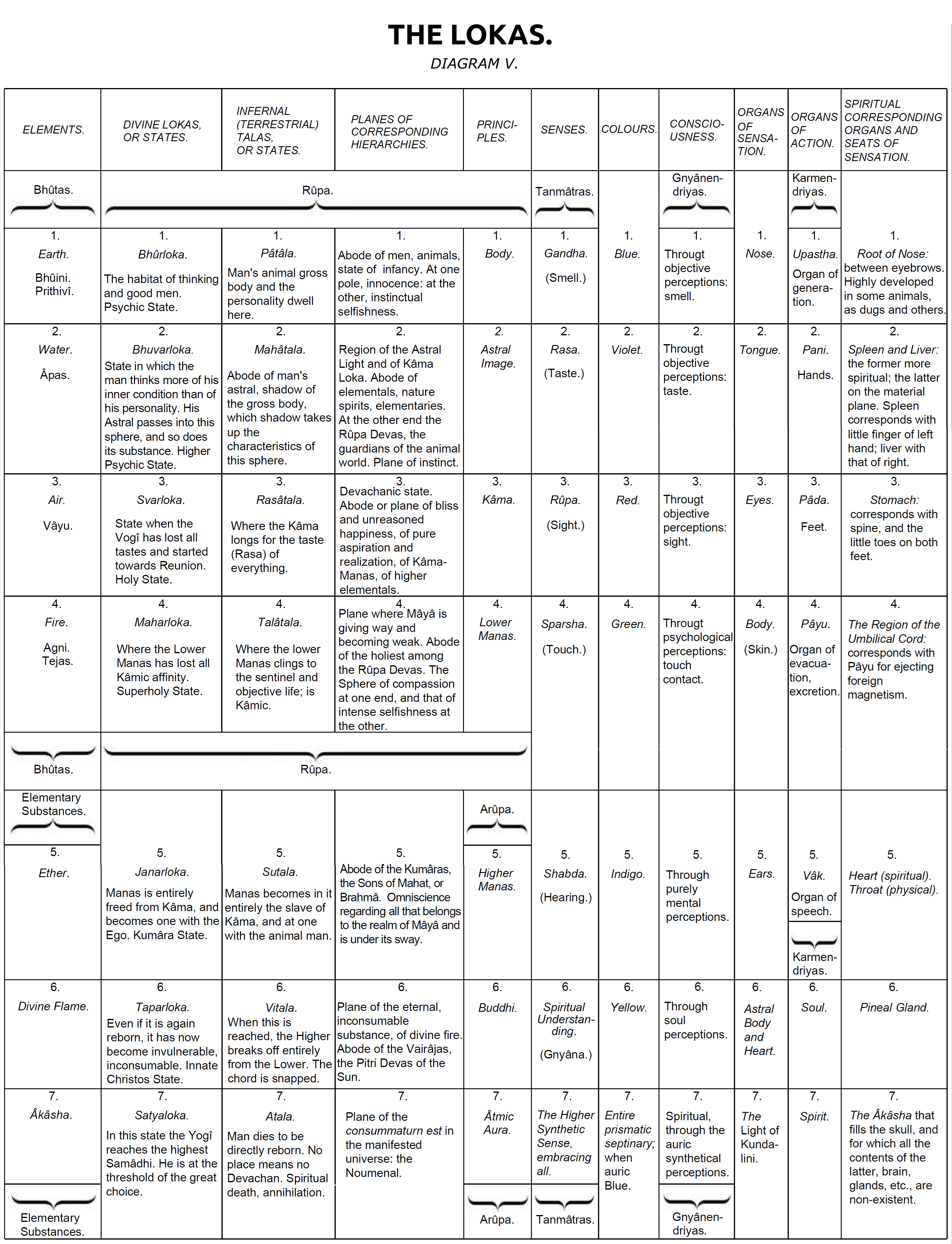
THE LOKAS.
In their exoteric blinds the Brâhmans count fourteen Lokas (earth included), of which seven are objective, though not apparent, and seven subjective, yet fully demonstrable to the Inner Man. There are seven Divine Lokas and seven infernal (terrestrial) Lokas.
SEVEN DIVINE LOKAS
1. Bhûrloka (the earth).
2. Bhuvarioka (between the earth and the sun [Munîs]).
3. Svarloka (between the sun and the Pole Star [Yogîs]).
4. Maharloka (between the earth and the utmost limit of the Solar System).{861}
5. Janarloka (beyond the Solar System, the abode of the Kumâras who do not belong to this plane).
6. Taparloka (still beyond the Mahâtmic region, the dwelling of the Vairâja deities).
7. Satyaloka (the abode of the Nirvanîs).
SEVEN INFERNAL (TERRESTRIAL) LOKAS
1. Pâtâla (our earth).
2. Mahâtala.
3. Rasâtala.
4. Talâtala (or Karatala).
5. Sutala.
6. Vitala.
7. Atala.
[DIAGRAM V.]
These the Brâhmans read from the bottom.
Now all these fourteen are planes from without within, and (the seven Divine) States of Consciousness through which man can pass—and must pass, once he is determined to go through the seven paths and portals of Dhyâni; one need not be disembodied for this, and all this is reached on earth, and in one or many of the incarnations.
See the order: the four lower ones (1, 2, 3, 4), are rûpa; i.e., they are performed by the Inner Man with the full concurrence of the diviner portions, or elements, of the Lower Manas, and consciously by the personal man. The three higher states cannot be reached and remembered by the latter, unless he is a fully initiated Adept. A Hatha Yogî will never pass beyond the Maharloka, psychically, and the Talâtala (double or dual place), physico-mentally. To become a Râja Yogî, one has to ascend up to the seventh portal, the Satyaloka. For such, the Master Yogîs tell us, is the fruition of Yajna, or Sacrifice. When the Bhûr, Bhuvar and Svarga (states) are once passed, and the Yogî's consciousness centred in Maharloka, it is in the last plane and state between entire identification of the Personal and the Pligher Manas.
One thing to remember: while the infernal (or terrestrial) states are also the seven divisions of the earth, for planes and states, as much as they are Kosmic divisions, the divine Saptaloka are purely subjective, and begin with the psychic Astral Light plane, ending with the Satya or Jîvanmukta state. These fourteen Lokas, or spheres, form the extent of the whole Brahmanda (world). The four lower are transitory, with all their dwellers, and the three higher eternal; i.e., the former states, planes and subjects, to these, last only a Day of Brahmâ, changing with every Kalpa: the latter endure for an Age of Brahmâ.
In Diagram V. only Body, Astral, Kâma, Lower Manas, Higher Manas, Buddhi and Auric Âtmâ are given. Life is a Universal Kosmic principle, and no more than Âtman does it belong to individuals.
In answer to questions on the diagram, H. P. B. said that Touch and Taste have no order. Elements have a regular order, but Fire pervades them all. Every sense pervades every other. There is no universal order, that being first in each which is most developed.
Students must learn the correspondences: then concentrate on the organs and so reach their corresponding states of consciousness. Take them in order beginning with the lowest, and working steadily upwards. A medium might irregularly catch glimpses of higher, but would not thus gain orderly development.
The greatest phenomena are produced by touching and centering the attention upon the little finger.
The Lokas and Talas are reflections the one of the other. So also are the Hierarchies in each, in pairs of opposites, at the two poles of the sphere. Everywhere are such opposites: good and evil, light and darkness, male and female.
H.P.B. could not say why blue was the colour of the earth. Blue is a colour by itself, a primary. Indigo is a colour, not a shade of blue, so is violet.
The Vairajas belong to, are the fiery Egos of, other Manvantaras. They have already been purified in the fire of passions. It is they who refused to create. They have reached the Seventh Portal, and have refused Nirvâna, remaining for succeeding Manvantaras.
The seven steps of Antahkarana correspond with the Lokas.
Samâdhi is the highest state on earth that can be reached in the body. Beyond that the Initiate must have become a Nirmânakâya.
Purity of mind is of greater importance than purity of body. If the Upâdhi be not perfectly pure, it cannot preserve recollections coming from a higher state. An act may be performed to which little or no attention is paid, and it is of comparatively small importance. But if thought of, dwelt on in the mind, the effect is a thousand times greater. The thoughts must be kept pure.
Remember that Kâma, while having bad passions and emotions, helps you to evolve by giving also the desire and impulse necessary for rising.
The flesh, the body, the human being in his material part, is, on this plane, the most difficult thing to subject. The highest Adept, put into a new body, has to struggle against it and subdue it, and finds its subjugation difficult.
The Liver is the General, the Spleen is the Aide-de-Camp. All that the Liver does not accomplish is taken up and completed by the Spleen.
H.P.B. was asked whether each person must pass through the fourteen states, and answered that the Lokas and Talas represented planes on this earth, through some of which all must pass, and through all of which the disciple must pass, on his way to Adeptship. Everyone passes through the lower Lokas, but not necessarily through the corresponding Talas. There are two poles in everything: seven states in every state.
Vitala represents a sublime as well as an infernal state. That state which for the mortal is a complete separation of the Ego from the personality is for a Buddha a mere temporary separation. For the Buddha it is a Kosmic state.
The Brâhmans and Buddhists regard the Talas as hells, but in reality the term is figurative. We are in hell whenever we are in misery, suffer misfortune and so on. ...
———————
{861} All these "spaces" denote the special magnetic currents, the planes of substance, and the degrees of approach that the consciousness of the Yogî, or Chelâ, performs towards assimilation with the inhabitants of the Lokas.