 ◄ BACK
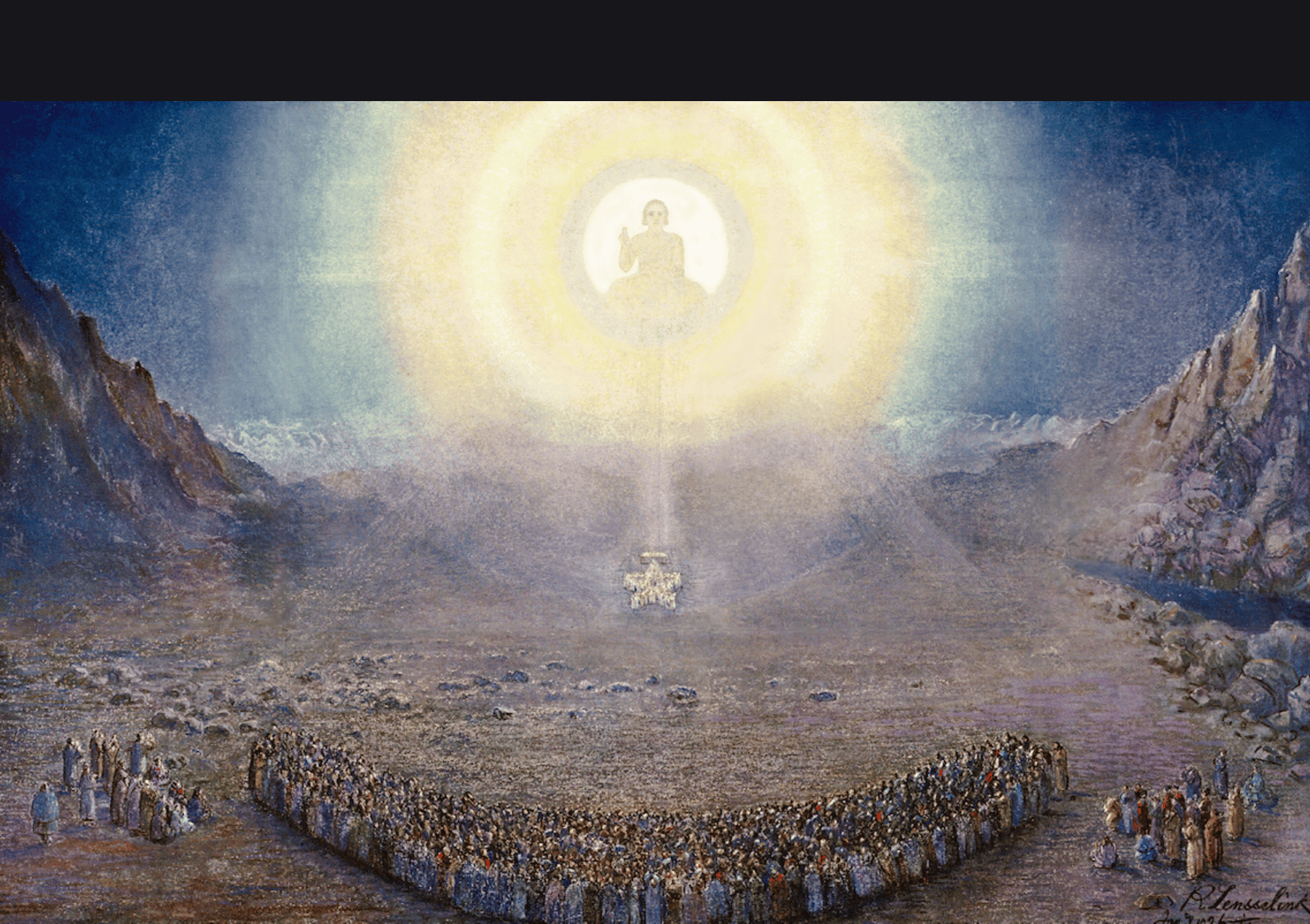
[cover: The Wesak Festival, painting by R. Lensselink.]
(C.W. Leadbeater, The Masters and the Path, pp. 431-446, 1927.)



The occasion selected for this wonderful outpouring is the full-moon-day of the Indian month of Vaisakh (called in Ceylon Wesak, and usually corresponding to the English May), the anniversary of all the momentous occurrences of His last earthly life—His birth, His attainment of Buddhahood, and His departure from the physical body.
In connection with this visit of His, and quite apart from its tremendous esoteric significance, an exoteric ceremony is performed on the physical plane at which the Lord actually shows Himself in the presence of a crowd of ordinary pilgrims. Whether He shows Himself to the pilgrims I am not certain ; they all prostrate themselves at the moment when He appears, but that may be only in imitation of the prostration of the Adepts and Their pupils, who do see the Lord Gautama. It seems probable that some at least of the pilgrims have seen Him for themselves, for the existence of the ceremony is widely known among the Buddhists of central Asia, and it is spoken of as the appearance of the Shadow or Reflection of the Buddha, the description given of it in such traditional accounts being as a rule fairly accurate. So far as we can see there appears to be no reason why any person whatever who happens to be in the neighbourhood at the time may not be present at the ceremony; no apparent effort is made to restrict the number of spectators; though it is true that one hears stories of parties of pilgrims who have wandered, for years without being able to find the spot.
All members of the great White Brotherhood, except the King Himself and His three disciples, usually attend this ceremon ; and there is no reason why any of our earnest Theosophical members should not be present at it in their astral bodies. Those to whom the secret has been confided usually try so to arrange matters as to put their physical bodies to sleep an hour or so before the exact moment of full moon, and to be undisturbed until about an hour after it.
The Valley
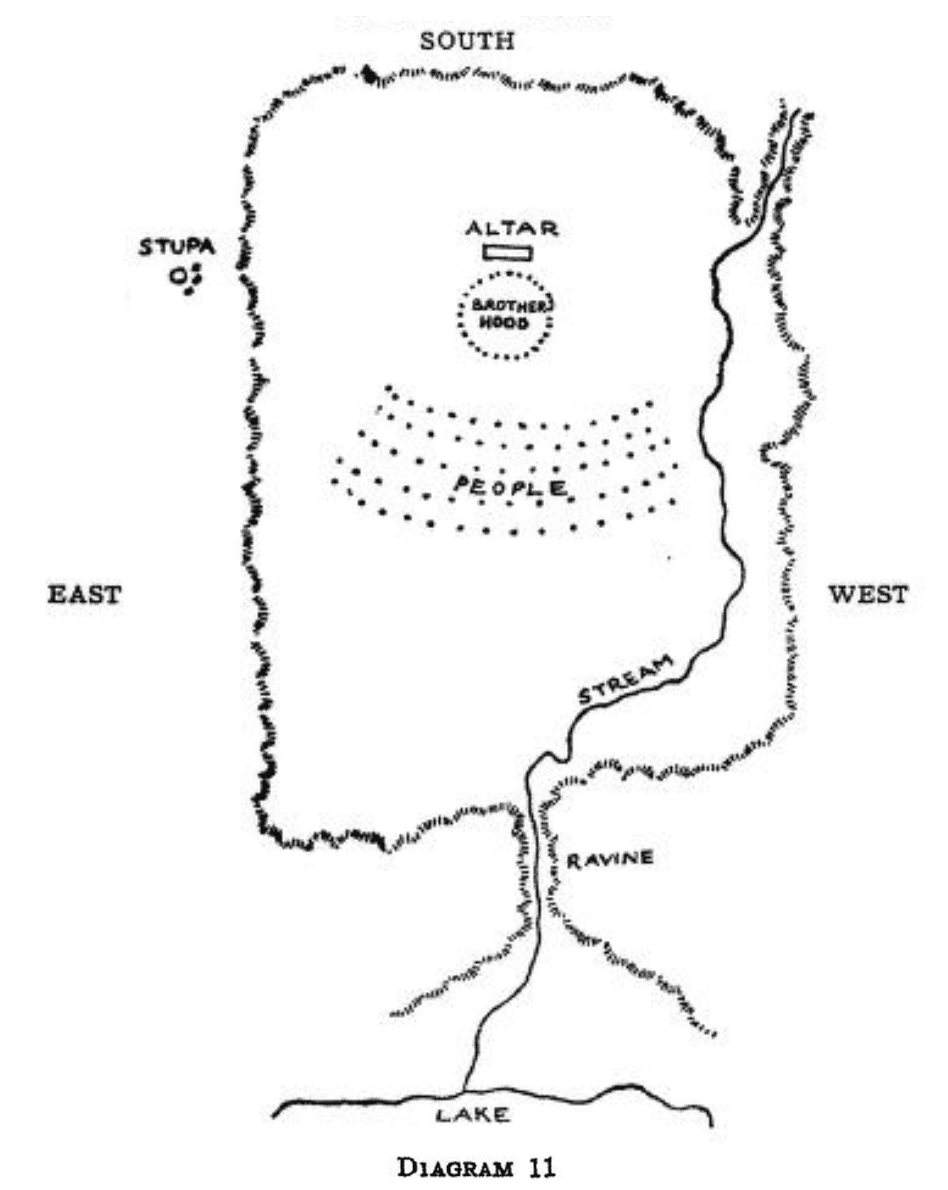
The place selected is a small plateau surrounded by low hills, which lies on the northern side of the Himalayas, not far from the frontier of Nepal, and perhaps about four hundred miles west of the city of Lhassa. This little plain (see Diagram 11) is roughly oblong in shape, its length being perhaps a mile and a half and its breadth rather less. The ground slopes slightly downwards from south to north, and is mostly bare and stony, though in some places covered with coarse wiry grass and rough scrubby vegetation. A stream runs down part of the west side of the plateau, crosses its north-west corner, and escapes about the middle of the north side through a pine-clothed ravine, eventually reaching a lake which is visible at a distance of some milesThe surrounding country seems wild and uninhabited, and there are no buildings in sight except a single ruined stupa with two or three huts beside it, on the slope of one of the hills on the eastern side of the plain. About the centre of the southern half of the plain lies a huge block of greyish-white stone, veined with some glittering substance—an altar-like block, perhaps twelve feet in length by six feet wide, and standing about three feet out of the ground.
For some days before the appointed time an everincreasing cluster of tents of strange and uncouth appearance (most of them black) may be seen along the banks of the stream, and down the sides of the neighbouring hills; and this otherwise desolate spot is enlivened by the camp-fires of a considerable multitude. Large numbers of men come in from the wandering tribes of central Asia, and some even from the far north. On the day before the full moon all these pilgrims take a special ceremonial bath, and wash all their clothes in preparation for the ceremony.
Some hours before the time of the full moon these people gather in the lower or northern part of the plain and seat themselves in a quiet and orderly manner on the ground, always taking care to leave a considerable space before the great altar stone. Generally some of the lamas are present, and they usually take this opportunity to deliver addresses to the people. About an hour before the moment when the moon is full the astral visitors begin to arrive, among them the members of the Brotherhood. Some of These generally materialize Themselves so as to be seen by the pilgrims, and are received with genuflections and prostrations. Often our Masters and some even greater than They condescend on this occasion to converse in a friendly manner with Their pupils and with others who are present. While this is going on those who are. appointed to do so prepare the great altarstone for the ceremony by covering it with the most beautiful flowers and placing at each corner of it great garlands of the sacred lotus. In the centre is placed a magnificently chased golden bowl full of water, and immediately in front of that a space is left among the flowers.
The Ceremony
About half an hour before the moment of full moon, at a signal given by the Mahachohan, the members of the Brotherhood draw together in the open space in the centre of the plain to the north of the great altar of stone, and arrange Themselves three deep in a large circle, all facing inwards, the outermost circle being composed of the younger members of the Brotherhood, and the greater Officials occupying certain points in the innermost circle.
Some verses from the Buddhist scriptures are then chanted in the Pali language, and as the voices die into silence, the Lord Maitreya materializes in the centre of the circle, holding in His hands the Rod of Power. This wonderful symbol is in some way a physical centre or fulcrum for the forces poured forth by the Planetary Logos, and was magnetized by Him millions of years ago, when first He set the human life-wave in motion round our chain of globes. We are told that it is the physical sign of the concentration of the attention of the Logos, and that it is carried from planet to planet as that attention shifts—that where it is, that is for the moment the central theatre of evolution, and that when it leaves this planet for the next, our earth will sink into comparative inertia. Whether it is carried also to the nonphysical planets we do not know, nor do we understand exactly the way in which it is used, nor the part which it plays in the economy of the world. It is kept usually in the custody of the Lord of the World at Shamballa, and so far as we know this Wesak Festival is the only occasion on which it ever leaves His care. It is a round bar of the lost metal orichalcum, perhaps two feet in length and about two inches in diameter, having at each end a huge diamond shaped into a ball with a cone projecting from it. It has the strange appearance of being always surrounded by fire—of having an aura of brilliant yet transparent flame. It is noteworthy that no one but the Lord Maitreya touches it during any part of the ceremony.

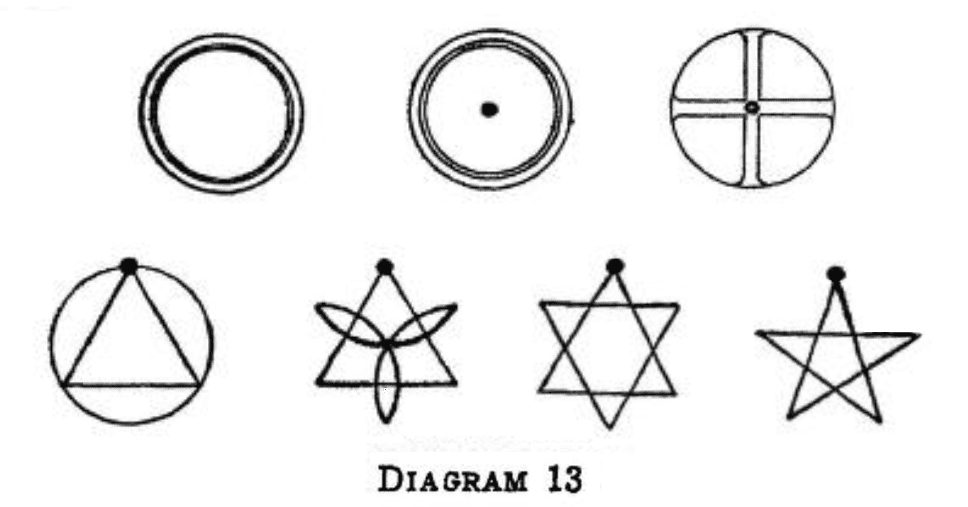
On His materialization in the centre of the circle all the Adepts and Initiates bow gravely towards Him, and another verse is chanted. After this, still intoning verses, the inner rings divide into eight parts, so as to form a cross within the outer circle, the Lord Maitreya still remaining at the centre. At the next movement of this stately ritual, the cross becomes a triangle, the Lord Maitreya moving forward so as to stand at its apex, and therefore close to the altar-stone. Upon that altar, in the open space left in front of the golden bowl, the Lord Maitreya reverently lays the Rod of Power, while behind Him the circle changes into a rather involved curved figure, so that all are facing the altar. At the next change the curved figure becomes a reversed triangle, so that we have a representation of the well-known sign of the Theosophical Society, though without its encircling snake. This ' figure in turn resolves itself into the five-pointed star, the Lord Maitreya being still at the southern point nearest the altarstone, and the other great Officials or Chohans at the five points where the lines intersect. A diagram of the symbolic figures is herewith appended, as some of them are not easy to describe.
When this seventh and final stage is reached the chanting ceases, and after a few moments of solemn silence the Lord Maitreya, again taking the Rod of Power into His hands and raising it above His head, utters in a few sonorous words of Pali:
" All is ready; Master, come! ”
Then as He again lays down the fiery rod, at the exact moment of the full moon, the Lord Buddha appears as a gigantic figure floating in the air just above the southern hills. The members of the Brotherhood bow with joined hands, and the multitude behind Them fall on their faces and remain prostrate, while the others sing the three verses which were taught by the Lord Buddha Himself during His earth life to the schoolboy Chatta:
The Lord Buddha, the Sage of the Sakyas, is among mankind the best of Teachers. He has done that which was to be done, and has crossed to the other shore (Nirvana). He is filled with strength and energy; Him, the Blessed One, I take for my guide.
The truth is non-material; it brings freedom from passion, desire and sorrow; it is free from all stain; it is sweet, plain and logical; this truth I take as my guide.
Whatever is given to the eight kinds of the Noble Ones, who in pairs form the four grades, who know the truth, verily brings great reward; this Brotherhood of the Noble Ones I take as my guide.
The Greatest Blessing
Then the people rise and stand gazing at the presence of the Lord while the Brotherhood chants for the benefit of the people the noble words of the Mahamangala Sutta, which has been translated thus by Professor Rhys Davids:
When yearning for good, many devas and men
Have held divers things to be blessings;
Do thou then inform us, O Master,
What is the greatest blessing?
Certain slight modifications have been introduced from other sources, when they seemed decided improvements.
Not to serve the foolish.
But to serve the wise;
To honour those worthy of honour;
This is the greatest blessing.
To dwell in a pleasant land,
To have done good deeds in a former Birth,
To have a soul filled with right desires;
This is the greatest blessing.
Much insight and much education,
Self-control and a well-trained mind,
Pleasant words that are well spoken;
This is the greatest blessing.
To support father and mother,
To cherish wife and child,
To follow a peaceful calling;
This is the greatest blessing.
To bestow alms and live righteously,
To give help to one's kindred,
To do deeds which cannot be blamed:
This is the greatest blessing.
To abhor and cease from sin,
To abstain from strong drink,
Not to be weary in well-doing;
This is the greatest blessing.
Reverence and lowliness,
Contentment and gratitude,
The hearing of the Law at due seasons;
This is the greatest blessing.
To be long-suffering and meek,
To associate with the tranquil,
Religious talk at due seasons;
This is the greatest blessing.
Self-restraint and purity,
The knowledge of the Four Great Truths,
The realization of Nirvana;
This is the greatest blessing.
Beneath the stroke of life's changes
The soul that stands unshaken,
Passionless, unsorrowing, secure;
This is the greatest blessing.
Invincible on every side
Is he who acteth thus;
On every side he walks in safety;
And his is the greatest blessing.
The figure which floats above the hills is of enormous size, but exactly reproduces the form and features of the body in which the Lord last lived on earth. He appears seated cross-legged, with the hands together, dressed in the yellow robe of the Buddhist monk, but wearing it so as to leave the right arm bare. No description can give an idea of the face—a face truly God-like, for it combines calmness and power, wisdom and love in an expression containing all that our minds can imagine of the Divine. We may say that the complexion is clear yellowish-white, and the features clearly cut; that the forehead is broad and noble; the eyes large, luminous and of a deep dark blue; the nose slightly aquiline; the lips red and firmly set; but all this puts before us merely the outer mask and gives but a little grasp of the living whole. The hair is black—almost blue-black—and wavy; curiously, it is neither worn long according to Indian custom, nor shaved off altogether in the manner of Oriental monks, but is cut off just before it reaches the shoulders, parted in the centre and swept back from .the forehead. The story is told that when the Prince Siddartha left home to seek the truth, he seized his long hair and cut it off close above his head with a sweep of his sword, and that ever afterwards he kept it at the same length.
One of the most striking features of this wondrous apparition is the splendid aura which surrounds the figure. It falls into concentric spheres, as do the auras of all highly advanced men; its general plan is the same as that of the Arhat depicted in Plate xxvi in Man Visible and Invisible, but the arrangement of its colours is unique. The figure is englobed in light which is somehow at the same time dazzling and yet transparent—so bright that the eye can hardly rest upon it, and yet through it the face and the colour ot the robe stand out with perfect clearness. Outside of that comes a ring of glorious ultramarine; then in succession glowing golden yellow, the richest crimson, pure silvery white and a magnificent scarlet—all these being of course really spheres, though showing as bands when seen against the sky. Shooting out at right angles, outside . all these, are rays of all these hues intermingled, and interspersed with flashes of green and violet, as will be observed when we refer to our frontispiece.
These colours, in exactly this order, are described in ancient Buddhist scriptures as constituting the aura of the Lord; and when in 1885 it was thought desirable that a special flag should be found for the Buddhists of Ceylon, our President-Founder Colonel Olcott, in consultation with our Sinhalese brothers at Colombo, evolved the idea of utilizing for that purpose that same significant grouping of colours. The Colonel tells us {1} that he learnt some years later from the Tibetan ambassador to the Viceroy of India, whom he met at Darjeeling, that the colours are the same as those in the flag of the Dalai Lama. The idea of this symbolical standard seems to have been widely accepted; I have myself seen it in Buddhist Temples at places as far apart as Rangoon and Sacramento in California.
Through a most unfortunate mistake these bands of colour were given in a wrong order in the plate accompanying the first edition of this book; the error has now been corrected. It is of course impossible to obtain in a printed illustration any approach to the brilliancy and purity of the colours as seen in the sky; all we can do is to offer a suggestion to help the imagination of the reader.
In earlier books we have described scarlet in man’s aura as expressing anger only; so it does in the ordinary lower astral; but quite apart from this, we find that at higher levels a far more magnificent and luminous scarlet, the very essence of living flame, betokens the presence of dauntless courage and high determination. It is of course as denoting the possession of these qualities in a superlative degree that it appears in the aura of the Lord Buddha. We might conjecture that the somewhat unusual prominence of this brilliant scarlet band may be significant of the special manifestation of those qualities in that age-long work of self-development to which I have referred on page 427.
The Lord Maitreya, who takes so prominent a part in this ceremony, will in due course of time succeed to the office now held by the Lord Gautama. It will perhaps be of interest to compare His aura with that which we have just described. The easiest way to imagine it is to look at the illustration of the aura of an Arhat on Plate xxvi of Man Visible and Invisible and then modify it in imagination as here indicated. It has a general resemblance to that, but besides being so much larger the colours are somewhat differently arranged.
The heart of it is blinding white light, just as in the case of the Arhat; then, eliminating the yellow from that part, let the rose-coloured oval retain its present position, but extend it inwards up to the edge of the white. Outside that rose-coloured oval put a band of yellow instead of the blue; outside the green comes a belt of blue; outside of that the violet, as in the book, but outside of the violet again a broad band of the most glorious pale rose, into which the violet imperceptibly melts. Outside of all comes the radiation of mixed colours, just as in the book. The rays of white light flash through it in the same way, yet even they seem faintly tinged with the ever-present pale rose. The whole aura gives the impression of being suffused with the most delicate yet glowing rose, much as is Plate xi in Man Visible and Invisible.
A point which seems worthy of notice is that in this aura the colours come exactly in the same order as in the solar spectrum, though orange and indigo are omitted. First the rose (which is a form of red) then the yellow, shading into green, blue, violet in succession. And then it goes on into the ultra-violet, melting into rose—the spectrum beginning again in a higher octave, just as the lowest astral follows upon the highest physical.
Of course that is a very poor description, but it seems the best that we can do. It must be understood that it exists in many more dimensions than we can anyhow represent. In order to say thus much about it I have tried to do something nearly equivalent to taking a three-dimensional section of it. But it is wise for us to remember that it is by no means impossible that another section might be taken in a slightly different manner, which would yield somewhat dissimilar results, and yet be quite as true. It is hopeless to try to explain on the physical plane the realities of the higher worlds.
When the Mahamangala Sutta is finished, the Lord Maitreya takes the golden bowl of water from the altar-stone, and holds it above His head for a few moments, while the multitude behind, who have also provided themselves with vessels filled with water, follow His example. As He replaces it on the altar-stone another verse is chanted:
He is the Lord, the Saint who is perfect in knowledge, who possesses the eight kinds of knowledge and has accomplished the fifteen holy practices, who has come the good journey which led to the Buddhahood, who knows the three worlds, the unrivalled, the Teacher of gods and men, the Blessed One, the Lord Buddha.
As this ends, a smile of ineffable love beams forth from the face of the Lord as He raises His right hand in the attitude of benediction, while a great shower of flowers falls among the people. Again the members of the Brotherhood bow, again the crowd prostrates itself, and the figure slowly fades out of the sky, while the multitude relieves itself in shouts of joy and praise. The members of the Brotherhood come up to the Lord Maitreya in the order of Their admission, and each sips the water in the golden bowl, and the people also sip theirs, taking the remainder home in their quaint leather bottles as holy water to drive away all evil influences from their houses, or perhaps-to cure the sick. Then the vast company breaks up with mutual congratulations, and the people bear away to their far-distant homes an ineffaceable memory of the wonderful ceremony in which they have taken part.

Energy Follows Thought