 ◄ BACK
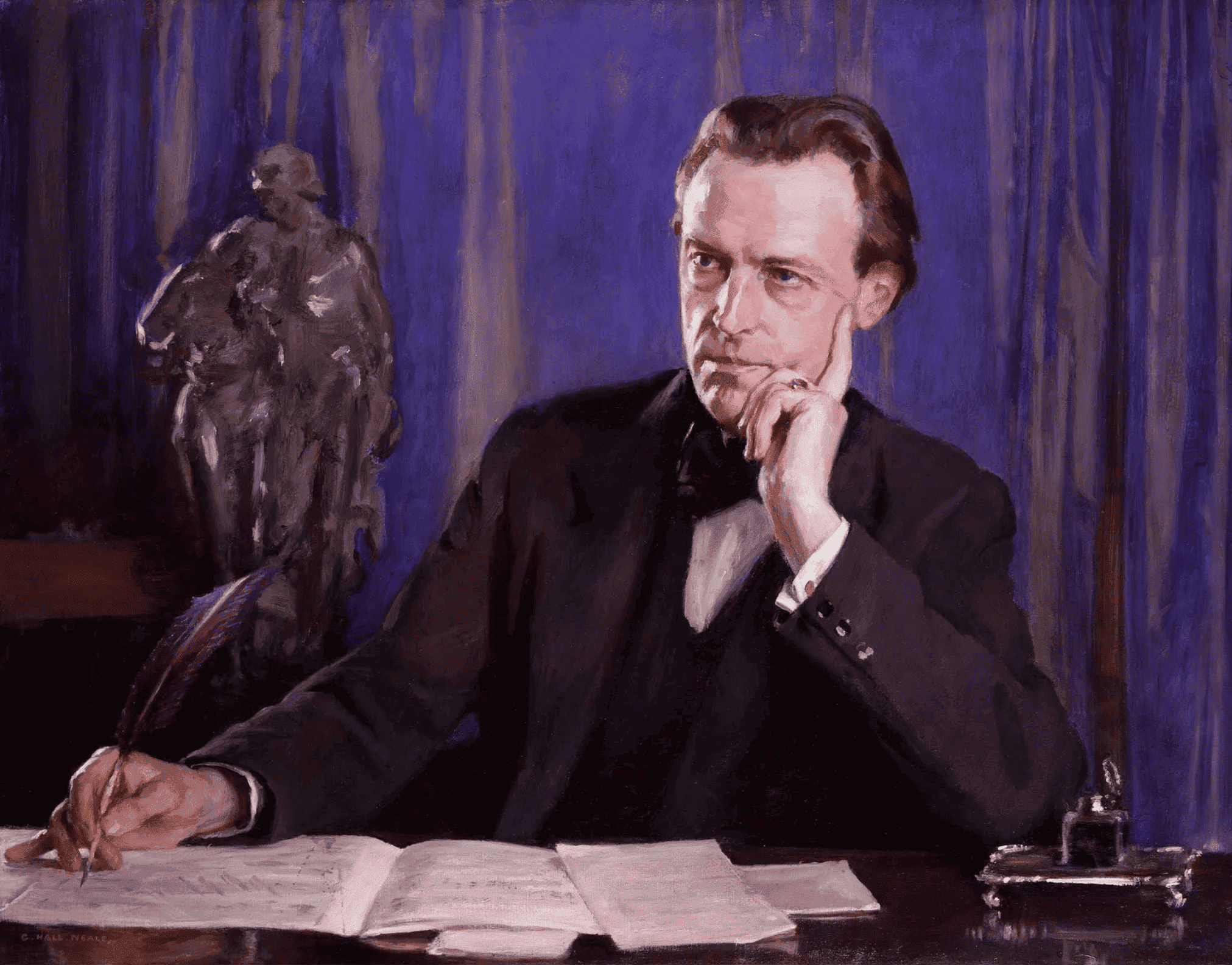
[cover: Cyril Scott, by George Hall-Neale © National Portrait Gallery, London.]
(Cyril Scott, The Initiate | Some Impressions of a Great Soul, 1920.)

The Circuitous Journey Explanatory
How the circuitous Journey came to be written has been stated in the episode headed “The Prelude” to added. The process known as “writing through” a receptive person is one recognized by those who possess any knowledge of occultism of occult methods, but the general public is unenlightened respecting this, and probably for the most part skeptical, and, in spite of what I may relate, is likely to remain so. Skepticism, however, does not alter facts, nor can the oratory of the unseeing annihilate the convictions of those who see, for, as Mrs. Besant pithily puts it, “Ignorance can never convince knowledge.” But be that as it may, for those at any rate who have ears to hear, I am constrained to express my conviction that the ideas, ethica l, philosophical and mystical, contained in the following pages have been impressed on me by the initiate I may now rightly call my Master.
True it is, is some cases I may unwittingly have distorted certain of those ideas, and so “brought them through” incorrectly, but should this be. Then I alone am to blame, and not he who used me as an instrument.
With regard to the “manner” adopted for the writing of the story, I was given certain instructions by Justin Moreward Haig before he finally left London. “Let the English be quaint, flowing, and as poetical as possible,” he had said, “for occult truths impress themselves more readily on the reader if they be clothed in melodious language. Also endeavour to decorate the large story by a number of smaller stor ies, and do not fail to be lavish with simile and parable.”
Thus I have attempted to carry out these instructions to the best of my ability, and I need nut mention one significant fact in addition: When Haig told a certain kind of story or discoursed on ethics, I noticed his language took on a particular sound and flow which was exceedingly striking and compelling. Well, strange to say, as I started writing my story, I found myself unconsciously imitating that very musicality of language. Then one day whe n I was particularly conscious of Haig’s presence, I mentally put the question, “Did you impress on me the style of writing as well as the ideas?” And the answer came: “I did not actually impress it on you, but you got a certain flavour of the way I might write, simply because we are in such close rapport.”
PART II
- Chapter I.
- Chapter II.
- Chapter III.
- Chapter IV.
- Chapter V.
- Chapter VI.
- Chapter VII.
- Chapter VIII.
- Chapter IX.
- Chapter X.
- Chapter XI.
- Chapter XII.
- Chapter XIII.
- Chapter XIV.
- Chapter XV. (non-existent)
- Chapter XVI.
- Chapter XVII.
- Chapter XVIII.
- Chapter XIX.
- Chapter XX.
- Chapter XXI.

LONG ago, in a past generation, and in a distant mountainous country, there lived a rich man, Antonius by name, who had partaken of all the enjoyment his riches could offer, and then grown weary and satiated, as a child wearies of a toy which has lost all its attractiveness. And finding life unendurable by reason of the utter tedium he felt within his pleasure-wasted mind, he turned to the study of ancient books and ancient lore, endeavouring to while away the long hours in the acquirement of knowledge, living alone and seeing no one; for the visits of his former companions only disturbed him in the pursuit of his studies. So as the sat one day reading, as was his wont, in the shade of his garden, it chanced that an old beggar came through the gate, and stood before him asking for alms. And being of a kindly disposition and void of all parsimony, he drew forth his purse and gave that old beggar a handful of coins, bidding him, with a word of good cheer, go on his way, and let fortune attend him. But that old beggar, having thanked him for his unusual liberality, said, “Be not so hasty to dismiss me, O generous One, lest I go without repaying you for what you have done; for that were ungracious indeed, since you have given me more than ever I expected to receive.” So then Antonius, thinking within himself, “what can this ignorant old beggar possess that he talks of repayment?” smiled indulgently, and suffered him to remain, looking at him the while askance , and waiting for what he might have to say. But that old beggar smiled indulgently in return and said, “O, would-be Philosopher, know that appearances are deceptive, and wisdom is oftentimes clothed in very modest garments, being the property of the poor as well as the rich; and know also that Chance is but a phantom word which has no place in Truth, and that what brings me here is not chance at all, as you supposed, but the results of desire working unseen through the forces of Nature. For truly my coming is but the outcome of your thirst for knowledge, and your generosity is the sesame which permits me to let you pass the first doorway towards the secret path to Truth, since the Truth I have in view for you can only be attained by the large-hearted and generous-minded, and by none else-verily, by none else.” Then Antonius began to prick up his ears, and to think within himself, “Truly I have been mistaken in this old mendicant, for, in spite of everything, he appears to be somewhat of a sage, and talks with the voice of learning rather than with ignorance, therefore I shall do well to listen to him and pay heed to what he has to impart.” But aloud he said, “O Stranger, so rich in wisdom yet so poor in possessions, think not I wish to dismiss you without giving you a hearing; on the contrary, I beg you to be seated, and my servant shall bring refreshment ere you depart on your way, for you have the air of one who is traveling, and I take it also you are very old?” And so that aged mendicant sat down, folding his tow hands on the top of his knobbed staff, while Antonius went to the house and gave orders that fruit and bread and wine should be brought into the garden: and then he returned and waited for what the old man should say. And that old man, after thanking him courteously, looked searchingly and steadfastly into his eyes, and said: “O Seeker! Only the very beginnings of knowledge are to be culled from the pages of books, and, although your reading has been long and steadfast, yet unless you have already le arnt this much, your study has been well-nigh in vain. For know that true knowledge is along to be found in your own soul, and the way to your soul is through the passage of the heart, from which all darkness must be banished by the light of selflessness. And, this being so, it behooves you to lay aside your books, and seek for knowledge elsewhere, leaving your house and possessions to the care of your servants until your return. For what you seek is not to be found here, but on the summit of yonder snow-clad mountain, where dwell the Masters of Wisdom, ever waiting to impart their inestimable treasures of Enlightenment to those who are courageous and persistent enough to achieve the great ascent. But, as only the selfless can earn the right to receive that knowledge, so one of their conditions is, that you journey not along, but lead others to their Temple to Wisdom as well; and even if they on their part should weary of the climb and retrace their steps, leaving you to pursue the remainder of the way in solitude, will the Masters nevertheless receive you and give you your reward. But know that the distance of yonder mountain range, and the task is difficult and arduous, but there are many halting places on the way, in the shape of towns and villages, where you must sojourn and rest. And yet, in each of these halting places you will learn not only a further stretch of the on-leading path, put also a fragment of knowledge, which shall prepare you as a preliminary initiation, so to say, for the enlightenment of your final goal; and that goal itself is none other than the finding of the philosophers’ Stone-as in the language of allegory it is expressed{*} - by which you shall attain the vanquishment of death and the possession of unending Bliss.”
{*} Research has shown that the Philosopher’s Stone was never intended to be other than a purely symbolical term.
Then said Antonius: “O venerable old man, although your body is emaciated with long years, your speech has retained the energy of youth, and words flow from you as a rivulet rushing swiftly to the sea of Wisdom, and therefore ring true within my ears. But nevertheless you ask you the impossible, in demanding that I should find others to bear me company on so long and arduous a journey, for where am I to seek for those who desire knowledge, not only strange in itself, but purchased by so strange and difficult a price? And moreover, who will believe me if I tell them on yonder summit lies, in the custody of a few Anchor ites, the Philosophers’ Stone, about which they have never heard, and of which, in all probability, they will not care to hear either? Do you think my former boon companions would do anything but laugh me to scorn, were I to lay before them so fantastic and unverifiable a proposal? Truly, your integrity may be indubitable, but your conditions were hard indeed to carry out.”
Then that old mendicant suffered the suspicion of a smile to play upon his wrinkled face, and answered: “O Nescient One! Were the conditions the Great Ones impose impossible of carrying out, either in your case of in that of another, truly would I not have come here to waste my breath in unprofitable discourse, and the telling of falsehoods; for have I said that I came by the inexorable decrees of fate in answer to your aspirations, and not by the illusion of Chance or fortuitous circumstance? Therefore, before you tell me of the impossible, take heed and hear what I have further to say, for unbeknown to yourself you are already a little way along the road to knowledge, and have already fulfilled, unconsciously to yourself, a few conditions of the Great Ones which hitherto I have not defined.” And as he was speaking, servants emerged from the house and came across the green sward, bearing in their hands a tray laden with fruits and bread and wine; so he hesitated, and waited to continue, until they had gone back into the house, courteously ignoring a gesture on the part of his host that he should refresh himself with the proffered repast. Then he continued: “And now I will tell you in what way you are already a little stretch along the pathway to knowledge, for have you not wearied of your eating and drinking and your fondness for women, and all ten enjoyments which your riches have purchased for you, and did you not turn from them because they sickened you, and cloyed your renouncing them all without effort, in that they no longer afforded you any delight?”
Then Antonius looked at the old man and answered: “Truly, I have done as you say, but indeed what other course could I have pursued, seeing that to cling to delights which are no longer delights were the summit of folly, and equivalent to embracing the form of a phantom which has no substance coarser than air? Nor in casting away willin gly that of which I was weary can I see anything of merit, for rather had there been merit only if my action had been contrary to my desire, and not in accord with it instead.”
Then that old mendicant smiled with a sapient smile, and said: “O Innocent One! Yet tinctured with a drop of Wisdom! Only he who renounces without effort has truly renounced at all; for to refrain from that which the mind still desires is to walk on the edge go a precipice, for ever in the danger of falling into the abyss; and what were the use of a shattered corpse to those who would impart knowledge; for just as a corpse cannot hear, being deaf to all sound, so he who is gnawed by the worms of desire cannot hear either, being deaf to all Wisdom. And now reflect and delve into the recesses of your memory, lest among your companions there be not a few you can take on your journey to Truth; and if there be none that you love, perhaps there be those who still love you, and because of that love, if for nothing else, will follow you along the great Road." And then that old beggar, after having partaken of a little refreshment, slowly arose from his seat, and, bidding his bewildered host farewell, departed and went on his way.
Now Antonius possessed a friend, who stood as it were apart from his other companions, and whom he loved with a tender and steadfast devotion, seeing in him an example of learning, benevolence, and love. And he dwelt not far away, in a cypress-girded villa by the sea: a man, it was said, of vast wealth, yet, unlike the wealthy, choosing to live a life of simplicity and moderation rather than extravagance and revelry. And Antonius thought within himself: " I will repair to my friend Pallomides, and at any rate ask his advice concerning the proposition of this mysterious old mendicant, for was it not he himself who lent me those books I have been so long studying, and therefore it is not unlikely he may be able to tell me which course to pursue-if indeed I should pursue any at all." And so, immediately the thought had come into his mind, he set out along the white shady road, overhung by t he intertwining branches of the trees, planted like sentinels on either side, and suffering the deep blue of the cloudless sky to peep through the interstices of their green leaves. And as he drew near the villa in which his friend lived, he could discern his tall and beautiful figure wandering to and fro on the terrace overlooking the calm, noiseless sea; and his head was bent down over a book, from which now and then he looked up, as if to inhale the scent of innumerable roses lifting their pale faces to the morning sun. Then when he saw Antonius approaching, a smile of joyful welcome overspread his calm and classic countenance, and he went forward to meet him and give him a welcoming embrace, as was the custom in those longago days. And then Antonius told him for what purpose he had-come, and of the mysterious old beggar who sought to persuade him to embark on so strange and unfathomable a journey, begging him to extricate his bewildered mind from the dilemma of its inclination and doubt. And Pallomides looked at him with impenetrable smiling eyes and said : "Are you not a little easy of credulity, O friend, seeing that a disreputable old beggar-man coming to ask alms of you can so dexterously impress your mind with a project which may turn out to be nothing more than the very height of folly, so that your journey, if you decide to undertake it, may end only in disappointment and regret.? Nevertheless, I also have heard that on yonder mountain summit is a monastery of mysterious monks, possessed of an incalculable treasure of knowledge, and that to reach them through that long and ladorious ascent is to earn a reward ourweighing all the material riches of the world. And yet to persuade you to go were a responsibility I am indee d loth to undertake, and to persuade you to remain were equally a responsibility; for whom knows, that the old mendicant may not be sincere in his gratitude and wish to do you a good turn, and let you profit by a knowledge of which he is too old to avail himself on his own part? Moreover, even if your journey turn out to be in vain, you have little to keep you here in our world below, and therefore if seems no great harm could accrue one way or the other, for you are in the prime of life, and have many years before you as yet, and on your return could still pursue your studies, aye, perhaps the better for your travel and adventure.”
Then said Antonius: “You say well, but the conditions imposed are difficult of carrying out, and where am I to seek for a friend to bear me company on so strange and seemingly chimerical a quest; for apart from you, who are patient of my scheme by reason of your large-mindedness and leaning, what other can I persuade to believe in my integrity, instead of regarding me as a madman or a fool?”
Then said Pallomides: “Surely you flatter one who is unworthy of flattery, since my large-mindedness is nothing but a little worldly wisdom, realizing that no opportunity placed on the path of man is to be wholly disdained and let slip away. Not is it so hard as you suppose to find a companion for your journey, for, if a man is not forthcoming, perhaps a woman might be found in his stead.”
Then replied Antonius: “But what woman do I know other than those with whom I have amused myself in former days, and who are unsuited to my quest; for even if I could induce them to follow me, the Wise Ones would hardly receive them as pupils for a knowledge so high? Moreover, I have neglected them, and let them melt like dreams away from my life, forgetting almost their names, so that I could not find them now even if I would.”
Then Pallomides looked at his friend with the gaze of a father, as he said: “The seekers of wisdom do not disdain even their dreams, lest underlying their diaphanous texture there be some meaning of import and weight; and even should there be nothing, yet to essay their retention were an exercise for the memory not to be despised; for surely your own must be of the shortest if you cannot recall at least one of your many loves; or surely you spoke without forethought, or are seeking an excuse to hide from me your disinclination to take one of the weaker sex as your companion, lest she should prove a hindrance to you rather than a help.”
And then Antonius laughed a little shamefacedly, and said: “O, reader of character! You have divined somewhat of the truth, for I fear to burden myself with a woman who may for ever desire to repose or linger or turn back, being as whimsical and capricious as the breeze, and as lavish of her tears as a moisture-laden cloud of its rain at the change of the moon.”
But Pallomides answered him gravely, and said: “Yet are you not thus forgetting the conditions imposed, and seeking to consider your own ease, avoiding the very first task you must undertake, to achieve your reward; for verily, did not that old man tell you that selflessness along could give you entry into the Temple, and for that reason it was you should be accompanied by others, but not for the gratification of your own comfort or to mitigate the irksomeness of your journey upon the long road? Nevertheless, take heed, I would not persuade you to go, as I would not dissuade you either; but if you are fain to try your fortune on the strength of the words of that old sage, then folly were it to try it half-heartedly, ignoring one portion of his so unequivocal directions, and only obeying the other instead; for it seems truly the portion you would discard has every whit as much value as the portion you would obey.”
Then Antonius smiled a little sadly, and said: “No doubt you are right in this case, as you have been to my knowledge in most others, for truly a thing that is worth doing in part is worth doing altogether; and, although I will seek first for a man companion to go along with me, yet should I fail in this, I will do as you say and take a woman instead.” And he hesitated for a moment, looking a trifle appealingly at his friend, then added: “vain were it, I opine, to ask you to come with me yourself?”
And Pallomides laughed with kindly amusement, and answered: “Yes, I fear it were vain indeed.”
So then Antonius departed and went back to his home, steeping himself in his troubled reflections, and trying to devise some plan for the search of a companion and some oratory to convince him, if he should find one, of the value of the quest. And he reflected for several hours, until the twilight was beginning to settle upon his garden, and then set forth in the direction of the town, intending to visit many of his former comrades, though hopeful of little suc cess for the object on which he was bent. And so, after going from one to the other, and receiving nothing but laughter and good-natured mockery for his pains, he was compelled to give up his search, which, as he correctly presaged, had come to nought. Then said he to himself: “With the men I have utterly failed, as I expected, for after all they only liked me for the good food and wine I lavished upon them in former days, and not for myself; since when I ask of them aught me to scorn, deeming me a fool. So now will I try with the women instead, for one at least loved me and vowed she would always love me, though I treated her badly, and turned my own life away from hers without further ado. So who knows but that she may love me still; and even if chary of believing in the object I have in view, she may go with me because of love, if for nothing more; for what ties have courtesans to tether them to this place or than, and, seeing I have money and to spare for both of us and many more, surely there can be few other obstacles in the way?”
And so Antonius at length came to the house of one, Cynara, his former mistress; and to her he laid bare the project he had so close to his soul, while she on her part listened with wide-open eyes, full of a love which had neve r died. But as he was telling the tale, he noticed that she had aged, and much of her former beauty had faded away with the passage of years, and her body had grown thinner, and her eyes a little sunken with a weariness of soul which, on the one hand, touc hed his heart with something of pity, and, on the other, caused him to shrink a little from her away. And he thought to himself, as he looked at her and talked to her in the gloaming of the rushlight: “Truly I wish she seemed to love me a little less, for surely she will embarrass me with her devotion, and perhaps I shall need to feign that which I no longer feel. And yet, if she loved me no more, certainly she would not do as I ask her, and come with me on my journey: therefore, the importunity of her love I must accept as the price of her companionship, and so endure it as best I can.”
And then, when he had finished speaking, and come to the end of his tale, she looked into his eyes, and answered playfully: “O faithless, yet beloved one! Although thou hast left me these long years with never a message nor an inquiry after my welfare, and only now when thou dost want something of me, seekest me at last, as, who knows, a final resource; yet, because I still love thee. I will go along by thy side on this strange journey, being glad to have recovered thee when I thought thou wast gone for evermore. For just as thou art enwearied by thy riches, so am I wearied by my amours, and would fain make an end to them all and seek for something better on the roadway of life; the more so, as my loves existed in name only and not in truth, since, glimmering through every one of them, was thy imperishable image, and the undying memory of thee and thy love; and although I know full well thou dost care for me no longer, yet nevertheless I will companion thee faithfully and ask nothing in return.”
So then Antonius rejoiced in his heart, saying to himself: “At last I have found someone to go with me on my way; and now my doubts are set at rest, and I can prepare for my journey without further ado.” But to Cynara he said: “Thou wast ever noble, and didst treat others better than they ever treated thee, making of my own delinquent self no exception to the rule of thy softheartedness. Yet in this instance thou shalt be repaid a thousandfold by a reward of which thou canst not even dream until thou dost learn a little further of what is I store. But now I will depart, and will send for thee at the appointed hour, when I shall have made all the essential preparations for our journey; and until then, farewell.”
So then Antonius began to trace his steps to his own home once more, with a light heart and a mind full of expectation and an enthusiasm which he made no efforts to suppress. And as he walked along, plunged in his own felicitous meditations, suddenly a thought darted like an arrow into his brain, causing him for a moment to feel as if all his project had burst like a bubble floating in the air. For as he turned the bend of the road along which he was walking, a view of the far-off mountain range suddenly came upon him, as the full moon, just rising above its highest peak, silhouetted it against the fathomless dark blue of the immeasurable sky. And he said to himself: “Surely I am mad to think I can ever ascend to that cloudkissing height, where certainly to my knowledge no footstep has ever trod and no traveler had returned to tell his tale. And surely that beggar must so at he gave me no directions how to discover the way, telling me only of the conditions under which I was to journey instead. And did I not let that mysterious old mendicant depart without exacting a promise that he would return and enlighten me further how to proceed? And now in all likelihood he has gone away for ever, and to try to discover him were as vain almost as the attempt to discover a particular shell at the bottom of the sea.”
Then suddenly as he turned the final bend of the road before his own house, there, as if in direct contradiction to his thoughts, he saw that very old beggar seated waiting just outside his garden be the gate; and his heart expectation, so that he hastened his steps until he confronted him where he sat.
Then that old beggar arose and bowed, but without any preamble and without for Antonius to speak, said with measured accents, as is the custom with those who are old: “And now, since you have decided to go with you, listen well to what I have to impart, for without my directions difficult were it indeed for you to find the way, as also the guides and halting places at each juncture of your journey. But first let me deliver you this little amulet, which you must wear attached round your neck and hidden beneath your garments, for it is a symbol whereby your prospective instructor shall know who you are and what is your quest; nor must you fail to show it whenever demanded of you, otherwise you can receive no instruction, and so will have your journey in vain.”
But Antonius in his astonishment interrupted him and said: “Old man so enshrouded in mystery! How came you to know I have decided to embark on this strange journey at all, let along that I had found a companion?”
But the old man put up his hand to silence him. Saying: “I have no excess of time for the soling of idle questions; so take this amulet as I have said,” and Antonius took the amulet form his hands, he continued immediately: “And now learn that your first destination is a village lying on yonder lowest slope at the foot of the two great overhanging rocks, which you will discern on your approach, after a day or so of journey on foot. And at the very last house at the further end of that village, which you must know, consists of but one long street, you will knock, and the owner of the house will receive you and instruct you further how to proceed. But take with you but little in the way of money, and wear but modest apparel, looking as a beggar rather than as a wealthy man; and of servants you must take none at all, but only a weapon to guard yourself against attack and a staff to assist you in your ascent. And now farewell, and may the gods guide you and protect you on your way.” And without another word or look, that old beggar turned and was gone round the bend of the road out of sight.
Then Antonius tantalized by perplexity on the one hand, yet, utterly convinced as to that old man’s integrity on the other, turned into his gate and so into his house, determined to set out on his journey without protracted delay. And he called to him his servants, saying: “I am soon about to travel for a while on some business of importance to myself, not knowing how long it will be before I shall return; but as during my travels I shall be the guest of friends, I therefore desire to take no servants with me, intending to journey without baggage and retinue and encumbrance of any kind; and I have fixed the day after tomorrow for the day of my departure.” Then having said this and partaken of the supper that was awaiting him, he went to bed and slept far into the dawn, dreaming of that mysterious old sage, and Pallomides, and Cynara, and snow-capped mountains all in one, as is the way of dreams.
And on the appointed day Antonius and Cynara set out on their journey together, for he had dispatched a message to her respecting their meeting place and the hour of setting forth. Nor had he failed to ta ke a farewell of Pallomides in his villa by the sea, deeming, who knows, a long separation might be between them, or even one that would never have an end at all.
And so those two wayfarers plodded for many hours along the dusty roads, now resting, now walking on again, now taking a little refreshment at a wayside inn or throwing themselves on the grass for repose by the edge of a stream; and sometimes they bathed their hot and aching feet in the cool waters of a river, splashing their faces to wash away the dust and sweat engendered through the burning sun. And yet as Antonius grew more tired with the passage of time, he thought to himself: “Woe is me for my folly in choosing to travel thus without horse or servant like a beggar, dragging my legs after me as if they were stones increasing in weight at every step. And here am I, with all my wealth, because of the babbling of an old beggar-man, leaving everything of comfort behind, and going in search of I hardly know what.” But as he looked at his companion bravely tramping along by his side, her face was calm and without complaint, though the lines under her eyes had deepened with fatigue. And in response to his look she smiled with a smile in which weariness and encouragement, as it were, seemed blended in one, but she did not speak, for she was too tired to find any words to say. And Antonius thought to himself: “Ah, if I could but love her as she loves me, my road were disburdened of much of its weariness and brightened by so small a thing as a smile, as hers seems to be brightened by my even taking notice of her at all. For truly she must have a noble heart to place such implicit faith in me and love me these long years even through the glamour of so many other amours; and if she were not so faded, who knows I might have loved her a little in return?” and he looked again at her, but this time smiling with a kindliness in his glance he had not shown hitherto, so that as she smiled back at him with a furtive joy in her eyes, he felt he could play on her soul as the hand of a bard plays on his lyre seeking to bring forth joyful sounds. And straightway a thought shot into his mind which made him very glad, for he said to himself: “Have I got a new game to play which will while away the hours of my tramping, and sobring me all the quicker to my destination? And the very simplicity of the game is half the attractiveness, in that it can be played anywhere almost, and not only between my present companion and myself. And yet it is strange that I never thought of it be fore, and that the look in the eyes of a jaded girl who loves me, yet whom I cannot pretend to love in return, should be the very first to open my own eyes to its existence. Although had it been otherwise, and had I loved her in return, most likely all of it would be with love and passion, and hence blind to the subtler things of the heart. And now I will look at her again with a glance even kinder than before, and take note of her response, for somehow or other to give her a little joy, and watch its effect on her countenance, gives me not only a little joy in return, but opens the shutters of my heart as it were to let in a tiny beam of some vast immeasurable and mysterious ocean of joy vibrating outside.” And he looked at her once again, this time with a smile of compassion, and taking her arm to help he climb the little ascent of the road on which they walked. And she turned a gaze upon him mingled with gladness, affection and gratitude, pressing his arm a little against her body in response, but uttered no word. And he said solicitously. “When we get to the top of this incline we will rest for a while before going on to yonder village and seek an inn to shelter us for the night, for thou hast walked far enough and done thy task bravely, and without a murm ur, even though the heat has been very intense and the day interminably long. But now I feel the cool breeze springing up from the sea over there on the right, and we have reached higher ground, as thou canst see, and I hope thy limbs, as mine, are beginning to feel a little lighter in consequence, for the air is freer up here on the hill among the pines.” And she answered him: “Truly, the weariness of my limbs is almost forgotten in the lightness of my heart, and even if weariness seems to chain my feet to the earth, my spirit is free, and has cast off chains far heavier than any that can bind my body; and all this I owe unto thee, seeing that thou didst choose me as a companion out of others more suited to go with thee on thy strange venture.” And he said: “Not so, for as to this I would not delude thee, in that everyone of those others laughed me to scorn, and utterly refused to go; and this had it not been for thee I could not have gone at all, and must needs have given up my project altogether. And yet, now I am glad thou art my companion rather than one of the others, so that I think destiny has chosen for me better than I could have chosen for myself; for where could I find a comrade so longsuffering and trustful as thee? And who knows but much of my instruction will not come from thee also, since this journey is none other than a journey of knowledge, and every factor therein has its message for him who is perspicacious enough to understand.” And she looked at him with a gaze of such dulcitude in return that for a moment her fadedness was eclipsed by the deep soulfulness of her eyes, so that he thought within himself: Who knows but that I may still love her a little after all, for though she he faded, her eyes are inexpressibly tender, and her voice as soft as ever at was before? And he pressed her arm a little tighter and helped her tenderly to the top of the hill.
AND that night, as he promised, they slept at an inn, and when the morning came, arose early and went on their way, which meandered by the side of garrulous streams, and through woods of umbrella pines and orange groves and olive trees, and every variety of luxuriance illumined by a resplendent sun. And all around them were unlating hills and verdant valleys, flower-prinked and songful with the carols of countless birds, accompanied by an undertone of myriad humming insects intoxicated by the early morning air. And the whole day long, although the sun rose in all its intensity and poured down on the hill tops, yet the way of these two wanderers lay through shaded cuttings, between wooded slopes, cool and moistened by the running rills. And their hearts were joyful and unified as they walked side by side, exhilarated by the breezes which gently swept through the valleys, and braced their nerves almost to the point of ecstasy. And Antonius had thought as he carried out: To-day I will play me newly discovered game even more than yesterday, and watch its effect on my companion as we walk along. And so sometimes he would stray into one of the meadows in order to pick her out a special flower which he espied lifting its head from amongst the floral profusion, composing the capricious pattern on the carpet of blossoms overspreading the grass. And then he would give it to her, watching the while the expression in her hazel eyes as she took it from his hand. And as he scrutinized her, softening his own eyes with the sweetness of fraternal affection he thought to himself: All these years have I lived and yet not learned so simple a thing as to give a little of my heart with the gift of my hand; for although I gathered my companions around me, lavishing on them food, and wine of the choicest vintage, yet not for the delight of giving did I do these things, but only that I might enjoy their society and divert myself with ribaldry and jest. And no wonder I wearied of riotousness and folly, seeing it left me no delight in my heart, but only a reaction of insufferable aridness instead, goading me to more riotousness and folly, so that I might drown and forget that reaction with further excess.
And when it came to twilight-tide, and the red disc of the sinking sun was slowly disappearing behind the now far-distant sea, they came finally in sight of their destination, the village nestling at the foot of two great rocks which the old beggar had described. And then as they palled through the one long street as directed, the wondering inhabitants looking the while with some curiosity upon them, they at length descried the last house situated a little apart from the others in a garden surrounded by trees. And Antonius knocked with his staff at the door, which was opened by a man of calm and dignified appearance, and a benignity or countenance which went straight to the heart.
And he said: “Welcome, O strangers, and yet not strangers, for I have awaited your coming-unless indeed I be mistaken, and you are not the travelers I expected?” But immediately Antonius brought from beneath his garment the amulet he was instructed to show, saying: “Your surmises are in truth correct, as you can see by the scrutiny of this sign. And yet how did you know we were coming, for surely no messenger on horseback preceded us and advised you of our arrival?”
But the man in the doorway only smiled and said: “Enter first and refresh yourselves, and ask me what you will afterwards, for you must be weary after so long a journey on foot these hot summer days, and my wife awaits your companion (on the verandah overlooking the garden) ready to take her to her room and attend to her wants, as I on my part will attend to yours.”
Then later on in the evening, after they both had refreshed themselves and partaken of supper in the company of their host and his wife (whose names were respectively Aristion and Portia, and who were adepts in the art of hospitality as well as beautiful to look upon) Aristion took his two guests into another room, and, begging them be seated, sat down confronting them. And he turned to Antonius with a kindly smile, and said: “And so you are seeking the great Arcanum, and the Masters of Wisdom have directed you to me that I may give you your first initiation?” And Antonius replied: “I know little of these Masters of whom you speak, having obtained my grain of knowledge from a few ancient books and from an old sage masquerading in the form of a decrepit beggar, who, after admonishing me to discard my studying as practically worthless, sent me to you. And yet I was not permitted to come along, but was directed to bring a companion-as you see-so that she also might share suc h knowledge as I might obtain; for than was the condition imposed, and to ignore that condition was inevitably to fail.”
And Aristion said: “You have done well, and have fulfilled the first behest of the great one who sent you; and that being so, I am prepared and happy to act as your instructor, at any rate up to a certain stage, and then if you prove yourself willing, to pass you on to one yet higher in the scale than myself.” Then Antonius said: “So that old beggar was after all no beggar, but one you call a great one in disguise? And I thought as much, for his learning was incompatible with this mendicancy, and his speech betrayed him, savouring not of ignorance, but of refinement instead!” And Aristion laughed and answered: “Your surmise is not altogether at fault, not yet is it the truth either, for that old mendicant is but as yet a pupil, and was sent by his master, it is true coming willingly to enlighten you, yet nevertheless not entirely of his own accord. Nor was it he who sent you here, but his master, using him merely as a mouthpiece and an emissary, and nothing beyond. And indeed it lay within your reception of him whether your heart was ready for our order of knowledge or no; and if you had sent him away, then would you with your own hands have closed the very first gate on the path, for truly the key to the beginning of all enlightenment is faith and a discerning credulity, without which no knowledge could be acquired at all.”
And then having finished, he turned to Cynara and said: “And you, are you also willing to be instructed, like to your companion? – if so, tell me a little of yourself, seeing that although I know already something of him, by a method of which at the moment I may not speak, yet of you I know nothing at all.”
And Cynara blushed a little, and said shyly: “Truly I desire to go along with him wherever he may go, and learn with him whatever he may learn, for I have given my promise that this should be so; but I am doubtful whether you will be ready to teach me so exalted a science, for my life has been evil, and I have gone the way of the flesh instead of the spirit, having been a courtesan, and so in all likelihood a person quite unfitted to be taught at your hands.” And Aristion smiled kindly upon her and said: “And have you loved very much, and is he your last love, inspiring you to surrender your former ways of living and search for wisdom instead, alongside of him?”
And Cynara answered: “Although I have loved many a little, yet truly I have loved him the most; and he is not the last, as you suppose, but rather the first, whom I have never forgotten and of whom I never ceased to think, though we were long parted, and I was amusing myself with others in his place.”
And Antonius interrupted her and said: “It is true we were long parted, as she told you, but the parting was my doing, and no fault of hers, for when I wearied of my boon companions and my riotous living, and sent them all away, I sent her along with them, and told her I would see her no more. And so I am to blame, and truly not she.”
And Aristion looked at her with benevolence, and smiled as he answered: “Nay, of blame we do not speak, for who am I to blame those who have done me no wrong? Moreover though the saying be trite, yet verily experience is the best of teachers, and those who have lived not at all are unfit candidate for the science of the soul, since what they have never tasted they may yearn to taste in the future; if it be but out of curiosity, and for no other reason. And so for some, the surest foundation for the path of knowledge is satiety, and not inexperience, for only those who have known desire themselves, can understand and condone desire in others, thus acquiring forbearance and sympathy, without which no true wisdom and happiness can ever be attained. For in evil there is always lurking something of good for him who knows how to seek, and therefore on the plane of appearance the difference between good and evil is one of degree rather than one of kind; a sublime truth, yet of which the wise along are aware. And so, far from blaming your for having tasted of the fruits of the senses, I think, on the contrary, you have both a point in your favour, for the lesson thereby you have learnt could in your case not have been achieved in any other way. Moreover the cold and the passionless, being deficient in force and vitality, are useless as aspirants to the science of the soul, with requires emotion and warmth and power in place of weakness and impotence; for how can a lower desire be transmuted into a higher one if it does not exist at all, seeing that the quintessence of wisdom is the transmutation of the baser into the more exalted, without which the attainment of the final goal were utterly impossible, and hence its undertaking practically in vain? And now, as the night is approaching and the min is too weary for the understanding of divine philosophies and the learning of lessons, let us seek the cool of the garden and refresh our souls with the sight of the moon, which, as you see through the window, is rising over the brow of the hill and flooding the landscape with its sublimating beams. But tomorrow we shall discourse again, and so day after day until the time comes for you to seek another teacher; though until then you are my guests, and welcome to remain as long as you wish.”
And in the morning Antonius rose betimes, full of a joyful expectancy and a calm delight which he had never experienced heretofore. And he thought within himself: there is a peacefulness about this household surpassing any I have entered, save perhaps that of Pallomides, my friend, in his villa by the sea; and I am so full of contentment here that I think when the time comes I shall be very loth to depart. Moreover my host and his wife have around their entire persons a serenitude and benignity which render them lovable at first sight, causing me to feel as if I had know them many a long year, instead of but a few hours. And now I wonder what sort of learning this paragon of charity and tolerance has to impart, for me seems he will be no hard taskmaster, judging from his discourse last night and the manner in which he condoned our delinquencies, a procedure quite at variance with the stern maxims I have read in my various books. And as he was engaged in these reflections a servant came to his room and said: “My master awaits you at your convenience for the morning meal in the garden by the foundation.” So then Antonius, after completing his toilet, went down into the garden as he was requested, and together with Aristion, his wife, and Cynara, partook of a light repast in the shadow of the trees, while the trickling notes of a melodious fountain played a soft accompaniment to their conversation and cooled the air with its diaphanous opalescent spray, wafted by the morning breeze. And after the meal was over Aristion said: “In yonder little temple at the foot of the garden, among the pines, we will pursue our morning studies, and I shall await you both there in an hour from now, when my other duties are fulfilled.” And as in the interval Antonius, together with Cynara, loitered about, exploring beyond the garden-close the surrounding slopes, Antonius thought to himself: Far away and inaccessible indeed does that snow crowned summit look which one day I am destined to climb, and whether I shall ever reach it is a matter filling me with doubt, for somehow, now I am nearer, it seems to be further away rather than the reverse, and its whole contour looks more formidable from this spot than it does from my own town. And he turned to Cynara and said: “The problem of how thy little feet are to climb yonder lofty mountain troubles me sore, unless indeed we learn some magical method of transport, defying the laws of nature, and carrying us on the wings of the wind up into the snowy air.” And Cynara looked at him and smiled as one who worried not over the future, but is content to wait without questioning. And she said: “To-day is too sweet to be marred by the anxieties of tomorrow, and why weigh down a light heart with the burden of fears which may be nothing but phantoms, having no reality at all?” Then Antonius laughed and answered approvingly: “Thou speakest already after the way of wise, seeming to be gifted with a natural philosophy without the labour of study, as a bird is gifted with song; and I think Aristion is likely to find thee an apter pupil than I am with all my reading, so that unless I bestir myself thou wilt surely outstrip me and attain the goal first. But now we must go to the little temple and seek our teacher, for I think an hour must have gone by, and to keep him waiting were inexcusable and wanting in courtesy, seeing he gives us everything and asks nothing in return.”
And as they came round the bend of the garden path facing their place of meeting they saw the tall figure of Aristion already crossing the sward. And he greeted them with a smile, and bade them be seated on a stone bench between two of the pillars supporting the domed roof, round which the roses twined in rich profusion. And Aristion sat himself opposite to them on another bench, and reflected for a moment ere he began to speak.
And then he said slowly: “If it were possible to enjoy the aggregate of all earth’s delights and rid them of every drawback and every reaction, yet would their pleasure not compare a thousandth part with the Bliss arising from proficiency in the Science of the soul, for that Science is the art of striking the very fountain-head of all Bliss, which is, as it were, within man himself, and not without. Nay verily, as all joy coming from without is conditional, so all Bliss coming from within is unconditional, and hence eternally present whether we know it or not. And yet, even the joy which as I have said comes from without, does so in appearance only, and not in reality, for neither wealth nor lands, nor delicious food, nor gorgeous apparel contain joy in themselves, but only serve to draw out a minute portion of that infinite joy latent in the soul of every being. Nor can this be otherwise, seeing that, to one man rich apparel affords delight yet not to another, and to a second man great possessions afford delight yet not to a third, and to a third man delicious food affords delight yet not to a fourth; and so on it goes well nigh to infinity; for if joy lay inherent in all these things rathe r than in man himself, truly there would be no diversity of taste, but utter uniformity instead. Nay, the objects of sense are as nothing more than a number of reeds, and the Mind is the player, and joy the wind which produces the sound; for verily the win d is put into the pipes by the player himself, and certainly cannot proceed from them of its own accord, since were the skill and the breath of the minstrel absent, the instrument could emit no sound at all, and thus were al useless as any stone.” And Aristion paused for a moment to look questioningly at his pupils so as to ensure that they understood, and then he continued: “And now learn, that the Science of Wisdom is to make the mind one with the unconditional joy that lies within, and which is the Reality in contrast to the Illusion; and yet, not only with unconditional joy, but also with its concomitants unconditional Beauty and unconditional Love, without which two other qualities perfect Joy were impossible to attain. But to this end, the mind must be purified of all dross by an effort of will, as a dewdrop must be free of dust in order to contain a perfect reflection of the sun: seeing the Soul is as the sun of infinite Joy, and the purified mind is that which reflects it; though indeed the simile is but arbitrary, and at best a halting attempt to bring the truth to your understandings. Nay, rather is it, that the mind must be saturated with the joy of the soul, and every feeling hostile to that ineffable joy removed by the will, as the dust from the mirror is removed by the hand of the polisher. For the particles of dust on the mirror of the mind are none other than the vices and sorrow-bearing emotions of humanity, which are illusions, containing in reality no sorrow at all, though seeming to do so by reason of that very illusion. For what else is sorrow than the absence of joy, as darkness is nought but the absence of light, when the sun is excluded by the closing of the shutters, though it be shining outside all the time? And know therefore that as he who opens the shutters of his room to the light of the sun, banishes all darkness, so does he who opens the shutters of his mind to the joy of the soul, banish all sorrow, which falls away from him then as easily as water from the feathery back of the swan, or the transient frets of childhood from a grown-up man. For just as no object, whatever it be, contains joy in itself, so no object nor train of circumstances, whatever it be, contains sorrow in itself: and to know this is the first and most valuable of all lessons, which rids a man of every illusion and eventually sets him free.” And there Aristion smiled with affection upon his two pupils, and arose from his chair, saying “And now enough philosophy for one day. For although the instructor may be ever ready to teach, the pupils are apt to grow weary, and so lose the capacity to learn. Moreover he has other duties which must not be neglected, and which demand his attention elsewhere, so that he must leave you awhile to your pursuits.” And with this Aristion departed, and did not return till the evening in time for supper. But at the advice of his wife, Antonius and Cynara wandered about in the adjoining woods, in perfect contentment, listening to the chatter of the streams and the song of the birds, reflecting on all they had heard, and wondering what new lesson was in store for them on the morrow.
And again at the same hour of day those three met once more in the little temple among the pines. And after they were all seated Aristion smiled upon them with the suspicion of a twinkle in his eye, and began: “Once there was a goose who lived among his own kind in a farm on the hillside, passing his monotonous existence as every other goose does, wadding about and quacking incessantly, adding to the general hubbub and chatter of the yard. And his owner was a man who, as it would seem, was not content to breed a number of animals merely, but needs must breed a number of children as well; for these children were to be seen rampaging around the farmyard at all hours of the animals themselves, ever on the alert to discover some new prank they might play and some new excuse for making a greater noise. And one day the eldest, who was a boy, said to his brothers and sister: ‘I have learnt from my comrades at school a prank we may play on yonder goose, which requires nothing more than a bit of chalk wherewith to make a circle on the ground; for if we do this and place that old goose in the center, it will remain there, deluded into the belief it is a prisoner and so we will have considerable fun watching its antics.” And no sooner had he said this than he drew from his pocket a piece of chalk, making therewith a large circle on the ground, meanwhile telling his brothers to catch the goose and place it in the center. And no sooner was this done than happened exactly as has been said, for that foolish old bird waddled about and round its imaginary enclosure, seeming utterly unable to find a way out. And it thought to itself: “Woe is me, for here I am imprisoned in this enclosure which these intolerable children have made, and now I can no longer wander about pecking up bits of food, so that, who knows, I may be left to starve and meet my death in this ignominious fashion, while my jailers look on and laugh me to scorn. And it quacked and flapped its wings in its extremity, deploring its bondage, yet never realizing for one instant that all the time it was free.”
And Aristion paused for a moment and smiled, and then he said slowly: “And now know that that goose is none other than a parallel of the mind of mankind deluded by ignorance, and pestered by fears which are purely imaginary and relative, having no substance in actual fact. For just as in reality that deluded old goose was absolutely free, and at any moment could have stepped over its imaginary boundary, so it mankind in reality eternally happy, and needs only to realize its happiness in order to become what in all truth it already if. For its sorrows are lesser illusions proceeding entirely from the greater illusion, and are susceptible of banishment by the realization of truth, seeing that Truth and Illusion cannot exist at the same time, any more than fire and water can exist in the same place. For know that once there was a timid woman, who walking one night in the dark along a lonely lane, espied, as she thought, a man standing immovably by the roadside, so that she was overcome by fear, but on approaching, discovered it was merely a tree; and with the realization of the fact of the tree, the illusion of the man vanished, together with all her fears, which were based on illusion, as was the man himself. And now, as I said yesterday, the way to banish illusion is to make the mind one with truth, which is the essence of bliss; for theory without practice is of little avail, as merely to cry out Art! Art! Were of little avail for the painting of a picture. And so the science of the soul consists, among other things, in the practice of concentration, by which the vicissitudes of the mind are brought under control, and no longer permitted to jump like a monkey in unending restlessness, willy nilly, from one thing to another; for like a pond is the mind covered with innumerable ripples, set in motion by the wind of desire and the vagaries of desultory thought; and not until those ripples are calmed can the smooth bedrock of the pond be seen, which is the soul itself.” And then Aristion arose from his seat and said: “But enough for to-day, and tomorrow, at the same hour, we will continue our lessons; meanwhile you are welcome to amuse yourselves in whatever way you will.” And thereupon he went into the house.
And on the following day those three went for the third time to the little temple among the pines, and after they were all seated Aristion smiled benignly upon his two pupils and said: “All virtues come hard to those who have not identified themselves with unconditional happiness, and sought first the things of the spirit; for as only he who has perfect health feels no fatigue in the taking of exercise, so he who has unconditional happiness feels no effort in the practice of virtue. And so the wise ponder unceasingly on the bliss of the soul, willing themselves to feel it eternally, in that by so doing, all unselfish and noble actions become a joy in themselves, and ne ver a hardship. But the foolish, on the other hand, pondering not on the Bliss of the soul but on the pleasure of the senses, lament continually, saying: ‘Woe is me, for how difficult it is to be virtuous, and how tedious is life without a little vice to flavour the food of existence, which sickens my place with its utter insipidness and poverty of taste.’ And so they go around seeking for means to put an end of their tedium, and yet never find it, seeing the means is in themselves, and nowhere beyond. And yet, hardly less foolish are those who say: ‘I will seek for virtue by suppressing all my emotions and making myself like to a stone, which feels nothing at all, and therefore can do no harm; and if I gain no happiness in this world I shall at least gain it in the next, and in this way shall reap my reward.” And Aristion paused for a moment to reflect, and then went on: “Know that there are two ways to be rid of vice, a right way and a wrong way, the one being slow and uncertain, the other being speedy and sure; for just as the foolish physician studies disease in order to bring about health, so the wise physician studies health in order to annihilate disease, saying to his patients: ‘Fulfill the condition of health, and diseases will fall away from you of their own accord. And if this is so with the body, in like manner is it also with the mind, which is full of maladies in the anger and other excrescences full of pain and bitter sensations, aching incessantly, and allowing us no respite at all.’ Then asks the sufferer: ‘How am I to rid myself of these evil humours which torment me and leave me no peace?’ and the physician of souls in the shape of a priest answers: ‘Kill them by poison, so that they die and harass thee no more.’ And so then the sufferer endeavours to kill them, sometimes succeeding after great effort, and sometimes not succeeding at all. And when they are dead, having kicked and screamed in the process, flickering at the end like a candle on the point of expiration, he thinks to himself: Now I have annihilated my weaknesses, and yet somehow I am not much the happier, and the process was intolerably painful and hardly worth the effort after all, and surely there must be something wrong, for it was less tedious to feel a little hatred or jealousy or passion than to feel nothing whatever? And then peradventure a wise physician of souls chances his way, saying: ‘My friend thou hast endeavoured to cure diseases by the study of disease, instead of by the study and fulfillment of the condition of health, and so thy second plight is little better than thy first, since now thou hast neither disease nor health, but something which stands midway between the two, and is utterly negative and neutral; a body as it were without a soul. For although thou hast got rid of thine evils, Good is not there to take the place of thy pains, but merely the thing which is neither good nor evil, pain nor happiness, being tedium, and nothing beyond. Nay thy whole procedure was at fault, and thou didst commence at the wrong end of the undertaking, destroying evil instead of building up good; for unlike everything else, spirituality begins at the top, and not at the bottom, and the purest happiness is to be found in the rarefied air of the azure welkin, into which the mind must soar like a bird, and not in the murky atmosphere of a slum. And as it is with the air, so it is with virtue and happiness, seeing that a man can only oust the bad air in his lungs by filling them with pure air, and not by depleting them altogether, as thou, metaphorically speaking, hast done, and become well nigh suffocated in the attempt. And so as I said, the only way to be rid of sorrow from the mind is to oust it by the incessant concentration on Happiness, as the way to be rid of hatred is to ponder on Love, and of evil on good, and of vice on virtue; for verily it is better to love good than merely hate evil, seeing that hatred in whatever form it exists, is an evil in itself.’ And now our lesson is over until tomorrow, and the rest of the day is yours to amuse yourselves according to your own inclinations.” And with this, Aristion arose, and smiled, and walked across the garden, and to out of the gate.
AND the next day those three met for the fourth and last time in the little temple among the pines. And when Aristion had greeted them with his usual smile, and they were all seated, he began:
“He who would reach wisdom must learn to grow up out of childhood and become a man, seeing that the majority of mankind are but children, though they deem themselves adults. For the indications of a child are its liked and dislikes, its capacity for lamenting over things unsuited for lamentation, as also its capacity for rejoicing over other things which call for hardly any rejoicing at all. And yet, as the adult smiles with indulgence at the childishness of children, so does the sage smile with indulgence at the childishness of Humanity, seeing the majority are but large children in disguise, rejoicing and lamenting over circumstances unworthy of either the one or the other. For the man is angered by the evil ways of his fellow saying: ‘Cursed be he and his wrongdoing, let him get out of my sight, for he is abhorrent to me in his folly,’ forgetting all the time that his own anger and curses are nothing but folly also, and that he is merely adding folly to folly, which is nothing but childishness. And another laments over the loss of a trinket, saying: ‘Woe is me for I have lost my jewel, and now I can to longer adorn myself with it and make myself beautiful’; and yet this also is childishness, for what after all is a trinket to an adult but the equivalent of a toy to a child?’ And another one worries and frets, saying: ‘I have heard that people spread this or that report about me, or relate I am one thing or the other, and as all they say is untrue, therefore let me revenge myself upon them by spreading evil reports in return’; and this also is childishness, for how can the chattering of a few parrots disturb the serenitude of a mind other than that of a child? Moreover this anger and desire for revenge is nothing but wounded vanity, which belongs to the occupants of the nursery rather than to the hall of the adults. And to impress this on your minds I will tell you a story: For once there was a married man who possessed a friend he loved so dearly that he took him to live for a time at his own house, treating him almost as a brother. But as his wife was very beautiful that friend conceived a romantic passion for her, and, unable to withstand the temptation, committed adultery with her one night when his host was away, and then realizing what he had done, deemed the only way to make amends was to put an end to the amour by departing, never to come back; and so before the husband returned he quitted the house and went a long journey, but falling in with a band of thieves, was robbed and murdered, and so never seen any more. But the husband, when he came home discovered by accident what had occurred in his absence, and being overcome with anger and jealousy and mortifica tion, conceived in his heart a terrible lust for what he foolishly deemed the heroism and dignity of revenge, so that he started out, almost then and there, in search of his ‘friend,’ but could never find him, seeing he was dead. And he pursued his search for weeks, which lengthened into months, and months which lengthened into years, putting himself to an infinitude of trouble, yet ever goaded on to new efforts by one inextinguishable idea which he made no attempt whatever to expel from his mind. And then finally, when at last he came to see that will his wanderings throughout the entire country were proving utterly in vain, and he was getting old and ill and worn out in consequence, he returned home, for all the money he took with him was exhausted, and so he had no other course left. But in the meanwhile his wife, whom he had abandoned had left without even the sending of a letter of a message of any kind, finding herself deserted by her lover, and forsaken by her husband, and torn by feelings of grief and remorse and yearning all blended into one, grew ill of a mortal sickness, and finally died. So when her husband returned he came back to a deserted house, covered with dust and cobwebs, and falling into disrepair; for his wife had been dead for a score of moons, and the priest had buried her in the burial ground near by. And then when that culprit in the shape of a husband saw what had occurred, although he had not a trace of pity for his wife, he had an abundance of pity for himself, and for his own loneliness, and for the wrongs done, as he thought, to his own heart; and longing for consolation, he repaired to the house of that very priest who had buried his wife, pouring out his woes in a torrent of fretful words. But that old priest, after listening to him for a while, looked at him coldly and said: ‘Childish and evil man what avails it to rail at woes and miseries which thou hast brought on thyself by thine own wicked ness and folly, and by thine unquenchable thirst to do a thing that is not worth even thinking about, even wandering the world over to carry out? For only a fool or a child in the nursery were so utterly lacking in discernment as to pit the pain and trouble and botheration lasting over months or years, against a very doubtful pleasure, whic h at most could only last but a few moments, and even when obtained, would in all probability be followed by years of more pain and more trouble in the shape of remorse, and inappeasable regret. Moreover, whose but the mind of a fool or a child could be so utterly void of weightier ideas or matter of import, as to conceive of, and ponder over, a pleasure which any person with the smallest grain of discernment could not account a pleasure at all. For even if thy friend did possess thy wife, he did so not in order to spite thee, or willfully to injure thee, but simply because he could not resist; a fact which is self-evident from the sequence of events, in that he quitted thy house the very next day, so that he should he removed from a temptation he was totally unable to withstand. And thus does thine own folly outweigh his in every respect, seeing that in absolutely cold blood thou didst ponder over and rejoice in the contemplation of a terrible injury, while he on his part never desired to injure thee at all. And now, what is the outcome of thine inconceivable childishness, which through the collective yet fatuous notions of the ignorant and undiscerning, thou wast deluded into regarding as heroic and grand? For, firstly, thou hast wasted years of thy life in an utterly fruitless search, giving thyself an infinitude of trouble for nothing; and, secondly, thou hast lost thy wife, who died of a grief which could easily have been prevented by thy forgiveness; and, thirdly, if thou hadst found thy friend thou wouldst have killed him, and so deprived thyself of his existence as well; thereby losing everything and gaining absolutely nothing whatever. Moreover, just as thy evil intention was undeniably childish and fatuous, so was the notion that gave it birth nothing but childishness also, seeing it was solely the outcome of delusion and vanity, attributes both belonging to infancy rather than to manhood. For only the foolish think to possess the devotion of another entirely for themselves, totally blind to the possibility of losing it. Or a part of it, through circumstances over which they have no control, as was the case with thy wife and thyself. Not do any but children and misers clutch and snatch at a thing, saying, “This is mine, and nobody else is to have it but me.” Besides, both thy love for thy wife and thy affection for thy friend were impure, and tainted with selfishness and vanity and reprehensible egotism, for had it been otherwise thou wouldst have placed their happiness before thine own, and if not heroic and magnanimous enough to condone their amour, wouldst have at least forgiven it, which had in all truth cost thee infinitely less trouble than journeying the world over in the way thou didst. So that altogether thy conduct has been such as to smirch thy soul with so grievous a taint that only a life of penance and benevolence and self-sacrifice can save it from consequences which were horrible in the extreme, and which, apart from this, nothing whatever could avert, seeing that as a man sows so must he reap, without the palest shadow of a doubt?”
And here Aristion paused for a moment, having come to the end to his story, and then he said slowly and with emphasis: “Know therefore that the vices and weaknesses of mankind are nothing but childishness is disguise, and that only the glamour cast upon them by the ignorance of folly and of conventionality causes them to be endowed with a fictitious dignity which is no dignity at all; as is the case with resentment and jealousy and every species of revenge or backbiting. For, as that old priest rightly said, it is less trouble to forgive than to seek for revenge, and only he whose mind is utterly void of weightier matters would give such a thing a moment’s consideration. And so, to be rid of weaknesses, we must behold them in their true light, and not in their fictitious one, as the woman I yesterday’ story beheld the tree, which at first she thought to be a man. But, above all, we must identify our minds with that Unconditional happiness which is within, for by so doing we shall render all wrongs as insignificant and remote as the bleating of a few sheep in a far-away fold.
“And now I have taught you all I am authorized to teach, your next instructor *(Both the long journey and the various teachers at each stage are purely symbolical of the aspirant’s gradual development) being a hermit dwelling at the top of yonder distant hill in his hermitage among the trees. And to him I will give you a word, Antonius, although he already awaits you both; while, as to a lodging place, there is a cottage near by where you can obtain food and shelter, seeing he has no room for you in his little hut. Nevertheless, remain here until the morrow, or as long as you will, for the journey is greater than it looks, and it will take you a whole day to arrive at your destination, even if you start very early in the morning.” And Aristion arose and smiled, saying: “Until we meet this evening-and may peace be with you both.” Then he crossed the garden and went out by the gate.
And the next day Antonius and Cynara arose very early, and bidding farewell with a feeling of regret to their host and his wife, set out on their further journey, being directed how to proceed by Aristion himself. And for long hours they walked on a road, which was a ledge running along the side of a hill, and affording a view very beautiful to behold. For beneath them was a broad valley containing a wide serpent-like river, blue as the sky above, yet fringed with the shadows of poplars, dyeing it with a light green just beneath its banks. And in the valley were picturesque villages dotted here and there, as also on the great slopes of the mountains opposite, which were covered with patches of woodland and meadowland, and on which the herds grazed, wafting the tinkle of their little bells across the valley with the sighs of the breeze. And sometimes the notes of a shepherd’s pipe were just audible far away in the distance, coming from who knows where, while at others stains of a song floated upward from the voice of a happy boatman, slowly paddling along the river in his boat. And Antonius said, as they turned a bend of the road, coming upon a solitary cow lazing on the grass: “I wonder what yonder cow sees of all this loveliness, for although its eyes no doubt are as ours, and thus these mountains and woods and the river down below must look in one sense the same, yet nevertheless they must be utterly devoid of meaning, or possess a different one altogether, and one we could never divine.” Nay, are not beauty, colour, and poeticalness surrounding us on all sides, and yet the re is a creature endowed with consciousness, yet utterly unconscious of these things, as a fish is unconscious of all outside its own element? And so did not Aristion say rightly when he said: “Nothing in itself contains Beauty or Happiness but only serves to draw out a particle of that infinite Beauty and Happiness latent in the mind, or better said in the soul’? And no doubt yonder cowherd emerging from that little hut over there is well-nigh as blind to all this loveliness as his cow itself; for although he sees the same contour of the mountains and the same unfathomable blue of the welkin, yet the poetry of it all, this is lacking altogether in his perception, for he has none in his mind.” And Cynara answered playfully: “Me seems thou hast profited quickly by thy lessons, the more so as even a cow can teach thee something in spite of all thy long study and learning; but as to yonder cowherd, who knows but what wisdom he may not have learnt in his communing with nature, being perhaps a sage in disguise, as thy old beggar-man, to whom we owe a debt it were hard indeed to repay. And therefore let us not be too ready to cast aspersions on our humbler fellows, seeing that appearances are so deceptive, especially, as strange to say, I feel an unaccountable affection for yonder cowherd, even though he be dirty and ugly and altogether ungainly; and thus ram loth to hear thee say he has no poetry in his soul.” And Antonius laughed and answered: “It seems thou hast also profited by thy instructions, for surely thou dost feel a suspicion of Unconditional Love in thy heart for yonder fellow, who has nothing whatever in his favour to call forth a more personal feeling; and as I have learnt something from the cow, and thou hast learnt something from his master, we are now quits.” And Cynara laughed in return, but replied: “Not so, for if my love were really unconditional yonder fellow would have little to do with it, and I should have been conscious of it all the time, even before I had seen him at all. And now I will tell thee a little secret, which thou canst believe or not, according to thy inclination; but she who has love in her heart must needs exhale it all around, for such is the nature of true love, being like the sun, which, when it is once admitted into the room, illumines everything, even the ugly things as well as the beautiful. Not is love which fails to do this real love at all, but only selfishness masquerading under its name.” And Antonius smiled at her with approval, saying: “Little philosopher, thou art indeed worthy of so exalted a title, and did I not tell thee I was destined to learn much wisdom from thy lips, which act, it would seem as a mouthpiece to thy lofty intuition.” And then they both fell to talking of Aristion and his teachings, and his serenitude and his charm, wondering at the same time what their next teacher would be like, and what strange lessons he had in would be like, and what strange lessons he had in store for them. And they walked on all the day, only resting once to take a meal at a little village situated at the top of a gorge, down which a thunderous torrent flowed, rushing impetuously to the broad river below. And after their meal they were compelled to descend this gorge, amid great boulders and moss-covered rocks, splashed by pa rticles of cool spray, but they were unable to converse owing to the resounding music of the waters, which drowned their voices with its own. Then late in the afternoon they arrived in the valley by the side of the broad river, on which white swans glided mid the shadows of cypress and poplar trees; and in front of them stood the hill they were to ascend in order to reach their destination, a hill covered with woods. Then after a slow and arduous climb, they reached the top, at sundown, finding a little cottage nestling among the trees, at which they asked their way of an old woman standing on the threshold. And in reply, she asked quaintly: “Be ye the twain that Petrius the hermit is expecting? For if so, your lodging be here in this house, and he will await you in the morning.” And Antonius answered in the affirmative, thinking to himself: these people seem to know everything; by what magic do they acquaint themselves of the doings of others? But to her he said: “Be it so, and now, good dame, provide us, I pray you, some food, and also water wherewith to refresh ourselves, for our journey has been long, and we are very tired.”
So the next morning they arose early, and having bathed and broken their fast, they were directed by the old woman to go a few hundred paces down the right side of the hill, where the forest was especially dense and the path almost overgrown and difficult to discover. And, following her instructions, full of expectation and enthusiasm not altogether unmingled with a little awe, they finally came out at a space in the shape of a greensward, containing a round tarn of pellucid water, and a stone hut, over which wild creepers clambered in verdant profusion. And in the hut was seated a man of calm aspect, with a pointed black beard and a long robe suggestive of a monk’s habit, though of a less somber colour, being a beautiful rich blue, a shade darker than the sky. And when he saw them approaching he rose and smiled, and came forward to give them welcome with a few well-chosen affable words. And he said: “It is a long time since I have had a new pupil, for the teacher is more ready to teach than the pupil to learn; and yet we cannot go a seeking for neophytes, since in our Science, the rule is different from other Science, and the pupils cannot be sent to school be their elders, but must come entirely of their own accord.” And he smiled again, saying: “My accommodation is of the meanest, but the green grass affords the softest of seats, and so us sit down under the shadow of these trees by the little pond, which is always fragrant and cool, issuing from a spring in the middle of the wood.” And when they were seated Antonius looked at the hermit and said: “Father, I am struck by the seeming unchangeable happiness and serenitude of not only Arestion, who sent us both here, but also of yourself, who in spite of your utter solitariness and choice to live away from the world, have nothing of austerity in your countenance at all.” And the hermit laughed a little, and answered: “A sad philosopher, O brother! Were indeed a contradiction in terms, and quite unworthy of the title, since what were the value of philosophy unless it brought us peace?” “and yet,” replied Antonius, “I have heard tell of many a philosopher who was austere and sad, pulling a lengthy face and appearing, lonely and misanthropic, and out of true with the world.” And again the hermit laughed gently, and replied: “Then it seems your philosophers were such in name only, but not in fact, for to him who realizes the oneness of life and all beings, there can be no loneliness nor misanthropy nor discontent, but completely the reverse instead. And yet to bring this about within us a divine indifference, making it utterly immaterial whether we live in the word or out of the world, or in a palace or in a hovel, or in one place or another. For know there are two kinds of indifference-a divine indifference arising from unchanging happiness, and a profane indifference arising from unchanging tedium; and the one pertains to the sage and the other merely to the cynic. For just as the former declares: I am too happy already ever to feel sorrow, so the latter declares: I am too sorrowful already ever to feel more sorrow, or ever to feel joy at all; so that the more sorrow, or ever to feel joy at all; so that the attitude of the one is positive and of the other entirely negative instead. And thus the true philosopher cultivates a divine indifference, which is brought about by an unwavering contemplation of the bliss of the soul, and which I am authorized to impart to such pupils as are willing to learn.” And Petrius smiled and stroked his beard for a few moments, looking from one to the other of his two prospective disciples with a glance of affection. And then suddenly his face became grave, and he said: “But there are secrets in the process of instruction which must not be divulged to the profane, for to those who practice diligently great powers accrue, which if placed in the hands of the evil would be grievous instruments of destruction, and therefore a menace to the welfare of Humanity. And so I am compelled to take steps to insure secrecy from the lips of those I teach, for should they fail me in this respect, then the speedy way of knowledge must be closed to them, leaving on choice but that they should take the tardy way instead. Not is this secrecy all, but faith and tolerance must be added as well, since tolerance is the great security against misuse of power for erroneous purposes, glamoured by the semblance of good. For once, long ago, out of a misguided kind-heartedness, I relaxed the rules of our order, allowing one of my disciples to acquire a few powers before he possessed the necessary tolerance in his heart to use them aright. And this disciple entertained a great affection for a friend, fanatically desiring him to pursue the same path to knowledge as he himself, seeing it had brought him happiness; but that friend would have none of it, returning angry responses to all his entreaties, declining finally to hear any more. Then my disciple in his fanaticism said: ‘Well, seeing you are utterly blind to everything that is for your own good, I will make use of my powers, and so compel you to comply with my wishes’; but the matter coming to my knowledge, I banished that foolish disciple for three years, telling him to learn the virtue of tolerance before his return, seeing that all fanatics were dangerous to the community, as well as totally lacking in discrimination and wisdom. For know that all people, whoever they be, are going along the pathway to knowledge best suited to themselves and their characters and temperaments. And to endeavour to coerce them into taking speedier or more direct routes is not only wasted activity, but is also nothing short of folly, and likely to accomplish their downfall. For the incentive to all action is the search for Happiness, and the only difference between the saint and the sinner is that the former searches the direct way and the latter the indirect way. And yet, just as only the brave and strong can hope to climb perpendicularly up the mountain side without coming to grief, while the weaker must needs take the winding and longer spiral can hope to climb the precipitous mountain-side to Divine knowledge, the weaker ones having to take the slower path, in that any other course would inevitably result in their destruction.” And Petrius the hermit paused again, allowing his eyes to wander for a moment to the blue sky as if in reflection, and then his gravity of expression melted once more into that of a smile, and he said: “The object of Divine Science is the transformation of ordinary consciousness into one which no words can portray, and which alone can be experienced but never described. And yet this is no argument against its possibility and existence-as many wiseacres and learned ignoramuses would have us believe-for who could describe sweetness to one who had never tasted honey, or love to one who had never loved, or the faculty of seeing to one born blind, who’ all these things are capable of being experienced nevertheless? But as in order to experience many a mundane thing, certain conditions must be fulfilled, so to experience God-consciousness certain conditions must be fulfilled also; the first being knowledge what to practice, the second being knowledge how to pr actice, and the third being practice itself, for without this trinity of prerequisites noting can be attained. And now my task is to enlighten you respecting all these things, and after a preliminary explanation, which tomorrow, at the same hour, I will give, your practices will begin, and may fortune attend you.”{*} And then Antonius and Cynara, deeming these words to be an intimation that their instructor desired to be left to his meditations, arose to depart; returning, after a little ramble in the woods, to their own habitation.
{*} The practices here referred to are those of Yog Vidya, a secret science which came from India, and spread throughout the whole World in the course of time. It has been in England for ever 300 years, though kept very secret.
And it so happened that the air of the hills made them unusually hungry, prompting them to ask the old dame who kept the cottage what she could provide for their mid-day meal. But in reply she looked as if the question had never been put before, answering: “What else would ye expect to find on a lonely hillside but bread and milk and cheese and butter, seeing I have nothing but my cows down yonder to supply me with food?”{*} And Antonius looked meaningly at Cynara, saying, when the old dame had departed: “It seems our hardships are beginning, for how am I to contrive to sustain my body on such meager and monotonous nourishment, being totally unused to fare comprising neither meat nor wine?” And yet, suppose I must console myself with the thought that many a poor mortal is compelled to live on even less, having but water and bread, and nothing beyond, while not a few luckless fellows are starving altogether. And Cynara laughed and said: “It is as thou sayest, but, nevertheless, thy consolation is but a poor one; and certainly not very noble, and perhaps not really a consolation at all; since how can the sufferings of others ever act as a comfort to oneself, seeing they ought rather to act as the reverse? Nay, a better and more exalted consolation were in the reflection: If I myself have to undergo deprivations, thank Fortune I am the only one, and at any rate, my fellow creatures are happy and totally free from my own particular woes.” Then Antonius laughed in return, and said: “Little philosopher, thou art indeed quick with thy wise and witty repartee, pricking the bubble of the false and foolish catch-phrases of the unreflecting which fall from our lips carelessly, without our taking the trouble to enquire what they may mean, or whether they contain a particle or truth at all. But now, with thine aggravating wisdom, thou hast robbed me of consolation altogether, seeing my own lesser deprivations bring home to me the greater ones of others, which I had never thought on before; and the only way to undo the wrong thou hast done is for us to go into the woods and gather wild berries and herbs, so that we may argument the meanness of our meal; the extra trouble being thy punishment for outwitting me with thy bothersome repartee.”
{*} Abstinence from all stimulating food is advised for beginners in the Science of Yog. Besides, killing animals is incompatible with the high degree of compassion exercised by Adepts.
And the rest to that day those two wayfarers spent in the search for berries and sorrel and many varieties of edible herbs good to the taste; but when the morrow came, after a night of dreamless and refreshing slumber, they required again to the Hermit’s hut a little way down the hill.
And when he had greeted them kindly he said: “Yesterday I hinted to you that all life is in reality one, and the highest Consciousness is that of Unity, in contradistinction to separateness; the former engendering Bliss and the latter engendering pain. And now learn how this is the truth; for just as the wave is one with the ocean, its separateness consisting in name and form only, and not in actual fact, so is each living creature one with the Universal Consciousness; though in name and form he appears to be separate. And yet not only is the wave one with the ocean, but consequently conjoined with other waves, though possessing an individuality of its own; no two waves being exactly alike. And similarly is it with Humanity, for although each unit of consciousness possesses an individuality, yet it is conjoined to all the other units, in that, as already implied, all consciousness is one. And for this reason it is that every high precept declares: Love thy neighbour and do him no injury, for to injure thy neighbour is to injure thyself, seeing that in this great ocean of Universal Consciousness the law of eternal Recurrence obtains, and that which a man projects from himself eventually comes back to himself in accordance with the great law of Cause and Effect or Sequence and Consequence.” And Petrius paused, and smiled and asked: “Do I make myself clear to your understandings?” And Cynara replied: “Indeed, Father, who could fail to comprehend one who assists his pupils with such simple and well-chosen similes?” Then Petrius continued, and said: “And the object of the Divine Science is to realize this oneness with all Life, so that, as I already said, a transformation of consciousness takes place, and the individual comes to know himself unified with the Universal, and so attains to unconditional Bliss here and now; and not merely in the future, as the ignorant suppose. And as a preliminary to this end he should project a feeling of perfect love towards all being, yet at the same time, paradoxical though it may sound, catch that very feeling, as it were, in the net of his own mind, holding it there for ever, and never letting it escape. For this incomparable practice opens the door of Realisation, though the method be tardy in its results, however certain those results in the end. But the speedy method of achieving this realization is a secret, or rather a series of secret practices, which in part I will divulge to you, disclosing to you more and more if you should prove yourselves worthy, but withholding them if you prove yourselves the reverse. And now go home to your cottage, returning to me in the morning; but in future come separately, the one coming an hour after the other; nor must you divulge to each other what I teach until I give you permission; for how should a person expect that another should keep a secret he is unable to keep himself? And yet even secrecy is the thing that requires a little practice, being a good exercise for the control of the tongue, which is ever too ready to babble when it were best silent. But now, farewell until to-morrow, and may peace go with you.”
AND for many weeks Antonius and Cynara practiced the great Science under the tuition of Petrius the Hermit, pursuing their task diligently, and employing the mornings to that end, wandering over the hills and amusing themselves the rest of the day. And, strange to relate, they both began to look younger and healthier and more beautiful. And Cynara lost all her fadedness,{*} regaining her youth, but with an expression of countenance which had never been there before, and which straightway went to the heart of any of her beholders, as also the added mellowness of her voice, full of sympathy, benevolence, and love. And Antonius thought to himself: Truly Cynara’s attractions may become a menace to my peace of mind, and path of knowledge, for surely my instructor would disapprove of any form of passion, and if I succumb, instruct me no more, so that I shall be undone altogether. And yet I cannot desert Cynara just to reinstate my peace of mind, leaving her to live without a companion or protector. Besides, she seems to love me more than ever, and I would rather do anything than let her suffer, after all she has done for me. For in this manner did Antonius reflect and question and ponder, wondering what the outcome would be in the end, yet saying nothing either to Petrius or to Cynara herself.
{*} This is not fiction, but fact, in that some who practise the science of Yog Vidya regain their youthfulness.
And one afternoon, having on previous days exhausted all the other walks in the vicinity of the cottage, and chosing for a change to wander farther afield, Antonius and his companion came to a little village situated in a valley some few miles away. And the day being hot, and both being a little tired after their walk, they made their way to an inn, thinking to take there their evening meal and walk home in the light of the moon. So as they sat in the garden of that hostelry eating their supper they overheard a conversation going on between a few other guests hidden behind a leafy partition, and so out of sight yet perfectly audible. And one said, “Ah, yes, he practices magic up there in the wood, and waylays the innocent, pretending to give them valuable secrets.” “Aye,” said another, “and all to get them into his power and have his will of them afterwards.” “And that is why,” said a third, “he dare not live in any of the villages, but up there all by himself, because he knows full well the people would drive him out of any respectable place, with his sorcery and evil doings.” “And now,” said the first again, “I learn he’s got another woman in his clutches, a good-for-naught who came with a man; but I know full well what the end will le, for the man will be sent off and the woman will remain, and when he’s had his fill of her he’ll send her off too; and so on it will go, until one day he calls down vengeance on his evil head.” “Aye, and what is more,” said the second, “he’s not alone in his wickedness, for there’s a whole black brotherhood of them, assisting each other in their nefarious designs, and bringing the innocent to perdition.” And then there was a shuffling of feet and a few remarks which could not be overheard, as the speakers got up to move away. But Antonius and Cynara looked at one another, feeling a strange misgiving in their hearts, though it lasted but a moment, leaving, nevertheless, the faint adumbration of a doubt behind in its wake. And as they walked home they treated each other to the substance of their reflections, yet never once expressed a doubt as to the integrity of their teacher, whom they now loved and ve nerated, seeing the proofs of his teachings had been made manifest in their own selves. But the next morning, although Cynara said never a word to her instructor concerning this, yet Antonius broached a subject which he knew might head to the throwing of some light on what he had heard. And he said: “Father, as every day Cynara becomes more and more beautiful, I fear lest the ashes of my old desire should be fanned once again into flame, all the more so, as this time, contrary winnowers, two forces hard to be overcome, even if it be desirable to overcome them at all. And yet, if what I fear should come to pass, I am at a loss to know the course I ought I pursue, and whether it were best for me to depart altogether from her, which certainly would solve the difficulty in a way no other procedure could bring about.” And then Petrius pondered for a moment, and replied musingly: “That course were always a possibility, for separation is as a rule the best remedy for passion, though why forestall things which, who knows, may never materialize, and so allow the mind to embrace all manner of apprehensions totally futile in themselves? Nay, to fear a thing is the most likely way of giving it birth, seeing that the mind is creative, and what a man thinks, that does he create sooner or later; while conversely, that on which a man refuses to think at all he starves, so that the very germ of it dies for want of sustenance.” And Petrius smiled and added: “So now go home and be happy, and think no more of the matter one way or the other, for that is the fact advice I can give.”
So then Antonius went back to his cottage, thrust deep into the labyrinth of a variety of reflections in which faith and doubt swung like a pendulum from one point to another. For he reasoned: if my ma ster were false, as those voices in the garden maintained, them why did he not jump at once at the opportunity I offered him, and so banish me, retaining Cynara for himself; and yet, on the other hand, why did he allow me even to entertain the notion for one instant of deserting her and leaving her in the lurch, instead of commanding me to restrain my desired on pain of some evil penalty, which he easily could have done? Nevertheless, to doubt him seems totally reprehensible on my part, seeing all he has accomplished for me; for truly the proof of the fruit is in the sweetness of its flavour; and everything connected with my practices has come about exactly as he foretold. And then Antonius grew angry with himself and thought: I will put an end to all this, and confess my doubts to-morrow; telling the whole story without further ado. And so the next day he carried out his design, and related the incident of the walk and the hostel, and the slanderous voices in the garden, and all that followed as the result. And when he had finished speaking Petrius looked at him with a smile, which conveyed the adumbration of disappointment, but nothing more, though it went to the heart of Antonius, afflicting it with sorrow and shame and regret, as no anger nor scolding nor resentment could ever have done. And Petrius said: “My brother, the ignorant explain away all things according to their ignorance, knowing no better, and if they be evil at the same time then their explanations are evil as well. For those speakers of whom you relate are confronted by a puzzle they are unable to solve without taking slander and uncharitableness to their assistance, and that being so, they clutch at an uncharitable falsehood in place of a charitable truth, never troubling for a moment to reflect whether they be right of wrong, being only too glad for an world at large is totally incapable of understanding altruism and selflessness in connection with motive, believing in no motive at all rather than an altruistic one. And yet those speakers were but the instruments of the powers of evil known as the Black Brotherhood, and ever working to turn the disciple from the Right Hand Path as soon as he shows signs of becoming a force for good. For it was they who unbeknown to yourself prompted you to go to yonder tavern, so that you might overhear what you did. And although I knew this to be so, in that these evil brothers are perceptible to the subtler senses of the initiate, nevertheless I did not warn you, thinking it advisable you should both be put to the test, and your faith should be tried in the way it undoubtedly was, such tests being necessary for your advancement, and a prelude to the receiving of greater spiritual truths. For learn, that we of the White Brotherhood strive to turn even evil into good, taking the very tools of our opponents and using them for loftier purposes ourselves; and although the poisoned edge of these tools as used in their hands had done you no harm, yet the cleaner and sharper edge, as used by us, scratched you just a little, seeing that you came through the assay victorious, it is true, but not entirely unscathed. For the first and very best course is never to doubt at all, and the second is to doubt your own doubts, as you did, while the third and wrong course is to doubt altogether; and that means retardation, or even failure in the end.”
Then Antonius looked sadly at his teacher, and said: “O, Master, I am reproved by your kindness as well as your power to convince, making me ashamed of my doubts and sorry for what seems to me now my ingratitude; nevertheless, were it right if I were to go blindly forward without ever questioning anything at all?” and Petrius replied with a smile of affection: “Nay, that were uncalled for indeed, though your very query undoubtedly shows me you confound questioning with doubt, thinking them to be one and the same thing, which truly they are not, possessing on the contrary a very subtle distinction; for to question is to have faith and to believe in the validity of that which one questio ns, and so is positive and constructive, but to doubt is to disbelieve in the utility of the question itself, and so is negative and destructive or to propound the matter in other words: the act of questioning is the method whereby we seek to construct som ething on a foundation we known to be sound-as one who having found a firm rock busies himself with the design and construction of the house he desires to build; but the act of doubting is to disbelieve in the possibility of constructing any house at all, deeming the foundation to be rotten and unsound in itself, and so unable to support any structure whatever. And yet, think not that doubt in itself is a sin, but merely an indication, showing the amount of ignorance, or, if you will, knowledge, in the mind of him who doubts, for he who must needs be shown two pairs of pebbles to convince him that two and two make four-doubting its possibility-at once indicates to his teacher his lack of intelligence, in that he is unable to realize the simple fact without being confronted by the material proof. And now go home, and think no more on the subject in a remorseful way, for truly remorse is a waste of good activity, identifying the mind with sadness and depression instead of joy, which is its divine inheritage.” And when he had finished speaking Antonius seized his hand and kissed it, turning away without another word.
And many more weeks went past, each week bringing a little more knowledge and happiness and power, and, in addition, beauty of body and beauty of soul. And one day Petrius said to Antonius: “And now a few hidden powers are on the verge of waking, and merely a touch, as it were, is necessary to bring them into manifestation, and then a portion of the subtler realms of nature will be visible to your now etherialised senses. And yet before this course I have a commission to give you, necessitating a journey of a few hours on foot, which you will take alone. For I have here a package of value, which I wish you to deliver to a brother living in a village on the crest of that hill which we can see from a little opening there in the trees.” And he led Antonius to the spot he had mentioned, taking at the same time a small packet from his breast, and giving it to him, with sundry instructions. And so the next day Antonius set forth on his errand, happy to be rendering a service to the teacher he loved, yet at the same time regretting the instruction he had go forego as a consequence. And the sky as he started, was covered with dense clouds, which broke into torrents of rain, rushing soon in rivulets down the side of the paths, and carrying mud and pebbles and gravel along with them, so that Antonius got wet to the skin as he picked his way along, as best he could, with the aid of his staff. But when he got down into the broad valley below the rain ceased and the great vapoury curtains rolled aside, giving here and there a vista of the firmament, like blue lakes surrounded by grey indefinable foliage. And then, in one clearing, he could see the snowy mountain peak which was some day to be his destination, projecting its great chin into the sky, enveloped by a grey misty beard of clouds. And he thought to himself: “How long will it be before I ascend that great summit, and indeed shall I ever ascend it at all, being content to remain here below, for am I not becoming happy enough without venturing forth any further? And yet if the joy to be encountered up there is proportionate in increase to that I have already encountered, then were it folly to abide where I am now for ever.” And with such-like reflections he got across the broad valley, and began ascending the hill on the other side: hastening his steps so as to reach his goal before the sun sank down, leaving him no light to guide him on his way. For the evil weather had retarded him sorely, and as to returning to Petrius that same day, it had now become impossible, seeing it would be nightfall ere he could fulfill the object of his mission. And the climb was steep and slippery, by reason of the recent heavy end, although as twilight approached, he could see the light of his destined village twinkling in the damp air above. And then suddenly as he climbed, apprehensive of nothing but making a false step in the dark, there sprang out from among the trees a man, who threw himself upon the wayfarer without a word, trying to wrest the packet from the folds of him garment, so that a struggle ensued, which had indeed proved disastrous had not Antonius been the stronger man. And at the moment of attack Antonius had thought to strike his assailant with his staff, but, swift as lightening, there came the counter-thought to stay his hand lest he should do the man injury. And then, all at once the man wrenched himself free, and Antonius saw the gleam of a dagger in his hand as he stood menacingly a few paces off. And he said, “Give me that packet or else I will plunge this dagger into your breast.” But Antonius answered: “That may not be, for this packet is not mine to give.” Then the man said: “I will be merciful and let you keep the packet if you will open it and read out to me the secret which it contains, for only on that condition will I spare your life.” Then said Antonius: “Alas, if my life goes, then the secret goes also, for there will be no one to prevent you from seizing it; and yet if we fight I on my part will only attempt to disarm you, and not kill you, seeing I am filled with pity for one who is driven to such a plight as to be tempted to rob the innocent, who have done him no wrong. And look, I too have a wea pon on my person with which no doubt I could destroy you, being the stronger man, but to use it against you were evil, and not to be thought of on that account.” “Then,” said his opponent, “cowardly fellow, you are afraid of your own skin, and are but hiding your cowardice under the guise of magnanimity, and although I am the weaker man, yet nevertheless I would fight for the possession of that secret, which means more to me than life.” Then at so unjust a taunt, a flame of anger shot into the heart of Antonius, taking all his strength to subdue its force; and yet the very next instant an impulse arose to throw the dagger away (and so be beyond temptation), which he followed without another thought. And then, to his astonishment, suddenly a voice of unspeaka ble gentleness said: “My father, the conquest is yours, and the ordeal is over, and truly you did well; for in reality I am no thief at all, but am the very brother for whom the packet was destined, having come to meet you, that I might help your teacher in the carrying out of the test, which had to be applied solely for your own good. And now pick up your dagger and put it back into its place; though some day not very long hence, you will need it no more, for he who acquires perfect love is freed from all attack, seeing he learns to protect himself with weapons mightier than swords.” And so then Antonius, overcome with joy and relief and astonishment blended into one, picked up his dagger, too overtaken with surprise to speak, but his enemy, transformed into a friend, came forward and took his arm, saying: “And now let me assist you the rest of the way, for this night you will spend with me in my house, where indeed you are thrice welcome; and shall have food and warmth and rest, which you well deserve.” And Antonius followed him, and felt strangely at peace through the very gentleness of his voice, though of his face he could hardly see anything at all, because of the darkness and the density of the wood. And his companion said: “The ordeal was severe, and even more so than you divined yourself, not knowing how deep it was calculated to probe into your heart. But of that we will speak later, when you have put on dry clothes, and eaten, and refreshed yourself; for in a few minutes we shall be at my own door.”
So then a little while and Antonius stood in the house of his new friend, being thus enabled to look on the face corresponding to that gentle voice; and the light of the lamp showed a man of some thirty-five years of age, spare and slender, but full of activity, vitality, and strength, and void of all femininity in spite of so marked a gentleness whenever he spoke. And his house, though modest and free from luxury, was neat and full of taste, and apparently tended by one male servant, who prepared a bath for Antonius and provided I change of clothes, for which he felt indeed grateful, seeing he was wet and weary and a little cold. Then when he had bathed and changed and eaten, he said to his new companion: “And now, I beg you tell me more of the meaning of all that has occurred, for although I realize I have been subjected to a test, yet I am unclear as to all that test implies, and what is its exact value and import.” And his companion said: “Know that the time has come, as no doubt Petrius already told you, for your initiation into the method of attaining powers which are denied to the profane, but before this can be, the teacher must have assured himself that the pupil can be trusted with forces so potent, lest he be placing fire, as it were, in the hands of a child. For know that the heart must be purified of all temptation to take revenge, or bear resentment under any provocation whatever, as also to be free of angry impulses, leading to lack of control, and any form of retaliation and smiting back. And yet this is not all, for respecting these powers absolute secrecy must be retained, so that the pupil would sooner lose his body almost than give his secret away. And so, I being one of the brotherhood, was instructed to put you through this severe test, attacking you to discover whether you would strike back, and then trying to wrest a secret from you in addition, in order that I might probe your integrity to the full.” “Then,” said Antonius, “ all this I now understand, but on one point I need further enlightenment, for why when I refused to fight to the death, telling you even if I had you in my power, I would only protect myself, never striving to injure you fatally or even at all-why, in the face of all that, did you call me a coward, seeing that to fight you at such odds hardly merited the taunt?” Then his companion smiled upon him very benignly, and said: “My brother, that was the very climax of the test, aimed at unearthing in your heart the absolute finesse of bravery, which is more essential to the neophyte than that of any other kind. For learn that bravery (and conversely cowardice) are of two orders, the lesser being physical and the greater moral; and whereas the former is dependent merely on health and general well-being, the latter is dependent on something far higher altogether, and therefore rarer as well. Nay, strange to say, the one often seems to contradict the other, as is did in your own case, for truly he who refuses to fight must ofttimes be accounted more heroic than he who stands up to face the fray. And this is so, because to the moral hero the taunts of friends and foes mean as little as the blows of the adversary to the physical hero, who thinks alone of conquest, and nothing beyond. And yet how can that compare with the generosity of one who says ‘Truly my adversary! In the face of being deemed a coward by the whole world, I will not risk taking thy life, even though thou hast done me a multitude of wrongs; for what is the death of my reputation in comparison to the death of thy body, which would surely plunge thy mother and brethren into mourning and woe!’ And so now, my friend, you realize why I called you a coward, when in truth you were nothing of the kind, for it was solely to probe the depths of your moral bravery; and the test was indeed severe, seeing that for a fraction of a moment you wavered, and needs must throw away your weapon lest you had been tempted to succumb.” Then his companion ceased speaking, and looked approvingly on Antonius, but the latter said: “Then the victory was not altogether complete after all, for had it been otherwise I should never have needed to cast the dagger away?” And his companion answered smiling: “Nay, were everyone of us absolutely perfect, them the necessity for these ordeals would not exist at all; and yet think no more of that, for if the heart be right the hand is stayed from doing wrong, and the impulse which you felt was nothing but a little flicker of the expiring fire of habit, brought over from hundreds of previous lives, and not to be utterly quenched in a moment of time. And now give me the packet entrusted to you by our brother, and I will give you one in return, which you will deliver to him in its stead.”
And in the morning Antonius set out to walk back to his temporary home, his mind full of joy and love and felicitous expectation. For the rains had departed, leaving an aftermath of snow-white curly clouds in the turquoise sky and a moist fragrance on the earth, refreshing to the senses, and even to the very soul itself. And hundreds of little flowers had come forth in the night, mingling their motley colours with the laved and brightened verdure of the woods and lanes and meads, so that the love-laden soul of Antonius sang, as it were, a hymn of adoration to Nature, as he walkedon his way. And he thought to himself: “I have been parted from Cynara but a whole day and night, and yet I am longing to get back to the sight of her beautiful face, which somehow mingles itself with all this loveliness and enriches its very essence in a mystic unaccountable way. And not only that, but the calm face of my beloved teacher is also blended with it all; and the more I love Cynara the more I love him, and the more I love him the more I love Cynara, and all are one, commingled in a great unity of joy.” And he hastened his steps, carried along by the exhilaration of his thoughts, making him feel as if he were treading on air, replete with mere shadows of flowers and grass and mossy paths, offering no resistance whatsoever.
Then, as evening approached, he neared his home, and as he was some few hundred paces away, he saw the figure of Petrius coming to meet him down the hill. And he took the packet from his breast in readiness to hand it over, but when Petrius saw it, as they came quite close, he embraced his pupil and said: “My brother, thou hast done well, and I am glad to see thee back, carrying the palm of victory. And now yonder, at my hut, Cynara awaits thee, impatiently having longed for thy return; and yet say nothing of all this to her, for to do so would frustrate my designs, seeing she also has her ordeals as well as thee.” So Antonius gave his promise as they went together towards the hut, where on seeing Cynara once again, he kissed her with a joy in his heart standing by their sides, regarded them as a benign father might look on two happy children at play.
And the following day, after each had received their usual hours of instruction, Cynara and Antonius rambled about in the woods, as was their custom in the afternoons, especially towards the cool of evening, whiling away the time with happy talk. But this day the face of Antonius looked a little sad and museful, so that Cynara commented upon his silence, asking him the reason, and begging him not to withhold from her what lay in his heart. And he looked on her with a sad intensity, saying: “O, Cynara, I have progressed a little along the path of knowledge, having conquered a few obstacles with some success, little dreaming that the most formidable one lay slumbering within my very heart all the time, only waiting to awaken and come to life.” And Cynara said: “And play what is it?” and he answered: “O, Cynara, it is thyself, and my love for thee, which all these weeks has lain dormant, and now of a sudden has woken up, knocking at the door of my realization like one who will not be denied!” And Cynara smiled at him a sagacious smile, and said: “And yet why is it an obstacle, seeing my own love has been awake for thee all the time?” And he answered: “Alas, that makes it in one sense the worse for me, and not the better, for the very barrier to my passion which thy unrequital would have is thus removed, and so my asceticism of the body stands on the brink of an abyss, with mo railing whatever to prevent its fall, which unless something totally unforeseen happens must sooner or later come about, do what I will.” Then Cynara smiled again a sapient smile, and replied: “As thou so very sure that absolute ascetism, as thou close call it, is demanded of those that love, seeing that love itself transforms the lower into the higher, and so makes it pure?” And was not our former teacher Aristion married, so disproving by the example what thou hast just breast in readiness to hand it over, but when Petrius saw it, as they came quite close, he embraced his pupil and said: “My brother, thou hast done well, and I am glad to see thee back, carrying the palm of victory. And now yonder, at my hut, Cynara awaits thee, impatiently having longed for thy return; and yet say nothing of all this to her, for to do so would frustrate my designs, seeing she also has her ordeals as well as thee.” So Antonius gave his promise as they went together towards the hut, where on seeing Cynara once again, he kissed her with a joy in his heart he was at no pains to conceal; while Petrius standing by their sides, regarded them as a benign father might look on two happy children at play.
And the following day, after each had received their usual hours of instruction, Cynara and Antonius rambled about in the woods, as was their custom in the afternoons, especially towards the cool of evening, whiling away the time with happy talk. But this day the face of Antonius looked a little sad and museful, so that Cynara commented upon his silence, asking him the reason, and begging him not to withhold from her what lay in his heart. And he looked on her with a sad intensity, saying: “O, Cynara, I have progressed a little along the path of knowledge, having conquered a few obstacles with some success, little dreaming that the most formidable one lay slumbering within my very heart all the time, only waiting to awaken and come to life.” And Cynara said: “And pray what is it?” And he answered: “O, Cynara, it is thyself, and my love for thee, which all these weeks has lain dormant, and now of a sudden has woken up, knocking at the door of my realization like one who will not be denied!” And Cynara smiled at him a sagacious smile, and said: “And yet why is it an obstacle, seeing my own love has been awake for thee all the time?” And he answered: “Alas, that makes it in one sense the worse for me, and not the better, for the very barrier to my passion which thy unrequital would have erected is thus removed, and so my asceticism of the body stands on the drink of an abyss, with no railing whatever to prevent its fall, which unless something totally unforeseen happens must sooner or later come about, do what I will.” Then Cynara smiled again a sapient smile, and replied: “Art thou so very sure that absolute ascetism, as thou dost call it, is demanded of those that love, seeing that love itself transforms the lower into the higher, and to makes it pure? And was not our former teacher Aristion married, so disproving by his example what thou hast just said?” Then Antonius replied: “O, temptress! Art thou also a test in disguise? For if so, then this is surely the worst so far, and methinks I shall fail.” And Cynara replied: “Nay, to my knowledge at least, I am no test, though who knows what is in the mind of our teacher, for I may be a test quite different from what thou dost think, and not one of an order to try thy asceticism, but to try thy selflessness instead, seeing it is sweeter to be loved in return when one loves as I love thee, than not to be loved at all.” Then Antonius answered: “But have I not just told thee I love thee very much?” And Cynara replied: “But what is the good of love if it be never expressed? For to hide one’s love in one’s heart, withholding its happiness from those who desired to receive it, is to ignore the very first pr inciple of true love, which is nothing else but to give happiness unto others, placing them always before one’s own self.”
Then said Antonius passionately: “O, my Beloved, an ocean of gems would I give to render thee happy, and thy words stab me like a knife in the heart; and yet I am torn ‘twixt my love for thee and its yearning to give thee all the happiness lying in my power, and my yearning for knowledge, which certainly will be withheld if I fall a prey to passion, for so I read in the ancient books. And yet this is not all, and my terrible dilemma does not end here, seeing that if I remain by thy side I shall certainly succumb to thy loveliness, and if I go away I shall be tortured with yearning to come back, not only because of desire to see thee again, but also because of pity for thy sadness, which would almost break my heart.” And then Cynara, beholding the extremity of his woe, took his head to her breast and stroked his hair, kissing his head repeatedly and soothing him as one soothes a child. And he complained, “Woe is me, who thought I had reached happiness dependent on nothing but the soul, and yet now, that happiness seems covered by a veil, and I am utterly undone, yearning for thy kisses as I have never yearned before{*} the more so because I long to make thee happy, and realize how thou must have suffered all this time when I hardly loved thee at all. And yet thou art stronger than I, never once complaining nor reproaching me for my selfishness, although all the time thou didst know that when I first met thee I only made love to thee to amuse myself and gratify my passion, and for no higher motive whatever. For in those days love was unknown to me, a mere dream and folly at which I used to laugh with the cynicism of ignorance and inexperience. And now this is my punishment, coming by the hand of nature through the law of sequence and consequence, which is, as it were, avenging thee for the wrongs I did.”
{*} This if not fiction, but fact, in that some who practise the science of Yog Vidya regain their youthfulness.
And then Antonius suddenly lifted like lighting through his brain and, and he cried: “Once I selfishly sent thee away by reason of my desire to obtain knowledge, thinking solely of myself, and not of thee; but fate has been kind, allowing my the chance to repair my error, sending thee back again for that very reason; and now, for a moments, I thought to leave thee once more, or deny thee my love, about to commit the very same error I had committed before, totally discarding the lesson I was no doubt intended to learn. And yet this cannot be, and to deny thee my love seems now as reprehensible as it seemed right a moment ago, for have we not learnt all along that knowledge may not be purchased by selfishness and the sufferings of others; and even if I be deluded, and that knowledge be withheld as the result, then it were better to wait for it a little longer than to buy it at so fatal a price. So now my mind is made up, and to-morrow I will tell Petrius my difficulty and my resolve, knowing he will bear with me in his charity and tolerance, and understand, as perhaps no one else in the world can do.” And as he finished speaking, Cynara flung her arms around him in a transport of joy, pressing him close to her breast as if she were unwilling ever to let him go.
And on the morrow Antonius went down to his master at the wonted hour, full of reflections and speculations as to what he would say, and I what manner he would receive his resolve, remembering how one day not so very long ago that self-same master had advised him on the very subject he was now going to approach. And yet, as he recollected that advice, one thing troubled and puzzled him a little whit, seeing that Petrius had said in effect: “Separation is the best remedy for passion.” And to leave his beloved therefore was not utterly beyond the boundaries of consideration. But verily now, af ter so many more weeks together in the sweetest and closest companionship, even the mere thought itself stung him like a poisoned arrow shot into the very center of compassion, namely, his large and loving heart. And then of a sudden his reflections came to a pause, for the bend of path brought him within sight of Petrius, who waved his hand in welcome as he approached.
And after the usual greetings Antonius told him his tale, and his difficulties and fears, and the resolve he had in view, as well as his comfort and forgiveness, for he knew himself to be weak and still tainted by desire, longing all the time to be strong. And so, as he came to the end, he said: “And if this be another test you have devised for me, O father, then it seems I must fail.” And Petrius looked at him lovingly and compassionately for a moment without speaking, and then, with deliberation, he said: “My brother! The wise go slowly and with dispassion, exacting not too much from themselves, and being content to walk ere they can hole to run, not to say fly. And the wise also having learnt in their tolerance and charity to exact nothing from others, have at least earned the right to demand not the totally impossible from themselves, which is practically what you are doing, seeing you would attempt to thwart altogether the strongest force of Nature, without the necessary knowledge and power to achieve so prodigious a task. And so, if you will forgive me the simile, you are like a child who, thinking to fight a giant, laments on being confronted with so formidable an opponent, over his own helplessness and weakness, instead of over thinking to fight him at all. For your error does not consist in your defeat, but rather in your lack of humility, prompting you to deem yourself stronger than in all truth you are as yet, seeing perfection cannot be attained in a few weeks, or even months or years, and more than often not in a whole lifetime. Moreover, you have misunderstood the nature of the problem, which does not consist in the total annihilation of all passion by a process of killing out, but rather its purification and control. For learn that passion is of three kinds: the selfish gratification of one’s own desire for the mere sake of obtaining sexual pleasure, without taking into account the welfare of one’s partner in the act; and that is the first and lowest kind, since it is devoid not only of unselfishness, but also of the purifying influence of love. And the second form is the desire for union with the body of a woman for whom one entertains affection and devotion, yet nevertheless in the act of passion thinks of self at all, but solely of the welfare and enjoyment of the beloved, performing the act of passion not for the gratification of the senses, but solely as an expression of love on the physical plane, or in other words, to bring another being into the world of men.”
“And so, now you must see, that this is no test of my own devising, but one which exists through the very nature of things, and one by which you can learn an invaluable lesson, and so adjust the debt between yourself and the beloved. For, although a little while ago, solely to test your faith, I hinted that the treatment of passion with the oblivion of unremembrance were in some cases to effect a cure, yet in the present instance to resolve on such a procedure would be altogether reprehensible, seeing the desertion of your beloved a second time were not only to ignore the debt already incurred, but to incur a greater one as well. For learn, that although the fullest knowledge cannot be purchased by the pains and woes of others-just as Heaven cannot be reached by climbing a ladder composed of dead men’s bones. So that altogether your resolve was right, and the test which Nature imposed has been withstood. Nevertheless, see that you learn its lesson to the full, tempering passion by the purifying waters of moderation, unselfishness, and control, for by so doing will you gain instead of lose, and thus prepare the way to that Happiness which is too continuous to suffer passion or any form of desire to find therein a place at all.”
Then said Antonius: “O, master, I am consoled and enlightened by your words, and also full of gratitude; and yet tell me why did I read in those ancient books, that complete asceticism of the body was essential to the pursuit of the highest wisdom?” And Petrius smiled and said: “The way of the world is actually to make a pursuit of Desire, seeking every means to increase it rather than let it run its natural course. And this if altogether hostile to the Science of God, for who can, or even cares, to think of the things of spirit when he is altogether engrossed in the things of the flesh? So that knowing this to be the case, those ancient writers emphasized the necessity for the practice of continence, meaning thereby moderation and clean living, but not torture of the body in the shape of attempting to oppose the natural appetites altogether. For to do this would mean not to be rid of them, but rather to drive them into the mind itself, which were the height of folly, seeing they are then liable to become an obsession, torturing their victims unceasingly and distraction them from all nobler thoughts and deeds. Nay, let me tell you how once there lived a high-minded and altruistic but simple man, who went about doing good and meditating on Love and the Divine Consciousness, seeking to bring consolation and happiness and enlightenment to all people he met. And one day an emaciated old devotee chanced across his path, and after expounding the felicities of devotion, said to him: ‘But to attain to the highest and purest state of the mind, it is necessary to fast, refraining altogether from food for several days on end, for this advice I have given to many, and the results that accrued were wonderful in the extreme, as I know from my own experience.’ So then, that unsuspecting and over credulous altruist immediately followed this advice without any further questioning, beginning his fast that very same day. But alas, far from any miracles in the form of ecstatic visions or transports of joy accruing as a result, something of an entirely different order came about instead; for the sensation of hunger took complete possesstion of his mind, suffering him to think of nothing else whatever, and making him weak and ailing in addition, so that he had neither the strength to do any more good works nor the concentration to think exalted thoughts. And then, while he was in this deplorable condition, a friendly old priest, who was at the same time a physician, called at his house, having heard that he was ill, and so unable any longer to perform his good works.” And he said to him kindly: ‘My son! What is the nature of thy complaint, and how didst thou come by this emaciating malady, which so grievously stands in the way of thy numerous and merciful duties?’ And then he told his confessor the whole tale, so that that old priest hardly knew whether to laugh or to chide, doing a little of both in the end. And he said: “One thing is simple, and that is the remedy, which is to eat, and at once, without any further ado. But this is not the whole of my advice, which further consists in counseling thee not to be led astray by desire to emulate others in methods which may be applicable to one man’s condition, but may be highly inapplicable to another, for a feat which an acrobat can perform with ease the ordinary man cannot perform at all; or again, the fruits which to twenty persons may taste good, to the twenty-first may taste bad: seeing that nothing whatever applies to the whole world, there being in all things exceptions by reason of individual circumstances, environment, and state.”
Then Petrius paused for a moment, and smiled, adding: “And now, do you understand the moral of my story, and in what way it applies to yourself priest said, this is something which each man must discover for himself through his own perspicacity, knowing the rules set down in all books are indications for the general mass of students and humanity itself, and not laws blindly to be followed by all. Nay, the speediest progress is ever attained by doing good to others, and not merely refraining from evil, and spending a whole lifetime in eradicating one particular vice or attribute from one’s character, especially when it acts as an obstacle to that very doing of good. For truly he who thinks least of his own character benefits it the most.” And Antonius answered: “I have understood: for just as food is a means arranged by Nature to perpetuate the life of the body, so is passion a similar means to perpetuate the life of race; and therefore to deny oneself passion altogether is like denying oneself food; a denial which instead of aiding one to progress, acts instead as an obstacle to the doing of good, by reason of the obsessing thought of hunger which ensues, as in the case of the overcredulous altruist of your story. For both food and passion are right if used for their rightful purposes, namely, to appease hunger; and only if they be turned into a hobby as it were, do they become evil, placing as formidable an obstacle on the path of progress, as the opposite extreme of attempting to discard them altogether.”
And then Petrius interrupted him, saying: “And now I will confide to you another little morsel of wisdom, but one which perhaps your have already guessed from the result of your practices; for without a doubt purity of the heart affects the body, and hence all the bodily functions as well, so that he who embraces his beloved as an act of devotion, having no selfishness in his heart, loses nothing in the form of spiritual power by that embrace, feeling no reaction or weariness as a result; but he, on the hand, who embraces his mistress out of lust, and nothing beyond, having an impure and loveless heart, weakens and injures both body and mind. And so the moral is: Into everything whatsoever it be, bring purity and love, which is the secret of health and harmony of the body as well as of the soul.”
Then Antonius arose, kissing the hand of Petrius, as he said with gratitude: “Truly the ways of the wise are wonderful and replete with comfort, never demanding the impossible nor the totally impractical, as does the so-called wisdom of the world, which is but emptiness and hypocrisy in a mask. And now my heart is lightened and encouraged to proceed with the great work;” and so saying he turned away; walking homewards up the hill.
And in front of the cottage Cynara sat awaiting him with impatience, wondering what he would say. And as he approached with joy on his face, “have I profited by thy wisdom and intuition, and indeed thou wast no temptress, but the mouthpiece of truth, and altogether my resolve was correct.” And he led her away to a little bench among the trees in the garden close, kissing her repeatedly when they had sat down. And she said: “Now is the cup of my happiness full to the brim, the more so for the long waiting, for which I am now altogether glad instead of sorry.” And he replied, with the very quintessence of love shining from his eyes: “Thou wast ever the most generous of souls, never once reproaching me for my misdeeds, and even now I believe thou didst help me to my resolve, not for thy sake so much as for mine own, knowing that any other way spelt misery for me, as undoubtedly it did.” But for answer, she merely pressed his hand to her hear t, her silence giving consent. And he said: “I knew it was so, seeing thou dost answer me nothing.” Then suddenly he added: “O, Cynara, where didst thou learn thy nobility, for as many a time I have repeated, thou art more advanced than myself.” And she replied, smiling: “Not so, for thou hast what I have not, and yet that would make up quits rather than me superior to thee. Nevertheless, if I have learnt any nobility at all, thou knowest my life has been far from exemplary, being by many considered totally evil, yet from evil is always to be learned a little good, as the result of experience, if from nothing else. For, through that very experience, and the woes attendant thereon, I acquired a few things I could never have acquired otherwise; being battered at it were, into gaining a little wisdom by the painful knocks of self-imposed fate. Aye, as one after another deserted me, I learned not to grieve, but to take things as they came, realizing the futility of resentment and the value of resignation instead. And when I saw their hearts turned away from me to other more graceful and attractive women, I learned not to be jealous, but to be rid of my vanity and pride, as also not to reproach my errant lovers for leaving me in the lurch. And now I am glad of all this, seeing I will make thee a better mistress and friend than otherwise I ever could have done.” And Antonius exclaimed: “Talk not of mistress, but rather of wife, for now I will never let thee leave me again unless it be of thine own choice.” But Cynara answered quickly: “Not so, since a man of thy station must not marry one like unto me, who in the eyes of the world possesses no virtue at all, and who may act as a millstone round thy neck when thou dose return as a great sage to that very world thou hast now renounced. For when the time comes, thy mission is to teach and help others towards wisdom, yet who will listen to thee, and believe in the integrity of a philosopher who takes not a goddess of learning, in the form of some high-born lady, for his partner in life, but merely a despised and ignorant courtesan instead?”
And Antonius cried in ecstatic admiration: “O, Cynara, truly thou art even nobler than I thought thee all along, if indeed that were possible, and never have I loved thee as I love thee now, feeling as if my heart would break with a transport of devotion. And yet thy words sadden me, seeing they imply thou canst even think for a moment of a separation which were utterly intolerable to me, as I had hoped also to thee. And as to thy high-born lady, curses be on her and the impotent chatter of the world, which could put her absolutely negative virtue against thy adorable nobility of soul. For truly the much praised innocence and virtue of most women, is nothing but a fortuitous restraint, resulting in a total lack of experience, and therefore entirely negative, as the tameness of caged bird, which, were it let loose for a moment, would immediately fly away.” Then said Cynara with a playful laugh, “Thy arguments no doubt are ingenious, and worthy of an orator; nevertheless, what I said is true, and so I will be all in all to thee,{*} yet at the same time leave thee thy liberty; for so long as thou art glamoured by the intoxication of love, thou art in no fit condition to decide whether I be a fitting wife for thee or not, and thy wits have forsaken thee just a little, requiring the passage of time to bring them back. But now I will close thy further arguments with kisses, and take thee deeper into the wood, where we may think of nothing else but love.”
{*} This is symbolic of the fact that conventional morals are not of necessity an indication of spirituality at all, nay, often the reverse, seeing in many cases they are based upon selfishness and vanity.
Now after a few more weeks had gone by, the time came for the undertaking of a further step on the journey, which led to a town situated some day’s march away, higher up in the hills. So than one morning Petrius told his two disciples they must bid him farewell and fare forth to newer fields. “And from now on,” he said, “your lives must be different for a time, and no longer secluded from your fellows, but rather must you be as missionaries, seeking to spread a little enlightenment abroad, though at the same time sedulously guarding the secret of those practices I have entrusted to your care. And to this end you will need money and more clothing and equipment generally, taking a house which shall be ready for you, having been arranged for your coming at my request; while as to the money and clothes, I will notify one of the Brothers living near your own house to dispatch a servant on horseback, so that you can give him all the needful instructions yourself. For we of the Brotherhood have a means of communicating with one another across space, as you in the near future will learn, realizing that space is no obstacle to the power of thought or the transplanting of consciousness from one place to another. And so to-morrow evening your servant will be here, and no the following day you will set forth for the doing of new deeds. Moreover, in the town which is your destination, and known as Marbletown (since all the buildings are composed of white marble), you will find another teacher, Florian the sage by name, a man of venerable appearance and renowned for his wisdom. And yet you will only go to him once in a while, though you will seek him at the moment of your arrival, seeing that the will indicate to you the place of your abode; also the work you shall undertake.”
So then, all happened as Petrius had said, his own servant arriving the following evening with money and equipment, and also mules on which to ride for the journey, for it was long and steep. But as the hour for departure approached Antonius’s heart was moved to sorrow, and touched with the pathos of saying farewell, so that he could scarce keep back the tears which uncontrollably welled up into his eyes. And he said brokenly, as he approached Petrius for the last time: “Much have I learned from your lips, O master! But one thing I have failed to learn, and that is to feel no grief at parting from one whom I love. And now I am totally overcome with sorrow, born of a devotion and gratitude which can find no expression in words, but only in tears instead.” And Petrius looked at him with unspeakable dulcitude and compassion in his gaze, and, taking his hand, said, in the most soothing tones: “Be not ashamed of thy tears, my Brother, which flow from the poetry of thy nature, and are more eloquent of gratitude than many a well chosen word. And yet it is rather I who should be grateful to thee, for thy implicit faith and patience and diligence and aptitude; and if I too do not weep it is because thy departure means no separation from thee at all, seeing I will follow thee with my consciousness to the very ends of the world: as also my beloved Cynara” (and he drew her to him, as she stood close by sorrowfully looking on). “For know that the link between master and pupil can never be broken, and that your consciousness has now become a part of my own, eternally blended in the great world-soul. And so, sweet friends! Be not sorrowful over an illusion, and think not you can leave me in reality, merely because the body goes away. For the time will soon come when you can leave me in reality, merely because the body goes away. For the time will soon come when you can actually see me, and commune with me whenever you will, having acquired, as it were, the eyes to perceive that which it still denied you to perceive now. Nay, a farewell is but a wasted sadness, although, until the eyes have become incapable of tears, until the eyes have become incapable of tears, dried for ever by the pure sunshine of joy emanating from the soul, it needs must be. Nevertheless, if my love could dry you tears, assuredly it would, but seeing it cannot, then know this separation will only be short, because your internal sight will awaken very soon, and you will see your old teacher standing lovingly by your side as if you had never parted from him at all.” And then he embraced them both long and tenderly, saying: “And now, sweet friends, go! For to protract this parting were but to prolong your sadness. And may my blessings and peace go with you on your way.” Then Cynara, with strea ming eyes, led the now sobbing Antonius away up the hills, and Petrius looked after them with a smile, in which love and compassion and paternity were all blended into, until he could see them no more.
So from then onwards the life to the two wayfarers underwent a change, beginning by their journey to the town of Marble, them a long sojourn amid its white wall. But this time the journey was neither long nor arduous was permitted to take. Nevertheless, for a little while his heart was sorrowful, and the scenery and incidents of the journey all passed before him almost unnoticed; his thoughts all the time remaining with Petrius, and the pathos of that leave-taking, which had so touched his soul. And yet this sorrow was but of short duration, and disappeared so quickly that he was moved to say to his companion: “Truly wonderful is this Science of God, which dispels dolefulness so rapidly, causing it to fall from one like water off the feathery back of a swan, as our teacher Aristion said. And somehow I feel as if even its sorrows were more beautiful that the most beautiful pleasures of the world; if indeed they be beautiful at all, for everything becomes sublimated, no matter what it be, and the most of all does love, my sweet companion of the soul.” And Cynara looked at him tenderly, wafting him a kiss as she rode on her mule by his side. And then, as the late afternoon approached, and they came to the crest of a hill, they saw the white loveliness of Marbletown below them in a large hollow, overshadowed by enormous mountains on the further side. And the reddening sun dyed its domes and cupolas and towers with orange, causing it to look like an enchanted pleasance hidden away from the profane travail of mankind among the hills. For large cypress trees arose here and there amid its buildings like great sentinels keeping an endless vigil; so that Cynara exclaimed: “Never have I beheld anything so impressively silent and beautiful before!”
And then a little later on, after much enquiry and seeking, the travelers found themselves before Florian, the sage, who answered to the title in the fullest meaning of the word. For his hair was white and long, thrown back from a lofty broad forehead, which, however, was totally free from lines; and his beard was snow white, pointed, and flowing down well-nigh to the region of the heart, while his eyes were strangely deep set, and gazed froth at his beholders as if they could penetrate into the very soul itself. Furthermore, he had the bearing and dignity of a courtier, with a gravity seldom tempered even by a smile, though when he did smile his face transformed itself into something so totally benign and dulcet as to change him into another being, as it were, altogether. Nor was his voice out of keeping with his general mien, being deep and resonant and impressive, for he spoke with deliberation and emphasis, yet interspersed his conversation with a suspicion of wittiness, which was rendered all the more humorous by reason of the fact that he seemed totally oblivious of it himself; accompanying his most pithy remarks with scarcely a shadow of a smile.
And as Cynara and Antonius were ushered by a servant into his awe-awakening presence he rose from a chair, in which he had been seated reading a scroll, and bowed, making a gesture with his long thin white hand, praying them to sit down. And he said, as he resumed his seat: “From my friend Petrius your come, I believe? And it is well. And your house is prepared, lying close by here, to which my pupil Leonidas shall presently conduct you.” And then he paused for a moment, while Antonius thanked him for his courtesy, after which he continued: “The gods have sent you to assist me in our word; for this town is full of budding philosophers in need of instruction, being for the most part nut learned idlers, working within the precincts of a circle, thinking to discover truth therein, and totally blind to the fact that the very truth is outside their circle altogether.” Then Antonius said: “O, venerable Father! With such a one as yourself in their midst, surely they do not lack a redeemer, and can scarcely be starving for want of enlightenment.” And the sage answered: “I, as you see, carry a weight of years, and so am deemed old-fashioned and out of date, being treated by these younger ones with mere indulgence, mingled with somewhat of scorn and on abundance of irreverence. And yet, that is my protection, leaving me unmolested to remain, as it were, the power behind the throne. For they say: ‘He is but an old man who shuffles along the tumbledown slums of antiquated philosophies, and therefore his opinion is of no value.’ And so they leave me entirely in peace, which is what I desire, thus enabling me to direct my younger disciples to work for our cause, without seeming myself to come into the matter to work and influence mankind, and give a pauper’s mite towards the improvement of humanity. For alas, the present age in which we live is plunging headlong into the morass of materialism and ignorant unbelief, a fact arising from that meager knowle dge, which is a dangerous thing, by reason of its total lack of humility, and its consequent fertilization of pride instead. And thus our philosophers erect a fictitious knowledge based upon nothing but nescience, denying, as a result, the immortality of the soul and the existence of any consciousness outside and above the physical envelope, trying to convince even those whose psychic eyes are open to the perception of superphysical beings, that all such perception is imagination, and nothing beyond. And ye t assuredly ignorance can never convince knowledge, as also inexperience can never negate the fruits of experience; which, by the way, recalls to me a story I will tell you, seeing it may prove useful one day city filled with ignorant and superstitious people, who angered the gods by reason of some unholy and sacrilegious rites which they performed, involving horrible cruelty and torture in the shape of human sacrifices. And not only were innocent men and women offered up to demons, but first their eyes were put out, while the populace looked on intoxicated by the spectacle and the sounds of the screams of agony which filled the air. And then at length, as I said, the gods grew angry, and vowing to put an end to such monstrous activities unless they ceased forthwith, never to be resumed, sent a proclamation to the city by the mouth of a holy man, who came from afar and took up his stand in the market place, exhorting them to mend their ways. But as they would not listen to him, all with the exception of five or six turning a deaf and scornful ear, at last he exclaimed, ‘Seeing ye are deaf and obdurate, it now falls on me to cary out the behests of the gods, my masters, which is to curse this city in such wise that all its inhabitants, save those who heed me, and their children and grandchildren and great-grandchildren, shall be stricken with blindness. And this I now do in the name of the Almighty.’ And his voice rang out, terrible and overwhelming in the awfulness of the curse. Then, with the exception of those five or six repentant ones, all the inhabitants of that city began to lose their sight, so that their children and grandchildren and great-grandchildren were born blind, having no memory or idea of what it meant to see at all; but the progeny of those few repentant ones were born, as are the rest of the world, with their visible faculty unimpaired. And so it came about that from time to time great discussions arose between whose congenital blind ones and whose who could see; and the former argued: ‘Aye, fools, why this thing ye call seeing is all imagination and trickery and nonsense, having no foundation in fact, and ye prate to us about it solely to give yourselves airs and make yourselves conspicuous and important, and to endeavour to get the better of us ordinary but more sensible mortals.’ Then the latter tried to convince them by logic and rhetoric, but seeing all arguments failed, they said: ‘Very well, we will convince you by doing things ye are totally unable to do yourselves,’ which was no difficult matter, seeing they were unencumbered by the limitations of blindness, and could perform at all. But again their opponents said: ‘This it no proof, for your performances are but conjuring tricks and the evil devices of charlatans and impostors, so away with them, and let us hear no more.’ And then at length the time came for the expiration of that curse, which was brought about by the appearance of a strange and imposing physician, who suddenly arrived in that stricken city, creating a sensation by reason of a wonderful balsam he applied to the eyes, causing, after repeated application, the blind to see. And those who suffered themselves to be treated were cured, but the rest, pronouncing the man to be a quack and an evil influence, conspired against him, so that the authorities banished him from the city on the slanderous pretext that he obtained fees under pretences that were palpably false. Then the gods, learning of this, said amongst themselves: ‘The curse we inflicted on these foolish denizens, in or der to punish them, and so lead them from their iniquitous ways, has run its course, and is therefore at an end, but if they choose to inflict a second curse on themselves in the shape of bigotry and folly, so that they scorn the Opportunities we now afford them, then that is an affair of their own, and no longer one of ours; whereupon those gods went on with their work. But as a result that city remained stricken with blindness for another two generations, and would have remained so until this day, had not those few enlightened ones who were cured gone forth, out of pity for their fellows, and brought back that physician, and many another like him, so that in the end all were restored.”
Then that old sage paused for a moment prior to expounding the moral of his story, looking the while at his two listeners with penetrating gaze. And he said: “The meaning of my allegory is not far to seek for those who have understanding, for that stricken city is none other than the world, and its denizens the inhabitants of this globe, who possessed at one time the eyes to see in the shape of clairvoyant faculties and super-physical perception, but by reason of desire for gain, and lust for power, and other wickednesses born of selfishness and materialism, the controllers of Destiny were compelled to deprive them of those extra senses, cursing them as it were with blindness, and making exceptions merely of a few enlightened and more altruistic souls, so that the truth might never fade altogether from the world. And yet the time has now approached for the termination of the curse, and those same controllers of Destiny have sent physicians in the form of Adepts and Prophets and Teachers, to cure the blindness of Humanity; but instead of welcoming their new deliverers, they will have none of them, prolonging the curse of their own accord by reason of bigotry, and pseudo-sapient negation, and intellectual vanity, and such like attributed of ignorance masquerading under the guide of knowledge; so that they persecute those deliverers, endeavouring to banish them altogether from the domain of serious thought. Nevertheless, out of compassion for their persecutors those deliverers remain, instilling into the minds of poets and philosophers and writers little gems of Truth, though unbe known to those writers themselves. For know that inspiration is nothing less than a glimpse of truth, culled from a higher plane, and put into the heart of the poet of philosopher by favour of intelligences working incessantly for the enlightenment of huma nity; so that his capacity to become inspired is commensurate with his capacity for holding himself receptive, and freeing his mind from the obstacles of bigotry and vanity and egoism, which taint the heart as nothing else in the world. And now, my son, as I said, this city is full of budding philosophers, as also of poets and sculptors and minstrels of every kind, for they gravitate here by reason of its beauty and purity of air: and some of them are preaching utter folly, while others catch a glimpse of truth here and there, and so may sooner of later be drawn into the Brotherhood; though seeing, as yet, disciples are few, I am glad to have yourselves to swell the ranks, and say a word for me in the Hall of Discussion, sowing here and there a seed which may fall on good ground….. But now I will call my pupil Leonidas, that he may escort you to dwelling, for it is not well to keep your servant waiting outside with the mules too long a time.” And so he walked slowly from the room, but with back unbent and a step as firm as if he were a young man.
And Cynara turned to Antonius with a mischievous smile, saying, beneath her breath like an indiscreet schoolboy when his master has left for a moment the class: “I wonder how old he may be, and why does he look at all old, when the others are young in comparison, for he is not only venerable but he inspires me with awe?” and then, at that very moment, he came back into the room, bringing with him a young man, medium in stature, and with an unusually small head, and a manner denoting an abundance of vitality, expressing itself in rather quick movements, though devoid of any agitation. And this new comer greeted his fellow students with an affiliating smile and a few warm words of welcome, saying he placed himself at their service and was ready to do for them anything they desired. So then, having bid goodbye to the sage himself, they found themselves in a little while at their new abode, which, though modest, was tasteful and comfortable, and spotlessly clean; while a twilight of gold, tempered with the virginal whiteness of its walls, arose from the dim rays of the now lighted lamp.
And so from then onwards the life of these two underwent a change, and they returned once more to their fellows, making many friends and engaged in all manner of activities. And as time went on those powers which had been promised to Antonius awoke and came into being, so that, for one thing, he found himself endowed with a flow of language and eloquence which astounded even his own mind; as also the power to heal the sick of many diseases, and, above all, to heal, as it were, the soul of sorrow. And as a result of this all manner or people collected round him, some to learn, some to discuss, and some to be healed; but enemies{*} and also aroused envy and suspicion by reason of his good works and healing, seeing he took no money for his pains, and to enraged the physicians on the one hand, and the priests on the other, who inquired into his religious convictions, and found them not as their own. And the doctors said among themselves: “He heals for nothing, therefore he will ruin us, for all our patients will leave us and go to him instead. Moreover he sins against our knowledge of medicine, using methods of which we do not approve, and whic h must be quite erroneous; so that if the patient gets well it must be merely the result of their own credulity, and nothing else.” And the priests said: “He never takes part in any of our ceremonies, nor enters our temples, nor praises the gods, therefore he must be a heretic and an evil influence, and so a danger to the community; and well it were if we could accomplish his downfall.” And the conventionalists said: “He transgresses against the laws of society, failing to observe this and that; besides many of this disciples are women and girls, and seeing he takes no fee for his instruction, and as nobody does anything for nothing in this world, we may be safe in pronouncing him a libertine, who covers up his immoralities under the pretence of imparting philosophy.” And even the Atheists condemned him, saying: “He is a charlatan, a trickster, and an impostor, performing miracles, which are but conjuring tricks, in order to gain notoriety; and the very fact that he takes no money is a proof of what we say, because by this means he gains even greater notoriety, pretending to be an original and a philanthropist and a saint. And yet, when we ask him how he accomplishes his feats, he evasively replies, ‘By a knowledge of natural laws, the secret of which he is not permitted to reveal,’ showing at once that the entire matter must be trickery, and nothing else.” And so, as time went on, although his friends remained steadfast, his enemies increased, hurling at him calumny and slander of every sort, and seeking to thwart and exasperate him by every manner of means.
{*} This is always the case, for the powers of evil seek every means to place obstacles in the path of those who become a force for good.
But he said within himself: “My happiness, which is of the soul, cannot be extinguished by the pitiful folly of these ignorant mortals; and yet it seems, the story of that old sage was something of a prophecy concerning myself, and the end will be that I shall be banished from this city and sent forth on my further journey by the decree of fate, irrespective of my own inclinations; and that very soon.” Nay, so it happened; for the priests conspired with the physicians, and the physicians with the atheists, and all three parties went to the authorities demanding that this charlatan be tried and then imprisoned, or else expelled from the community altogether. But in the meanwhile his friends came to him and said: “We have heard that to-morrow or the next day you will be arrested, and therefore beg you to fly from the city while there is yet time, for to go of your free will is better than to be driven forth.”
But Antonius said: “Not so, I am content to wait and be taken; for had it been intended that I should do otherwise{*} my masters would have apprised me of the fact. Nevertheless, I am grateful for your counsel, seeing it prepares me, and so warns me to bid farewell to my friends while yet I may.” So that same day he visited Florian the Sage, knowing that from him he would receive instructions as to the next step in the journey; for during his sojourn in Marbletown, Florian was ever his director and counselor in secret. And this old sage said, as he entered: “My son! You have done well, and sown much good seed in this city, obtaining many disciples for the Science of the soul; and yet your downfall, though apparently evil, will bear good fruit, for it will weed out the true disciples from the weak and sickly in spirit, showing forth those who are genuine from those who are mere dabblers, and ready to fly at the first sign of danger, losing faith at once. But as to yourself, together with Cynara, the last part of the journey may now be undertaken, seeing you ha ve earned the right to attain your final initiation from the Masters, who, as you know, dwell beneath yonder snowy peak which we can see through this window. But know that the ascent is long and arduous; yet struggle to your utmost, so that you attain the goal, allowing yourself never once to think of defeat. And now the way is clear, since the summit is ever before you; but should you be uncertain as to the way, ask your mind, so to say, and the answer shall be forthcoming.” And then Antonius bade him farewell, and thanked him for his instruction and the fruit of wisdom he had so freely bestowed, whereupon the old man embraced and blessed him, wishing him Peace.
{*} This downfall in the eyes of the World is a thing every great Initiate has to face: and one of the rules is, that he should never defend himself to the extent of vindicating his own character. Even the greatest of Adepts, Jesus, had to face this; and, as to lesser initiates, of late years one is reminded of Mme. Blavatsky and others.
So then Antonius returned to his house, and, together with Cynara, prepared for departure, not without a little mild sadness in his heart. And he said to her: “Hast thou bid farewell to thy teacher Florian, for who knows what the morrow may bring forth?” and she answered: “I will go now.” But just as she turned to depart, suddenly, without any warning, Petrius the Hermit stood by their side. And a light shone around him of surpassing beauty, while in his eyes gleamed that benevolence and love which was ever there, but now intensified and lovely which was ever there, but a great joy came up into the hearts of Antonius and Cynara, mingled with adoration and love, so that they felt like kneeling and worshipping him then and there; but he said: “I am but mortal, and come but according to my promise of not long ago, for rather is it that your own faculties to perceive have awakened, so that you may see me almost whenever you will.” And then he said: “And now listen, for to-morrow the authorities will take you, Antonius, but well I know you will be faithful the your trust, and divulge no secrets, making no defence, nor disclosing the fact that Florian has been your instructor in any way whatsoever; for your downfall in the eyes of men is your exaltation in the eyes of the Masters, as also the indication that your labour in the field of publicity is over, or at least for the present; being a matter for your own determining whether you resume it later on. But know, that those who suffer disgrace for the Masters and the cause of Humanity, are rewarded a thousandfold, as you will learn in due course. And now, my blessing be upon you both until we meet;” and so saying he vanished from their sight as suddenly as he had come.
And in the morning, as predicted, soldiers arrived at the house and arrested Antonius, taking him then and there before the tribunal, where Cynara followed, refusing to be parted from him at so critical and momentous an hour. And a large assembly of people was present, for the matter had got noised abroad, filling the populace with an intensity of curiosity and speculation and excitement and morbid joy. But Antonius, on his part, faced his judges and the spectators with unruffled mind, saying to himself: “I will make this an occasion for endeavouring to do a little good, so striving to follow the Great Ones, and using evil tools, as it were for righteous purposes.” And as he stood up with so calm a countenance confronting them all, some of the spectators whispered among themselves: “This is either no impostor at all, or else the very king of impostors, seeing he can invest his face with so much dignity and serenitude at the very moment of his disgrace.” Then when all was ready the spokesman said: “We have it against you that you have corrupted the women and maidens of this city, under the pretext of teaching them a secret science, luring them away from the true religion, and imposing on their credulity by pretending to commune with spirits, and perform miracles in the shape of healing diseases. And all this being so, we look upon you as a danger to the community, and as an evil influence, which it behooves us to rid ourselves of. Seeing we have the welfare of our citizens at heart.” And Antonius smiled and said calmly: “ I am apprised of your charges against me, and what then?” And the judges being non-plussed, and thinking themselves about to be deprived of the divertissement they had expected, seeing the prisoner showed no signs of making any defence, conferred with one another in an undertone, scarcely knowing how to proceed; while a great murmur, indicative of disappointment, was audible among the crowd. Then said the spokesman again: “Should you be unable to prove your innocence, then the penalty is imprisonment or banishment.” And again Antonius smiled, and answered with unruffled serenitude: “Be it so; and yet in demanding proofs of my innocence, first state the proofs of my guilt.” Then another of the judges said, reading from a scroll: “We have dispatched messengers, and ascertained that formerly in the town of your birth, you led an evil life, steeped in profligacy and riotousness and vice of every sort.” And Antonius replied with dispassion: “Are then the follies and misdeeds of infancy a criterion of the behaviour of manhood? And must, in your estimation, a human being necessarily conduct himself at ten as he conducted himself at two, or at thirty as he did at twenty, or at seventy as he did at forty?{*} For is there no such thing as a change and reformation and outgrowing in manhood as well as in youth? Nevertheless, although your statement is no proof, but merely an inference, proceed with your table of charges.” And the judge said: “We have learned that the greater part of your so-called pupils are women and young girls, not youths and men, which is significant in itself; but when we learned further that you took no fees for your instr uction, which was of suspiciously long duration, it is evident that your were repaid, not by money, but by favours in the form of licentious enjoyments, seeing that no man gives time and services without demanding something in return. Nay, this is evident, knowing as we do your former life.” Then Antonius said calmly: “Here again is no proof, but merely an inference; and yet undoubtedly you have me at a disadvantage, knowing that my innocence is as unprovable as my guilt: for were I to summon all my female pupils as witnesses, being assured they would deny the illicit intercourse of which you suspect me, yet the answer on your part would be: ‘There witnesses are no proof whatever, seeing certainly no woman would avow her own disgrace.’ Nevertheless, nothing would induce me to summon any witness at all, in that by so doing I should place their reputations in jeopardy in order to save my own; for such is the nature of scandal, that even should I be acquitted, people would say, ‘his witnessed lied in order to readjust themselves in the public eye.’” Then the judge said: “We see you deny nothing, drawing there from our own conclusions; and yet this is not all there is against you, so that I shall now proceed with the further charges, each one going to establish your guilt. For it is known that you pretended to use secret powers, and worded on the credulity of the innocent, feigning to cure their diseases, when all the time the patients would have, and did get well of their own accord. And this imposture on your part was doubly reprehensible, since it went to deprive the physicians of an honest livelihood, by luring their patients away from them, and discountenancing the exalted science of medicine.” Them Antonius allowed the suspicion of an ironical smile to cross his lips, and said:
“An exalted science is one which is tempered with altruism and nobility, seeking before all else to effect a cure, if it be that of therapeutics, and if it be any other, to enlighten humanity and manifest Truth. And the genuine scientist is he who manipulates his convictions so that they coincide with facts, and not facts so that they coincide with his convictions, as your physicians have done respecting myself. For, finding I was able to effect cures by methods unknown to themselves, and therefore beyond the boundaries of their knowledge, they dishonestly denied my cures, or attempted to explain them away, instead of investigating first, and then, if necessary, avowing their own limitations afterwards.” Then said the judge sternly: “To slander the physicians will avail you nothing, and only assist in establishing your guilt, for your statement is inconsistent with Truth, seeing that several physicians approached you, requesting you to confide to them your secrets, which you refused to do: and yet from that very fact we draw our conclusion, being assured that there existed no secrets to disclose at all, since the entire matter was one of imposture, and nothing more.” Then said Antonius with a gentle smile: “To him who seeks in the proper spirit, truth and knowledge will not be withheld, as also to him who is ready to fulfill the essential conditions, in order to receive instruction; but seeing your physicians came to me utterly in the wrong spirit to begin with, and then totally refused to comply with the conditions I was compelled to impose, what else could I do but send them unenlightened away? For know that certain knowledge can be used for evil as well as for good, just as fire may be employed to destroy as well as to warm; and to place my particular order of knowledge in the hands of the untrustworthy, were not only the height of folly, but also a menace to mankind at large.”
{*} Those who suppose a riotous early life cannot lead to spirituality let them remember the case of St. Francis of Assisi.
And then once more the judges began to confer in an undertone, while the buzz of subdued talking was again to be heard from among the assembly. But after a few moments the spokesman arose and said: “Nevertheless, in spite of what you have just declared, there is yet a way for you r minimize your disgrace, and re-establish your reputation, for since we believe there are no secrets, and you declare the contrary (seeking to evade their disclosure by pretending it were dangerous for mankind at large), then tell us those secrets in private, so proving their existence without further ado. Nay, if we consider them of value, your integrity will be proven beyond a doubt, whereas if we do not, then no harm will have been done.” And again a slight hubbub began to be audible among the crowd, but the spokesman quelled it, as did also the voice of Antonius delivering his reply. For he said, with deliberation: “As to my disgrace and my reputation, these are nothing to me whatever, and to seek to minimize the former were childish, and not worth the pains, while as to the latter, well, desire for a good reputation is born of vanity and egotism, and nothing beyond. Moreover, in this instance, to gain my reputation in the eyes of the world, were to lose it in my own eyes, thus proving my heart to be vain and egotistical and untrustworthy, and ready to endanger Humanity for the worthless prize of public opinion. And so what you demand I am not ready to comply with; therefore proceed with your charges if you have any more to bring.”
Then said the judge: “We have it against you that you teach heretical and superstitious doctrines, luring your pupils away from the only true Religion, and pretending to commune with their departed kinsmen and friends, yet knowing all the time that such a thing is impossible, and so totally unsusceptible of proof.” And Antonius replied suavely: “Your words convict me of superstition, and yet what greater superstition is there than that which declares nothing is true save that which can be proven, and conversely, all is untrue which is susceptible of apparent disproof? For that son can prove that his father in name is his father in reality, seeing the fact is far easier to disprove than to prove? Nay, once there was a madman who possessed the delusion that his nominal father was not his father at all, and when his physicians and friends remonstrated with him he lacerated them with the keen edge of his argument, so that they had one and all to retire and give up the case. For, he contended, ‘I have merely been told that my mother’s husband is really my father, and, as all men are liars, it is probably untrue. Then one of his friend said: ‘But your mother is a virtuous woman, and not an adulteress, and it is well known she never possessed a lover.’ But that exasperatingly logical madman replied: ‘Who is in the position to say whether she possessed a lover or no, since all women with any sense whatever consort with their lovers in secret, and not in the market place of on the roof of the house? Besides, even if she possessed no lover, who knows but that one day she walked alone in the lanes and encountered a scoundrel or couple of scoundrels, who outraged her then and there?’ then another of his friends said: ‘But surely if that were the case, seeing she is still alive to tell the tale, she would have apprised the authorities and created an uproar, so that soldiers would have been dispatched to catch those ruffians and bring them to justice?’ And the madman answered: ‘Not so for my mother would have been chary of owning her own disgrace, or even if not that, then anxious for the dishonour and chagrin caused to her husband by publicity, and so would have deemed it best to keep silent and suffer her wrongs without complaint.’ And in this way did that insane logician argue, having an unanswerable objection to every proposition, though his father was really his father all the time. And yet, though his arguments were perfectly sensible, and might have applied in one case out of a million, yet my contention is, they were so extremely unlikely as to be hardly worth a moment’s consideration, being born of delusion, and nothing less. And now that is just the case with your own arguments concerning my guilt, for they likewise are born of delusion; the delusion of criminality which exists as a fixed idea in your minds; for as in the case of that madman, most of your arguments are likewise based upon suppositions so unlikely that only to the hyper-credulous could they carry any weight at all. Nay, learn that the credulity of the sceptic is every whit as great as that of the believer, affording indeed matter for astonishment to the reasonin gmind; for the only difference is, that whereas the believer is credulous about one set of things, the sceptic is credulous about another, offering explanations to negate phenomena, which are a thousand times more difficult to credit than the phenomena themselves.”
And as he said this a slight murmur arose among the assembly indicative of approval, which was however immediately quelled by the judge; but Antonius continued his speech entirely unmoved. And he said: “What can be proved, then, and what can be disproved, is no criterion or Truth nor of untruth; but learn nevertheless that thinking can be dishonest as well as acting, and he who brings an unlikely and totally far-fetched explanation to bear on the matter, solely to suit his own preconceptions or beliefs, is a dishonest thinker without the shadow of a doubt. And just in this way you have all erred respecting myself (as assuredly respecting others as well); possessing what I term the minds of spies,{*} and reading criminality and vice and evil into all things which appear strange and foreign to your thoughts, instead of seeking for more charitable and likely explanations first. And so, entirely ignoring the simple truth, which is embodied in the one word altruism, and is the key to the whole matter-seeing that he who has found happiness himself desires that others should be happy also-you bring forward a number of untenable suppositions, and credit me with attributes and powers I do not possess at all. For to account for the fact that I take no money from any of my numerous disciples, you endow me with the erotic capabilities of a chanticleer, conveniently forgetting the rake or libertine is discernible from other men, by reason of the signs imprinted on his frame and face, as the result of excess. And to account for my doctrines and clairvoyant faculties, you call me an impostor, again conveniently forgetting that impostors have very good reasons for imposing, namely, in order to obtain money, which I for my part have no desire to obtain at all. And then, finally, you say that I lure my disciples away from the true religion by pretending to commune with the true religion by pretending to commune with the souls of the departed, which you further say is impossible, because totally unsusceptible of proof. Nevertheless, what is the backbone of all religion other than belief in the immortality of the soul? And so if I commune with the departed for the comfort and enlightenment of the bereaved, I am helping to prove Religion, and not to disprove it, and theref ore teaching my pupils to know that which hitherto they have merely believed.” And then again a slight disturbance, indicative of some approval and also a little astonishment, was audible among the assembly, while the judges on their part conferred in an undertone at some length, finding the accused inconveniently rich in argument and logic flow of words.
{*} This really means the mind of a detective, who is always on the look-out for crime, and so, often sees in the most harmless action something of a criminally suspicious nature.
Then finally the spokesman said: “Although you are endowed with the gift of talking, nevertheless we remain unconvinced, considering you as a bad influence in our midst, a breaker of our sacred traditions, and an inciter of others to do likewise; and yet, after deliberation, we are inclined to be merciful, looking upon you, after listening to your defence, rather as a deluded man than an our-and-out criminal. And this being so, we are willing to minimize the penalty somewhat, which shall not be imprisonment, but merely banishment from this city without permission ever to return.” Then Antonius said, with a smile of gentleness: “I am apprised of the sentence, and depart with but one regret, which is of the nature of sorrow and compassion for those mine enemies who conspired to accomplish my downfall; for alas, by the law of Retribution, over which I have no control, these must sooner or later suffer, without a shadow of a doubt; and not so much for the wrong done to me as to those who desire I should remain. For learn, that every moment of unhappiness brought upon others by our misdeeds must be paid for by unhappiness to ourselves in return.{*} Nor will the fact that I broke your traditions and customs and conventions alter this in the least degree. For traditions are not susceptible of hurt, as are the hearts of human beings as yet unimmune to all suffering, through the sun of Enlightenment and truth. Moreover, if I went against your traditions, I did so because they stood in the way of altruism and charity and the bringing of comfort and enlightenment to other.” Then suddenly he turned to the assembly with a smile of surpassing benevolence, and said: “My brothe rs and sister! To-morrow I leave this town, as you have just heard, for ever; and yet before I go, will you bear with me for a few moments while I tell you a story?” And a great applause arose, with shoutings of “Aye; tell us a story;” for he had won the sympathy and approbation of the crowd, by reason of his eloquence and benignity.
{*} This in occult literature is called the law of Karma.
So then he began: “There lived formerly in a little town among the hills a widower who possessed two sons; and he was much addicted to the pleasures of the chase and athletic games, as no doubt are many of you. But one day while he was out hunting he fell from his horse and injured himself so severely that his comrades were compelled to fetch a bier and carry him home, where he remained for the rest of his life an incurable invalid, never able to go forth any more, nor even to move from his couch. Nevertheless, he made no complaint nor fretted, thus showing himself to be so great a paragon of virtue that the priest, who visited him from time to time, said: ‘Truly the sight of this uncomplaining sufferer is a veritable sermon in itself.’ And so long years passed away, and those sons grew up, showing themselves to be dutiful and loving towards their father, albeit reluctantly compelled to leave him much in solitude, by reason of the fact that both had become merchants, and so must needs spend the greater portion of the day in the counting horse. And then, one day it so happened, as this sufferer was getting well on in years, that some friends came to visit him, bringing with them a young woman of comely appearance and a kind and charitable heart. And when she beheld him lying there she was filled with compassion and solicitude, so that filled with compassion and solicitude, so that she begged to be allowed to come and enliven his solitude from time to time, and tend him, almost like a nurse. And this she did, making that old man’s days less lonely and so happier, administering to his wants and comforts, until she become, as it were, out of gratitude, and because she was kindly and comely and lovable, that old man at length developed a romantic attachment for her, as she also for him, out of pity and admiration for his patience and nobility of soul. But when these two sons, who were also attached to one another in their brotherly way, realized what had happened, they said: ‘This will never do, and what does our old father want falling in love at his age, showing himself so deficient in dignity? Morever, people will talk and indulge in objectionable gossip, for it is against the conventions for an old man to have a young and attractive woman about him, and along with him at all hours of the day. But, worst of all, who knows but that he may not bequeath her his fortune, or a part of it, and thus deprive us of our rightful inheritance? So that we must certainly put an end to this unseemly and dangerous state of affairs without further delay.’ Then those two hard-hearted sons conspired together, and forbade that young woman the house, giving strict orders to the servants that she never be admitted on any pretext whatever. But as a result, the light, as it were, went out of that old man’s heart, and because of longing and grief and loneliness, and disappointment at the hard-heartedness of his sons, he contracted a fatal illness, suffering tortures of every sort, until he eventually died and went to Elysium. And only on his deathbed, through the kindly intervention of a benevolent old priest, who expostulated with those hard-heartedness and pitiless sons, was he suffered to bid farewell to his be loved, and so die in peace. But the hand of fate, in the form of the law of sequence and consequence struck down those sons, separating them as they had separated others; for the younger shortly afterwards went to sea and was attacked by pirates and killed, while the elder was left to mourn his loss, living a life of solitude and sadness, for his Brother was his only friend in the world.” And Antonius paused for a moment and watched the crowd; and then he said:
“And now learn that there are times to adhere to conventions and times to go against them, as in the case of this story and in my own case; for assuredly those. Two sons, though they did what was right according to the ordinary ways of the world, committed a terrible crime against the heart; so great indeed that the hand of self-imposed destiny smote them without further delay. Nay, seeing that old man had been sorely afflicted enough by reason of his terrible and incurable infirmity, to afflict him still further, taking advantage of his helplessness,was an action of cruelty, dastardly in the extreme. For to love, and fall in love, is mot a sin, but rather a virtue; and to punish it, instead of to reward it, is a crime in the eyes of God.” And then he turned once more to his judges, and said, with dispassion and a smile of pity: “You, who condemned me, have committed a crime against the heart also; but seeing I bear you no ill-will, and you neither awaken the pain-bearing emotions in me of resentment or anger, your crime can do me no harm. Nevertheless, think well over what you have done for the sake of those who follow, and stand before you as I stand here today. And now, Citizens of Marbletown, farewell, and my peace be with you!”
Then the soldiers took him away, but among the crowd there was a great uproar, for the people said:” He has been wrongly condemned, and he was no impostor, but a holy and just man. Did he mot look noble and imposing as he stood there, and was he mot a great orator?” And with such like expressions did they manifest their fee lings until they dispersed. But Antonius was escorted back to his own house, where by reason of a special favour he was permitted to say goodbye to his disciples and friends, though some of them never came, deserting him then and there, for they feared public opinion, and were loth to be seen in his company ever again. Then when all were assembled, and they had crowded round him, giving vent to their love and admiration in soulfelt words, he said: “My friends, though I go, yet there are others who can not only discourse as I have, and better, but who can teach you and impart to you secrets I was not permitted to disclose. And now my downfall here, though seemingly evil, is really good, since it has shown the true disciples from the false, and the steadfast in the pursuit of knowledge from the fickle-hearted and weak.” So then the rest of that day they all spent in philosophical discourse, and arrangements for further instruction either from the lips of Petrius or Florian the Sage; but as the hours drew near to say farewell, some wept because of love and gratitude and sorrow at parting, not only from Antonius, but from Cynara as well.
AND in the morning the two wayfarers found themselves once more on the road; and this time it was for the very last part of the journey. And Cynara clung lovingly to Antonius as they walked along, calling him her hero and other fond names, expressive of tenderness and admiration and love. And they sometimes laughed together over the proceedings of the previous day, and yet at other times were a little sad because of compassion. For, said Antonius: “If it is so easy to condemn one man who is innocent, it is easy to condemn hundreds; and although in my own case it matters not a whit, for I ,as also thou, have a happiness of the soul nothing can take away ,yet others are not so fortunately situated ,and may suffer unmentionable agonies as a result of their disgrace .” But Cynara answered: “Although what thou sayest is true, nevertheless even the innocently condemned are not absolutely innocent in one sense of the term, for thou hast forgotten they are but suffering by reason of their former misdeeds, which although they may no longer recall them in any way, still bear result, according to the law of cause and effect. And so, my beloved, thou art forgetting thine own words of yesterday, and in one sense pitying those who are merely preparing the way to happiness by paying off their old debts.” Then said Antonius, kissing her and laughing: “O, paragon of Wisdom! Thou art ever ready wit h an argument to dispel my sorrow, and so art an embodiment of to the very quintessence of Consolation; for although many can cajole the mind into forgetfulness of its pains, thou dost banish the pains themselves with unerring dexterity. And yet one little pain thou art still loth to banish, and dost thou know what that is?” And she replied: “How reading my know?” Then said Antonius: “By reading my thoughts, which I am well aware thou canst do.” But Cynara answered: “Nay, that were not justified without thy permission.” Then said Antonius. “But I give thee permission.” And Cynara laughed, and looked a little embarrassed, and said: “Thy thoughts embody b question and a wish.” And Antonius said: “Thy surmise is correct, and what is thy answer?” And Cynara replied: “I will give thee an answer at the end of the journey, when we are back in our own home, if we ever go back at all; but at present I will give thee a kiss instead, to seal thy lips.”
And when he had received her kiss he said: “Ah, at the mention of home I had a sudden and ungovernable yearning to see Pallomides, my beloved friend, once again; and his calm and beautiful face arose before me like a divine portrait, as he spoke to me across the great space .Oh, truly it seems very long since I saw him for the last time in his villa by the sea. And now, little sorceress! I believe thou didst somehow conjure up his image before me in order to divert my thoughts from further questioning; was it not so?” And she answered: “Nay, it was nothing of the kind, and no doubt thy friend Pallomides was thinking of thee at that moment, and thy mind being like a mirror, reflected his image.”
And just as he had finishes speaking they turned a bend of the path, along which they walked, and lo, there in front of them lay a dog which had injured its paw, and was in sore distress, moaning and making a pitiful noise. And as immediately Antonius went up and petted it is wagged the very end of its tail, and looked appealingly up into his face. So then Antonius stroked and caressed it the more, and talked to it, the while examining its wound, which had come about by reason of a large splinter having got embedded in the flesh, causing thereby a festering sore, And Cynara said: “Do thou search for and remove the splinter while I go and seek a certain leaf, which we will lay on, after having bathed the wound with water.” So saying she went into the adjoining fields, first taking a little pot from her bundle wherewith to bring water from the trickling mountain spring. But Antonius, on his part, plucked a big sharp thorn from a shrub near by and said to the dog soothingly, as hw proceeded to work: “Old friend, with one thorn we make war against another thorn, even as we make war against another thorn, even as we set a robber to catch a robber;” and the dog whined and yelped and wriggled, but nevertheless it understood, and was grateful. And when the thorn was extracted it wagged its tail and licked the hand if its benefactor, until Cynara returned with the leaf and some water in a lit tle pot. And then she set to and bathed the wound, finally bandaging it with the aid of a strip of linen she took from her bundle, tying it in such a manner as to fix the leaf upon the sore. Then said Antonius: “We cannot leave this younger brother of ours to starve upon the road so far away from any habitation, and therefore we must take him along with us, lest he be homeless, having gone astray and got lost.” So saying, he lifted that sufferer in his arms very gently and took him along.
And when it came to eventide those three wayfarers, after much climbing, arrived at a village high up in the mountains. And the snow was on the ground, for the altitude was great, and it was now winter, so that they were cold, and also hungry and very tired; and the dog had proved no mean weight to carry so long a way. And they found but a very poverty-stricken and dilapidated guesthouse, seeing that few travelers ever came to so remote a spot, especially in wintertime. Nevertheless they were able to obtain food and drink, and warmth from a log fire burning merrily on the hearth. And the innkeeper proved kindly and full of solicitude for his guests, as also full of inquisitiveness to know what possible enterprise could bring them so far, and at so unseasonable a time of the year. And Antonius, in response to his enquiries, said: “Friend, we seek a monastery situated near or on the summit of this very mountain, and so to-morrow, at daybreak, we journey forward without further delay.” Then that kindly old innkeeper put up his hands in solicitous horror, and said: “Ye can never climb that peak, and in the winter too, and one of ye a lady at that; besides what would ye with those strange monks up there, who, it is rumoured, practise all manner of unheard-of arts, and who, to our knowledge, receive no visitors?” And Antonius replied: “Nevertheless we go, and that is assuredly our destination, unless we die on the way.” Then said innkeeper, wringing his hands: “Alas, alas, ye will surely perish in the snow or fall down a ravine, or die of cold and fatigue; and so, through mere foolhardiness, you will go to your deaths, and never be heard of any more.” And Antonius said: “Friend, not so, for we are extra strong and full of vitality; therefore have no fear, and be not distressed on our account!” But the innkeeper answered: “And ye so young and so beautiful to lie frozen corpses in the snow, with no human eyes, but only the stars to behold you ever again.” And Antonius said: “Truly you have a tender heart, and will not go unrewarded for your sympathy and well-meant efforts to deter us from pursuing our enterprise, but the sight of your compassion for us awakens compassion on our part for you in re turn, which we would gladly dispel, and, seeing we know no other way, then go down into your cellar and fetch a bottle of the best wine, that you may drink with us and thus feel a little less melancholy.”
And then the face of that tenderhearted old man lighted up, and, thanking Antonius, he shuffled out of the room on his quest. And Cynara said, when he was gone: “Thou seest the Lords of the Left-hand Path are again at work to deter us, but this time they work partly through goodness and tender-heartedness and solicitude, using that lovable old man for their purpose, instead of scandal-mongers and unjust judges and the like, as heretofore. For truly the virtuous may be employed for evil purposes as well as the wicked, though no ill, but as thou didst say, reward will accrue to this our friend in return, seeing he is totally innocent of any evil design. And yet with him and is goodness, is it not as with the pure waters of a river, which quench the thirst of many a thirsty soul, thereby doing good, and at the same time prevent the wayfarer from pursuing his way, thereby doing evil?” And Antonius smiled with affection on his beloved: “But,” he said, “little moralist! This time thy simile is somewhat lacking, for where do the Lords of the Left-hand Path come in with respect to the river?” And Cynara answered: “They so contrive that they lead the traveler to a place where there is neither a ford nor a bridge, or where the torrent is so swift that he fears to cross.” So then Antonius replied with a laugh: “Thou hast scored thy point, and I on my part will pay my forfeit by giving thee a kiss.”
And then, as bedtime approached, Antonius entered into his meditation, and in a little while he saw Petrius before him, radiant with love. And the Hermit said: “My disciple, thou hast done well, and yesterday thou didst sow good seeds, turning the occasion of thy trial into a sermon for the good of the populace, and making a defence which, though seeming to be one, acted as no defence at all, nor divulged any secrets according to our decree. And now, as a reward, thou shalt wander tonight, when thy body is asleep yet thy soul conscious, into regions of untellable loveliness and Bliss. And yet, be on thy guard, lest thou shouldst think to thyself: this unspeakable joy is allsufficing, and now what need have I to go further and face the last and greatest ordeal? For learn, that until the End is attained there should always exist in the heart of man a Divine Discontent, ever murmuring, ‘even this is not enough,’ seeing that only when the End is achieved does Bliss become an Absolute and Eternal Consciosuess, never to leave the soul any more. Therefore, as I said, be on thy guard, and may my blessing go with thee!” And then Petrius suddenly disappeared.
So then that night Antonius went into a profound sleep of the body, but unspeakable consciousness of the soul, as his Master had foretold. But when the morning came he awoke and rubbed his eyes, refreshed in a way he had never felt before, yet at the same time feeling as if he had returned to a prison, or to a state of dream instead of waking life. And when he had ar isen and dressed, and while, together with Cynara, he broke his fast, he said: “Beloved, last night, as I slept, I was together with thee in realms of unspeakable joy and light and colour, totally indescribable in any words whatsoever: and now tell me, hast thou also a recollection of so sublime a state?” And she answered: “I have, and yet I cannot tell thee of that state, for, as thou sayest, words cannot describe a condition which is beyond all experiences ever to be found on the dull planes of earth. But this I can tell thee, that the earth-consciousness seems like a dark shadow-land, born of unreality and delusion in comparison with that state from which we both have emerged, And now I understand full well why mystics and philosophers all describe their ecstasy and ecstatic vision in various and conflicting terms, so arousing the criticism and skepticism of the unenlightened; for those mystics, in attempting to achieve the impossible in the way of description, resorted to hyperbole and extravagant similes, relating of streets of gold and precious stones, which have no existence in fact, but constitute merely a feeble endeavour to convey some idea of the luxuriance and magnificence and radiance inherent in such exalted planes.” Then said Antonius: “Beloved, in spite of what thou hast experienced, art thou willing to go forward?” And Cynara answered: “I am, and this very hour.”
So then they furnished themselves with a supply of food and drink, for there were now no more villages on the way, and having arranged to leave the dog with the kindly innkeeper, who renewed his entreaties that they should remain, they set out in the cold crisp air. But that dog, out of gratitude, yelped and whined, trying hard to escape from the restraining hand of its new master, as it saw them depart; and they could still hear the sound of its lamentations as they went further on their way.
And Antonius said: “Gladly would I have brought that poor pitiful creature along with us had I not feared he might perish in the snow; and now, assuredly he must think to himself (if he can think at all, which I scarcely doubt): ‘Strange are these humans, who do a kindness at one moment and the a terrible unkindness in the next, awakening my love for them by an act o charity, and then spurning it afterwards by going away and deserting me altogether.’” And Cynara said: “Nevertheless it is not only dots who reason in this way respecting their masters, but likewise human beings respecting the Deity or His Agents for when good luck attends them they say ‘how kind is God,’ but when ill-luck comes in its turn they say, ‘ now I am forsaken by God,’ never realizing that the latter may be just as much a manifestation of the Deity’s benevolence as the former, Nay, more so, even as thy apparent desertion of that dog is a greater manifestation of thy kindness, than bringing him to perish in the snow, And yet the reason for men’s miscomprehension of the Deity is not far to seek, seeing their mistake lies in the fact that they regard everything in part instea d of in its entirety, thinking one portion evil and the other good, and forever asking why this should be so, For the unenlightened are ever ready to chide God and the Law of Nature, instead of chiding themselves, forgetting that in whatever way the Cosmic scheme might have been arranged, they would still find fault, and deem things could have been ordained to greater advantage.” Then said Antonius: “Truly thy practices have endowed thee with eloquence, and seeing thou hast read few or no books, more and more does the truth become manifest that eloquence and inspiration come from the heart, and not from the brain.” And as he spoke, suddenly they heard the dog coming running along as best it could in three legs through the snow. Then said Cynara: “Behold, thou art outwitted, and this faithful creature has broken loose its moorings and escaped.” And the dog approached, wagging its tail and prancing about and snorting and jumping up, first around Antonius and then around Cynara, in an ecstasy of joy, so that neither had the heart to send it back, And Cynara laughed and said: “See, this dog is more faithful to its Deity than man to his, for it says, ‘Even if thou dost seem to forsake me, yet will I not forsake thee.’” And she patted its shaggy and ill-kempt coat and kissed its head.
So then those three plodded on all day through the snow, on which the sun shone with a brilliancy blinding to the eyes, and yet warming to the heart. And the ascent was very arduous, and time and again Antonius needs must ask himself the way. And around them on all sides arose innumerable white peaks and mauve and azure valleys tinted by the blue sky and shadows, while the air was like the choicest sparkling wine. But as evening approached it began to grow icy cold, for the sun sank in a great vermilion disc, deserting as it were the earth, and leaving it like a great heart voided by love, and light and comfort, and everything which sustains life. And Antonius said: “We can see no more, and we are too weary to proceed any further, so w ith our hands we must dig a hole in the snow to shelter us from the icy wind, and so rest. But let us beware that we go not to sleep, for to fall asleep in the snow means never to wake any more.” And so they did as he said, and rested a long while, until the cold cynical moon arose and gave of its ghostly light, looking like a mask suspended aslant in the deep unfathomable lapis sky. And then at length they plodded on with increased difficulty for another few hours, until, by reason of utter weariness, theywere compelled again to dig a hole in the snow and recline, sheltered from the wind. And so they passed the entire night, which each succeeding hour rendered more and more difficult, until at last they felt they must perish. But when finally the sun rose they rose also, beginning again the awful ascent, which seemed to get more formidable at every step. And the dog grew so weak and weary that Antonius needs must add to his difficulties by carrying it on his shoulder; for, said he, “I would as life die myself as leave it to die.” But Cynara said: “The time will soon come when thou must leave us both to die, for in a little while I shall be able to go no more.” And he looked at her with a terrible anxiety, and saw she had grow haggard and ill, so that his heart almost wept as it were for pity and love. And he tried to cheer her with inspiriting words, saying the way could hardly be much longer, seeing they had gone so far already; but as time went on her strength ebbed lower and lower, so that she could scarcely make any headway at all. And then at last, as once more the sun descended and the icy chill of evening came over the earth, she sank down, utterly incapable of moving another step. Then Antonius was well-nigh overcome with despair, and totally at a loss what to do, for to return were as useless and fatal as to proceed, while to carry her in his arms had become impossible, seeing his own strength had all but ebbed away. And so he began to chafe her hands, and her face, and her limbs, and to press her to himself and whisper soothing words, while the dog nestled close to them both, making demonstrations of affection, and licking her face and hands as best it could in the utter extremity of its weariness. And Cynara whispered: “Do thou go on alone, my beloved, and leave me to sleep, for now I know what the Masters meant, and the attainment for the goal for me is not to be in this body, but on the further side of death.” And Antonius answered, kissing her with the lips, as it were, of his very soul: “Then for me also attainment is on the further side of death, for leave thee now I could not, even if the whole universe were my reward.” And she began to beg and implore with the last flicker of her expiring strength, saying: “How can I go to my happiness, knowing thou hast failed through me?” And he said: “To die with thee is to have triumphed, and not to have failed; for truly I believe this is the last ordeal, and the last test of the heart, which is to renounce life, that we may in reality gain it and emerge from these prisons of bodies, so as to be eternally free.” And she answered faintly: “Not so, for thou hast still strength to reach thee.” And again she began to entreat him he should go on, and leave her to sleep in the snow.
Then all at once her voice ceased and her eyes closed, and her face took on the pallor of death, and Antonius, as he pressed his lips to hers in his agony of suspense, could feel no breath. And he cried in his transport of despair: “Will nothing on earth save her? And where are our Masters? And where is the happiness of my soul?” And for moments, which seemed to him hours, he shook in a paroxysm of weeping, moaning to himself: “Now I am utterly forsaken and alone.” But his faithful companion licked his hands, and pressed its muzzle into his face, and nestled closer against his body, and then. Whined, and then wagged its tail, and then yelped, and then licked again, and nestled still closer in a transport of sympathy and consolation, almost every whit as intense as his master’s despair. Then all of a sudden it stopped and lifted its head and raised its ears and listened; and then it barked, and then sniffed, and, finally, as if for a moment it had lost all its weariness, scampered off in three legs and disappeared behind a great boulder of snow that stood like a tower on the edge of the slope. And Antonius uncovered his face, and looked up wondering; and instantly from behind that boulder came two tall figures, with the dog prancing and barking at their side, as if to hasten them on. And they were dressed in a strange monkish garb of a dark colour, and had long pointed beards, though Antonius was too overcome to notice anything save that they were men. But as they came nearer he recognized their habiliments, and so knew them at once to be the monks of the Brotherhood, for the moon had now risen and lighted them up with its pale beams. And when they were quite close, in the extremity of his anguish, he prostrated himself at their feet and cried: “O, Masters, you come too late, for my beloved is dead.” And then one of them, who was the tallest and most imposing, lifted him up with the gentleness of a woman, and said in a voice of ineffable tenderness and encouragement: “Not so, my brother, for she does but swoon.” And immediately the othe r produced a small phial containing a dark liquid, and, raising her head, opened her lips and poured it down her throat. Then in a few moments, while Antonius looked on in a transport of suspense and hope, she opened her eyes. Whereupon that same brother lifted her up in his arms as if she were but a child, and said: “I will take her hence, for it were not well to linger here any longer-do you follow me as soon as you can;” and so saying he moved away. But Antonius faltered: “My limbs refuse to stir, and my head swims, and I am totally undone.” Then the tall monk knelt down beside him, and stroked his hand for a moment, and smiled loving. And he said: “Thy woes are over, my brother! And thou hast cone through thy severest ordeal with nothing worse than an exhausted body, which will soon be restored. And now drink this, for it will revive, thee as nothing in the world has revived thee before.” So saying, he also produced a phial, and held it to Antonius’s lips. And he drank, reposing his head against the monk like a comforted child. And then very soon he began to feel refreshed and strengthened, so that every sensation of ill and dizziness faded like magic away, while in his soul he felt an indescribable relief, so intense that he was almost fain to cry for joy grief. But instead, he said at length: “Now I am ready to go, and indeed glad to walk once more, for my clothes are frozen, and I would fain reach our destination, which I hope’s now not very far away.”
And the monk said: “Nay it is close at hand, and in a very short time we shall be there.” So saying, he rose, and gently raising Antonius as well, they began to move away. But when they had gone a few steps, suddenly Antonius stopped and said: “But the dog, why does it not follow?” And he looked round to see that faithful companion lying immovable on the snow. And he said, with compassion in his voice: “Alas, if that old friend be dead my heart will surely burst with pity; and yet perhaps he also merely swoons, and may be revived.” And immediately he went back and knelt by the dog, and patted and stroked it, and tried to rouse it, but to no avail. And he said to the monk: “I pray you give me of your elixir to refresh this unfortunate dog.” And the monk replied: “What, waste my precious elixir on a mere dog?” Then Antonius cried: “Ah, would that I had not taken the precious fluid, that this poor creature night have had my portion instead.” And the monk said: “Why waste your grief over one who is oblivious to pain, being unconscious, and therefore contented? Moreover it is not well to linger here, so come away to where warmth and comfort, and food, and, still better, your beloved await you.” Then Antonius exclaimed: “Never will I come and leave this poor faithful dog here until I know he is utterly past all help, and if you will not give me of your elixir then I will carry the dog to the monastery, in order to see if warmth will revive him, for certainly I will not leave him to die in the snow.” Then that monk said in a voice suddenly charged with approval and sweetness and love: “My brother, thou hast indeed learnt the true compassion, and now I see thy evolution has been, as it were, along the Way of Mercy, and thou art fitted for a Helper of Mankind. But in any case I would have saved thy faithful hound, not only for thy sake, but because of love for a younger brother in evolution.” And then once again he produced that life-giving phial, and after administering its precious contents to that all-but expiring dog, lifted it gently in his arms, and thus carried it home.
So then Antonius and the monk, whose name was Pasimunda, instead of ascending the mountain summit, walked along a projecting ledge some considerable way below the top. And when they had come round to the further side, there, not far away in a valley, sheltered from all winds, lay the monastery, illumined by the white light of the moon, whole from its little windows gleaned forth yellow beams, tinting the snow. And Pasimunda said: “Behold our destination, and does it not look like an embodiment of welcome, with every window lighted up as if for a festival? And now, if you look beyond it ,you will see the lights of a village glimmering in the circumjacent whiteness, for we are not so isolated as you supposed; and he who knows the right path can reach the world of men without difficulty at all, as you will see, when the time comes for you to go home.” And Antonius answered: “Truly my home has now become the whole earth, and I feel myself no longer a denizen of any one city, nor an owner of any one house, nor a native of any one country; and yet some day I will gladly return to my own home for the sake of reunion with a friend I love; for not only do I love him, but owe him a debt of gratitude I can never repay.” And Pasimunda said: “A nd of what nature was his service?” And Antonius replied: “He opened my eyes to that Great Science, and although he lent me but a few books and so awakened my interest, yet had it not been for him and his kind action. I should have wasted the whole of my life.” And Pasimunda said: “Only the wise know what incalculable effects may accrue from the most trifling acts of benevolence; and yet methinks very soon you will learn that your debt is of even greater magnitude than you supposed. But now, walk warily, for the descent is steep and the path slippery, so take care lest you fall.” So then in a little while Antonius at last reached the end of his journey, and as he entered the great monastic hall, lit by lamps and a blazing log fire, Cynara came forward and embraced him long and ardently. And the dog, now perfectly restored, sprang from Pasimunda’s arms and jumped up around his master and mistress, while the other inmates of the monastery, who had collected awaiting the evening meal, stood round looking on, and smiling with their wonderfully benevolent eyes. Then one of the brothers led Amronius to a room, where he found everything prepared for his comfort and refreshment, telling him to make a little haste, as suppertime was at hand. So he bathed, and put on the warm dry clothes that had been laid out for him, making all possible speed, for he was very hungry after so long a fast. But as at length he walked along the narrow long corridor towards the refectory, he thought to himself: “Somehow I have a premonition that I stand on the verge of a great and joyful surprise, and yet I know not what it can be, for surely the entire scale of the unexpected is exhausted, save that of the realms of spirit which are illimitable, and can only be brought about within my own soul, and not by any exterior thing.” And then, suddenly as he turned a corner of the corridor, he beheld the open door of the refectory, and lo! There, standing just a little way inside, and talking to Cynara, he saw Pallomides. And in a moment they had embraced each other with the ecstasy of two long parted souls re-unified, while Antonius said: “Little did I dream that the cup of my happiness could be filled like this to the very brim; and yet the unexpected sight of thee, my beloved friend, has brought it about as nothing else in the world could have done. But tell me, how camest thou here?” And Pallimides laughed gently, and said: “Nay, this is a retreat to which I often come, accounting it as much my home as my villa down yonder by the sea.” And Antonius said in astonishment: “Then thou art also a brother, but since when? And why wouldst thou not come with me when I asked it of thee?” And Pallomides laughed again, and said: “Nay, seeing I had come the way thou didst come already, it was not necessary to make the same journey again, and especially for thy sake it had been inadvisable.”
Then suddenly Antonius divined the truth, remembering the words of Pallomides.
And he said, with love and reverence: “Master, I owe thee everything, and now I believe thou it was who sent that old sage in the disguise of a mendicant to urge me to seek the Path, and so thou wast all the time the unseen power, as it were, behind the throne, directing me to my various teachers.” But then suddenly a bell rang for the evening repast, so that for answer Pallomides merely smiled, and led his pupil lovingly to the table, the head of which he took himself, putting Cynara on his right and Antonius on his left, while the rest of the brothers occupied the many seats along the two sides. And the discourse during that meal was light-hearted and happy. The gentle laughter of those care-disburdened monks falling like music on the ears of their two newly arrived guests. And Antonius thought, “Wonderful indeed is the modesty of the Great, for it is now obvious that Pallomides is the Chief of the Brotherhood, seeing he occupies the seat of honour; and yet all these years have I known him, and never once did he breathe a word of so momentous a fact.” But after the meal was over, and the brothers had dispersed, Antonius and Cynara and Pallomides were left alone. And Antonius said: “Master, tell us now what it all means, for although I divine much, yet I would gladly hear everything from thine own lips.” And Pallomides said: “My friend, call me not Master, and I will tell you both all that you wish to know; for learn that your journey, though actual, was also, as it were, symbolical, being as the journey of the soul to Divine Knowledge, as well as that of the body to its attainment. And although I could have instructed you in my own villa by the sea, yet nevertheless without that journey and its hardships and its bitter experiences, my teaching would have proved barren, or at the most very tardy in result. For the long way is often the shortest way in the end, and to teach (as thou didst, in Marbletown, Antonius) is to learn, by reason of the merit acquired, which allowed the opening of the gates to further knowledge. And now, up here where the air is pure and rare, and also untainted by the impure thought-vibrations of the city, you can both progress in a way which were well-night impossible elsewhere. And yet, although there is an easy ascent to this place, which I and my brothers take, nevertheless the more arduous one was necessary to you as a test and an experience to purify the heart, as now no doubt you realise for yourselves. But all the same, the very end of the journey is your own home, seeing it were fruitless to remain here for ever, and there is yet something to be done for the good of the world. And that home-coming will be again a symbol as well as a fact, for just as you will then have made a circuitous journey, so does mankind itself, going forth in search of happiness and knowledge, finally to learn they can alone be found within the soul.” And Antonius said: “Much did I read in thy books of the years of arduous strife and terrible deprivations necessary to the attainment of Divine Initiation, and yet were I to look back, save for that final agony, when I deemed I had lost all, the way has not seemed so very hard.” And Pallomides said: “Know my brother, that thy ascent did not begin in this life at all, as thou wilt soon see when memory of thy past lives comes once more; and although the beginning of thy present one, steeped as it was in the pleasures of the senses, seemed remote from, and totally incompatible with, the Path; yet appearances are ever deceptive, and he who seems to be the furthest away is often nearest to the goal, as was also the case with Cynara, thy faithful and self less helpmate and friend. For truly it happens times without number that what the world calls a sinner is often merely divided by so minute a thing as the breadth of a hair from a Saint, or at least a potontial Saint, and his vices are therefore but the last flicker of the expiring flame of the lower self, ere it dies never to live again.” And then Pallomides paused, and looked loving on his two pupils for a moment, saying at length: “And now I must go for a while to my meditations, and must leave you alone , but I will return shortly, ere we retire for the night.”
And when he had gone Antonius took Cynara’s hand and said: “Beloved this is the end, and yet it is but the beginning, for hitherto we have been as mere children learning to walk, and unable to act, because of our limitations, aye, even unable to feel and unable to love. For now I know what the uninitiated call love, in comparison to the ecstasy I feel for thee is hardly love at all, being a capricious admixture of desire and sadness, and fluctuating joy and apprehension and jealousy, and many other unstaple things as well.” And Cynara smiled and said: “As to love, thou sayest true, but as to the end, it is so for thee, but not as yet for me; for know that I have not gone through the terrible desolation which leads to the final goal.” And Antonius looked at her with the very essence of loving compassion in his eyes, and said: “Aye, I would I could spare thee that moment, for its agony is indescribable, and like the very aggregate of all agonies conc entrated in one. But shall I tell thee how it came to me?” And she answered: “Tell me!” And he said: “Know that out on the mountain yonder I thought thee dead.” And she squeezed his hand, and looked into his face with an ocean of eloquence in her gaze, but for a moment uttered no word. And then she said: “Yet had I been dead, thou knowest full well, that were no separation.” And he answered: “I know it well, and yet that was my ordeal, since for the last time the awful illusion of separateness overwhelmed my soul, leaving me like one utterly forsaken, and deprived even of Love itself. And yet, this I will tell thee, never is Succour so near as when it seems totally beyond all reach, and therefore remember this when the time comes for thy last ordeal. And now answer me something.” And she said: “What is thy desire?” And he said: “Didst thou hear the Master say there is yet something to be done for the world?” And she answered: “ I did!” And he said: “The limitations of space and time and fatigue having departed for ever, and the helping of the great orphan Humanity being the joyful delight of every brother, which he accomplishes by reason of his added capacity, then the work to which Pallomides referred must be related to the physical plane.” And she answered: “Maybe that is so; and what then?” And he answered: “Know that as these bodies last but a short while compared with Eternity, and the brothers to carry on the work are few, so that the complete climax of our earthly lives were only reached if we provided a vehicle for an exalted soul: May I now ask of thee two things? Give me a wife in the shape of thy beloved and beautiful self-and a son.” And she answered: “I will.”
So then, after a while, those two united ones returned to their native place, and in the course of time a son was born to them; and because of the purity of their love and the exaltedness of their souls, they attracted to themselves an entity so lofty that he became a great sage, leaving the world an enrichment in the form of a divine philosophy. But as for his parents in the Autumn of their lives, though still looking young and beautiful, they quitted the body, and are now working together in the highest spheres of Bliss, until the time comes for them to be reborn once more as an aid to the further enlightenment of Mankind.
THE END


energy follows thought