 ◄ BACK
(Manly Palmer Hall, THE GURU, 1958.)


By His Disciple
The Way of the East
As told to
Manly Palmer Hall
- Author's Foreword
- Chapter 1
- Chapter 2
- Chapter 3
- Chapter 4
- Chapter 5
- Chapter 6
- Chapter 7
- Chapter 8
- Chapter 9
- Chapter 10
- Chapter 11
- Chapter 12
- Chapter 13
- Chapter 14
- Chapter 15
- Chapter 16
- Chapter 17
- Chapter 18
- Chapter 19
- Chapter 20
- Chapter 21
- Chapter 22

THIS is a story of the Eastern way of life.
It has been my privilege to personally know the wonderful old Hindu teacher whom I call The Guru. Some of the things he says in this story were actually said to me. The character for whom I have devised the name Nadu is also a real person; it was through him that I met The Guru. Nadu himself told me the story of his life and how he became the disciple of the venerable teacher.
Some parts of my story are built from incidents in the lives of older disciples, so blended as to create a narrative typical of the life of Eastern discipline.
Names and places have been changed, in deference to Oriental mysticism, which does not give prominence to the experiences of persons. When a man undertakes the holy life, he chooses the way of simplicity and humility, performing good works but desiring no credit for himself.
The Lord of Lords is also a real person. Perhaps he is best described in the words of The Guru himself, as he spoke them to me while seated on his square of white cloth in the home of Nadu in Calcutta: "It is difficult for us to understand why the people of the West doubt the existence of the great Brothers of the Snowy Mountains. We know them, our fathers knew them, and they have been part of the life of our race since the beginning."
As we look about us in our own western world some of us cherish the secret hope that the day will come when wise men will have their disciples here also, to teach the great truths in the same simple and beautiful way that they are taught in India, that strange distant land where the Gods still walk with men.
MANLY PALMER HALL
May the gracious Goddess Saraswati, Lady of the Vina, who sings of the glorious deeds of the heroes, bestow upon me the power of words that I may record the virtues of my blessed Guru, the sanctified Sri Ramachandra Arjunananda Purascharanacharya.
MY name is Nadu Chatterji, and I was born in a little village in upper Bengal. On the day of my birth a learned pundit calculated my horoscope, and from the positions of the planets in my nativity, predicted that I would choose the religious life.
Near the time of my thirteenth birthday there was a great assemblage of Holy Men in the sacred city of Allahabad. Each day celebrated teachers and their disciples passed through the streets of our town on their way to the convention of the living Saints.
One morning my father said, "We give thanks to the Mahadeva, for this day is indeed fortunate; the Jagat Guru, the teacher of teachers, the Holy One of Putteshawar, journeying to Allahabad, will pass through our village before the setting of the sun."
My father then spoke thus of the venerable Saint Sri Ramachandra Arjunananda Purascharanacharya: "He is indeed a Rishi of the forest, for he lives in a secluded place, and has an oath that he will not cut his hair. No one knows the age of the Jagat Guru, but old men have said that their father's fathers were his disciples. He is beloved of the Gods, knows the deepest mysteries of the Vedas, and possesses the magic art of the Tantra. His disciples are in all parts of India, and he speaks to them by sending his thoughts upon his breath through space."
In the late afternoon the people of our village gathered along the road that led from the jungle. Each hoped that he might be fortunate enough to receive the blessing of the illustrious sage. It was as the long shadows were dimming in the twilight, that he came; beating upon the hard-packed road with the iron-bound staff in his hand.
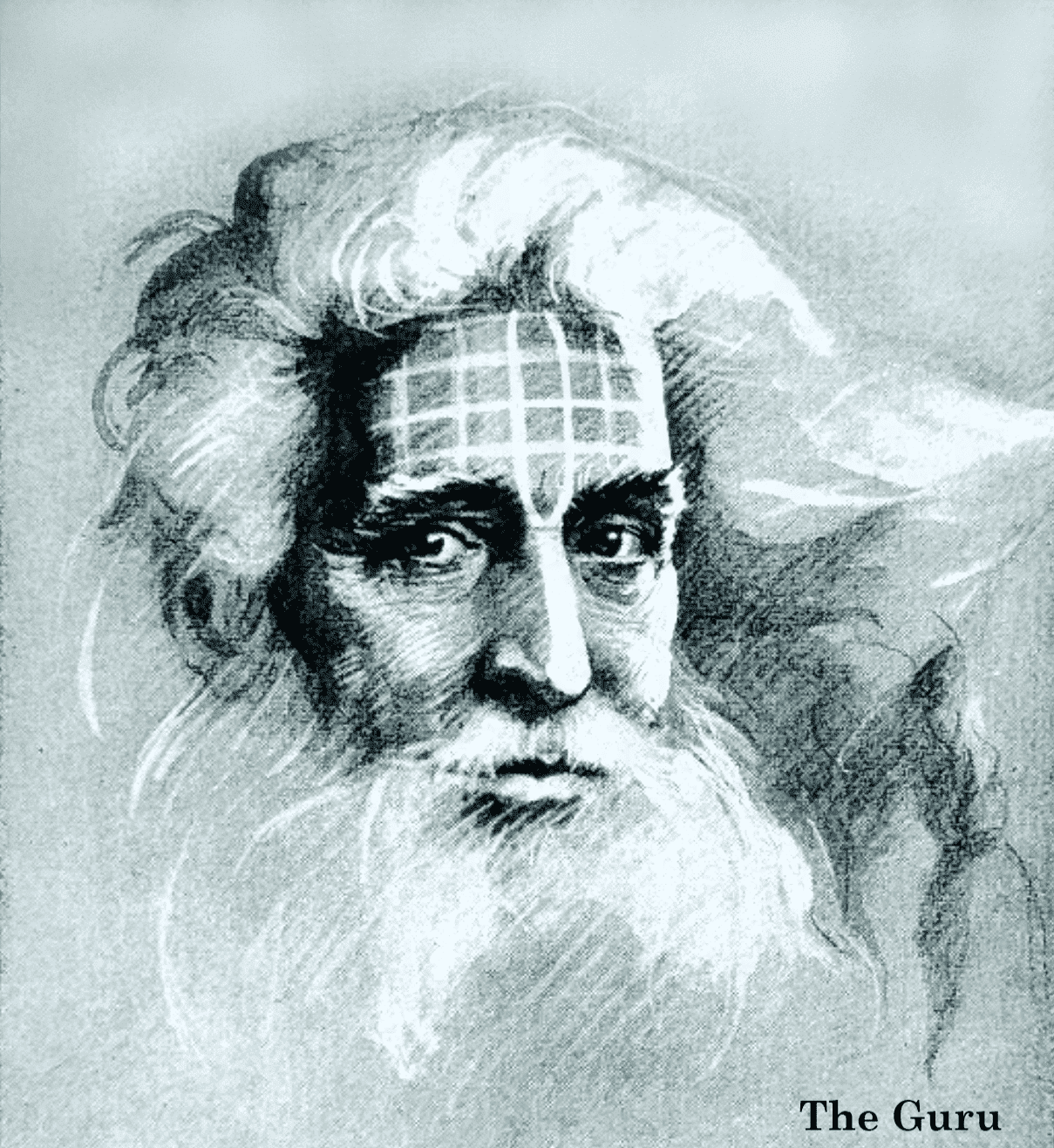
The Jagat Guru was a man tall and thin, his body gaunt from fasting and austerity. He wore only a loin cloth and the sacred twisted cord. His matted beard covered his breast, and his body was caked with gray clay. His long hair was streaked with gray, and hung nearly to the ground, and he seemed of great age; yet the Jagat Guru had walked more than two hundred miles to attend the solemn convocation at Allahabad.
Behind the great Saint, at a respectful distance, were a number of chelas and disciples; some fifty in all, who had made the pilgrimage with their master.
I stood beside my father as the blessed Guru approached, and as he came near, a feeling of intense longing and desire came over me, so that I ran forward and threw myself sobbing into the arms of the great man. The Guru embraced me with extreme tenderness; then he said, "Nadu Charagii, you are my disciple; leave all else and come with me along the old road of the Gods."
So it came to pass that in my thirteenth year I departed from my father's house with only a small bundle in a white cloth, and a brass water lota, and went away with the Jagat Guru to Allahabad.
I have never returned to the village of my birth. My parents are satisfied that the prophecy of my nativity has been fulfilled. I have found the holy life and I am content.
This is the true account of how it came to pass that I met the blessed Guru, and I give thanks to the Lotus Feet of the Great Mother, that in some former life I have merited the privilege of becoming his disciple.
ON the way to Allahabad I walked with the other disciples behind the Guru. We passed through many towns and villages, and everywhere the people gathered to pay homage to the great teacher.
By the time we reached Allahabad many holy men had already assembled there for the Kumbh-mela. Devotees were coming from all parts of India, and many were the famous teachers and venerable Saints who were in the assemblage.
The Guru was known to all of them, and was received with the deepest evidence of respect. By the time of the great ceremonies nearly a million of the religious had gathered about the sacred city. There was no room for them within the walls, but they made temporary camps outside, and they entered Allahabad only for the religious rites.
Many of the ascetics were bound by oaths to the performance of certain penances; others practiced special disciplines of purification and self-control. One who came from the Nilgiri hills, I remember, had taken in his right hand a lump of earth, and in this earth he had planted a small seed which he watered every day; the seed had sprouted and the plant was blossoming in his hand, its roots twisted about his fingers.
An old Swami, from the Dilwara Lakes, had resolved to control his mind by closing his left hand and not opening it again for the duration of his life. It was many years since he had opened his fingers and the fingernails had grown through the back of his hand.
While the Guru did not teach such practices for his own disciples, he respected these evidences of sincerity in others, and saluted all the mendicants with words of esteem and friendship.
The Guru, entering the city, went directly to the Ghats by the Jumna river; and we all followed him in respectful silence. Near the second Ghat the Guru turned, and ascending several steps, fell on his knees before a very ancient man seated under a rattan umbrella. Seeing my amazement, one of the disciples whispered to me, "That is the Lord of Lords, the Sublime Rishi, Azurelama, the beloved master of the Guru; he is ageless; and no man sees him except once in twelve years at the Kumbh-mela. On the day of the ceremony he is always seated here; but none sees him come, and none sees him depart."
Filled with curiosity, I turned to look at the sublime Lord who is master over a thousand Gurus. He was seated on a cushion of yellow silk, and wore a saffron colored robe of coarse wool. About his neck were many strings of large wooden beads. His hair was like the glacial snows on the crest of Himavat; it hung about his shoulders in soft shining waves. His face was dark, but without lines; and his great eyes, soft as those of a doe, looked with benign contemplation upon the bowed form of our Guru. On the forehead of the Lord of Lords was a caste mark of yellow clay, in the form of a grill, and in its midst the Trident of Shiva.
The Lord of Lords sat cross-legged upon his cushion, an old book lay open across his knees; and with one hand he stroked the long silvery threads of his beard.
My Guru spoke: "Exalted Father in God, accept the salutation of your spiritual son."
The Lord Rishi inclined his head. "Welcome, my son, to the convention of the holy men in the sacred days of the Kumbh-mela. My peace be with you and your disciples. Bring the little lad to me whom you have taken on this journey."
The Guru called me, and with great fear and reverence, I climbed the steps of the Ghat on my knees and prostrated myself at the feet of the Lord with the snowy hair. The Rishi extended his hand over me, and his fingers were long and slender, and he seemed to see through his hand.
"Nadu Chatterji," he said, "through the wisdom of the Great Lord of the Conch Shell and the Chakra, you have come among the Brothers of the Holy life. Obey your Guru in all things, and prepare yourself for the service of our Great Mother. In the day when you have fulfilled all, according to the instructions of your Guru, we shall meet again. Mysterious are the ways of the Gods, Nadu Chatterji; for you will be an old man when next you see the shadow of my hand. Om Tat Sat."
The Guru sat for several hours at the feet of the Lord of Lords, and they conversed together concerning the governing of the Brotherhood. At the end, the white haired Rishi embraced my master, and then returned to the quiet contemplation of his book as though none was near.
Later, after the celebration of the Goddess, we passed again by the Second Ghat; but the white haired Rishi was gone; and his cushion and his umbrella were gone likewise.
Thus it was that I was privileged to see the face of one of the Twelve Lords of the Sacred City; and this was the first of the great blessings that came to me when I became a disciple of the Jagat Guru.
IN the summer of my fifteenth year, the Guru, with several of his personal disciples, traveled beyond the Khyber Pass to take part in a celebration in honor of the Goddess Kali. Although I was very young, it was the wish of the Guru that I attend him; and thus it was that I was permitted to see the great ceremony.
It required several weeks to reach the Khyber hills; we walked for many days through deep valleys, and along the sides of rough hills; at last we came to a very ancient shrine on a broad plateau several thousand feet above the valley.
The altar of Kali was of rough stone, square in shape, and about four feet high. In the center of each of the faces of the altar was a huge iron ring. A quarter of a mile from the altar itself, by the side of a little stream, were several rest houses for the shelter of pilgrims. Nearly a hundred venerable and learned holy men were assembled about the rest houses, awaiting the arrival of my Guru, who I learned was to lead the ceremony.
The next morning at dawn, after we had completed our religious devotions, we formed a procession and walked over to the altar. Here the group broke up and formed a circle about a hundred yards in diameter around the central shrine. Several of the disciples advanced, bearing offerings. There were heaps of grain, fruits, and flowers, and small images made of tallow; all these were stacked together on the flat surface of the altar. Then four live goats were brought, and one was fastened to each of the iron rings set in the sides of the altar. When they had finished their appointed tasks the disciples withdrew a short distance to watch the ceremony, and I joined them.
Seated cross-legged on the ground the holy men proceeded to assume certain mudras, or postures of the hands and body. They formed a great ring, each man about twenty feet from the one next to him. They made a strange sight, these mendicants with their long hair and their bodies covered with clay. My Guru sat in the East of the circle and carried a small silver bell by which he regulated the rituals.
In the clear thin air of the mountains, slowly arose the steady chanting of the mantrams. All of the holy men intoned the sacred syllables in unison. At first their voices were like a low murmur, but as the hours passed the sound increased, to echo through the mountains as a strange wild rhythm. The tempo of the chanting became like the steady beating of a great drum.
It seemed as though my heart changed its rate to conform with the chanting. Louder and clearer came the steady measure of the ritual, and every few minutes I could hear above the sound of the chant the thin clear tinkle of the Guru's bell.
The sun had risen clear, like a ball of golden fire in the cloudless sky; but about noon a haze formed, floating in upon the currents of the breeze that twisted in and out among the mountains. Clouds obscured the sun until there was an appearance as of twilight. The clouds grew heavier and blacker, and thunder rolled along the Khyber Pass. Streaks of green lightning cut through the black clouds and seemed to strike the earth about us with terrible concussion. Above the sounds of the elements, and the thunder echoing and re-echoing through deep gorges and along snow-capped peaks, came the relentless rhythm of the chant. The mantrams mingled with the voice of the storm, and all nature, it seemed, was intoning together the strange melody of the dance of Kali.
I am a truthful man, and I shall explain to you exactly what occurred that day among the mountains of the Kanchanjungha.
Near the middle of the afternoon the storm came to its height; the air was green with electricity, and the tumult of the elements reached almost the limit of human endurance. Then, suddenly, a column of vapor formed directly above the altar, reaching up like a great thread of incense smoke to mingle with the storm clouds above. The vapor began to whirl, its density increased until a whirling cone several hundred feet in height swayed back and forth over the altar.
Then, in the midst of the cone, came the Goddess Kali riding on the storm. Her body was blue like the sky, and her hands and feet were red with the blood of sacrifice. Her long hair blew out like clouds of dark light, and her yes flashed like golden suns. She had eight arms and wore a girdle of human hands. She danced in the cone of vapor as though she were dancing upon the prostrate body of the earth. A huge figure, she suddenly reached down with one of her arms. I saw the flash of a great mace swung with irresistible power. With a blinding crash that shattered the mountains, the Goddess had struck the altar with her battle axe. Blue flames shot in every direction. We were blinded with the sudden glare.
Then, as our eyes regained their power, we saw that Kali had gone; the whirling cone had become only a thread of vapor that blew away in the breeze.
The storm clouds parted, and in a few moments the sky was clear; the sun was hanging like a copper globe over the glaciers of the western mountains. The chanting of the holy men slowly subsided.
At nightfall the ritual ceased, and the mendicants rose and in a quiet procession returned to the rest houses to spend their night in prayer.
The Guru came over to me, and taking my hand led me to the foot of the altar. "Behold my son, how the great Goddess has accepted the offerings of her Saints. See, each of the blossoms is withered and dead, the rinds of the fruits are all empty; and of the grain, nothing remains but the chaff."
He picked up a handful of the chaff and tossed it into the air, where it floated like a fine dust. I noticed also that the four goats were dead, and the Guru explained that the Goddess had taken all of the blood from their bodies.
The next afternoon the Guru and his disciples began their return journey. He was very anxious to reach Calcutta, where he wished to make arrangements for my schooling. I have never again attended the sacrifice to Kali, but other disciples who have made the journey in recent years tell me that nothing has changed.
Some day, I thought, I shall take my own disciples up into the Khyber country. But the Guru said that my life led in another direction.
And whatever he wills is my law and my joy.
THE Guru had about 60,000 disciples. Most of these lived in various parts of India, but a few had residence in Europe and America. Of this group less than 400 had ever seen the Guru. The master had about 100 advanced disciples, and it was these who directed the lives of the many lesser disciples and chelas. And it was in this manner that the Guru kept in touch with the great body of his followers.
Many disciples who had never seen their teacher knew his voice, having received his instructions in their meditation. The Guru had an hour set apart each day when he received the thought impulses of his students, and answered their questions through the subtle currents of the mind. During these periods of inward communion, the Guru could not be disturbed, and it was the duty of the disciples attending him to see that no one approached or spoke to him until he himself gave the sign that he had finished his work.
Among the disciples of the Guru was a Dutch merchant, who lived in Bombay. He was a good man, and the Guru had great hopes that this Hollander would go far in his mastery of the secrets of nature. Therefore, the Guru would frequently turn his thoughts to the Dutch merchant, and sometimes would discuss with us the spiritual progress of this favorite pupil.
The Guru would say, "My spiritual son in Bombay had a good meditation today." Or, on another occasion, he would observe, "My spiritual son in Bombay today is annoyed by that man from the bank. It is not good that business should interfere with the growth of the soul."
Mynheer Van Stuiten was married and had two small daughters. The Guru would nod his head with approval, remarking, "It is very good, my son in Bombay spent the afternoon playing with his two little girls. He is a good householder, which is according to the Vedas. A man who is born must pay his debt to nature. A good father is a good disciple."
One afternoon the Guru went with several of us for a short excursion into the hills. His eldest disciple, who lived with us, was devoted to botany and herbs, and when occasion permitted the Guru would accompany him and explain the mysteries of plant life.
We had been gone from the Ashram about an hour, and already had accumulated a number of plants for further study, when the Guru stopped short on the path and looked up toward the sun. Naturally, we all looked also, and after a few seconds we saw a small white object dropping from the sky. It fluttered about, moved by a light breeze, falling ever closer to the Guru. At last he held out his hand and we saw the object was a piece of folded paper which like a tiny bird came to rest on his fingers. The Guru opened it, and turning to us said, "This is a message from my son in Bombay. He is in great need; I shall go to him."
The older disciples understood immediately and prepared the Guru for the journey. They looked about and found a secluded place under the branches of a large tree. The Guru seated himself on a hastily constructed cushion of leaves and small branches. Then Banu, a good man who always attended the master, handed the Guru his forked stick.
This stick was a beautifully carved elbow rest of teak, about eighteen inches in length, its upper end forked to support the Guru's elbow while he was seated on the ground. Sitting comfortably with one hand across his knee and the other arm supported by the stick, the Guru closed his eyes and began intoning a mantram. Four of the disciples had seated themselves near the master, and the rest took up their places at a greater distance to prevent interruption.
Slowly the head of the Guru sank upon the arm that was held by the stick, and he seemed to be asleep. For the rest of this story I shall report what was afterward told to me by Mynheer Van Stuiten...
The Dutch merchant had sent his two children and his wife to a summer resort in the mountains to escape the heat of the Indian summer. Without warning, the cholera had broken out in the small village where the family was vacationing, and the youngest daughter, about six years of age, had been stricken. Mynheer Van Stuiten had hurried to them, bringing the best doctor in Bombay; but the child was sinking rapidly and its death was only a matter of hours. In his despair the father had written the little note to the Guru, and performing certain mystic rites had burned the paper and blown the ashes into the air. In some strange way these ashes had been brought to the Guru and had fallen into his hands in the form of the note, entirely unburned.
In the house where the little girl lay sick, the father and mother, the doctor, and the family nurse, sat about the bed watching the course of the dread disease. Suddenly, the curtains that divided the room from another apartment, were pulled aside and the Guru quietly entered.
Van Stuiten had never seen his teacher, but instantly he knew that it was the Guru. The good wife, Mevrouw Van Stuiten, the doctor, and the nurse saw nothing, and could not understand the sudden agitation that came over the father, who fell on his knees, sobbing, with his head against the side of the bed. The Guru walked over to the sick child, and reaching out his hand, touched the fevered face of the delirious little girl. She opened her eyes and saw the Guru, and although his appearance was somewhat wild and strange, she was not afraid, but saw only the beauty in his eyes.
The Guru spoke to her, "You have been asleep, little Sita, but now you are awake; it is time that you went out to play with your sister, who is lonely for you. Come let us go together."
All that the doctor saw was that the little girl reached out her hand as though to take hold of someone, rose quietly from her bed, and ran through the door into the garden. A few minutes later she could be heard laughing and playing with her sister...
After about twenty minutes the Guru raised his head from his arm, and spoke to the disciples who were about him. "My Dutch son is happy now; his little girl is playing with her sister, and we can continue our discussion of the medicinal value of these herbs."
ONE morning the Guru asked me to come to his room at the Ashram to discuss the problem of my future. The master was seated against the wall on a large piece of white cloth; he motioned me to sit near him.
"You are but a boy," the Guru began, "and, my son, it is necessary that your education be given every consideration. What profession or trade have you selected for your career?"
I answered instantly. "Blessed teacher, I desire only the holy life; to be near you; to serve you; to obey you. I have no other ambition."
The Guru smoked his hookah through several moments of silence, and then continued: "There are great changes coming in the world, and young men must prepare themselves for their proper place in the new way of life that is coming to India. There will always be holy men, because theirs is the way of the Gods. But these new saints must be wise in the learning of the white races. It is only in this way that they can serve the Great Mother."
"I will do anything that you say," I replied. "You are the master of my body and my life. The virtue of a disciple is in obedience."
The Guru nodded with understanding. "I shall send you to school, and then to the University, so that you shall have every advantage of education and knowledge. I shall select for you the honorable profession of medicine. Nadu Chatterji, you will become a doctor. In this way you shall pass your discipleship, serving the sick and bringing health to our people. We shall go immediately to Calcutta where I will enroll you in the best school."
There was great heaviness in my heart as I asked, "Does that mean, beloved father, that I shall be separated from you?"
"Yes, for a time, but in the summer you can come to me; and I will be in Calcutta on numerous occasions. The beginning of wisdom, my son, is self-discipline. You become great by obeying."
I reached over and reverently touched the foot of my Guru, and he laid his hand upon mine. There was a sob in my voice when I replied, "I will obey; for to me your word is the word of the Gods."
Thus it came about that a few days later we went to Calcutta on an English train; and the Guru took me to the school of a celebrated mowlana. This scholar was a Mohammedan gentleman of profound mind and deep understanding.
The mowlana received us in a study furnished according to the European manner. He was a short, stout gentleman, wearing striped trousers and a morning coat. Except for the darkness of his skin and his tightly wound turban, he might have been an English gentleman. My Guru wore his yellow silk cloth and his beads, and carried his iron-bound staff, and he led me in by the hand.
"Most esteemed friend, Mowlana Abu-Bakar, this is my son in God, Nadu Chatterji. I place him in your care, so that you may prepare him for the University. You will teach him all useful arts, both of the East and of the West; and I desire especially that he shall have four languages in addition to his native tongue. These are to be English, German, Greek, and Latin."
The Mowlana Abu-Bakar rubbed his hands together slowly and inclined his head. "It shall be as you say, Most Esteemed and Venerated One."
The Guru then concluded; "He is to be a doctor; train him in all matters useful to the art of healing. Keep him in your house, regard him as your son, and instruct him in your faith; for he must learn that all God is one. I will visit him upon occasion. Give him everything that is necessary to his comfort, be strict but kind; and send the bill to me."
The Guru rose and embraced me, and placed my hand in that of the mowlana. Abu-Bakar touched his forehead and bowed to the Guru. "The peace of Allah shall abide between us, and I will be a father to the boy."
In this way my education began, and I lived in the house of Abu-Bakar for three and a half years.
IT was during my second year in the school of Abu-Bakar that I spent my vacation with the Guru in a lonely Ashram near Simla, in the Himalayan mountains. He had only three disciples with him on this occasion, because he had resolved to perform a long fast and discipline. He required a period of purification because it had been necessary for him to spend several months in Agra, and the vibrations of the city had been difficult.
I had been with the Guru about three weeks when he said to me, "My son, these are the old mountains where the Gods dwelt in ancient times. These are places of prayer and meditation, and it is time for you to go out and perform your first vigil. About a hundred miles to the north there is an old monastery of the Redhat Lamas, and a few miles beyond is an Ashram that is reserved for my disciples. There you will go alone, and remain for one month, devoting your time to listening for the voice of our Great Mother, who speaks to us in these sacred hills."
The next morning, carrying only my water lota and a few necessary possessions wrapped in a white cloth, I walked alone down a little path that led through the mountains to the monastery of the Redhat.
It was the first time I had ever been entirely alone in a strange wild forest, and at first I was afraid. At night there were many strange sounds, and I knew that wild animals were all about me. It required nearly ten days to reach the Ashram, and although it seemed many times that I had lost my way, I arrived safely at the little one-room white mud house, which was the resting place for the Guru's disciples. I put new straw on the floor, and then gave myself up to contemplation. There was fresh water nearby and I lived on fruit and berries which I found in the forest.
A month passed very quickly, for I became less and less aware of time. Many days I spent listening to the soft voice that seemed to speak to me from the earth, and the air, and the nearby stream.
And I was happy and content, for I knew these were the voices of our old Mother of the Mountains.
A few days before the time of my departure, I went out one morning and walked along a narrow path lined with low dense foliage. I had proceeded only a few hundred yards when suddenly, and without warning, I was struck a severe blow on the back of my shoulders. The blow was very painful, and knocked me bruised and astonished into the shrubbery by the side of the path.
Looking up, dazed and a little hurt, I saw the Guru standing on the path. With his iron-bound staff held in one hand he had struck the blow. As I looked into the face of the great man, he pointed with his finger to the path; and I saw coiled in the middle an adder with its forked tongue flashing in and out of its mouth like red light.
The Guru spoke. "Had you put your foot down, Nadu, it would have bitten you to death."
The Guru turned then, and taking a few steps disappeared around a bend in the path. I jumped to my feet and ran after him, but when I reached the turn in the road there was no one there.
Later, from one of the disciples, I learned that at the moment I had seen him, the Guru was a hundred miles away at Simla, engaged in earnest conversation.
The Rajah of Putteshawar had called upon the Guru to ask about the conduct of the State. The Guru had received the Rajah, although it had forced him to break his seclusion. When they had been talking for some time, the Guru suddenly said, "Your Highness, at this moment my son in God is about to place his foot upon the head of an adder; I must go to him." The Guru remained silent for several minutes, and the Rajah was discreetly quiet. Then my master spoke again to the Rajah. "The danger is passed, and we can continue our discussion."
Thus, it appears that the blessed Guru knew all things that took place in the world, and was ever mindful of the needs of his children; and I give thanks, that in his gracious kindliness he has extended his love to me, who am the least worthy of his chelas.
WHEN the Mowlana Abu-Bakar informed the Guru that I was ready to take the entrance examination for the University, my master came immediately to Calcutta to arrange for my matriculation.
For the first time in my life I put on a suit of English clothes, which the mowlana had ordered for me from his own tailor. I was uncomfortable but quite pleased with my appearance. The Guru arrived with two disciples, and Mowlana Abu-Bakar showed him my scholastic record, which was quite creditable.
In the afternoon, the Guru went with me to the great buildings of the University, which had stone pillars like those of a Greek temple. We climbed the broad flight of steps and entered a long passageway lined on either side with portraits and busts of illustrious scholars and scientists. It was very impressive. We came at last to a large door and were ushered into the study of Sir Doctor Deems-Browne. He was a fine scholarly looking gentleman with a very English face and short cropped gray hair. Above his desk was a full length oil portrait of Queen Victoria, in her robes as Empress of India.
The Guru turned to me. "Nadu Chatterji, this is my esteemed friend, Sir Edward Deems-Browne, a very wise man in the wisdom of the West, and a famous surgeon. He is your new father in learning."
The Englishman rose from his chair and approaching the Guru made a stiff little bow, as though not accustomed to bowing to other men. "Sri Purascharanacharya, you are my friend of many years; I will do all I can for the young man, you can depend upon it."
I watched the English doctor's eyes, which were light and very blue, and I saw a great love in them as he looked into the face of my Guru. I realized then that Sir Deems-Browne was a friend of India, and understood the soul of our people. I was therefore content; I could trust this kindly man to lead me in the way of knowledge.
The Jagat Guru discussed his plans for me with the Sir Doctor. It was arranged that I should live in the house of a wealthy gentleman belonging to the sect of the Jains. This man had endowed a house for young students and only those of serious mind were permitted to live there.
My courses of study were laid out, and it was decided that I should specialize in general surgery and tropical diseases. The course was five and a half but the Sir Doctor was of the opinion years, that I could complete it in less time, because of the excellent tutoring I had received from the Mowlana Abu-Bakar.
The University term began in a week, and in the meantime I lived at the Ashram of the Guru, near the temple of Shiva in Calcutta.
The Guru received many visitors, for his coming to Calcutta was an occasion of importance to his numerous disciples who lived in the area. Each come to pay his respects, and many brought offerings of fruit, flowers, and small religious pictures.
The Guru arose from his cushion every morning at five. He would then bathe, and on several occasions it was my privilege to assist him with his morning bath. The next two hours were reserved for his devotions.
After these rites the Guru had breakfast of rice and tea, and then about seven-thirty he seated himself on the large white cloth and received visitors. Those who came were of all classes and races, and there was always a long row of shoes and slippers outside the entrance of the Ashram. All who entered removed their footwear in respect for our saintly master, and on entering into his presence seated themselves cross-legged on one corner of the white sheet.
The Guru spoke to each in his own language, and most of the interviews lasted only a few moments. At one o'clock the Guru took his second meal, usually of fruit, and then rested for an hour. At two-thirty he gave instructions to his disciples, and at four received visitors again. At seven he had his evening meal of rice with saffron and fruits cooked in it. About sundown he would walk with a few of his disciples, sometimes making a short pilgrimage to some nearby shrine. In the evenings the Guru was usually of a humorous turn of mind, and sometimes he would tell stories of his boyhood, and too, of the great people who had come to him that day for instruction. It was always a blessed occasion to be with the Guru in the evening.
At ten o'clock he retired to meditation, and we did not see him again until morning. This was his day when in the city, and I was privileged to have four evenings with him on this occasion, for which I give thanks to the Blessed Mother.
THE Guru spent several weeks in Calcutta during the summer of my third year at the University. I saw him at once, for he was desirous of learning the effects of my scientific training on my religious life and convictions.
I reported faithfully upon the progress I had made in my studies, assuring the Guru that I always performed my devotion upon rising and prayed to the Great Mother that she would give to me the understanding of those things which I was learning. At the beginning of each class I invoked the blessing of the Supreme One upon my professor, and my classmates.
The Guru listened gravely and nodded his approval. "It is good, Nadu, my son in God; for all knowledge is the gift of the spirit; and only to those who are grateful in the spirit will knowledge unfold itself like the petals of the lotus. From your Western teachers, Nadu, you will learn of art and sciences; but from your Eastern masters, you must discover the inner mystery of wisdom. You are not educated when merely you are well schooled. You are truly educated only when you are enlightened by inner truth. For inner truth takes dead facts and makes them live; and inspires the heart to the use of knowledge for the service of others."
I knew this in my heart, and was very silent; and in my stillness I could feel the thought of my master singing in my mind like the ancient hymns of the Vedas.
Suddenly in my reverie, the master spoke again. "Look, Nadu!" As I looked at the Guru I saw that he was holding something in his hands. He spread his fingers a little and I saw a small red squirrel peering out from between the Guru's fingers. The squirrel was entirely without fear, and running out between the open hands of the Saint it played about his arms, hid itself in his long hair, and finally perched on his shoulder with its small face against the side of his beard.
The Guru stroked the little animal saying, "And now Nadu, my son, I will show you a mystery. In your University you have studied this little animal, is that not so?"
"Yes, beloved master, I have learned all that the English books can tell me. Would you like me to describe the parts of the squirrel and all that is known about it."
"No, my son, I will ask you but one question. Why is the squirrel?"
I was silent, for I knew that I could not answer; and the Guru continued: "Knowledge, my son, is to know the names of all the members and structure of this little squirrel; but wisdom is to discover the life of this little animal, in the midst of all its parts and members. For this reason, Nadu, you must come back in the end to the Masters of the White Mountains. For only through the ancient arts that were taught to the first Saints, can you come to know the little heart that flutters in a tiny red squirrel. All the great and the learned are without this knowledge until they go out into the mountains and learn from the voice of the Mother."
Had I, before this, been inclined to accept the white man's way of learning, the words of my master would forever have dispelled the illusion.
The Guru continued, "Watch me, Nadu, and watch the little red squirrel."
The Guru reached to his shoulder and gently picked up the little animal, stroking its back and its long fluffy tail. Then, holding the squirrel between his hands, he breathed upon it, and whispered several words in the ancient language of the Senzar, which I could not understand.
Suddenly, the squirrel changed before my eyes into a small brown bird with a red breast and a yellow beak. The bird fluttered for an instant and then perched on the Guru's finger, singing a soft clear song.
The master looked at me. "Does this seem a miracle, Nadu, that I have changed a red squirrel to a small brown bird? It is no miracle; it is because I whispered words of power, and a little whirling wheel in the heart of the squirrel whirled more rapidly; and by this very whirling the squirrel was changed into a bird. This, my son, is the secret of breath and of Yoga. It is the same when you go to school; your learning shall be like the squirrel; but by the secret of breath and Yoga you shall give wings to your learning, and then the things you have gathered out of books shall become alive and shall sing the song of Our Mother."
I remained for five years in the University and received my diploma and became a physician, according to the will of the Blessed Guru. Though I learned much that was to be of service to my people from the white man's school, I learned most from my Guru, on that day when he made a little brown bird out of a red squirrel.
THE Guru had received the use of a considerable grant of land from one of the Maharajas. The estate was in the mountains near Darjeeling, in the foothills of the Kanchanjungha. There was an old temple on the property and part of a ruined cloister. In the shade of a broken arch the Guru held classes, and many students came to receive instruction. There were some not belonging to his school who attended lectures on various occasions.
One afternoon, Chuni Sen, one of the younger chelas, approached the Guru with considerable excitement in his manner. He had shortly returned from a nearby village where he had learned of an unusual impending event. "Blessed teacher," exclaimed Chuni Sen, "I have just learned that His Royal Highness, the Maharaja of Indopur has sent his son, Prince Nahib, to attend your lectures for the summer. His Highness is arriving by carriage this afternoon."
The Guru smiled and inclined his ear. "Yes, Chuni Sen, Prince Nahib is on his way to join our assembly; but do not permit the occasion to agitate your mind with too many hopes. I suspect that His Highness is a poor scholar."
About five o'clock we heard sounds in the valley of approaching carriages and a cloud of dust could be seen rising from the dirt road. The older disciples studiously ignored the approach of the royal guest, but Chuni Sen and several of the younger chelas were visibly impressed and watched the face of the Guru with discreet side glances.
Our teacher had moved out from the shadow of the broken arch, so that he could enjoy the last warmth of the late sun. A villager had brought him some confections in a clay bowl, and the Guru was eating these slowly with a carved wooden spoon. He seemed entirely unconcerned at the prospect of a Royal student.
The ruined temple was a short distance from a road partly hidden with a growth of young cedars, and among these trees the carriages stopped. The Guru motioned to me. "Nadu, my son, receive our guests and make them welcome." So I rose and went down to the road, while the young chelas seated to one side eyed me curiously.
The first carriage was very large and beautiful, and on the doors were the crests of the princes of Indopur. The carriage was driven by a bearded coachman in livery, and inside sat a young man faultlessly attired in European clothes. In the second carriage, which was less pretentious, was another man, evidently the Prince's gentleman, surrounded by a great deal of luggage. There was also a large wagon loaded with heavy boxes, bags, and packages. These were under the care of two servants.
The coachman opened the door, and the Prince then stood and descended from the carriage with great dignity, carrying a slender black cane. I advanced and bowed deeply. "In the name of the blessed Guru, Sri Ramachandra Arjunananda Purascharanacharya, I welcome you, Prince Nahib of Indopur, to the Ashram of Kailasvastu. I am Nadu Chatterji, a humble disciple of the Guru."
Prince Nahib acknowledged my greetings with a haughty inclination of his head; then stood beside the carriage looking about him. Finally selecting an open space on a small rise above the road, he pointed with his cane, saying to his valet, "Put my camp there." Then turning his back to me, he went forthwith over to the knoll and watched while his servants brought his luggage and equipment.
As my presence was no longer required, I returned to the Guru, and found him covering his bowl of sweetmeats with several green leaves to keep the contents cool. The Guru was chuckling slyly to himself, and his eyes were sparkling with good humor.
He called over to the young chelas, whose faces were alight with excitement, "You may go, my sons, and learn how the young Raj sets up his tent."
The boys hastened away, and seeking vantage points, squatted on their heels, while the servants of His Highness assembled a large tent of red and white bunting, which was divided into several rooms. These were elegantly outfitted with collapsible furniture, and the ground was strewn with thick rugs. Chuni Sen's teeth gleamed in the evening light as he watched the valet putting together a large collapsible bathtub, and he whispered to another Chela, "The young Prince intends to be comfortable. It is our Guru who deserves these luxuries"
Prince Nahib had his dinner from solid silver plates, served with all formality in the open doorway of his canvas palace. But that evening it was my privilege to bathe the Guru from a wooden bucket.
All the next day Prince Nahib sat in a large chair, waiting to be called into the presence of my master. The next day he waited also; and by the second evening was visibly annoyed. About the middle of the third morning his gentleman approached the Guru to inquire concerning an appointment. My teacher was very grave and most dignified, but his eyes were shining with humor as he informed the valet that he would give the matter consideration, and to return in the afternoon.
Just before dusk the valet came back and remained for some time with the Guru. I was seated near the door when I heard the tinkling sound of my master's bell. I immediately entered and sat quietly on the floor. The Guru turned to me.
"My son in God, this is Rama Datta, a good man descended from the race of the Sun. I have accepted him as my disciple. He will remain with us as one of the Brotherhood."
It was my privilege to carry these tidings to Prince Nahib, and I selected two of the young Chelas to accompany me on this important mission. His Highness received us civilly, but with no spirit, and inquired why his servant had not returned.
After the formality of greeting I spoke thus: "Your Highness, I bring you the greetings of the Guru; he knows you will be overjoyed to learn that he has this hour accepted your valet into the Brotherhood, conferring upon him the extraordinary merit of becoming his disciple. My Guru also wishes me to convey to you his gratitude for having brought to him this admirable man."
It is not seemly that I should describe the effect of my words upon the young Raja. Suffice it to say, he ordered his camp immediately dismantled; and the two chelas who were with me assisted in packing his belongings. An hour later the Prince of Indopur departed in his shining carriage.
I have learned that when H. R. H. the Maharaja learned of what had occurred he was disposed to transfer the succession to a younger son.
It was in this way that Rama Datta, the Rajput, became a disciple of the blessed Guru. He remained with the master for eighteen years, and then established an Ashram in London. He was a good man.
OCCASIONALLY the Guru would mention his English disciple, and every so often he would receive from her a bulky letter filled with questions. The Guru would then carefully remove an old fashioned pair of gold rimmed spectacles from their black metal case, and spend several hours carefully reading the letter. He would then dictate the answer to one of us who could write English. The Guru took a great interest in this English lady, and told me one day that she had been his student for more than fifteen years.
Finally, in one of the letters came the word that this Miss Hardwick, who taught in a school for young ladies of genteel families, was going to spend her summer vacation in India, in order that she might meet the Guru. She had been saving from her modest salary for years in order to make the trip possible.
The master was in his retreat near Darjeeling when word came to him that Miss Hardwick was registered at the Royal Hotel in Calcutta. The Guru sent one of his older disciples, Chundra Bose, to meet her and guide her to the Ashram.
In deference to English tradition, the Guru then sent to Delhi and requested the presence of the two maiden sisters of the Advocate General, who had been his disciples for many years. These two Hindu ladies came promptly, and were entrusted with the task of preparing the best room in the Ashram for the foreign guest.
Everything was therefore in admirable order when Chundra Bose arrived driving the ox team and small wagon. In the back of the wagon Miss Hardwick sat on her suit cases, a green parasol over her head.
Miss Madeline Hardwick was a tall and angular woman with short bobbed gray hair and a firm aggressive chin. She wore a tailored suit of gray tweed and substantial low heeled walking shoes.
The Guru received Miss Hardwick in his favorite seat in the shadow of the ruined arch. It was easy to see that the English lady, very nervous, held the great sage in profound veneration. The Guru was in a gracious mood and did all that he could do to set the foreign visitor at ease. After a few words of greeting, the master rang his little bell and the two Indian ladies came forward to install the English lady in the room prepared.
Miss Hardwick remained at the Ashram for three weeks, and took a lively interest in everything that we did. She had a sketching block with her and made numerous drawings, which she intended to develop into water color paintings when she returned home.
One day the Guru called to me, "Nadu, my son in God, what is the English lady doing this afternoon?"
"She is out near the ruined tank, making a sketch of the old cloister, most venerable teacher," I replied; "and she has the green umbrella with her."
The Guru nodded his head slowly. "She is very sincere and very eager; but, alas, these English people; it is hard for them to fit their mind for the contemplative life. Miss Hardwick is never still; she is so busily engaged trying to learn, that she has no time left for learning."
"Perhaps, Master," I suggested, "because I have studied in the English schools I can help her to understand the devotional life."
The Guru stroked his beard reflectively, and then looked up with a smile. "Yes, Nadu, you shall become the Guru of the English lady. Perhaps you will go now and give her the first lesson."
I found Miss Hardwick seated on a rock, her sketch block on her knees, drawing with one hand and holding her umbrella with the other. I sat quietly and watched the drawing. When she had finished the sketch she asked me for my opinion. I replied, "It is very pretty, Memsahib, but why have you made so many little lines, where one thin stroke would have sufficed? Among our people, we draw the picture first in our mind; and then with a few direct strokes transfer the thought to the paper."
Miss Hardwick looked at me steadily: and then asked slowly, "What are you trying to tell me, Dr. Chatterji?"
Seeing that she was not offended, I continued: "You make many little lines, Miss Hardwick, because you do not know where the right line ought to be. You have not the courage to trust all to a single mark of the pencil. Is that not so?"
Miss Hardwick thought for a moment, and then laying down her pencil she agreed with me. "Yes, what you say is true. I have not the courage or the skill to draw a picture with a few bold strokes of my pencil."
Suddenly I seemed to feel the Guru standing behind me; I turned my head; but he was not there. His voice however did whisper into my ear, "Go on, my son, tell her now; for she thinks as she draws-with many short and uncertain lines."
Encouraged by the conviction that the Guru approved, I explained as simply as I could the secret of our philosophy. "Memsahib Hardwick, the Guru desires that your years of faithful discipleship should be crowned by the achievement of the Samadhi. While you have been with us you have searched for Truth as you have drawn this picture, with hundreds of little uncertain motions of your mind. Never have you been still; never have you found the single simple line which is the evidence of the great artist. Do not be afraid. Do not grope with your thoughts for that which is beyond the power of thought. Cultivate the simplicity of silence."
That evening Miss Hardwick asked if she might see the Guru. He admitted her immediately and listened to her request. "Most venerable teacher," began the English woman, "how can I achieve the realization and come to the complete detachment that is here among these holy people?"
The Guru reached to a small dish and picked up a water lily that Chuni Sen had given him an hour before. He handed it to Miss Hardwick, the stem still dripping. "My daughter, take this to your room and meditate upon it; and when you have discovered its meaning return and tell me."
According to the two Hindu ladies from Delhi, Miss Hardwick did not leave her room for five days; and then with the dead and wilted flower in her hand she returned to the Guru. We all noticed how pale and quiet she was and we knew that she had not slept.
The Guru listened attentively when Miss Hardwick told her story. "The first evening I became more and more aware of the beauty of this flower. The second day I grew to understand the wonderful way in which it is made. The third day I found myself likening all life to this flower; and the fourth day I experienced this flower in my own heart. But on the fifth day I was aware no longer of life or of the flower, nor of myself. A great stillness came upon me; and as I looked at the wilted flower floating in the water, I could neither think, nor wonder, nor feel. It seemed as though time ceased, and all that remained was a strange impersonal pain that was very beautiful. I cannot describe it further, great teacher."
The Guru looked down at his hands which lay open on his lap. "You have done well, Miss Hardwick; now I think you can draw your pictures with a single courageous line."
The next day Miss Hardwick left for Calcutta, sitting on her suitcases and holding her green sun shade. The Guru received no more letters from her.
We asked him once why she had stopped writing. He smiled and replied, "It is no longer necessary to write letters when the heart can speak to the heart."
A YOUNG pundit, by the name Bishma Ray, A taught a grammar school in the village a few miles from our Ashram. Sometimes on Saturday afternoon he would bring a number of his pupils to our retreat, because the Guru liked to hear them recite their lessons. Our master would sit in the shadow of the broken arch, and the boys, who were from 10 to 14 years of age, would stand in his presence and answer various questions about history, geography, and mathematics.
One Saturday Pundit Ray brought with him a large map on rolled oil cloth; this was hung on the low wall beside the arch, and the fifth grade pupils pointed out, when requested, the locations of various cities and countries. This particularly pleased our Guru, who smiled and nodded his head each time one of the boys placed his forefinger on the correct spot on the map.
It was like a game. One of the smaller boys who wore a striped calico shirt was especially quick in answering the questions. "And where my son," smiled the Guru, "is Chicago?" I remember how the little chap jumped to his feet, bowed to the Guru and his teacher, and running to the map pressed his little thumb on the proper spot. The Guru beamed, "Very good, very good indeed; and because you are so accurate I think you had better run down the road about half a mile and meet the American gentlemen from Chicago, who has become lost trying to find the Ashram."
The little fellow ran off as rapidly as his short fat legs would carry him; and because the Guru was so evidently happy the other boys felt that it was permissible for them to smile also.
Our Guru then discussed the American gentleman with Pundit Ray. "He is coming to us with a letter of introduction from the Editor of the Calcutta Forward. A very good newspaper; I read it sometimes when I have the leisure. This American is in his country called a journalist, and he will be very interesting."
The Guru turned to the several small boys. "Now, my little sons, you must not make fun of our journalist friend; nor must you play any tricks on him, because he thinks himself to be a very important person." Immediately all trace of smiles disappeared from ten little faces, and the boys sat quietly, like a row of ancient yogins, while their teacher Pundit Ray nodded his approval.
Our Guru then turned to me, saying, "Nadu, my son, bring me my comb and my good yellow cloth; I must look my best for I am going to have my picture taken."
I hastened to bring the master the things he had asked for, but all of us were quite amazed and disturbed; the Guru never permitted himself to be photographed.
The master graciously permitted me to comb and braid his hair, and I was just finishing the several long braids when the American journalist reached the narrow path that led up to the Ashram. Little Babu, with his striped calico shirt, was walking solemnly ahead, carrying the American's hat in front of him with both hands as though it were the crown of the Empire. The Guru looked over the top of his gold rimmed spectacles, but his expression did not change.
The American gentleman carried a small traveling bag in one hand and a portable typewriter in the other. Around his neck were several straps from which hung cameras and other small cases. He was short and stout, with very little hair, and his face was tanned as though he spent much time out of doors. His eyes were sharp, and with a quick look about him he advanced directly toward the Guru. About ten feet from our Master he stopped, and setting down his bags, reached one hand to the inner pocket of his coat to get his letter of introduction.
It was then that the Guru spoke. "Greetings to the Ashram of Kailasvastu, Mr. Miller; and do not concern yourself looking for the letter of introduction; you left it in your dresser drawer in Calcutta. The letter was from my dear friend, Subrahmanya Das, of the Calcutta Forward, and it asks of me to give you what assistance I can in the matter of a book which you are writing about holy men of India. I trust that we can make you comfortable in our humble surroundings."
He turned to the small boy still holding the hat. "Babu, my son, show Mr. Miller Chicago on the map. Very good; now this one is more difficult; can you find Pittsburgh? See, Mr. Miller; Babu has just put his finger on your birthplace."
Mr. Miller was openly bewildered. The Guru told me afterward that it was always necessary to bewilder American journalists, who are a very peculiar kind of people. In a little while, however, Mr. Miller was entirely at home. We gave him the best room, and I introduced him to the various disciples and Pundit Ray.
I had noticed that the American journalist kept looking rather anxiously at the afternoon sun, and it came to my mind that he wished to photoghaph the Guru the first afternoon. As the master had previously given his consent, I assisted in setting up a tripod and arranging the camera. The Guru had me bring out two sacred relics and a small painting of Krishna, and these were placed on the ground by the master's side while the photographs were being taken.
Mr. Miller was very efficient, and the Guru most gracious; but when the films were developed in Calcutta later, only the relics were visible, the rest of the plates being entirely blank.
The Guru later observed to me that it would not have been polite to argue with the American journalist; so he took care of the matter in his own way.
MR. Miller remained at the Ashram for ten days, and during that time he asked all of us a great many questions. We tried our best to answer them, but the American journalist had little understanding of the deeper side of our beliefs. He attended several classes which the Guru gave in the afternoons, and in deference to him our master spoke part of the time in English. Mr. Miller wrote a great deal on his typewriter, and he read me some of his manuscript. He used very nice words, and was most respectful of the Guru; but I doubt if the Americans who read his book will gain more than a very incomplete idea of our philosophy.
It was on the third day of his visit that Mr. Miller had the idea to write a special article in the form of an interview with the blessed Guru.
The arrangements were left to me, so I went immediately to the master for his consent. The Guru agreed, and set the time for the following Friday in the late afternoon. I was told that an interview is a very important matter with American journalists, because when published in some paper or periodical millions of people read it.
On Friday, Mr. Miller sharpened many pencils and set up a small table so that he could take every word in shorthand, the form of abbreviated language writing extensively used by American journalists. The Guru had gone in the morning to the house of a local farmer whose child had received a vision from the Goddess Durga. Several disciples had accompanied him, but I remained with Mr. Miller to supply him with any inquired for information concerning the life of the Guru.
The interview began at three o'clock. Because of the importance of the occasion most of the disciples and some of the chelas were permitted to be present. A special invitation was sent to Pundit Bishma Ray, who was most anxious to attend. A learned Buddhist scholar came in from the hills, and the Brahman priest of the nearby village temple brought his uncle, who was blind but very well informed. The history class from the local school wanted to come, but it was feared that so many children might prove distracting. Mr. Miller graciously agreed to permit Pundit Ray to read a transcript of the entire interview at a special assembly of the entire school.
Promptly at three o'clock the Guru took his place on his favorite cushion, and after a brief prayer to the Great Mother announced that he was ready to be interviewed.
Mr. Miller began by inquiring as to the Guru's attitude on Anglo-Indian politics, which the master graciously refused to discuss. Mr. Miller was discreet enough not to press the matter. He turned the conversation to Einstein's theory of relativity.
The Guru explained that the term "relative" should be applied to all that is knowable by the intellect; and the term "absolute" to the Universal Reality which is discoverable only by internal realization. The discussion became very learned, and I noticed that the American journalist had some difficulty writing down in his strange characters the Guru's observations on the inclination of the plane of the continuum.
Mr. Miller next inquired as to the Guru's reaction to the achievements of Western science in general. It was then that our beloved teacher spoke thus: "The sciences of the West, my son, have accomplished much that is great and good; but they have limited themselves within the narrow confines of the material world. We have great scientists in the East also; they have no laboratories and no scientific equipment, but by the discipline of our ancient religion and philosophy they have made of their own bodies and their own minds the most perfect of all scientific instruments. These great Yogins have explored the distances of time and space and have come to understand causes, while your Western thinkers have been studying only effects."
Mr. Miller pressed the subject. "Would you advise then, that Eastern and Western scientists unite their efforts and share their knowledge?"
The Guru nodded his head. "I would recommend, Mr. Miller, that you select from your great universities and scientific institutions five of your greatest physicists. Men not only learned of mind, but liberal of mind, who have discovered enough to realize that they must discover more. Send these men to India, the cradle land of knowledge. Leave them here with us to obey our rules and live according to our disciplines and regulations. Let them remain for ten years, and then return to their own country and apply what they have learned, according to the dictates of their own hearts. By this action you would revolutionize the entire structure of Western learning, and forward your civilization by at least a thousand years."
In the pause following the Jagat Guru's immortal words the blind uncle of the Brahman priest sucked in his breath with a tone of intense satisfaction, and we all felt that we had been privileged to hear words of the most profound wisdom.
Mr. Miller then asked if it was possible for Occidental peoples to develop the strange clairvoyant powers of the Eastern sages. The Guru replied in the affirmative, adding that if Western peoples would develop a contemplative life, and free their minds from the strain of their economic ambitions, they could unfold their spiritual natures.
After further conversation on many interesting subjects Mr. Miller asked his final question. "Sri Purascharanacharya, have you any message that you would like to have published for the people of America from one of the living Saints of India?" The Guru was silent for a moment, and we all waited for his words. Then he said simply: "Yes, tell the American people to be practical." After several minutes of thoughtful silence, the Guru continued, "A nation is not practical because it is great in wealth, or strong in armament, or possessive of unusual skill or ingenuity. As our Eastern saying goes, 'A man is not a Rajah because he has many elephants.' A nation is only truly great when it uses wisely the resources which are at hand. Wise use determines not only greatness but survival. To survive, a nation must dedicate all that it has to the service of its own need. America, to be practical, must use its wealth and power to secure the complete happiness and well-being of its own people, and the improvement and protection of all other peoples less fortunate than itself."
After he had finished speaking the blessed Guru indicated that the interview was at an end. He asked for a bowl of rice and some tea, and invited Mr. Miller to share the simple repast with him. Then as a special surprise, rice and tea were served to all present, so that all were privileged to share food with our master.
It was a splendid interview, and Mr. Miller wrote it out very beautifully, and sometime later we received a printed copy from one of the American newspapers. The paper included a drawing of the Guru which was not very accurate, noting the regrettable circumstance that photographs taken of the master had not come out well.
At the suggestion of Pundit Ray a copy of the interview was sent to the Viceroy, with the suggestion that it be forwarded to his Majesty the King Emperor.
THE Guru returned from the Kumbh-mela about three weeks before my 25th birthday. The Pundit Bishma Ray had greatly desired to accompany the master, so I taught his grades in the local grammar school during the weeks of the pilgrimage. I remember the occasion well, for little Babu tried to ride his father's white cow to school one morning, and he fell off at the school house door. I set his wrist with a splint. Babu was my first patient in the practice of medicine.
The Guru was in excellent spirits when he reached the Ashram after the long pilgrimage. He greatly liked to walk, and always said that the spiritual experience of the Kumbh-mela and the interesting persons he met on the journey increased his strength and added years to his life.
On a morning a few days before my birthday the village postmaster arrived early with a large and important looking letter for the Guru. The master read it with great interest, nodded his head several times in approval, and smiled to himself. Then he looked at me over the top of his goldrimmed spectacles. I was very curious, but he did not offer an explanation and it would not have been proper for me to have asked questions. The master would speak when it pleased him to do so.
Chundra Bose, who was still living with us, was called several times into consultation with the Guru, and seeing that I was greatly interested in the mysterious conversations he informed me quietly that our master was planning a birthday party in my honor. I was overwhelmed at the thought of the great man devoting his time and energy to such a humble purpose. But Chundra Bose assured me that the plans were affording the Guru great pleasure.
My 25th birthday was an occasion which I shall always remember. The Guru decided, because of the fineness of the weather, to hold the festivities on a flat piece of ground in front of the broken arch where he loved to sit. Early in the morning, friends from the village began to arrive, bringing fruit and native confections. The chelas had made a large amount of saffron rice in the huge iron kettle in which our daily food was cooked. Several important pundits had been invited, and little Babu's father in appreciation for my setting his son's broken wrist, contributed the services of three excellent native musicians, including a celebrated old lady who was quite blind but played the vina exceedingly well. Four o'clock in the afternoon was set as the hour for the banquet, and shortly before three, Chundra Bose came to the little cottage where I was living to announce that the Guru requested my presence at the Ashram.
After I had seated myself on the corner of the white cloth a few feet from my blessed master, the Guru slowly put on his spectacles and opening a little box beside him took out the large letter which the postman had brought earlier in the week.
"Nadu, my son," the Guru began, as he unfolded the letter, "I know you will be happy to learn that I have received this long and beautiful message from your father, and this smaller note from your mother. They are well and happy, and content with the progress which you have made. The last of their children is married and settled in life, and they are planning to retire to the vale of Kashmir, where they will devote their remaining years to holy works."
"Your father has sold his business, and has sent to me with this letter a bank draft for twenty-five thousand rupees. This money is to be used to establish you in your medical practice. The Gods have been kind to you Nadu, my son; and I know that you will remember your father's and mother's goodness in your daily devotion."
I could only reply, "Blessed teacher, ever since I have been your disciple I have prayed for the happiness of my parents."
The Guru nodded. "You are a good son, Nadu; and now the time has come when you must take up your duties as householder, and husband, and father, and servant of your people."
The Guru laid the letters on the white cloth at my feet with the check. "You will want these; the letters will be kept among your most sacred possessions, and the money is to buy scientific equipment and medicines. This is indeed your birthday; for your new life has come, a life in the world-serving the sick."
I was silent; and the Guru waited, gently refraining from breaking in upon my thoughts. Then, as I looked up and smiled, the master continued, "It is the law of our people that every man who comes into the world must pay his debt, and every woman also. It is only by bringing our own children into life and giving them the same opportunities that we have enjoyed that we fulfill the spirit of the Vedas. You will be the father of two children, a son and a daughter. You will care for them, educate them, and establish them in their way of life. This is the law of the householder. When you have completed this duty, then you may retire into the contemplation of spiritual things. Now you must live in the same world that ordinary men have accepted as their mortal lot."
The Guru reached over and rang his little silver bell. Chundra Bose drew aside the doorway curtain and entered. The Guru smiled and inclined his head. An instant later Chundra Bose returned, ushering a young Hindu girl wearing a pale blue sari. She came forward timidly and sat on the opposite corner of the white sheet.
"Nadu, my son, this is the wife I have selected for you. Her father was one of my disciples. She knows our way and will serve you faithfully in all things. She will be the lady of your house and the mother of your children."
It was thus that I met Radha, who became my wife according to the will of the blessed Guru, and I have never regretted his decision; it was wise because he knows the hearts of all that live.
The interview ended, the guests had arrived; we went out to join them and at the banquet my bethrothal was publicly announced. Radha sat beside me and served me saffron rice from a wooden bowl. It was a truly great occasion, and our Guru was so pleased that in the early evening he sang old songs of the mountains; songs which the God Indra sang before the world was finished; and the old lady who was blind accompanied the songs on her vina.
THE day following my birthday the Guru discussed with me the plans for my professional career. He had made all the arrangements, and it was necessary only to inform me of his decisions.
As we sat in the shade of the broken arch, the Guru spoke thus: "I have communicated with his Royal Highness the Maharaja Rama of Dharapur; he is a very progressive man who was brought to the throne by the peculiar favor of the gods, for he was born a shepherd boy. The Rama is devoting his vast income to the education of his people. He has built schools and universities, libraries, and medical colleges, and is very desirous of improving the health of all of his subjects. His Royal Highness has graciously expressed his willingness to be your patron, and offer you the support of the State in a program to bring medicine and Western healing methods to the smaller villages of his Kingdom."
"Therefore, you will travel immediately to Dharapur, where you will present these letters to the Maharaja Rama. Under the protection of so fine and noble a man you will have many opportunities, not only in private practice, but to build institutions, make new laws, and in many ways improve the life of the people. Go, my son, and my blessing is with you in all things. We shall not meet again until I send for you."
It is thus that I left the Ashram of Kailasvastu. The Guru embraced me and gave me certain papers that I would need upon the journey. Also a sum of money sufficient for my personal wants. The rest of the day I spent in simple packing and saying farewell to the many chelas and disciples who I had come to know and love.
Radha had returned to the home of her father, and we would be married in Dharapur. The blessed Guru had already arranged in advance for the ceremony.
I was two days upon the train and arrived at the beautiful city of Dharapur in the late afternoon. The streets were very wide and there were many parks and gardens. I remember in one of the small parks was a fine statue of the Maharaja riding on a spirited horse.
I presented my letters at the palace, and was immediately admitted to the presence of the Rama. He was in a beautiful room, the walls of which were all made of mirrors. His Royal Highness was of middle age, short, and slightly heavy. He wore a long yellow silk coat and a tight fitting little black cap. He had a fine noble face with kindly eyes which reminded me of my blessed Guru.
After I had paid my respects, the Rama asked me to sit down; and his words to me were in substance as follows: "Dr. Chatterji, you are a young man starting out to make your way in the practice of medicine. Here in Dharapur we need doctors, young doctors, doctors of our own people and of our own race. We have several excellent British physicians, and they have worked very hard; but they do not understand the India we know. They bring science, but not understanding."
"Your eminent master, the great Saint Purascharanacharya, has taught you many things; mysteries of the soul, and of the mind. If you will combine the spiritual truths you have learned from him, with the scientific knowledge which you have gained in the universities, you can become a great leader of our people."
I assured the Maharaja that my one desire was to serve India, in this way keeping faith with the great philosophy which I had learned from the Guru. The Rama was pleased, and extended his hand in western fashion; for he lived much of his time in Europe.
"Tomorrow then," he continued," we will meet here at the palace; and I will go with you to the new hospital which has been opened less than a year. Here I will introduce you to the British and native doctors. It will be advisable for you to remain at the hospital for a year or two, so that you can become familiar with the broad program of public health which we have developed. Then I will place you in charge of a new hospital, now under construction in the North Provinces. Unfortunately, some of the neighboring states do not have a well organized plan for combating native diseases, and sickness is drifting constantly across our borders. Rules of hygiene and sanitation will be necessary to combat these epidemics. Until tomorrow then, Dr. Chatterji, and may God be with you."
The following day we rode about the city of Dharapur, visiting not only the new hospital but several clinics and schools. I was amazed at the wisdom with which the Rama was spending his great fortune to further the state of his subjects. He was very proud of the things already accomplished, and his enthusiasm made me feel that it was a great privilege to work with him.
As we parted, late in the afternoon, the Rama turned to me and smiled. "I understand, Dr. Chatterji, that you are to be married in a few weeks at the Ashram of your master here in Dharapur." Noting that I was slightly confused at the sudden question the Rama pressed my hand and wished me all the happiness and success.
On the day of the wedding, when we had all gathered at the Ashram, a messenger arrived. He brought me a beautiful photograph of the Rama, autographed, and framed in rubies and emeralds; and from the Maharani was a sari of solid gold thread for Radha. The Rama expressed his regrets at not being present, but explained that it had been necessary for him to make his usual trip to the mineral springs at Baden, in Germany.
I remained at the hospital in Dharapur a year and a half, and was then appointed to the new hospital in the north hills. Here I was given a staff of young doctors and nurses, and for the first several months a British Army surgeon was also in residence. After his departure I took over the entire management of the institution, which had a hundred and twenty beds, and remained as director of the hospital for twelve years.
MY new hospital was located on the outskirts of a small village. Radha and I decided not to live within the hospital area; so we took a house nearby with a pleasant garden and several fine old trees. There was a detached building beside the house, and here I made an office and a small laboratory. These arrangements enabled me to build up a private practice in addition to my work at the hospital. The private practice was important because it brought me into close contact with the life of the people, which is difficult in a large institution.
Everything came about exactly as my Guru had predicted. Two years after we had settled in our little home my son was born. We named him Ramachandra, in honor of the Guru. The baby was delivered in the hospital, Doctor Malhar Dan, a fine young man and my junior associate, performing the obstetrical work. The following year our daughter was born, and we named her Lilya, in honor of my wife's mother.
In order to increase the effectiveness of the health program which the Maharaja Rama was so generously financing, I began a survey of health conditions in the several small towns and villages of my district. All of my findings I carefully wrote out, adding notes and suggestions as to how conditions could be improved. Radha took an active part in this work, visiting homes of various classes and suggesting hygienic and eugenic measures. It was my hope that from these notes and observations a detailed report could be compiled, which I could present to the Rama.
After working on the notes for nearly four years it seemed to me that they were sufficiently complete to be forwarded to his Royal Highness. The secretary at the hospital kindly offered to make a complete typewritten copy, and this I sent to the Rama with a long letter of explanation.
Several weeks passed and we heard nothing from Dharapur, and I was beginning to fear that my report had not pleased the Maharaja. Then, one afternoon, soon after I had returned from my office at the hospital, I heard a motor car stop in front of the house. It was an old and dilapidated vehicle which belonged to Mahadeo Rao, who insisted on calling it a motor cab.
I went to the door, expecting that it would prove to be a patient who was not well enough to walk to my house. But the small and stout gentleman in the plain gray business suit who got out of the car was the Maharaja Rama himself.
His Royal Highness was entirely unattended, and Mr. Rao had no idea of the identity of the important passenger he had brought from the train.
Carrying a small suit case and a large portfolio, the Rama entered our little garden, and I hurried forth to meet him. He refused to permit me to carry his bag and we entered the house together. His Royal Highness graciously met my wife, and showed great delight at seeing my children.
The visit was so unexpected that we were unable to make any special preparations to entertain his Royal Highness, and he insisted that we should not alter in any respect the routine of our living. The Maharaja Rama stayed in our little home for nearly a week. He was a very simple and natural person, entirely unaffected by his high position. He slept in our spare bed, shared our food, and walked with me each day to the hospital.
The second evening, as we were finishing supper, the Rama intimated that he wished to discuss my report. Realizing that his Royal Highness desired to have a business conference with me, Radha rose and excused herself; but the Maharaja said quietly, "Mrs. Chatterji, you have assisted in the preparing of this report, and we would be happy to have you remain. This is modern India, where both men and women can contribute equally to the progress of our State."
It proved that the Rama was very pleased with the information we had sent to him. He complimented both of us on the spirit of service which had induced us to the long and difficult task of compiling the information. He was gracious enough to approve of my suggestions, and indicated that they would receive immediate attention.
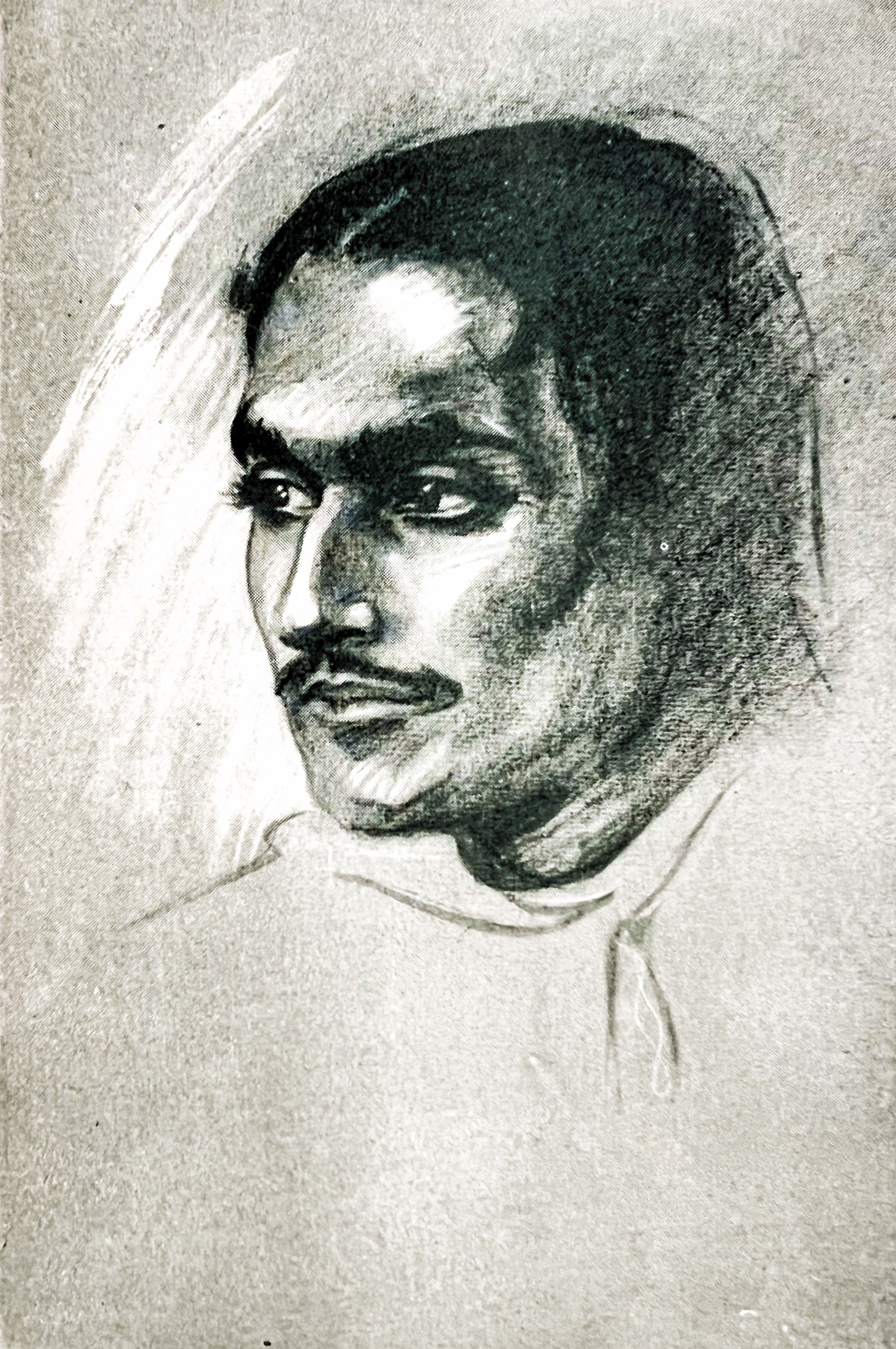
Nadu
His Royal Highness was also deeply interested in the private practice which I had established, and asked to see the file of my case histories. I discussed with him several important cases, and poem in honor of the Maharaja's visit. This he read:
Our hearts are like little gardens
by the village road;
Love for you fills these gardens with
bright flowers.
Be gracious to accept, Great Prince,
these spirit blossoms,
For their fragrance is due to your own
tender care.
The Rama was kind enough to request a copy, that he might keep the poem in memory of the occasion.
The Rama had a kind word and a pleasant smile for each visitor, and complimented the mothers upon the beauty and merit of their children. His attitude throughout the long and trying evening was that of a loving father deeply interested in the happiness of his children. It was a very beautiful occasion, and my respect for His Royal Highness was enhanced to a deep personal affection.
At the very end of the evening, Mahadeo Rao approached with hesitancy to apologize for charging the Maharaja cab fare. He still had the coins which the Prince had given him, and these he asked permission to return. His Royal Highness insisted, however, that his financial condition permitted him to pay the fare without inconvenience.
Before the Rama left he invited Radha and myself and our children to be his guests at the Palace at any time we wished to make the trip to Dharapur. He recommended that we come the following February, when there would be an important gathering of scientists and physicians from several of the native states.
Mahadeo Rao insisted on driving His Royal Highness to the train, and as he had the only motor car in the town, the privilege was his by incontestable logic. Rao so arranged his route to the station that the Rama was driven through all of the principal streets. Every inhabitant turned out and cheered His Royal Highness with great enthusiasm. The people then formed a procession behind the motor car, and accompanied the Maharaja to the station.
It was the most important occasion in the life of the village since the death of a celebrated Saint nearly 200 years before.
MY son was ten years old when I received my first letter from the Guru. The master expressed his satisfaction with the work which I was doing, about which he kept himself constantly informed. He expressed the desire that I bring my family to him at the first opportunity, in order that he might confer his blessing upon the children.
The desire of the Guru comes first in the life of his disciples, and I made immediate arrangements for a brief absence from the hospital. I had already instructed both my son and daughter in the teachings of my blessed master, and young as they were, they fully realized the significance of the occasion.
The Guru was at his Ashram as Kailasvastu, and we went by train, making the last part of the trip in a motor car. Although I had not seen the Ashram for more than twelve years, nothing had changed. The chelas had grown up, but other young men had taken their places, and the same gentle atmosphere prevailed.
The Guru was seated in his favorite place in the shade of the ruined arch, and I could not see that he had aged in any way. As we approached the Guru smiled in greeting and inclined his head as was his custom. "Nadu, my son in God, and Radha, my daughter in God, I welcome you in the name of our Holy Order. And these little ones, are they not my grandchildren in God? They are welcome also."
The two children were self-conscious in the presence of the great man, and looked at him long and curiously. I had told them much about the Guru, and he must have seemed to them as one of the Gods.
The master held out his hand to the children. "Do not be afraid; come and sit here beside me." My son gained courage first, and taking Lilya by the hand, led her close to the Guru, and they sat down together facing him.
Seeing that the master wished to be with the children, Radha and I departed a short distance and spoke with the disciples whom I had previously known.
While we were thus engaged, I heard the silvery tinkle of Lilya's laughter, and looking toward the Guru I saw that our little girl was seated in his lap; and young Ramachandra was eating sweetmeats from the bowl which had been hidden, not too carefully, in a cool place near the Guru. The master was himself in a merry mood and we knew that he had captured the hearts of our children.
On this occasion we stayed only three days at the Ashram, because it was difficult for me to be away from the hospital. The Guru realized this, and assured me that my first duty was to my patients.
On the last evening of our stay, the blessed Guru performed a little ceremony that will remain forever as one of the beautiful memories of our lives. He received all of us together in the Ashram, and we sat about on the edge of the large white cloth. First, the master spoke to the children. "My little grandchildren in God, for you life is just beginning. In the days to come you too will seek the holy life. This is your Dharma; for before your births you were dedicated to the Gods and to the service of our Great Mother." The children were very silent and a deep and beautiful understanding shone through their eyes. The Guru reached over and placed a hand on the head of each. "And now, my little ones, accept the blessing of an old man who has long served the Gods and is the Guru of your father. May the Great One, who is Lord of all the world, and who is throned forever upon the seven coils of the eternal serpent, may the Great One bless you through the hands of his servant. May he keep you forever in the light of his spirit, guiding you in the way of righteousness. Om Tat Sat."
The Guru removed his hands from the children's heads and took hold of the right hand of each of them. "According to the Will of the Great Lord, you shall become my disciples, as your father was before you. I accept you into our Brotherhood according to the law of our fathers. Ramachandra, what have you to say?"
My son spoke, and I shall never cease to marvel at the wisdom of his words, for he was but ten years old. "Blessed Guru, on this day I fulfill the purpose of my incarnation. In past lives I have been a disciple of the Holy Order. In this life I shall continue in that discipleship, and in lives to come it is my prayer and hope that I shall always be a servant of the Great Lord, and fulfill his works." It was not the voice of a small boy but of an old man speaking; and we knew that our son, though young in body, was indeed old of spirit.
The Guru then turned to our daughter. "And what have you to say, Lilya?" She replied: "My brother has spoken my words, blessed master. Although I am but nine years old in this life, I too have been a servant of our Holy Order. I dedicate my life, as daughter, wife, and mother to the service of the great Lord, that he shall guide me to the Light of his presence; and I will obey his Guru in all things unto death."
It can be well imagined the joy with which Radha and I heard the words of our children, for we knew that they would carry on the work of our lives when our time of service had passed. We could see also the happiness in the face of our Guru, and we gave thanks in our souls for the good things that had come to us in the service of our people.
The master then addressed himself to Radha, my wife. "My daughter in God, your father was a Guru of our order, as was his father before him. When you were born your father brought you to me and I consecrated you to the service of the great Lord. You have fulfilled all of the duties which have been given to you, and now you have brought into the world a son and a daughter and have raised them up according to the laws of our Brotherhood; you have not failed in any thing." The Guru reached over and placed his hand on that of Radha's. "And now, my daughter, I accept you into our blessed sisterhood; you are no longer a chela, but one of my disciples."
There is little more that I can say of this blessed occasion. All whom I most loved in the world were now united with me in our Holy Order and shared with me the privilege of receiving instruction from the great master. The Guru last addressed himself to me. "Nadu, my son, there is nothing more that I can do for you. I have fulfilled this day the most secret desire of your heart. For the present you must continue in your service as householder and father. The children shall remain with you for another five years; then you will bring them to me. In the meantime, instruct them in the way of our brotherhood and perfect their understanding of the religion and philosophy of our race. When you have completed your work as a householder, then you too shall be advanced in the Order. Until then, may the blessing of the Lord of Lords, who is eternal, be upon you."
The next day we returned to Dharapur, and from that time on there was a new spirit in our home, and we lived together with complete consecration to the teachings of the blessed Guru.
ONE evening, as I was working in my little laboratory, Sunkar Das brought his wife to me. The good woman was very much upset about the health of her third grandson. When the child was born, the family astrologer had warned that the boy might die in his sixth year. The fatal time was at hand, and little Rabu had been stricken with an obscure tropical ailment and was unable to retain his food.
Mrs. Das had brought the boy's horoscope; and this she unrolled and begged me to seek among the planetary positions the cause and remedy for the ailment. Unfortunately, I was not versed in these matters, although I had seen the Guru studying the nativities of his disciples.
I asked Mrs. Das to leave the horoscope with me, and promised that I would include the health of her grandson in my evening meditation. I also suggested that she bring the child to the hospital the following morning, so that we could give him a complete physical examination. As the entire family had full faith in my professional abilities, they departed with some degree of hope and comfort.
After Mr. and Mrs. Das had left, I examined the horoscope, and read several times the section relating to the little boy's health. There were many curious symbols and figures which I could little understand, and these indicated a serious illness which might prove fatal. Encouraged that the pronouncement of death was not certain, I left the roll open on my table; and I then offered a short prayer, asking that wisdom be given to me so that I could save the life of Mrs. Das' third grandson. It was quite late, and having finished this simple devotion I closed the laboratory and returned to the house.
As I walked in the moonlight through our little garden I heard the sound of an iron-bound staff pounding on the dirt road. A religious mendicant was approaching, and as he came he chanted old Vedic hymns in a high thin voice. It was not usual for holy men to be abroad at night, so I stopped near the front gate in case the mendicant should require food.
A few moments later the holy man approached our gate. He was a very large, heavy man, and walked with long powerful strides. His hair, streaked with gray, was like the mane of a lion, and he wore a white cloth with one end twisted over his shoulder.
At the gate he entered our garden without hesitation, walking directly to where I stood in the shadow of one of our large trees. His greeting was short and simple. "May the Holy Word protect you, my son." I inclined my head and replied, "May the Great Mother bless you, venerable sir."
Then, according to custom, I inquired if he needed food or lodging. The holy man shook his head. "I have traveled far and my journey is not yet ended. I require nothing."
As we stood in the moonlight, I noticed that little flickering flames of light played about the head and shoulders of the mendicant, and I knew that he was a very sacred person. "Why, venerable sir, have you honored me by placing your foot upon the earth of my garden?" I inquired. The ascetic leaned on his staff and replied, "In the night a thought came to me out of this house; and the thought told me that Nadu Chatterji, a disciple of our Holy Order, had asked help for the sickness of the third grandson of Sunkar Das. Is it not so?"
"It is indeed so, most venerable sir; and I welcome you in the name of my blessed Guru and beseech your aid for the life of this little boy."
The holy man turned and walked toward my laboratory. "Show me the nativity of the child."
He seated himself on the floor of my office, and unrolling the long horoscope, studied the strange symbols for some time. At length he looked up, and resting his hands on his knees he spoke thus: "Dr. Chatterji, my son, there are diseases of the flesh which can be healed by medicine and science; and there are other diseases which can be healed only by the help of the Gods. I perceive that in another life this child was the father of one daughter, and because he wanted a son, he was cruel to this child, and neglected her, and desired that she might die. In order to accomplish his purpose, he carried her into the jungle, and left her to the mercy of wild animals. So you will perceive that he destroyed her by intent, but in physical actuality did not accomplish his purpose. For a very great and holy hermit discovered the little girl, and took her to his retreat. Here she grew up and became a great Yogini. This sanctified woman performed many actions of charity and goodness, and prayed that in this way she would atone for the sin of her father, so that he should be forgiven. Because of these circumstances, little Rabu has been afflicted with this sickness; but he shall be preserved through the prayers and good works of this holy daughter."
After listening to the story I inquired, "If the child is to recover, most venerable sir, what treatments will be necessary?"
The holy man rose and indicated that he was ready to leave the office. "Medicine will not avail; we shall go together to the house of Sunkar Das."
After a short walk we reached the cottage, and saw that there were lights in the windows. The child had taken a turn for the worse, and the family had gathered with the young doctor from the hospital staff who lived next door.
The holy man went immediately to the side of the bed, and looked down at the little boy, who was emaciated and racked with fever. The child was conscious, but had lapsed into spells of delirium. The holy man addressed the boy directly: "Rabu, my son, you are aware of the reason for your sickness; that it is your karma for a misdeed in your previous life?"
To everyone's amazement the little boy whispered, "Yes father, I know that I have sinned."
The holy man continued, "Do you repent of the evil thing which you have done?"
Again the boy whispered, "Yes, father; I repent, for I know that I deserted my daughter and left her to die in the forest."
The holy man spoke softly. "By the blessing of the Great Lord, the little girl was saved and performed many virtuous actions, becoming a great Saint; and in her prayers she remembered you, and asked that you be forgiven."
The sick child smiled feebly and answered in a low voice, "Blessed father, you bring me great happiness to know that my sin did not destroy my child."
The holy man then said, "I am here to fulfill the prayer of the great Yogini, your daughter. Behold, I bring you her prayer in my hands, and I give it to you in your heart; that you may become strong, and devote your life to good works." The ascetic cupped his hands, and then spread them over the heart of the sick child. He turned then to the parents. "Give the boy food; he will live; and when he becomes a man he shall be the father of a daughter, and he will love her greatly, and fulfill through her that which he failed to perform in a previous life."
The holy man then turned to me. "I have come a long way on my journey, and I have far yet to travel. Farewell, in the name of our Holy Order."
He walked quietly from the room, and I heard the sound of his staff and the thin high note of his song as he vanished in the night.
Rabu recovered and became a fine strong boy.
ABOUT the time of my son's fifteenth birthday, the Guru visited Dharapur as the guest of the Maharaja Rama. In the grounds of the palace there was a beautiful little building of white marble, inlaid with designs of mirrored glass. This was set aside for the use of the Guru and his disciples, and here the master received important visitors.
The Maharani was a woman of strong character and progressive mind, and her sympathies were entirely devoted to the social program of His Royal Highness. In recent years the Maharani had become interested in mysticism and the esoteric doctrines of our ancient religion. She desired to discuss these matters with the Guru, and this was the principal reason for his visit to Dharapur.
Knowing that the time had come for me to take our children to the master, I made the necessary arrangements for this great change in our lives, and with my little family traveled to the capital. His Royal Highness received us graciously and insisted upon assigning us apartments in the palace.
The Maharaja had greatly admired the palace of Versailles, with its gardens. He had brought architects and craftsmen from Europe to build him a palace patterned from that of the French kings. He had then furnished the great rooms with priceless antiques of appropriate design and style; and it was here amidst the duplicated splendor of a French court he lived with his one wife.
On this occasion I was privileged to meet His Highness the Crown Prince. He was a fine young man, tall and slender, and most gracious of person. He idolized his father, and was already resolved to carry on in every respect the program of public service which Prince Rama had instituted. The Crown Prince was a student at Oxford and had returned to Dharapur for his summer vacation.
During his stay with the Maharaja, the Guru never entered the palace, but would occasionally come and sit on the broad white steps that led up to the throne room and the chambers of state.
Here he would watch important personages enter and depart, and when the day was exceptionally fine would permit himself the luxury of a sun bath. Sometimes the Rama would come out and sit with him, and they would discuss together the problems of classical literature, in which the Maharaja was deeply versed.
One afternoon as the Guru was sitting quietly on the broad steps, I approached him and asked permission to interrupt his quietude. He motioned me to sit down, saying, "Nadu, my son, you have brought me the children, so I will tell you my decision concerning their future. I have decided that your son shall follow in the work that you have done, so that he can take your place when the time comes for you to retire into the holy life. The Maharaja Rama approves, and assures me that your son will enjoy his patronage. For your daughter I have unusual plans. It is my desire that she shall become a leader in the new political and social life of Indian women. Therefore, she will receive a formal education in political science. When she has completed such schooling as I consider adequate, I will send her to Europe, and probably to America."
Again I rejoiced in the great wisdom of the blessed Guru, and the profound knowledge which he had of the characters of our children. Many times Ramachandra, my son, had told me that he desired to be as his father, a doctor. And Lilya, my daughter, had read all the books that we could secure for her relating to the social reforms that were changing the state of the Indian people.
That evening, Radha and I took the children to the Guru in the beautiful marble guest house. Although the building was fully equipped with electric lights, the master prefered his oil lamp; and its tiny flame was reflected in the thousands of fragments of inlaid mirrors; it seemed as though the Guru was sitting in the midst of countless tiny stars.
Our master received the children with great affection, and spoke to them thus: "Ramachandra, my son in God, and Lilya, my daughter in God, you have been brought to me this night according to the ancient ways of our fathers. The world is changing, and men are living according to new standards. But in the midst of an ever-changing way of living and thinking, the old road remains unchanged. The world has many princes and many rulers, and there are many nations, with many ideals and purposes. But forever the Lord of Lords rules from the sacred island in the ocean of sand. Far above the mountains he sits upon his lotus throne, bearing the trident and the conch. Before him all the princes of the earth must bow down, for he is Lord of all. His ways never change, his purposes are forever the same; and all who would serve their people must obey his laws and follow the road that leads to him."
"My children, you are now dedicated to him. I am a humble Guru, a teacher of his laws, and it is my duty to instruct you in his ways and for his sake. If you love him you will obey me, and will perform without question any action which I require. By so doing, you will discipline yourselves; and self-discipline is the middle road that leads to the Sacred City. In obeying me you are not serving me, but are perfecting yourselves in obedience. Know, my children, that obedience is the perfect virtue. We become great to the degree that we obey. I shall speak no more of these matters, for I assume that you understand them. From now on, I am your new father, your guardian, and your teacher."
The master then embraced each of the children, and rang the small silver bell that was always beside him. An elderly woman in a long brown sari approached silently. The Guru addressed her. "Holy sister, these are the children whom God has given me. Take them to the room which has been prepared, and minister to their needs."
It was in this way that we parted from our children, and we did not see them again for eight years.
The next day Radha and I returned to the hospital, and a few days later the Guru left for a long pilgrimage into the North Country. He went as far as Nepal, and our children went with him. By indirect ways I learned that our son remained with the Guru for about a year, and was then enrolled in a fine school at Delhi. Our daughter lived in a house of the sisterhood near Calcutta, and was privileged to receive much instruction from the Guru himself. He took great interest in her education, and when she was eighteen he sent her to England, where she lived at the Ashram of our order.
We made no effort to contact the children, knowing that when the time had come for us to see them the Guru would communicate with us. For a time our home seemed very empty, but in our hearts we were entirely content and we gave thanks each day to the Great Mother that our boy and girl had found the old road that leads beyond the mountains of the Great Lord who rules the Sacred City.
FOUR years after we had taken the children to the Guru a serious emergency arose in one of the northern provinces that bordered on our state. Some of these provinces were ruled over by men less wise and unselfish than our venerated Rama. These feudal princes squandered their fortunes on personal pleasures, and neglected the needs of their subjects. In some cases the British Government interfered and forced the feudatory states to institute modern reforms. If, however, the native prince was not sympathetic, the procedure was extremely difficult, and slow to bear results.
In the late fall it was apparent that a famine was inevitable in this neighboring state. Our Maharaja out of his generosity dispatched large quantities of food, but Dharapur is not a large country and the supplies were inadequate.
The winter was extremely severe, and in the spring there were devastating floods. We all knew that sickness was inevitable, and were not surprised when summer brought with it the cholera.
Many families left their homes to escape the dread disease, and sought refuge in Dharapur. The Rama, fully aware that this migration might bring the cholera to his own state, built a number of temporary communities away from his cities to house these refugees. One of the largest of these communities was only a few miles from my hospital, and at the Rama's request I went there with a staff of doctors and nurses to check health conditions, and to set up an adequate system of sanitation.
As we had feared, the cholera broke out in several of these temporary communities, and in a few months we were confronted with a major epidemic. Both the Maharaja and the Maharani exposed themselves recklessly to the disease, working night and day side by side with their doctors and other officials. Although the Rama was himself in feeble health, the Gods protected his house, and neither of Their Highnesses contracted the disease.
In my district the death toll reached fifty a day, especially affecting small children and elderly persons. Supplies, particularly drugs, became scarce, and shipments were brought in by special trains. A number of my doctors and nurses became so depleted from overwork that they fell victims of the cholera, and died with their patients. Radha and I did everything that we could, but it was evident that the epidemic was out of control.
One evening, as I was checking a list of new victims which I would have to visit the following day, my mind for some reason reverted back to the times when I had taken long walks with the Guru and that old disciple who was studying botany and herbs. I remembered that my master had one day pointed to a small plant that grew in abundance along the roadside. On this occasion he had said, "When the blessed Gods brought forth the world by their meditation, they filled its earthy parts with seeds. From these seeds all manner of plants grow, and all these plants have healing in them. In every land there are herbs peculiar to that land, suitable to the healing of such sickness as is common to that land. This humble weed has a great virtue in it. If its leaves are boiled together with the stem and roots, it is a remedy for the cholera."
I tried my best to remember the appearance of that plant; but it was so many years ago that I could not be sure. I had some books, and I tried to find a picture that would remind me; but there was not any that seemed to support what I held in half forgotten memory.
Resolved to ask the help of my blessed teacher, I sent forth my thoughts upon my breath, as he had instructed me. Silently in my heart I said: "Blessed father in God, your children are in great pain, your people die. In your infinite mercy send me the memory of the plant which will heal their sickness." Then I was silent and waited; for I knew that the Guru would hear my call wherever he might be; and if he deemed it good, my request would be answered.
Suddenly my attention was drawn to the flowers in a small vase on my desk. Radha loved flowers, and every day she brought me blossoms from the garden. As I looked at them, the blossoms changed; the shape of the leaves changed; and I realized that my bouquet was one now of but ordinary garden weeds. Then I realized what had happened. The plant in the little vase was now the herb I sought. The Guru had heard my prayer, and in this way had answered it for me.
Taking the plant quickly, I studied its formation; it was one available in large amounts in the low hills west of the hospital. The next day we borrowed Mahadeo Rao's motor car, and in a few hours had filled the back seat with bundles of the short stubby plant. We had no time to dry the herb properly, so we used the sterilizing equipment to evaporate the moisture. We tried the tea first made from the plant on patients in the hospital, and found that its effect was almost magical. As soon as I was sure that the remedy was effective, I telegraphed the Rama; and arrangements were made to gather vast quantities of the weed and prepare the remedy in the large laboratory at Dharapur.
Thus it was that through the ever present love of the blessed Guru the cholera was brought under control; and many thousands lived who otherwise most certainly would have died.
LATER, the herb was analyzed chemically by several British scientists, and their report was most astonishing. So far as they could discover, the plant contained no chemical elements which would cause it to have special medical virtues, and yet in some strange way it was a panacea for a virulent disease. I have always wished that I might have asked the blessed Guru for an explanation. I feel that he would have told me that there are secrets in nature that defy science and bear witness to the peculiar working of a divine power.
A few weeks after the cholera subsided I received a message of congratulation from the Maharaja Rama. He told me that he had been pleased to make special mention of my work, and my medical discovery, in his report to the Viceroy. He intimated that this report would be forwarded to His Majesty the King Emperor and that in all probability I would receive a direct communication from the British Government.
The Rama added with a waggish facetiousness that there seemed to be considerable division of opinion in scientific circles as to the importance of my discovery, and even a perceptible tendency to disparage my findings. He advised me to ignore the controversy, and continue diligently my researches into the healing properties of the herb.
I was somewhat prepared, therefore, when I received an official communication from the Viceroy inviting me to New Delhi, and expressing his warm personal gratitude for my service to the Crown.
Radha and I went to Dharapur, where the Maharaja met us; and we traveled to New Delhi with him on his private train. I took the opportunity to explain that the discovery was not my own, but had been given to me in my dire need by the blessed Guru, to whom all credit was due. The Rama smiled.
"Dr. Chatterji, I understand these things; but the Viceroy will not understand. I am afraid you will have to take the burden for the discovery."
It was after we arrived at Delhi that I learned that the Rama intended to present me personally to the Viceroy. The Maharaja had a small palace at Delhi, and it was there we stayed while the final arrangements were being made. I clearly remember that the time set for my presentation was four o'clock on a Wednesday afternoon. At three-thir- ty, Radha and I joined the Maharaja in his spacious living room. His Royal Highness was dressed in a long yellow brocade coat and wore many decorations and insignia of his rank. His beautiful strings of matched pearls are the finest in India and have been among the treasures of his family for centuries. He carried a jeweled sword magnificently inlaid with diamonds, rubies, and emeralds.
When we arrived at New Delhi, a special guard of honor was waiting to receive the Rama. The Government buildings are a most imposing sight. The architecture shows considerable Indian influence and the buildings are of reddish sandstone.
In due course we were ushered into a small reception room where the Viceroy met us graciously and quite informally. His Lordship was a tall, slender English gentleman with an acquiline face and rather prominent cheekbones. His voice was cultured, soft, unmistakably British. The Rama presented me as a dear and trusted friend. I felt very humble as I listened to his words of praise. His Royal Highness then presented Radha, and the Viceroy seemed specially interested when the Rama told of the many things she had done to help the people of our province.
A few dignitaries were present, and these were introduced in turn. We then sat down, and the Viceroy asked me to tell something of my experience in the hospital, and of the work done by the native doctors during the cholera epidemic. We remained for about half an hour and I told my story simply, pointing out that our success was largely due to the wisdom and benevolence of His Royal Highness the Maharaja Rama.
The Viceroy then said that he had been informed that I was a disciple of that very venerable man, Sri Purascharanacharya; and that my life was dedicated to a Holy Brotherhood of mystics; he had therefore felt it appropriate that the reception be simple, in accordance with the precepts of the ascetic life. I expressed deep appreciation of His Lordship's thoughtfullness and understanding. The Viceroy then rose, invited the Rama to walk beside him, and led the way through several broad doors into a large room which held no furniture other than two great chairs on a low dais. Several military aides and other officials were waiting there. The Viceroy and the Rama seated themselves, and His Lordship was handed an important looking document. Rising, he acknowledged the presence of the Rama, and then addressed me before the small assemblage.
"Dr. Nadu Chatterji, Director of the North Hills Hospital of the Sovereign State of Dharapur, in the course of your professional duties you have made a valuable contribution to the health and well-being of the people under your care, and to all the people of India. Because of the exceptional nature of this service, the circumstances have been brought to the attention of His Majesty's Government. After due consideration His Majesty's Government is pleased to recognize your services in a manner befitting the merit of these services. I am therefore empowered to bestow upon you, Nadu Chatterji, the Order of Knighthood, a most signal and unusual distinction."
The Viceroy stepped down from the platform, and one of the officers handed him a sword. I hardly knew what to do, but His Lordship gently indicated that I should kneel on one knee. The Viceroy then touched my shoulders with the sword, saying, "In the name of his most puissant Majesty George, by the grace of God the Fifth; King of England, Ireland, Scotland, and Wales; Emperor of India, Protector of His Majesty's possessions beyond the sea, and Defender of the Faith, I dub you Sir Knight, bestowing upon you the Order of Knighthood. Arise, Sir Nadu Chatterji."
As I arose the Viceroy handed me the sword. "Sir Knight, this is your sword; may its blade always be bright, and may it be used only to defend God, the Emperor, and Justice."
Everyone waited, and it was apparent that I was expected to say something. I looked at the Rama and he smiled encouragingly, so I tried to express my appreciation. "Your Lordship, and your Royal Highness: I have never made a speech, and it is beyond my understanding why you have selected me from among so many others more worthy than I to receive honor. As Your Lorship said earlier, I am dedicated to a holy life, and am one of the humblest of the disciples of the Jagat Guru Sri Purascharanacharya. It is his inspiration, his wisdom, and his love which have set my life in the path of good works. All that I know I gained from him; and most of all, he taught me to live unselfishly, serving those who need, according to the law of our religion. He is the one who should receive all honors and all distinctions. He is the master of my life. I deeply appreciate this beautiful and generous action on the part of His Majesty's Government, and I shall try to be worthy of the confidence that has been shown in me. I love our people and will continue to serve them to the best of my ability, but my life does not belong to me; for in all things I obey my Guru, to whom I owe all allegiance after God."
As I finished, a voice spoke from the corner of the room, "My son in God, your words are good, and according to the way of our Blessed Order." I turned, and there seated quietly on the floor against the wall behind me, was my blessed teacher, his arm resting on his forked stick. I am afraid that my actions then were not in accord with the strict etiquette of the occasion. For the moment I forgot the presence of the Viceroy and the Maharaja; I hastened to my master, and on my knees before him, I laid the sword at his feet. "Beloved master, your disciple waits for your words of wisdom in this moment."
The Guru took the sword and laid it across his knees. "My son, you have earned this recognition, and it is good that you should receive it; for it will inspire others of our people to perform actions of merit. The honors of this world are in themselves of small consequence, but the spirit which bestows them is of great importance. It is good that men shall honor one another for their virtues. You have a new burden to bear, but you will bear it wisely until you have finished your work in the world of men."
No one had seen the Guru enter, and it was evident that the Viceroy was surprised, but knew enough of India to say nothing. The others who were gathered about waited quietly and with respect.
The Guru then said to me, "Sir Nadu Chatterji, you may present the Viceroy to me."
It was a tense situation, but His Lordship faced it with admirable composure. Arising, he stepped down from the dais, and approaching the Guru, bowed formally. I said, by way of introduction, "Sri Ramachandra Arjunananda Purascharanacharya, I have the honor of presenting His Lordship the Viceroy of India." The Guru inclined his head toward the Viceroy. "May the blessings of the Gods be upon you, my son; I am grateful to you as a father is grateful for the honor you have bestowed upon my disciple, who is my son in God."
The Viceroy answered quietly, "Sri Purascharanacharya, I am informed that the discovery of the remedy for the cholera is due to you. Unfortunately, we have no way of estimating the mysterious ways of your religion; so we honor the doctor who gave this discovery to the world. I am sure that if His Majesty's Government was able to do so, it would bestow great honors upon you for the many wise and wonderful things that you have done."
The Guru smiled and shook his head. "It is the way of our philosophy, Your Lordship, that the works of the Gods shall be given to the world through the disciples of our Holy Order. It is thus also in your world; God is the source of all good, but you reward men and not God for good works. Men must perform these works and dedicate their lives to unselfish deeds, and although the power is from God these men deserve the honors that are given to them. You have honored me through my disciple, and you have honored our Gods in the same measure. It is well as it is."
The Guru then turned to me and said with a curious smile: "And now, my son, I have journeyed far, and I have yet a great distance to travel. Good-bye, until that day which is to come."
The Guru indicated that he wished to rise, so I hastened to assist him. As he stood up the ironbound staff was in his hand; and without a further word to anyone he walked slowly from the room; and I seemed to hear the distant tinkling of a little silver bell.
It was thus that I became a Knight of the Empire, and while this was a great honor I feel it was still more important for the reason that the blessed Guru on that occasion revealed himself to the Viceroy and gave his blessing to the work which I had accomplished.
He took my sword with him; and years later I found it at his Ashram before the little altar which bore the pictures of Krishna.
MY last three years work as Director of Health for the State of Dharapur were devoted largely to the preparation of a textbook on tropical diseases. The Maharaja graciously permitted me to dedicate the book to him, and assured me that he would finance its publication and distribution. Radha and I left our little home in the hills and lived in the Capitol city, where I could be in closer touch with the numerous health projects of the State. His Highness the Crown Prince spent much time with me, as the Rama's health no longer permitted him to take as active a part in his program, as in earlier years.
The Guru had told me that my period of discipleship as a householder was to be twenty-five years. When this time was completed, I requested permission from the Maharaja to tender my resignation and return to the life of a religious ascetic. His Royal Highness was kind enough to understand my devotion to the spiritual work of our Order, and accepted my resignation and relieved me of my various duties.
Having settled all of our worldly affairs, Radha and I left Dharapur to join the master at Kailasvastu. When we reached there we were overjoyed at meeting our son and daughter, whom the Guru had summoned for this important occasion. Ramachandra, my son, a fine, tall young man, was due to graduate from the University the following year. Lilya, my daughter, had been studying at Columbia University in America, and had developed quite an Occidental point of view. We spent many evenings with our grown-up children and found that in every way they had fulfilled our highest expectations and hopes. In one of these conversations Lilya said: "Most venerable father, I know that the time is near for you to make your pilgrimage to the Great Ones who dwell beyond the mountains. How long you will be gone, and whether or not you will return, depends upon the Will of the Gods. This afternoon I spoke to the blessed Guru about the future of our beloved mother. It was my hope that she might return to America with me, until I complete my education. there. The master in his gracious understanding has agreed."
Lilya came over to me and kneeling beside my chair put her hands in mine. "Radha, your beloved wife, and Lilya your obedient daughter, will be waiting for you when you have completed the duties of your religious life. If you do not come back, we will be with you in thought."
The following day the blessed Guru called me to him.
As I sat before him on the corner of the white cloth, it was hard to realize the many years that had passed since first I had been his chela. The Master's long hair was still streaked with the same gray line that I had seen when I first met him. My own hair was also gray now, and quite thin; but in my heart I was still the little boy of thirteen who ran out of his father's garden nearly forty years before.
After a few moments the blessed Guru spoke.
"Nadu, my spiritual son, you have come back to the way of the Gods. Your work as a householder is finished. You have done your part to help the people of India. For twenty-five years you have served the needs of our Great Mother. Nadu, you have been a good disciple; you have obeyed me in all things and failed me in nothing. This day our association as teacher and disciple is complete. I release you from all the obligations which you have taken to me. You are no longer my disciple; you are no longer my son."
I turned to the teacher and my eyes were wet with tears. "Beloved father, I have no desire to be released; I desire only to be your disciple so long as I shall live. I wish only to obey you; I have no other life."
The Guru nodded his understanding. "It is according to our law, Nadu, that you shall always hold your teacher in the deepest respect, because he is the father of your spiritual life. But as a son must go forth out of his father's house, and must fulfill his own destiny, so you must go forth out of my house along the old road that leads to the Gods. I have served you and for that service you will always be thankful, because it is your nature to be thankful. But, Nadu, the road is long, and my Ashram is only a little rest house by the side of that road. I have taught you all that I can teach you. Now you must go on seeking others who can teach you more, and because those who would learn the most must give the most, you shall become a teacher, that by teaching you shall learn." The Guru reached over and embraced me. "Nadu Chatterji, you are no longer my disciple, you are my friend; you are no longer my son, you are my brother. Nadu, my brother in God, accept the blessing of your friend."
Later, the Jagat Guru told me that in a short time we should travel together to Shigatse, in the north country on the borders of Tibet. We would go on a holy pilgrimage, walking the entire distance, accompanied by a few of the elder disciples.
When the time for the pilgrimage came, I took off for the last time my European clothes and put on the garb of a religious mendicant. On that day I was no longer a Sir Doctor, but a Hindu holy man, one of four million of our people dedicated to the service of the Gods of our fathers. I wore a yellow cloth about my body and strings of wooden beads around my neck. One of the disciples carved me a staff and bound it with iron, and Radha, my wife, gave me a brass bowl tied in a piece of yellow cloth. In this I could keep the few worldly possessions that would go with me on my journey. In this bowl I placed the last letters of my father and mother, pictures of my wife and children, and a ring given to me by the Maharaja Rama when we parted. Also, I wrapped carefully and deposited in the lota a tiny painting on ivory of Krishna, which had been given to me by the blessed Guru.
After an affectionate parting with my wife and children, who asked my blessing which I bestowed with all my heart, I joined the Guru; and side by side we walked down the dusty road that lec from the Ashram to the great mountains of the north. Five disciples came with us, following a short distance behind. Many days we traveled, passing through villages and performing various useful tasks.
In one town, two men were arguing about the ownership of a cow. When we arrived, the principal people of the village gathered about us and begged that we would settle the dispute. The Guru and I sat under a tree, and the two men came forward, one leading the cow. I remained silent while the Guru examined into the dispute.
Finally, he reached over and picked up a small pebble; then addressed the two men. "My sons, this little stone is part of the body of our Great Mother, the Earth. I shall hold this in my hand; let each of you know that which is true in your hearts. Then, let each attempt to pick this stone from my hand; the one who is honest can take the stone, but the other who is not honest has not the strength to pick it up."
The two men stood silent, looking at each other and at the villagers who gathered about. After several seconds, one of the men came forward and picked the stone from the Guru's hand. The old master smiled. "My son, the cow belongs to you."
It was in this way that we journeyed to Shigatse, where we arrived after nearly seven weeks.
AT Shigatse we stopped in a little rest house that had been built years before by a wealthy merchant for the use of religious mendicants. In spite of his age, the Guru did not seem to have tired by the long walk, and received several visitors in the little yard which surrounded the guest house. Two other holy men were living nearby, and these came to ask the master about the interpretation of certain verses of the Rig-Veda. These the Guru explained at great length, and with profound wisdom.
The following morning at dawn we went together to the edge of the village. There were mountains all about us, and to the north the rising sun was reflected in shades of rose and purple from the great glaciers of Himavat. Beyond the village was a broad level plain extending for several miles to meet the rising hills. Across this plain was a winding dirt road rutted with the wooden wheels of ox-teams. The Guru stoped at the edge of the little plain and pointed to the road.
"There, Nadu, my brother, is the way of the Gods. Along that road you must go alone. You must not ask where you are going, or why you are going, or whom you shall meet along the way. Holding in your heart the priceless treasure of our blessed law, you must go forth to meet the Gods according to their will and pleasure. Perhaps you must follow this road for many years; perhaps indeed, you will become feeble with great age before you come to the end of this road. Perhaps again, you will lie down and die somewhere in the north, by the side of this wandering path. But ever be mindful that somewhere to the north is the thing that you are seeking; somewhere beyond the mountains the Gods are waiting."
I knelt at the Guru's feet to receive his blessings. He placed his hand upon my head, saying, "Nadu, my brother, receive now the blessing of an old man who has served the Gods. My strength goes with you, but only your own strength can truly serve you now." He then motioned for me to rise and embraced me, and I could see that there were tears in his eyes. Then he lifted his hands above his head and seemed to be speaking to someone far beyond the mountains. "Great Lord of the World, be gracious unto Nadu, my brother. Reach down from your lotus throne and take his hand, guide him along the old road in the footsteps of our fathers, and bring him to your Blessed Self, according to the promise of our faith. Om Tat Sat."
Staff in hand and carrying my little brass bowl wrapped in yellow cloth, I turned away from the Guru and began walking along the rough and uneven road with my eyes to the north. Slowly I crossed the little plain, and coming to the end of the level place I looked back. There, in the long shafts of the early morning sun, stood the Jagat Guru, leaning upon his iron-bound staff, watching me. I waved to him, and he raised a hand in benediction.
Beyond the level land the road twisted through deep valleys and along the edge of high cliffs. There were little streams, some of which I had to swim across, and there were rough places where the path seemed to disappear. Deeper and deeper into the mountains the road led. At night there were small rest houses where other pilgrims had stopped, but I met no person along the path.
My food was mostly of berries and small plants which I had learned to know, and I drank the water that flowed from the melting glaciers above.
By the evening of the twelfth day, the last vestige of the man-made world had been left behind. Even the rest houses were no longer available, and I slept in the forest. The country was very beautiful.
Just before nightfall, the road reached a strange formation of dark rocks. The rocks seemed as though piled up in the forms of temples and shrines. The path led among these rocks. As the sun went down, the sky was so bright with stars that it was easy to follow the path. Then, a thin silvery moon added its light, and the night was strangely calm and silent; and I knew in my heart that I was approaching some holy place.
Soon afterward, I noticed a soft glowing light shining from the rocks ahead of me. The light was of a golden rose color, and seemed to flicker and glisten in a strange way. Then, as I followed a turn in the path, I saw before me the source of the light. On a rocky ledge by the road an old man was sitting on a cushion of yellow silk. His snowy white hair hung about his shoulders to his waist, and on his forehead was the yellow caste mark with the Trident of Shiva. Instantly I recognized him. It was the Lord of Lords, the Sublime Rishi, Azurelama, the master of my beloved Guru. The rose light flickered about his body and his great soft eyes were looking straight into mine.
The Sublime Lord spoke. "Nadu, my son, do you remember me? I sat under a rattan umbrella on the Second Ghat at Allahabad at the Kumbh-mela, when you were thirteen years old. It was on that occasion that I told you that you would be an old man before you saw again the shadow of my hand."
I prostrated myself at the foot of the rock throne on which the great Rishi was sitting. "Exalted Being", I exclaimed, "from that first day I have carried your face in my heart; I have known that your words would be fulfilled, and that in some day to come I would see the shadow of your hand."
The Lord of Lords spoke again. "Nadu, my son, it is I that you came to seek along the old road of the Gods; for I am the keeper of the next rest house where you must linger for a time. Nadu Chatterji, you are my disciple, as your blessed Guru was before you."
It was there among the rocks on that starlit night that I sat at the feet of the Lord of Lords and received his instructions. "Nadu, my son, in the name of the Nameless One who abides in timeless space, I consecrate you as a Guru, a teacher of our ageless doctrine. You shall have your own disciples, to cherish you as you have cherished your master. These you shall instruct according to the law of our faith. When the time comes, that my beloved son in God, the sanctified Sri Purascharanacharya shall be taken from his present work and return to me, you shall take his place. You shall carry on his tradition and shall be his successor in all things. In this work you shall remain until your one-hundred and tenth year, at which time I shall call you back; and we shall go together with your blessed Guru to the City of the Gods. If you need me or desire to know my will, you shall become silent and turn your mind inward to your heart; there you will find me sitting as I am tonight, and I will answer your question and reveal to you my will."
The Lord of Lords arose from his seat upon the rocks, and stepping down to the path led me through a little valley; and beyond I could see the shadowy outline of a great temple. The Lord of Lords spoke. "Nadu, my son, this is my house. Here you will remain until the day which is appointed. Here you will practice our mystical devotions and prepare yourself to be a teacher of our Holy Order."
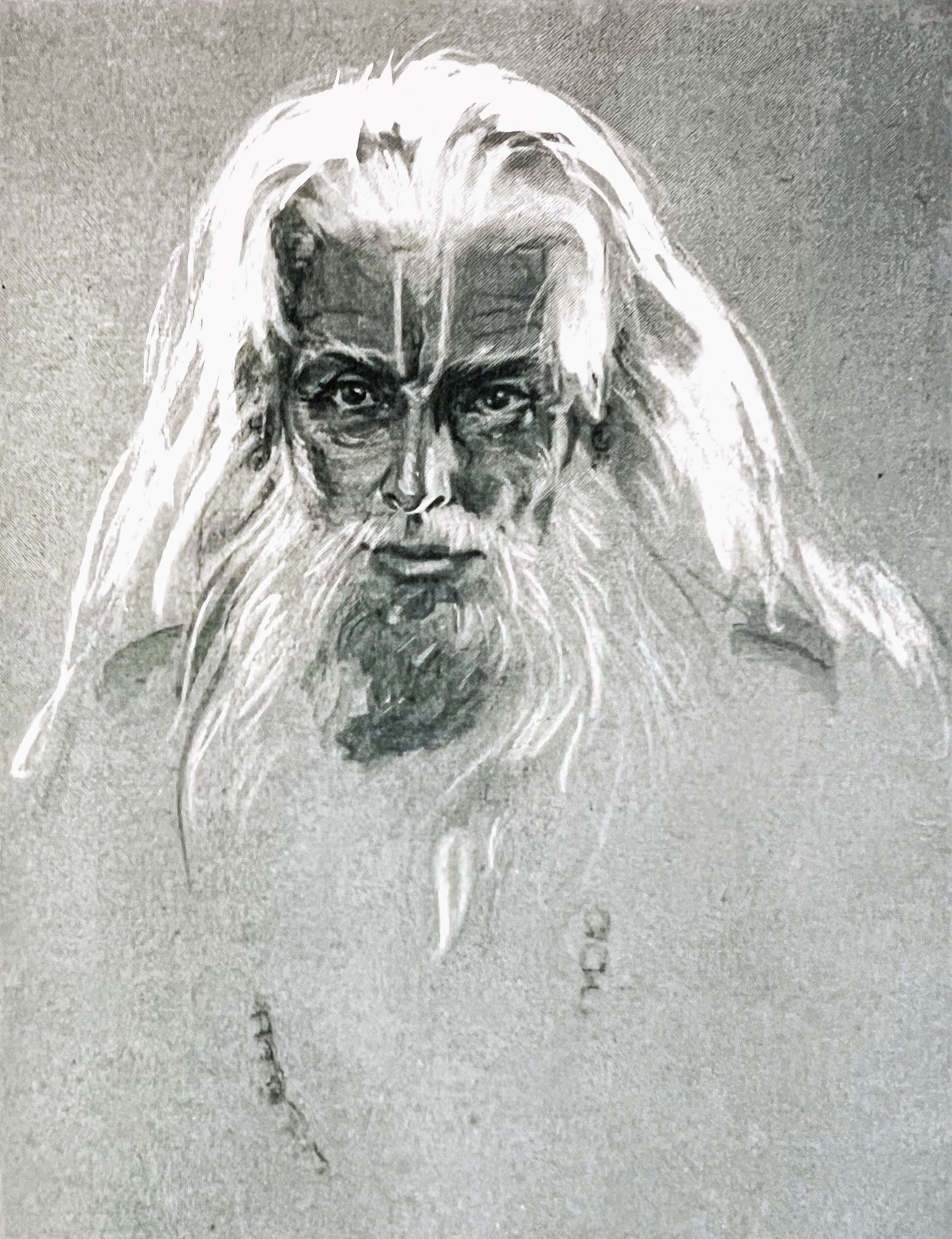
The Lord of Lords
* * *
All that was many years ago. I am now seated by the side of a ruined arch at the Ashram of Kailasvastu, in the place where my blessed Guru used to sit. I am seventy years old as I write these lines, and my chelas and disciples are gathered about me. I live only to serve them, and dream of the day when I shall see again the shadow of my master's hand.
My beloved Radha has left this world, and my children's children are among my disciples.
For all the mercies and blessings of my life I give thanks eternally to the blessed Guru. I await the day to come when side by side we shall go together to the Sacred City of our Lord.
OM.


Energy Follows Thought