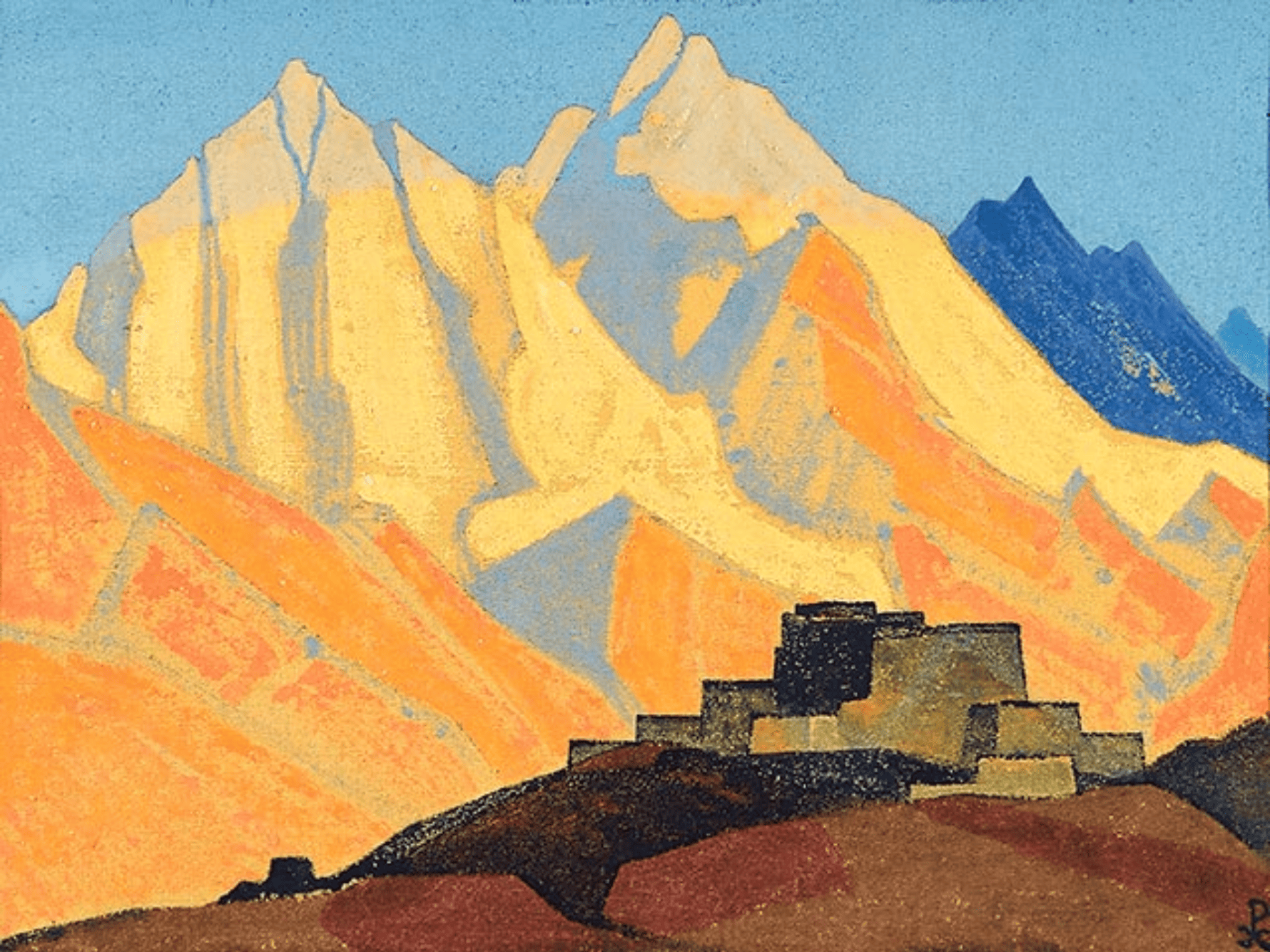
[cover: Sacred Himalayas, painting by Nicholas Roerich, 1933.]
(A.P. Sinnett, The Occult World, pp. 85-104, 1884.)
[The author sets out the clarifications on this subject received from Master Koot Hoomi.]



I am here enabled to insert the greater part of a letter addressed by Koot Hoomi to the friend referred to in a former passage, as having opened up a correspondence with him in reference to the idea which he contemplated under certain conditions, of devoting himself entirely to the pursuit of occultism. This letter throws a great deal of light upon some of the metaphysical conceptions of the occultists, and their metaphysics, be it remembered, are a great deal more than abstract speculation.
"DEAR SIR,—Availing of the first moments of leisure to formally answer your letter of the 17th ultimo, I will now report the result of my conference with our chiefs upon the proposition therein contained, trying at the same time to answer all your questions.
"I am first to thank you on behalf of the whole section of our fraternity that is especially interested in the welfare of India for an offer of help whose importance and sincerity no one can doubt. Tracing our lineage through the vicissitudes of Indian civilization from a remote past, we have a love for our motherland so deep and passionate that it has survived even the broadening and cosmopolitanizing (pardon me if that is not an English word) effect of our studies in the laws of Nature. And so I, and every other Indian patriot, feel the strongest gratitude for every kind word or deed that is given in her behalf.
"Imagine, then, that since we are all convinced that the degradation of India is largely due to the suffocation of her ancient spirituality, and that whatever helps to restore that higher standard of thought and morals, must be a regenerating national force, every one of us would naturally and without urging, be disposed to push forward a society whose proposed formation is under debate, especially if it really is meant to become a society untainted by selfish motive, and whose object is the revival of ancient science, and tendency to rehabilitate our country in the world's estimation. Take this for granted without further asseverations. But you know, as any man who has read history, that patriots may burst their hearts in vain if circumstances are against them. Sometimes it has happened that no human power, not even the fury and force of the loftiest patriotism, has been able to bend an iron destiny aside from its fixed course, and nations have gone out like torches dropped into the water in the engulfing blackness of ruin. Thus, we who have the sense of our country's fall, though not the power to lift her up at once, cannot do as we would either as to general affairs or this particular one. And with the readiness, but not the right to meet your advances more than half-way, we are forced to say that the idea entertained by Mr. Sinnett and yourself is impracticable in part. It is, in a word, impossible for myself or any Brother, or even an advanced neophyte, to be specially assigned and set apart as the guiding spirit or chief of the Anglo-Indian branch. We know it would be a good thing to have you and a few of your colleagues regularly instructed and shown the phenomena and their rationale. For though none but you few would be convinced, still it would be a decided gain to have even a few Englishmen, of first-class ability, enlisted as students of Asiatic Psychology. We are aware of all this, and much more; hence we do not refuse to correspond with, and otherwise help you in various ways. But what we do refuse is, to take any other responsibility upon ourselves than this periodical correspondence and assistance with our advice, and, as occasion favours, such tangible, possibly visible, proofs, as would satisfy you of our presence and interest. To 'guide' you we will not consent. However much we may be able to do, yet we can promise only to give you the full measure of your deserts. Deserve much, and we will prove honest debtors; little, and you need only expect a compensating return. This is not a mere text taken from a schoolboy's copybook, though it sounds so, but only the clumsy statement of the law of our order, and we cannot transcend it. Utterly unacquainted with Western, especially English, modes of thought and action, were we to meddle in an organization of such a kind, you would find all your fixed habits and traditions incessantly clashing, if not with the new aspirations themselves, at least with their modes of realization as suggested by us. You could not get unanimous consent to go even the length you might yourself. I have asked Mr. Sinnett to draft a plan embodying your joint ideas for submission to our chiefs, this seeming the shortest way to a mutual agreement. Under our 'guidance' your branch could not live, you not being men to be guided at all in that sense. Hence the society would be a premature birth and a failure, looking as incongruous as a Paris Daumont drawn by a team of Indian yaks or camels. You ask us to teach you true science—the occult aspect of the known side of Nature; and this you think can be as easily done as asked. You do not seem to realize the tremendous difficulties in the way of imparting even the rudiments of our science to those who have been trained in the familiar methods of yours. You do not see that the more you have of the one the less capable you are of instinctively comprehending the other, for a man can only think in his worn grooves, and unless he has the courage to fill up these, and make new ones for himself, he must perforce travel on the old lines. Allow me a few instances. In conformity with exact science you would define but one cosmic energy, and see no difference between the energy expended by the traveller who pushes aside the bush that obstructs his path, and the scientific experimenter who expends an equal amount of energy in setting a pendulum in motion. We do; for we know there is a world of difference between the two. The one uselessly dissipates and scatters force, the other concentrates and stores it. And here please understand that I do not refer to the relative utility of the two, as one might imagine, but only to the fact that in the one case there is but brute force flung out without any transmutation of that brute energy into the higher potential form of spiritual dynamics, and in the other there is just that. Please do not consider me vaguely metaphysical. The idea I wish to convey is that the result of the highest intellection in the scientifically occupied brain is the evolution of a sublimated form of spiritual energy, which, in the cosmic action, is productive of illimitable results; while the automatically acting brain holds, or stores up in itself, only a certain quantum of brute force that is unfruitful of benefit for the individual or humanity. The human brain is an exhaustless generator of the most refined quality of cosmic force out of the low, brute energy of Nature; and the complete adept has made himself a centre from which irradiate potentialities that beget correlations upon correlations through Æons of time to come. This is the key to the mystery of his being able to project into and materialize in the visible world the forms that his imagination has constructed out of inert cosmic matter in the invisible world. The adept does not create anything new, but only utilizes and manipulates materials which Nature has in store around him, and material which, throughout eternities, has passed through all the forms. He has but to choose the one he wants, and recall it into objective existence. Would not this sound to one of your 'learned' biologists like a madman's dream?
"You say there are few branches of science with which you do not possess more or less acquaintance, and that you believe you are doing a certain amount of good, having acquired the position to do this by long years of study. Doubtless you do; but will you permit me to sketch for you still more clearly the difference between the modes of physical (called exact often out of mere compliment) and metaphysical sciences. The latter, as you know, being incapable of verification before mixed audiences, is classed by Mr. Tyndall with the fictions of poetry. The realistic science of fact on the other hand is utterly prosaic. Now, for us, poor unknown philanthropists, no fact of either of these sciences is interesting except in the degree of its potentiality of moral results, and in the ratio of its usefulness to mankind. And what, in its proud isolation, can be more utterly indifferent to every one and everything, or more bound to nothing but the selfish requisites for its advancement, than this materialistic science of fact? May I ask then . . . what have the laws of Faraday, Tyndall, or others to do with philanthropy in their abstract relations with humanity, viewed as an intelligent whole? What care they for Man as an isolated atom of this great and harmonious whole, even though they may sometimes be of practical use to him? Cosmic energy is something eternal and incessant; matter is indestructible: and there stand the scientific facts. Doubt them, and you are an ignoramus, deny them, a dangerous lunatic, a bigot; pretend to improve upon the theories—an impertinent charlatan. And yet even these scientific facts never suggested any proof to the world of experimenters that Nature consciously prefers that matter should be indestructible under organic rather than inorganic forms, and that she works slowly but incessantly towards the realization of this object—the evolution of conscious life out of inert material. Hence, their ignorance about the scattering and concretion of cosmic energy in its metaphysical aspects, their division about Darwin's theories, their uncertainty about the degree of conscious life in separate elements, and, as a necessity, the scornful rejection of every phenomenon outside their own stated conditions, and the very idea of worlds of semi-intelligent if not intellectual forces at work in hidden corners of Nature. To give you another practical illustration—we see a vast difference between the two qualities of two equal amounts of energy expended by two men, of whom one, let us suppose, is on his way to his daily quiet work, and another on his way to denounce a fellow-creature at the police-station, while the men of science see none; and we—not they—see a specific difference between the energy in the motion of the wind and that of a revolving wheel. And why? Because every thought of man upon being evolved passes into the inner world, and becomes an active entity by associating itself, coalescing we might term it, with an elemental—that is to say, with one of the semi-intelligent forces of the kingdoms. It survives as an active intelligence—a creature of the mind's begetting—for a longer or shorter period proportionate with the original intensity of the cerebral action which generated it. Thus, a good thought is perpetuated as an active, beneficent power, an evil one as a maleficent demon. And so man is continually peopling his current in space with a world of his own, crowded with the offsprings of his fancies, desires, impulses, and passions; a current which re-acts upon any sensitive or nervous organization which comes in contact with it, in proportion to its dynamic intensity. The Buddhist calls this his 'Shandba'; the Hindu gives it the name of 'Karma.' The adept involves these shapes consciously; other men throw them off unconsciously. The adept, to be successful and preserve his power, must dwell in solitude, and more or less within his own soul. Still less does exact science perceive that while the building ant, the busy bee, the nidifacient bird, accumulates each in its own bumble way as much cosmic energy in its potential form as a Haydn, a Plato, or a ploughman turning his furrow, in theirs; the hunter who kills game for his pleasure or profit, or the positivist who applies his intellect to proving that + x + = -, are wasting and scattering energy no less than the tiger which springs upon its prey. They all rob Nature instead of enriching her, and will all, in the degree of their intelligence, find themselves accountable.
"Exact experimental science has nothing to do with morality, virtue, philanthropy—therefore, can make no claim upon our help until it blends itself with metaphysics. Being but a cold classification of facts outside man, and existing before and after him, her domain of usefulness ceases for us at the outer boundary of these facts; and whatever the inferences and results for humanity from the materials acquired by her method, she little cares. Therefore, as our sphere lies entirely outside hers—as far as the path of Uranus is outside the Earth's—we distinctly refuse to be broken on any wheel of her construction. Heat is but a mode of motion to her, and motion developes heat, but why the mechanical motion of the revolving wheel should be metaphysically of a higher value than the heat into which it is gradually transformed she has yet to discover. The philosophical and transcendental (hence absurd) notion of the mediæval Theosophists that the final progress of human labour, aided by the incessant discoveries of man, must one day culminate in a process which, in imitation of the Sun's energy—in its capacity as a direct motor—shall result in the evolution of nutritious food out of inorganic matter, is unthinkable for men of science. Were the sun, the great nourishing father of our planetary system, to hatch granite chickens out of a boulder 'under test conditions' to-morrow, they (the men of science) would accept it as a scientific fact without wasting a regret that the fowls were not alive so as to feed the hungry and the starving. But let a shaberon cross the Himalayas in a time of famine and multiply sacks of rice for the perishing multitudes—as he could—and your magistrates and collectors would probably lodge him in jail to make him confess what granary he had robbed. This is exact science and your realistic world. And though, as you say, you are impressed by the vast extent of the world's ignorance on every subject, which you pertinently designate as a 'few palpable facts collected and roughly generalized, and a technical jargon invented to hide man's ignorance of all that lies behind these facts,' and though you speak of your faith in the infinite possibilities of Nature, yet you are content to spend your life in a work which aids only that same exact science. . . .
"Of your several questions we will first discuss, if you please, the one relating to the presumed failure of the 'Fraternity' to 'leave any mark upon the history of the world.' They ought, you think, to have been able, with their extraordinary advantages, to have 'gathered into their schools a considerable portion of the more enlightened minds of every race.' How do you know they have made no such mark? Are you acquainted with their efforts, successes, and failures? Have you any dock upon which to arraign them? How could your world collect proofs of the doings of men who have sedulously kept closed every possible door of approach by which the inquisitive could spy upon them? The prime condition of their success was that they should never be supervised or obstructed. What they have done they know; all that those outside their circle could perceive was results, the causes of which were masked from view. To account for these results, men have, in different ages, invented theories of the interposition of gods special providences, fates, the benign or hostile influence of the stars. There never was a time within or before the socalled historical period when our predecessors were not moulding events and 'making history,' the facts of which were subsequently and invariably distorted by historians to suit contemporary prejudices. Are you quite sure that the visible heroic figures in the successive dramas were not often but their puppets? We never pretended to be able to draw nations in the mass to this or that crisis in spite of the general drift of the world's cosmic relations. The cycles must run their rounds. Periods of mental and moral light and darkness succeed each other as day does night. The major and minor yugas must be accomplished according to the established order of things. And we, borne along on the mighty tide, can only modify and direct some of its minor currents. If we had the powers of the imaginary Personal God, and the universal and immutable laws were but toys to play with, then, indeed, might we have created conditions that would have turned this earth into an arcadia for lofty souls. But having to deal with an immutable law, being ourselves its creatures, we have had to do what we could, and rest thankful. There have been times when 'a considerable portion of enlightened minds' were taught in our schools. Such times there were in India, Persia, Egypt, Greece, and Rome. But, as I remarked in a letter to Mr. Sinnett, the adept is the efflorescence of his age, and comparatively few ever appear in a single century. Earth is the battle-ground of moral no less than of physical forces, and the boisterousness of animal passion, under the stimulus of the rude energies of the lower group of etheric agents, always tends to quench spirituality. What else could one expect of men so nearly related to the lower kingdom from which they evolved? True also, our numbers are just now diminishing, but this is because, as I have said, we are of the human race, subject to its cyclic impulse, and powerless to turn that back upon itself. Can you turn the Gunga or the Bramaputra back to its sources; can you even dam it so that its piled-up waters will not overflow the banks? No; but you may draw the stream partly into canals, and utilize its hydraulic power for the good of mankind. So we, who cannot stop the world from going in its destined direction, are yet able to divert some part of its energy into useful channels. Think of us as demi-gods, and my explanation will not satisfy you; view us as simple men-perhaps a little wiser as the result of special study—and it ought to answer your objection.
"'What good,' you say, 'is to be attained for my fellows and myself (the two are inseparable) by these occult sciences?' When the natives see that an interest is taken by the English, and even by some high officials in India, in their ancestral science and philosophies, they will themselves take openly to their study. And when they come to realize that the old 'divine' phenomena were not miracles, but scientific effects, superstition will abate. Thus, the greatest evil that now oppresses and retards the revival of Indian civilization will in time disappear. The present tendency of education is to make them materialistic and root out spirituality. With a proper understanding of what their ancestors meant by their writings and teachings, education would become a blessing, whereas now it is often a curse. At present the non-educated, as much as the learned natives, regard the English as too prejudiced, because of their Christian religion and modern science, to care to understand them or their traditions. They mutually hate and mistrust each other. This changed attitude towards the older philosophy, would influence the native princes and wealthy men to endow normal schools for the education of pundits; and old MSS., hitherto buried out of the reach of the Europeans, would again come to light, and with them the key to much of that which was hidden for ages from the popular understanding, for which your skeptical Sanscritists do not care, which your religious missionaries do not dare, to understand. Science would gain much, humanity everything. Under the stimulus of the Anglo-Indian Theosophical Society, we might in time see another golden age of Sanscrit literature....
"If we look at Ceylon we shall see the most scholarly priests combining, under the lead of the Theosophical Society, in a new exegesis of Buddhistic philosophy; and at Galle, on the 15th of September, a secular Theosophical School for the teaching of Singhalese youth, opened with an attendance of over three hundred scholars; an example about to be imitated at three other points in that island. If the Theosophical Society, 'as at present constituted,' has indeed no 'real vitality,' and yet in its modest way has done so much practical good, how much greater results might not be anticipated from a body organized upon the better plan you could suggest? "The same causes that are materializing the Hindu mind are equally affecting all Western thought. Education enthrones skepticism, but imprisons spirituality. You can do immense good by helping to give the Western nations a secure basis upon which to reconstruct their crumbling faith. And what they need is the evidence that Asiatic psychology alone supplies. Give this, and you will confer happiness of mind on thousands. The era of blind faith is gone; that of inquiry is here. Inquiry that only unmasks error, without discovering anything upon which the soul can build, will but make iconoclasts. Iconoclasm, from its very destructiveness, can give nothing; it can only raze. But man cannot rest satisfied with bare negation. Agnosticism is but a temporary halt. This is the moment to guide the recurrent impulse which must soon come, and which will push the age towards extreme atheism, or drag it back to extreme sacerdotalism, if it is not led to the primitive soul-satisfying philosophy of the Aryans. He who observes what is going on to-day, on the one hand among the Catholics, who are breeding miracles as fast as the white ants do their young, on the other among the free thinkers, who are converting, by masses, into Agnostics—will see the drift of things. The age is revelling at a debauch of phenomena. The same marvels that the spiritualists quote in opposition to the dogmas of eternal perdition and atonement, the Catholics swarm to witness as proof of their faith in miracles. The skeptics make game of both. All are blind, and there is no one to lead them. You and your colleagues may help to furnish the materials for a needed universal religious philosophy; one impregnable to scientific assault, because itself the finality of absolute science, and a religion that is indeed worthy of the name since it includes the relations of man physical to man psychical, and of the two to all that is above and below them. Is not this worth a slight sacrifice! And if, after reflection, you should decide to enter this new career, let it be known that your society is no miraclemongering or banqueting club, nor specially given to the study of phenomenalism. Its chief aim is to extirpate current superstitions and skepticism, and from long-sealed ancient fountains to draw the proof that man may shape his own future destiny, and know for a certainty that he can live hereafter, if he only wills, and that all 'phenomena' are but manifestations of natural law, to try to omprehend which is the duty of every intelligent being."
I have hitherto said nothing of the circumstances under which these various letters reached my hands: nor, in comparison with the intrinsic interest of the ideas they embody, can the phenomenal conditions under which some of them were delivered, be regarded as otherwise than of secondary interest for readers who appreciate their philosophy. But every bit of evidence which helps to exhibit the nature of the powers which the adepts exercise, is worth attention, while the rationale of such powers is still hidden from the world. The fact of their existence can only be established by the accumulation of such evidence, as long as we are unable to prove their possibility by à priori analysis of the latent capacities in man.
My friend to whom the last letter was addressed wrote a long reply, and subsequently an additional letter for Koot Hoomi, which he forwarded to me, asking me to read and then seal it up and send or give it to Madame Blavatsky for transmission, she being expected about that time at my house at Allahabad on her way down country from Amritsur and Lahore, where, as I have already indicated, she had stayed for some little time after our household broke up for the season at Simla. I did as desired, and gave the letter to Madame Blavatsky, after gumming and sealing the stout envelope in which it was forwarded. That evening, a few hours afterwards, on returning home to dinner, I found that the letter had gone, and had come back again. Madame Blavatsky told me that she had been talking to a visitor in her own room, and had been fingering a blue pencil on her writing table without noticing what she was doing, when she suddenly noticed that the paper on which she was scribbling was my letter that the addressee had duly taken possession of, by his own methods, an hour or two before. She found that she had, while talking about something else, unconsciously written on the envelope the words which it then bore, "Read and returned with thanks, And a few commentaries. Please open." I examined the envelope carefully, and it was absolutely intact, its very complete fastenings having remained just as I arranged them. Slitting it open, I found the letter which it had contained when I sent it, and another from Koot Hoomi to me, criticizing the former with the help of a succession of pencil figures that referred to particular passages in the original letter—another illustration of the passage of matter through matter, which, for thousands of people who have had personal experience of it in Spiritualism, is as certain a fact of Nature as the rising of the sun, and which I have now not only encountered at spiritual séances, but, as this record will have shown, on many occasions when there is no motive for suspecting any other agency than that of living beings with faculties of which we may all possess the undeveloped germs, though it is only in their case that knowledge has brought these to phenomenal fruition.
Sceptical critics, putting aside the collateral bearing of all the previous phenomena I have described, and dealing with this letter incident by itself alone, will perhaps say—Of course, Madame Blavatsky had ample time to open the envelope by such means as the mediums who profess to get answers to sealed letters from the spirit world are in the habit of employing. But, firstly, the Jhelum telegram proof, and the inherent evidence of the whole correspondence show that, the letters which come to me in that which I recognize as Koot Hoomi's handwriting, are not the work of Madame Blavatsky, at all events; secondly, let the incident I have just described be compared with another illustration of an exactly similar incident which occurred shortly afterwards under different circumstances. Koot Hoomi had sent me a letter addressed to my friend to read and forward on. On the subject of this letter before sending it I had occasion to make a communication to Koot Hoomi. I wrote a note to him, fastened it up in an ordinary adhesive envelope, and gave it to Madame Blavatsky. She put it in her pocket, went into her own room, which opened out of the drawing-room, and came out again almost instantly. Certainly she had not been away thirty seconds. She said, "he" had taken it at once. Then she followed me back through the house to my office-room, spoke for a few minutes in the adjoining room to my wife, and, returning into my office, lay down on a couch. I went on with my work, and perhaps ten minutes elapsed, perhaps less. Suddenly she got up. "There's your letter," she said, pointing to the pillow from which she had lifted her head; and there lay the letter I had just written, intact as regards its appearance, but with Koot Hoomi's name on the outside scored out and mine written over it. After a thorough examination I slit the envelope, and found inside, on the fly-leaf of my note, the answer I required in Koot Hoomi's handwriting. Now, except for the thirty seconds during which she retired to her own room, Madame Blavatsky had not been out of my sight, except for a minute or two in my wife's room, during the short interval which elapsed between the delivery of the letter by me to her and its return to me as described. And during this interval no one else had come into my room. The incident was as absolute and complete a mechanical proof of abnormal power exercised to produce the result as any conceivable test could have yielded. Except by declaring that I cannot be describing it correctly, the most resolute partisan of the commonplace will be unable seriously to dispute the force of this incident. He may take refuge in idiotic ridicule, or he may declare that I am misrepresenting the facts. As regards the latter hypothesis I can only pledge my word, as I do hereby, to the exact accuracy of the statement.
In one or two cases I have got back answers from Koot Hoomi to my letters in my own envelopes, these remaining intact as addressed to him, but with the address changed, and my letter gone from the inside, his reply having taken its place. In two or three cases I have found short messages from Koot Hoomi written across the blank parts of letters from other persons, coming to me through the post, the writers in these cases being assuredly unaware of the additions so made to their epistles.
Of course, I have asked Koot Hoomi for an explanation of these little phenomena, but it is easier for me to ask than for him to answer, partly because the forces which the adepts bring to bear upon matter to achieve abnormal results, are of a kind which ordinary science knows so little about that we of the outer world are not prepared for such explanations; and partly because the manipulation of the forces employed has to do, sometimes, with secrets of initiation which an occultist must not reveal. However, in reference to the subject before us, I received on one occasion this hint as an explanation.
". . . . Besides, bear in mind that these my letters are not written, but impressed, or precipitated, and then all mistakes corrected.
Of course, I wanted to know more about such precipitation; was it a process which followed thought more rapidly than any with which we were familiar? And as regards letters received, did the meaning of these penetrate the understanding of an occult recipient at once, or were they read in the ordinary way?
“Of course I have to read every word you write,” Koot Hoomi replied, “otherwise I would make a fine mess of it. And whether it be through my physical or spiritual eyes, the time required for it is practically the same. As much may be said of my replies; for whether I precipitate or dictate them or write my answers myself, the difference in time saved is very minute. I have to think it over, to photograph every word and sentence carefully in my brain, before it can be repeated by precipitation. As the fixing on chemically prepared surfaces of the images formed by the camera requires a previous arrangement within the focus of the object to be represented, for otherwise—as often found in bad photographs—the legs of the sitter might appear out of all proportion with the head, and so on—so we have to first arrange our sentences and impress every letter to appear on paper in our minds before it becomes fit to be read. For the present it is all I can tell you. When science will have learned more about the mystery of the lithophyl (or lithobiblion), and how the impress of leaves comes originally to take place on stones, then I will be able to make you better understand the process. But you must know and remember one thing—we but follow and servilely copy Nature in her works.”
In another letter Koot Hoomi expatiates more fully on the difficulty of making occult explanations intelligible to minds trained only in modern science.
"Only the progress one makes in the study of arcane knowledge from its rudimental elements brings him gradually to understand our meaning. Only thus, and not otherwise, does it, strengthening and refining those mysterious links of sympathy between intelligent men—the temporarily isolated fragments of the universal soul, and the cosmic soul itself—bring them into full rapport. Once this established, then only will those awakened sympathies serve, indeed, to connect Man with—what, for the want of a European scientific word more competent to express the idea, I am again compelled to describe as that energetic chain which binds together the material and immaterial kosmos—Past, Present, and Future, and quicken his perceptions so as to clearly grasp not merely all things of matter, but of spirit also. I feel even irritated at having to use these three clumsy words—Past, Present, and Future. Miserable concepts of the objective phases of the subjective whole, they are about as ill adapted for the purpose as an axe for fine carving. Oh, my poor disappointed friend, that you were already so far advanced on the THE PATH that this simple transmission of ideas should not be encumbered by the conditions of matter, the union of your mind with ours prevented by its induced incapabilities. Such is unfortunately the inherited and self-acquired grossness of the Western mind, and so greatly have the very phrases expressive of modern thoughts been developed in the line of practical materialism, that it is now next to impossible, either for them to comprehend or for us to express in their own languages anything of that delicate, seemingly ideal, machinery of the occult kosmos. To some little extent that faculty can be acquired by the Europeans through study and meditation, but—that's all. And here is the bar which has hitherto prevented a conviction of the theosophical truths from gaining currency among Western nations—caused theosophical study to be cast aside as useless and fantastic by Western philosophers. How shall I teach you to read and write, or even comprehend a language of which no alphabet palpable or words audible to you have yet been invented. How could the phenomena of our modern electrical science be explained to—say a Greek philosopher of the days of Ptolemy, were he suddenly recalled to life—with such an unbridged hiatus in discovery as would exist between his and our age? Would not the very technical terms be to him an unintelligible jargon, an abracadabra of meaningless sounds, and the very instruments and apparatuses used but miraculous monstrosities? And suppose for one instant I were to describe to you the lines of those colour rays that lie beyond the so-called visible spectrum—rays invisible to all but a very few even among us; to explain how we can find in space any one of the so-called subjective or accidental colours—the complement (to speak mathematically) moreover of any other given colour of a dichromatic body (which alone sounds like an absurdity) could you comprehend, do you think, their optical effect, or even my meaning? And since you see them not—such rays—nor can know them, nor have you any names for them as yet in science, if I were to tell you . . . . 'without moving from your writing-desk, try search for, and produce before your eyes the whole solar spectrum decomposed into fourteen prismatic colours (seven being complementary) as it is but with the help of that occult light that you can see me from a distance as I see you'—what think you would be your answer? What would you have to reply? Would you not be likely enough to retort by telling me that as there never were but seven (now three) primary colours which, moreover, have never yet by any known physical process been seen decomposed further than the seven prismatic hues, my invitation was as unscientific as it was absurd? Adding that my offer to search for an imaginary solar complement, being no compliment to your knowledge of physical science—I had better, perhaps, go and search for my mythical dichromatic and solar 'pairs' in Thibet, for modern science has hitherto been unable to bring under any theory even so simple a phenomenon as the colours of all such dichromatic bodies. And yet truth knows these colours are objective enough.
"So you see the insurmountable difficulties in the way of attaining not only absolute, but even primary knowledge in Occult Science, for one situated as you are. How could you make yourself understood, command in fact, those semiintelligent Forces, whose means of communicating with us are not through spoken words, but through sounds and colours in correlations between the vibrations of the two? For sound, light, and colour are the main factors in forming those grades of intelligences, these beings of whose very existence you have no conception, nor are you allowed to believe in them—Atheists and Christians, Materialists and Spiritualists, all bringing forward their respective arguments against such a belief—Science objecting stronger than either of these to such a degrading superstition.
Thus, because they cannot with one leap over the the boundary walls attain to the pinnacles of Eternity—because we cannot take a savage from the centre of Africa and make him comprehend at once the 'Principia' of Newton, or the 'Sociology' of Herbert Spencer, or make an unlettered child write a new Iliad in old Achaian Greek, or an ordinary painter depict scenes in Saturn, or sketch the inhabitants of Arcturus—because of all this our very existence is denied. Yes, for this reason are believers in us pronounced impostors and fools, and the very science which leads to the highest goal of the highest knowledge, to the real tasting of the Tree of Life and Wisdom—is scouted as a wild flight of imagination."
The following passage occurs in another letter, but it adheres naturally enough to the extract just concluded.
"The truths and mysteries of occultism constitute, indeed, a body of the highest spiritual importance, at once profound and practical for the world at large. Yet it is not as an addition to the tangled mass of theory or speculation that they are being given to you, but for their practical bearing on the interests of mankind. The terms Unscientific, Impossible, Hallucination, Imposture, have hitherto been used in a very loose, careless way, as implying in the occult phenomena something either mysterious and abnormal, or a premeditated imposture. And this is why our chiefs have determined to shed upon a few recipient minds more light upon the subject, and to prove to them that such manifestations are as reducible to law as the simplest phenomena in the physical universe. The wiseacres say, 'the age of miracles is past;' but we answer, 'it never existed.' While not unparalleled or without their counterpart in universal history, these phenomena must and will come with an overpowering influence upon the world of skeptics and bigots. They have to prove both destructive and constructive—destructive in the pernicious errors of the past, in the old creeds and superstitions which suffocate in their poisonous embrace, like the Mexican weed, nigh all mankind; but constructive of new institutions of a genuine practical Brotherhood of Humanity, where all will become co-workers of Nature, will work for the good of mankind, with and through the higher planetary spirits, the only spirits we believe in. Phenomenal elements previously unthought of, undreamed of, will soon begin manifesting themselves day by day with constantly augmented force, and disclose at last the secrets of their mysterious workings. Plato was right. Ideas rule the world; and as men's minds will receive new ideas, laying aside the old and effete, the world will advance, mighty revolutions will spring from them, creeds and even powers will crumble before their onward march, crushed by their irresistible force. It will be just as impossible to resist their influence when the time comes as to stay the progress of the tide. But all this will come gradually on, and before it comes we have a duty set before us: that of sweeping away as much as possible the dross left to us by our pious forefathers. New ideas have to be planted on clean places, for these ideas touch upon the most momentous subjects. It is not physical phenomena, but these universal ideas, that we study; as to comprehend the former, we have first to understand the latter. They touch man's true position in the universe in relation to his previous and future births, his origin and ultimate destiny; the relation of the mortal to the immortal, of the temporary to the eternal, of the finite to the infinite; ideas larger, grander, more comprehensive, recognizing the eternal reign of immutable law, unchanging and unchangeable, in regard to which there is only an ETERNAL NOW: while to uninitiated mortals, time is past or future, as related to their finite existence on this material speck of dirt. This is what we study and what many have solved. . . . . Meanwhile, being human, I have to rest. I took no sleep for over sixty hours."
Here are a few lines from Koot Hoomi's hand, in a letter not addressed to me. It falls conveniently into the present series of extracts.
"Be it as it may, we are content to live as we do, unknown and undisturbed by a civilization which rests so exclusively upon intellect. Nor do we feel in any way concerned about the revival of our ancient art and high civilization, for these are as sure to come back in their time, and in a higher form, as the Plesiosaurus and the Megatherium in theirs. We have the weakness to believe in ever-recurrent cycles, and hope to quieken the resurrection of what is past and gone. We could not impede it, even if we would. The new civilization will be but the child of the old one, and we have but to leave the eternal law to take its own course, to have our dead ones come out of their graves; yet we are certainly anxious to hasten the welcome event. Fear not, although we do 'cling superstitiously to the relics of the past,' our knowledge will not pass away from the sight of man. It is 'the gift of the gods,' and the most precious relic of all. The keepers of the sacred light did not safely cross so many ages but to find themselves wrecked on the rocks of modern skepticism. Our pilots are too experienced sailors to allow us to fear any such disaster. We will always find volunteers to replace the tired sentries, and the world, bad as it is in its present state of transitory period, can yet furnish us with a few men now and then."
Turning back to my own correspondence, and to the latest letter I received from Koot Hoomi before leaving India on the trip home, during which I am writing these pages, I read :—
"I hope that at least you will understand that we (or most of us) are far from being the heartless morally dried-up mummies some would fancy us to be. Mejnour is very well where he is as an ideal character of a thrilling, in many respects truthful story. Yet, believe me, few of us would care to play the part in life of a desiccated pansy between the leaves of a volume of solemn poetry, We may not be quite 'the boys,' to quote —— 's irreverent expression when speaking of us, yet none of our degree are like the stern hero of Bulwer's romance. While the facilities of observation secured to some of us by our condition, certainly give a greater breadth of view, a more pronounced and impartial, a more widely spread humaneness—for answering Addison, we might justly maintain that it is ' the business of "magic" to humanize our natures with compassion'—for the whole mankind as all living beings, instead of concentrating and limiting our affections to one predilected race—yet few of us (except such as have attained the final negation of Moksha) can so far enfranchise ourselves from the influence of our earthly connection as to be unsusceptible in various degrees to the higher pleasures, emotions, and interests of the common run of humanity. Of course the greater the progress towards deliverance, the less this will be the case, until, to crown all, human and purely individual personal feelings, blood-ties and friendship, patriotism and race predilection, will all give way to become blended into one universal feeling, the only true and holy, the only unselfish and eternal one—Love, an Immense Love for humanity as a whole. For it is humanity which is the great orphan, the only disinherited one upon this earth, my friend. And it is the duty of every man who is capable of an unselfish impulse to do something, however little, for its welfare. It reminds me of the old fable of the war between the body and its members; here, too, each limb of this huge 'orphan,' fatherless and motherless, selfishly cares but for itself. The body, uncared for, suffers eternally whether the limbs are at war or at rest. Its suffering and agony never cease; and who can blame it—as your materialistic philosophers do—if, in this everlasting isolation and neglect, it has evolved gods unto whom 'it ever cries for help, but is not heard.' Thus—
'Since there is hope for man only in man,
I would not let one cry whom I could save.'
Yet I confess that I individually am not yet exempt from some of the terrestrial attachments. I am still attracted towards some men more than towards others, and philanthropy as preached by our Great Patron—
'—the Saviour of the world,
The teacher of Nirvana and the Law'—
has never killed in me either individual preferences of friendship, love for my next of kin, or the ardent feeling of patriotism for the country in which I was last materially individualized."
I had asked Koot Hoomi how far I was at liberty to use his letters in the preparation of this volume, and, a few lines after the passage just quoted, he says:—
I lay no restrictions upon your making use of anything I may have written to you or Mr. —— having full confidence in your tact and judgment as to what should be printed, and how it should be presented. I must only ask you . . . . " and then he goes on to indicate one letter which he wishes me to withhold. . . . . "As to the rest, I relinquish it to the mangling tooth of criticism."


Energy Follows Thought