 ◄ BACK
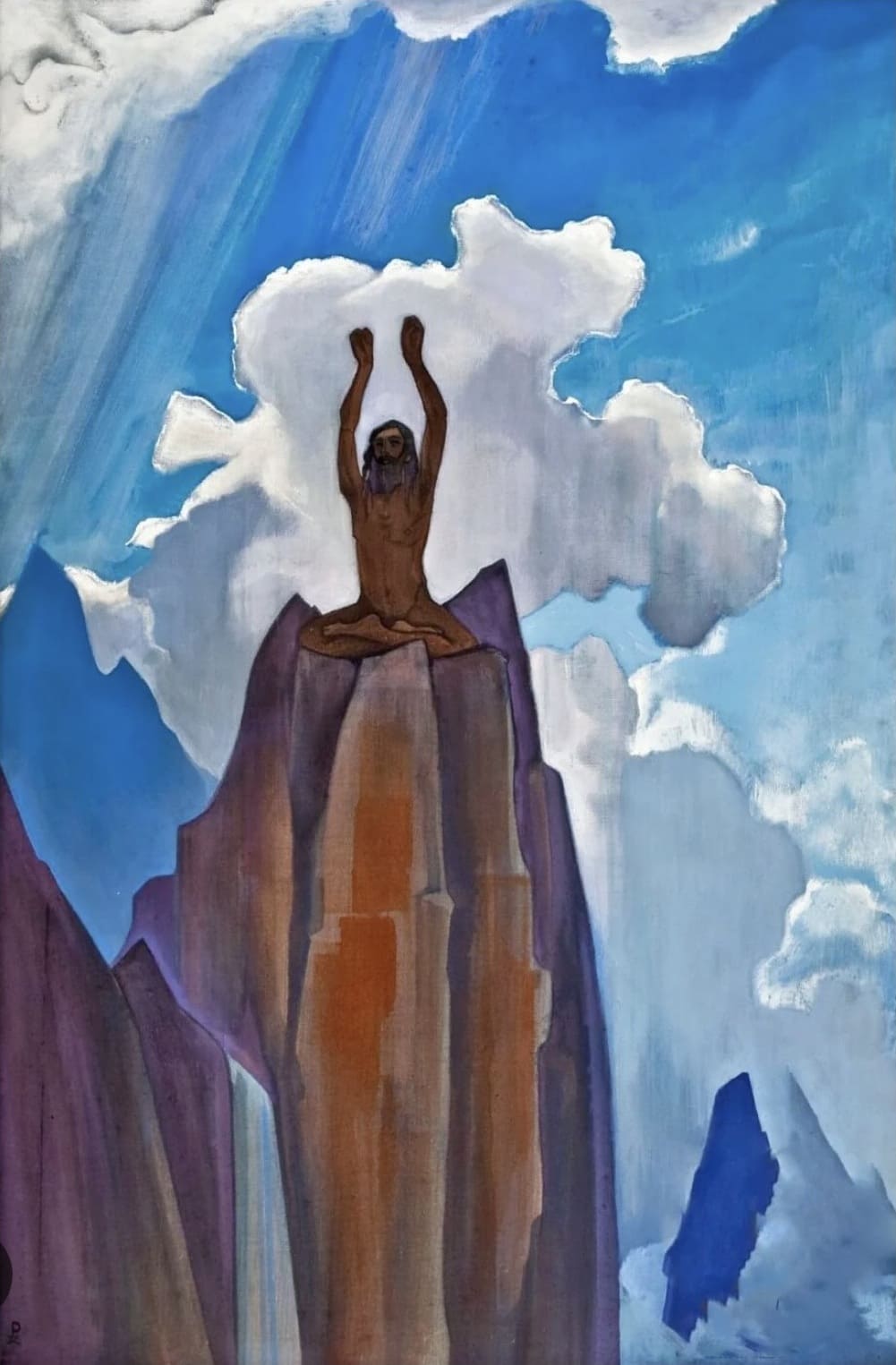
[cover: Ecstasy, painting by Nicholas Roerich, 1933.]
(A.P. Sinnett, The Occult World, pp. 110-117, 1884.)
[The author sets out the clarifications on this subject received from Master Koot Hoomi.]



The misunderstanding about the meaning of "Nirvana" is so general in the West, that it will be well to consider the following elucidation also:—
"Annihilation means with the Buddhistical philosophy only a dispersion of matter, in whatever form or semblance of form it may be; for everything that bears a shape was created, and thus must sooner or later perish—i.e., change that shape; therefore, as something temporary, though seeming to be permanent, it is but an illusion, 'Maya;' for as eternity has neither beginning nor end, the more or less prolonged duration of some particular form passes, as it were, like an instantaneous flash of lightning. Before we have the time to realize that we have seen it, it has gone and passed away for ever; hence even our astral bodies, pure ether, are but illusions of matter so long as they retain their terrestrial outline. The latter changes, says the Buddhist, according to the merits or demerits of the person during his lifetime, and this is metempsychosis. When the spiritual entity breaks loose for ever from every particle of matter, then only it enters upon the eternal and unchangeable 'Nirvana.' He exists in spirit, in nothing; as a form, a shape, a semblance, he is completely annihilated, and thus will die no more; for spirit alone is no 'Maya,' but the only reality in an illusionary universe of ever-passing forms. . . . . To accuse Buddhistical philosophy of rejecting a Supreme Being—God, and the soul's immortality—of Atheism, in short—on the ground that 'Nirvana' means annihilation, and 'Svabhavat' is not a person, but nothing, is simply absurd. The En (or Aym) of the Jewish Ensoph also means nihil, or nothing, that which is not (quoad nos), but no one has ever ventured to twit the Jews with atheism. In both cases the real meaning of the term nothing carries with it the idea that God is not a thing, not a concrete or visible being to which a name expressive of any object known to us on earth may be applied with propriety."
Again: "Nirvana' is the world of cause in which all deceptive effects or illusions of our senses disappear. 'Nirvana' is the highest attainable sphere."
The secret doctrines of the Magi, of the pre-Vedic Buddhists, of the hierophants of the Egyptian Thoth or Hermes, were—we find it laid down in "Isis"—identical from the beginning, an identity that applies equally to the secret doctrines of the adepts of whatever age or nationality, including the Chaldean Kabalists and the Jewish Nazars. "When we use the word Buddhists, we do not mean to imply by it either the exoteric Buddhism instituted by the followers of Gautama Buddha, or the modern Buddhistic religion, but the secret philosophy of Sakyamuni, which, in its essence, is certainly identical with the ancient wisdom-religion of the sanctuary—the pre-Vedic Brahmanism. The schism of Zoroaster, as it is called, is a direct proof of it: for it was no schism, strictly speaking, but merely a partially public exposition of strictly monotheistic religious truths hitherto taught only in the sanctuaries, and that he had learned from the Brahmans. Zoroaster, the primeval institutor of sun-worship, cannot be called the founder of the dualistic system, neither was he the first to teach the unity of God, for he taught but what he had learned himself from the Brahmans. And that Zarathrusta, and his followers the Zoroastrians, had been settled in India before they immigrated into Persia, is also proved by Max Müller. 'That the Zoroastrians and their ancestors started from India,' he says, 'during the Vaidic period, can be proved as distinctly as that the inhabitants of Massilia started from Greece. . . . . Many of the gods of the Zoroastrians come out. . . . . ; as mere reflections and deflections of the gods of the Veda.
"If, now, we can prove, and we can do so on the evidence of the 'Kabala,' and the oldest traditions of the wisdom-religion, the philosophy of the old sanctuaries, that all these gods, whether of the Zoroastrians or of the Veda, are but so many personated occult powers of Nature, the faithful servants of the adepts of secret wisdom—magic—we are on secure ground.
"Thus, whether we say that Kabalism and Gnosticism proceeded from Masdeanism or Zoroastrianism, it is all the same, unless we meant the exoteric worship, which we do not. Likewise, and in this sense we may echo King, the author of the 'Gnostics,' and several other archæologists, and maintain that both the former proceeded from Buddhism, at once the simplest and most satisfying of philosophies, and which resulted in one of the purest religions in the world. But whether among the Essenes or the Neo-Platonists, or again among the innumerable struggling sects born but to die, the same doctrines, identical in substance and spirit, if not always in form, are encountered. By Buddhism, therefore, we mean that religion signifying literally the doctrine of wisdom, and which by many ages antedates the metaphysical philosophy of Siddhartha Sakyamuni."
Modern Christianity has, of course, diverged widely from its own original philosophy, but the identity of this with the original philosophy of all religions is maintained in "Isis" in the course of an interesting argument.
"Luke, who was a physician, is designated in the Syriac texts as Asaia, the Essaian or Essene. Josephus and Philo Judeus' have sufficiently described this sect to leave no doubt in our mind that the Nazarene Reformer, after having received his education in their dwellings in the desert, and being duly initiated in the mysteries, preferred the free and independent life of a wandering Nazaria, and so separated, or inazarenized, himself from them, thus becoming a travelling Therapeute, or Nazaria, a healer. . . . In his discourses and sermons Jesus always spoke in parables, and used metaphors with his audience. This habit was again that of the Essenians and the Nazarenes; the Galileans, who dwelt in cities and villages, were never known to use such allegorical language. Indeed, some of his disciples, being Galileans as well as himself, felt even surprised to find him using with the people such a form of expression. 'Why speakest thou unto them in parables?' they often inquired. 'Because it is given unto you to know the mysteries of the kingdom of Heaven; but to them it is not given,' was the reply, which was that of an initiate. 'Therefore, I speak unto them in parables, because they seeing, see not, and hearing, they hear not, neither do they understand.' Moreover, we find Jesus expressing his thoughts . . . . in sentences which are purely Pythagorean, when, during the Sermon on the Mount, he says, 'Give ye not that which is sacred to the dogs, neither cast ye your pearls before swine; for the swine will tread them under their feet, and the dogs will turn and rend you.' Professor A. Wilder, the editor of Taylor's 'Eleusinian Mysteries,' observes 'a like disposition on the part of Jesus and Paul to classify their doctrines as esoteric and exoteric—the mysteries of the kingdom of God for the apostles, and parables for the multitude. 'We speak wisdom,' says Paul, 'among them that are perfect,' or 'initiated.' In the Eleusinian and other mysteries the participants were always divided into two classes, the neophytes and the perfect. . . . The narrative of the Apostle Paul, in his Second Epistle to the Corinthians, has struck several scholars well versed in the descriptions of the mystical rites of the initiation given by some classics as alluding most undoubtedly to the final Epopteia: 'I know a certain man—whether in body or outside of body I know not; God knoweth—who was rapt into Paradise, and heard things ineffable which it is not lawful for a man to repeat.' These words have rarely, so far as we know, been regarded by commentators as an allusion to the beatific visions of an initiated seer; but the phraseology is unequivocal. These things which it is not lawful to repeat, are hinted at in the same words, and the reason assigned for it is the same as that which we find repeatedly expressed by Plato, Proclus, Jamblichus, Herodotus, and other classics. 'We speak wisdom only among them that are perfect,' says Paul; the plain and undeniable translation of the sentence being: 'We speak of the profounder or final esoteric doctrines of the mysteries (which are denominated wisdom), only among them who are initiated.' So in relation to the man who was rapt into Paradise—and who was evidently Paul himself—the Christian word Paradise having replaced that of Elysium."
The final purpose of occult philosophy is to show what Man was, is, and will be. "That which survives as an individuality," says "Isis," "after the death of the body is the actual soul, which Plato, in the Timæus and Gorgias, calls the mortal soul; for, according to the Hermetic doctrine, it throws off the more material particles at every progressive change into a higher sphere. . . . . The astral spirit is a faithful duplicate of the body in a physical and spiritual sense. The Divine, the highest immortal spirit, can be neither punished nor rewarded. To maintain such a doctrine would be at the same time absurd and blasphemous; for it is not merely a flame lit at the central and unextinguishable fountain of light, but actually a portion of it and of identical essence. It assures immortality to the individual astral being in proportion to the willingness of the latter to receive it. So long as the double man—i.e., the man of flesh and spirit—keeps within the limits of the law of spiritual continuity; so long as the divine spark lingers in him, however faintly, he is on the road to an immortality in the future state. But those who resign themselves to a materialistic existence, shutting out the divine radiance shed by their spirit, at the beginning of their earthly pilgrimage, and stifling the warning voice of that faithful sentry the connscience, which serves as a focus for the light in the soul—such beings as these, having left behind conscience and spirit, and crossed the boundaries of matter, will, of necessity, have to follow its laws."
Again: "The secret doctrine teaches that man, if he wins immortality, will remain for ever the trinity that he is in life, and will continue so throughout all the spheres. The astral body, which in this life is covered by a gross physical envelope, becomes, when relieved of that covering by the process of corporeal death, in its turn the shell of another and more ethereal body. This begins developing from the moment of death, and becomes perfected when the astral body of the earthly form finally separates from it.
"The passages quoted, when read by the light of the explanations I have given, will enable the reader, if so inclined, to take up ""Isis"" in a comprehending spirit, and find his way to the rich veins of precious metal which are buried in its pages. But neither in "" Isis"" nor in any other book on occult philosophy which has been or seems likely to be written yet awhile, must any one hope to obtain a cut-and-dried, straightforward, and perfectly clear account of the mysteries of birth, death, and the future. At first, in pursuing studies of this kind, one is irritated at the difficulty of getting at what the occultists really believe as regards the future state, the nature of the life to come, and its general mise en scène. The well-known religions have very precise views on these subjects, further rendered practical by the assurance some of them give that qualified persons, commissioned by churches to perform the duty, can shunt departing souls on to the right or the wrong lines, in accordance with the consideration received. Theories of that kind have at any rate the merit of simplicity and intelligibility, but they are not, perhaps, satisfactory to the mind as regards their details. After a very little investigation of the matter, the student of occult philosophy will realize that on that path of knowledge he will certainly meet with no conceptions likely to outrage his purest idealization of God and the life to come. He will soon feel that the scheme of ideas he is exploring is lofty and dignified to the utmost limits that the human understanding can reach. But it will remain vague, and he will seek for explicit statements on this or that point, until by degrees he realizes that the absolute truth about the origin and destinies of the human soul may be too subtle and intricate to be possibly expressible in straightforward language. Perfectly clear ideas may be attainable for the purified minds of advanced scholars in occultism, who, by entire devotion of every faculty to the pursuit and prolonged assimilation of such ideas, come at length to understand them with the aid of peculiar intellectual powers specially expanded for the purpose; but it does not at all follow that with the best will in the world such persons must necessarily be able to draw up an occult creed which should bring the whole theory of the universe into the compass of a dozen lines. The study of occultism, even by men of the world, engaged in ordinary pursuits as well, may readily enlarge and purify the understanding, to the extent of arming the mind, so to speak, with tests that will detect absurdity in any erroneous religious hypothesis; but the absolute structure of occult belief is something which, from its nature, can only be built up slowly in the mind of each intellectual architect. And I imagine that a very vivid perception of this on their part explains the reluctance of occultists even to attempt the straightforward explanation of their doctrines. They know that really vital plants of knowledge, so to speak, must grow up from the germ in each man's mind, and cannot be transplanted into the strange soil of an untrained understanding in a complete state of mature growth. They are ready enough to supply seed, but every man must grow his own tree of knowledge for himself. As the adept himself is not made, but becomes so,—in a minor degree, the person who merely aspires to comprehend the adept and his views of things must develop such comprehension for himself, by thinking out rudimentary ideas to their legitimate conclusions.
These considerations fit in with, and do something towards elucidating, the reserve of occultism, and they further suggest an explanation of what will at once seem puzzling to a reader of "Isis," who takes it up by the light of the present narrative. If great parts of the book, as I have asserted, are really the work of actual adepts, who know of their own knowledge what is the actual truth about many of the mysteries discussed, why have they not said plainly what they meant, instead of beating about the bush, and suggesting arguments derived from this or that ordinary source, from literary or historical evidence, from abstract speculation concerning the harmonies of Nature? The answer seems to be, firstly, that they could not well write, "We know that so and so is the fact," without being asked, "How do you know?" and it is manifestly impossible that they could reply to this question without going into details, that it would be "unlawful," as a Biblical writer would say, to disclose, or without proposing to guarantee their testimony by manifestations of powers which it would be obviously impracticable for them to keep always at hand for the satisfaction of each reader of the book in turn. Secondly, I imagine that, in accordance with the invariable principle of trying less to teach than to encourage spontaneous development, they have aimed in "Isis," rather at producing an effect on the reader's mind, than at shooting in a store of previously accumulated facts. They have shown that Theosophy, or Occult Philosophy, is no new candidate for the world's attention, but is really a restatement of principles which have been recognized from the very infancy of mankind. The historic sequence which establishes this view is distinctly traced through the successive evolutions of the philosophical schools, in a manner which it is impossible for me to attempt in a work of these dimensions, and the theory laid down is illustrated with abundant accounts of the experimental demonstrations of occult power ascribed to various thaumaturgists. The authors of "Isis" have expressly refrained from saying more than might conceivably be said by a writer who was not an adept, supposing him to have access to all the literature of the subject and an enlightened comprehension of its meaning.
But once realize the real position of the authors or inspirers of "Isis," and the value of any argument on which you find them launched is enhanced enormously above the level of the relatively commonplace considerations advanced on its behalf. The adepts may not choose to bring forward other than exoteric evidence in favour of any particular thesis they wish to support, but if they wish to support it, that fact alone will be of enormous significance for any reader who, in indirect ways, has reached a comprehension of the authority with which they are entitled to speak.


Energy Follows Thought