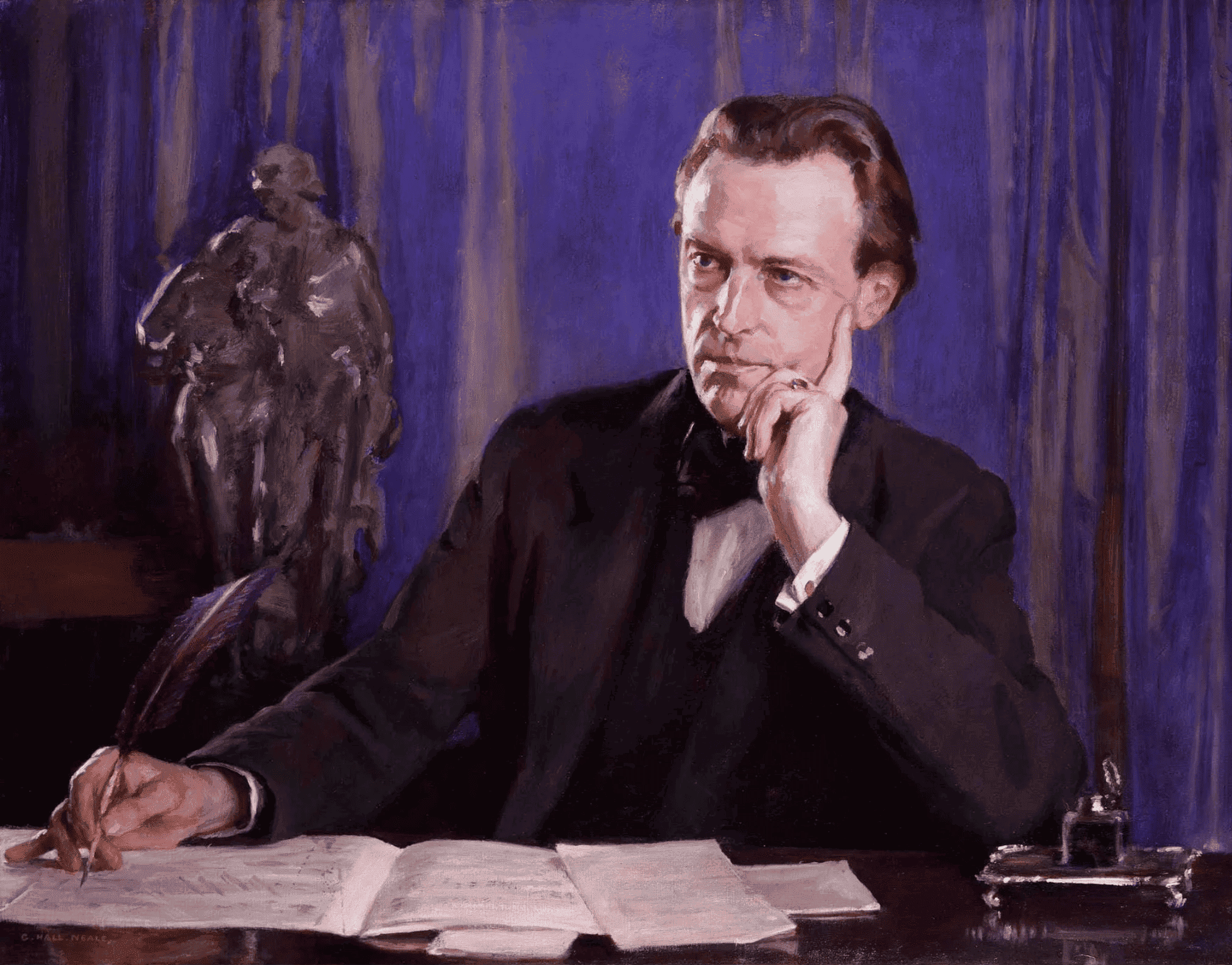
[cover: Cyril Scott, by George Hall-Neale © National Portrait Gallery, London.]
(Cyril Scott, The Initiate | Some Impressions of a Great Soul, 1920.)

To That Great Soul whose identity is concealed under the name of JUSTIN MOREWARD HAIG.
These Impressions Are Gratefully And Lovingly Dedicated.
PART I
- Introductory. On Initiates, Adepts, and Masters.
- I. The Man Himself.
- II. The Wise Innocent.
- III. The Second Meeting.
- IV. The Conventions of Mrs. Darnley.
- V. The Garden Party.
- VI. The Figure in the Room.
- VII. Daisy Templemore’s Rebuff.
- VIII. The Unchristian piety of Archdeacon Wilton.
- IX. The Philosophy of Death.
- X. The Chagrin of Major Buckingham.
- XI. The Triumph of Nobility.
- XII. The Strange Alteration in Justin Moreward Haig.
- XIII. My Sister’s Letter.
- XIV. The Re-Meeting of Gordon and Gladys.
- XV. The Self-Imprisonment of Mrs. Burton.
- XVI. The Conversion of Flossy Macdonald.
- XVII. The Prelude to the Story.
- XVIII. The Departure of Justin Moreward Haig.

Introductory
ON INITIATES, ADEPTS, AND MASTERS
THE story, if so it can be called, of Justin Moreward Haig is a true one, in so far that such a person does exist, although, as explained later, I have been compelled for many reasons to conceal his identity. And I emphasise the fact of his existence because there are a number of people who may doubt the possibility of attaining to that degree of perfection which he undubitably manifested, thus crediting me with writing romance instead of fact. And yet he does not by any means stand alone at his stage of spiritual evolution, for not only are there many more like him living amongst us at the present time, but if world-history is to be accredited with truth, there have been hundreds as great as and greater than he in the past. True it is that the so–called enlightenment of our twentieth century civilization seeks to negate or explain away the unusual powers of these men, but deeper thinkers who have taken the trouble to penetrate behind the veil of superficial knowledge are coming to the conclusion that the old truism “where there is smoke there must also be fire” is applicable to the case in point, and that this negation and explaining away on the part of so-called civilization is not the result of real knowledge, but of ignorance instead, Nor must we leave aside the contributions which Romance from the most ancient of times has afforded in this connection; dating from before the period of Kalidisa to the latest works of fiction published in the present year, we have novels, stories, and dramas dealing with mysterious and marvelous beings so far above the ordinary “man in the street” almost as a human soul is above an animal. Indeed, seeing this is so, are we not forced to ask the pertinent question whether the imagination of creative genius has not somewhere its foundation in Truth? Can all these poets, dramatists, and writers really be weaving the fanciful web of mere fable, and nothing beyond? For if so, why do they still persist, in the face of scientific ridicule, and thus continue to fill the public mind with falsehood and unsubstantiality? And the answer to this question is, consciously or unconsciously, they are stating the truth, and their subjective mind is aware of facts which their objective mind is ignorant of; for these Adepts, Sages, and Masters do exist, and he who knows how to search can find them and become convinced of their reality once and for all.
Now, although I have inferred that Romance is correct as far as the fundamentals are concerned, yet as a matter of truth it is very often incorrect in its details, or at any rate very misleading, in that it blends allegory with fact without notifying the dividing line between the one and the other. And to begin with, these great Adepts of Spiritual Science are not quite as mysterious as writers of fiction and even supposed fact would have us believe. Although I am aware that two such Masters (or Mahatmas, as they are often called) reside in the far distant fastnesses of Thibet, yet to suppose they all follow this example is to suppose a fallacy; for I know there are several such Masters living in England at the present moment, as well as in America and in almost all countries of the world. Nor do they remain in one locality, but often travel from place to place as any ordinary mortal might, being to all outward appearance perfectly human, nay, perfectly normal. They may not cruise about the world in a marvelous yacht, as Marie Corelli would have us believe (if that be her object), nor are they the “morally dried-up mummies” which Bulwer Lytton depicts in his prototype Mejnour, to be found in Zanoni, his occult novel; but as Romance permits itself, and quite naturally the indulgence of “romancing,” we must not expect accuracy from its writers any more than we must expect it from impressionist painters.
I have said that to all outward appearance these Adepts are perfectly normal, perfectly human; but it is to outward appearance only, and the result of a closer relationship with them, and their minds and faculties. To the casual cquaintance, apart from an appearance of unusual health, calm, dignity, and force, there is nothing which might awaken the suspicion that they possessed powers of whose existence he was entirely unaware. Dressing neither in strange garments nor living in ghost-haunted castles, these men, far from wishing to awaken the curiosity or admiration of their fellows, seek to render themselves as ordinary to the casual observer as they possibly can. Many of them even affect some harmless vice of their fellows-such as smoking for instance-in order the more to normalize themselves in the eyes of the world. But this is indeed only to the world, for those who come to them, seeking with the necessary qualifications occult wisdom at their hands, obtain a very different impression; an insight into their marvelous personalities, which to any others is sedulously denied. And it is absolutely essential that in order to find we must know how to seek, only to him who follows the requisite of this maxim is it possible to discover the truth; and that truth is very quintessence of real romance. In other words, the outer world, not knowing for what to search, finds nothing, or at best very little; so that for any portrayal of an Adept or Initiate, we must of necessity turn to the student or disciple, and to him alone; for through his thirst for occult wisdom he has eared the right to know the Masters as they really are in all their divine possibility.
Lets us then try to imagine a human being, devoid of the weaknesses and drawbacks of the ordinary person; a being who is utterly beyond the feelings of selfishness, vanity, jealousy, anger, hatred, and other “vice” of a kindred nature; moreover a being who possesses a consciousness so intense, so infinitely alive as to warrant the expression super consciousness rather than life. And this superconsciousness of necessity embraces a continual “sensation” of unconditional bliss and unconditional Love, conjoined with which is a supreme wisdom and power. As to the latter, the Adept, possessing knowledge of Nature and its laws as yet not disclosed to Humanity at large, is able to control nature forces in a way which the ignorant cannot even imagine, let alone follow: indeed, were he to exhibit the manipulation of those forces to the uninitiated (which, however, he never would to) they in their utter incredulity and ignorance would ascribe the whole exhibition to trickery, and pronounce him at best a conjuror, if not a fraud. In a word, show people what they cannot understand and immediately they will ascribe it to something they can understand-for that is ever the tendency of the ignorant.
We have thus attempted a description of the inner man; and now to deal with the outer aspect, the more visible side of the Adept. And to begin with, he manifests perpetual health, and in many cases perpetual youth, or better said, the prime of manhood. Electing to work unceasingly for the manhood. Electing to work unceasingly for the good of Humanity, and finding an aged body a hindrance to this, he brings his occult knowledge to bear on the molecules of his physical body, and so prevents the change known as age; finally dying when he chooses to die, and not before. Nor must we omit another point connected with his youthfulness and perfect health, namely the fact of his entire freedom from worry, and his entire immunity from all those jarring emotions which so tend to age the body and upset the bodily equilibrium. Possessing in his mind an eternal peace, the frets and troubles of life seem to him childish and insignificant, as insignificant as the troubles of infa ncy to the grown-up man. And yet being possessed of perfect Love, he can sympathise with others as a mother loves and sympathises with her child, and the very frets she knows it will one day outgrow. Indeed, as sympathy to be intrinsically valuable must be untainted with fear-for otherwise it were impotent truly to aid and console-so is the fearless sympathy of a Master the most valuable and help-bringing it were possible to conceive. And at the back of this utter fearlessness is Knowledge, that Knowledge which must ever exist as the only true basis of solace, the balm wherewith to soothe the bleeding heats of nescient suffering Humanity.
I have attempted this lame reader may the more Adept in order that my reader may the more easily understand the truthfulness of this book, and not credit me with adding to the large proportion of romance on the subject; for verily, in my opinion, “truth is more romantic than fiction,” whether it be stranger or not. Indeed, should I in the following pages succeed in depicting one-fourth of the magnetism of the personality of my teacher, then I shall not entirely have failed-which is all I can hope for in so difficult a task. I have, in fact, much to contend with, for the simple reason I am not permitted those scenic and ceremonial appurtenances which fiction draws to its aid. An Adept of High Initiate is so different in respect of greatness to the ordinary great man; so chary of fame and all its glamour that to know him in the spirit and flesh is really the only way to know him at all. Being devoid of vanity, and thus importuned by any form of curiosity on the part of the public, he seeks in every way to draw attention from himself instead of the reverse: and thus if he lives apart from the “world” it is to hide himself in solitude, and if he lives amidst the world, it is to hide himself among the crowd.
Chapter I
THE MAN HIMSELF
I HAVE before me the absorbing task of writing my impressions concerning a man who has reached a degree of human evolution so greatly in advance of his fellow-creatures that one might regard him almost as a living refutation of the old catch-phrase: “Nobody is perfect in the whole world.” The fact is, like many catch-phrases, the assertion involved is so far incorrect that one of the objects of this book is an attempt to prove its incorrectness.
Whether Justin More ward Haig (I am not permitted to reveal his real name) was what occultists call an Adept, this I cannot say: for in all honesty I do not know, the reason being that in matters concerning himself he was exceptionally reticent. But I do know that if one could erase the many unsatisfactory associations connected with the word saint, and rid the word “Superman” of its equally unsatisfactory ones , Justin Moreward Haig (I usually called him Mordward ) might with perfect right be called either of these, or both. Indeed, my association with this truly wonderful man showed me that a saint could exist without exhibiting an ultra-devotional temperament, carrying itself almost to a degree of unpleasantness, and a superman could exist likewise, without that arrogant love of power which is so characteristic of the Nietzsche an ideal. But there is one thing, however, without which neither saint nor superman could come into being, and that is an inherent spirituality; and although the wisdom-religion of Moreward Haig was as different from a man of very meager intelligence, to deny him a religion at all were to grossly misrepresent a certain side of his almost unique personality.
All the same, in speaking of religion and perfection we must not forget there are certain unreflective persons who imagine that to be perfect means of necessity to be tedious at the same time; they quite fail to realize that dullness is an attribute of imperfection rather than perfection, and that they might with equal lack of rectitude say that to be white is of necessity to be black, or that to live in the Nirvana of perpetual bliss would be to live in the tedium of a perpetual hell. If there was one thing which Moreward was not, it was tedious; such an epithet cannot apply-he was too unexpected in all his opinions and in most of his actions. He was not a man who merely talked poetry (for true poetry always has an element of the unexpected, otherwise it would be a banality), but his life itself was a continual poem-the poem which the highest ethics would demand that it should be, yet which the most exceptional human being hardly ever lives up to; for really to live up to that demand, and without any apparent effort, would be to do one of the most unexpected things on earth.
The story, if so it can be called, then, of this so exceptional man is a true one; in so far that such a person does exist, although, as explained later, I am compelled for many reasons to conceal his identity. But I feel constrained to emphasise the fact of his casual existence because there are a number of people who may doubt the possibility of attaining to that degree of perfection which he assuredly manifested, and so may regard him as merely another romantic and improbable creation of mere fiction. All the same, however much an actual living person Justin Moreward Haig may be, I must apprise my readers at the outset that I, on my part, am neither a species of Boswell to a present-day Dr Johns on nor a Dr Watson to Sherlock Holmes; I never lived in the same house-except for a day or two now and again-with Moreward, and therefore I could not follow him in all his adventures-if he had any-and relate them afterwards. All I set out to do is to record his opinions, and the way he lived up to those opinions as far as I have come into contact with them, and no further. I cannot write the story of his life, for he simple reason that I do not know that story; I can only surmise it may have been a very remarkable one, and there the matter ends. As to the description of the man himself: as regards personal appearance, I am requested not to give too much detail; and apart from that request, I think it expedient to allow the reader the full play of imagination: let him, in other words, form his own portrait of this remarkable man from the perusal of his sayings and actions. One has often noticed in life how many personal idiosyncrasies exist in connection with a preference for this or that physical type; and ma ny a hero of a novel has been spoilt for certain people by a description of the very type of personal physiognomy which they happen cordially to dislike. So that, in the present instance, I think such a thing is especially to be avoided; and, although I grant this course is far form usual, my plea is that expediency is weightier than convention. It is not a very difficult matter to establish the connection between what a man is and what a man looks; and when I present a human being who never indulged in the folly of worrying, and who was moderate in all things, the first supposition concerning him would be that he presented an appearance of perfect health. In addition to this, if I say that during the years I have known him, not once have I seen him sorrowful except with the pleasant and mild sorrow of perfect compassion, it is not difficult to imagine that his face was one of serene happiness, with that beauty of expression which corresponds invariably to such a state of tranquil mind. As to the psychic element in his personality, let those who have the notion that psychic faculties can only exist with an unpleasant concomitant of hysteria and the outward appearance which goes hand in hand with it, rid themselves of a notion so false; psychic faculties to be entirely reliable must be accompanied, save in very exceptional circumstances, by perfect health and by nothing short of it.
For the rest, I would add that Justin Moreward Haig entered my life some twenty years ago, and left it about ten years later for activities in another part of the world. Although I have his permission to write these impressions, yet at the same time he requests me to refrain from any description that would disclose his identity and the identities of those with whom he associated. Nor, as to the latter, could I well do otherwise, since no doubt many of them are still alive, and my allusions to some of their weaknesses might not be entirely to their liking. As to the former being thus restricted, I can but leave my readers to guess who this remarkable personage is, if in the course of their wanderings they have ever come across one who resembles him in Wisdom and Love.
I may add one word more, explanatory of how these impressions came to be written, for, should I omit this, my readers may credit me with a perfection of memory I make no claim to possess. The fact is, when I realized I had come into contact with a man of such exceptional wisdom-at least had acquired in connection with shorthand, jotting down many of his sayings whenever occ asion presented itself. True it is, I was compelled very hardly bring out a notebook in the presence of others, but the strain on my memory was at any rate only slight, for, having kept a diary for a write the events of each day in the evening before retiring to bed. For the rest, it is only right I should inform my readers that on certain occasions my memory may have played me false, and therefore the record has proved inaccurate as a result, of Justin Moreward Haig which he never uttered. Should this be so ,then the fault is mine and not his, and that being the case I prefer to call this book “Impressions” rather than any more presumptive title.
As to the anonymity of the Author, I think I need make no apology respecting this, for were I to reveal my own identity I should be in great danger of revealing the identity of its “Hero” as well. Moreover, in books of a moral-philosophical nature, the personal is not only uninteresting, but may often prove an obstacle, in that hardly a human being on earth is entirely without enemies. Often have I heard the remark, “If such and such a book is by that man, certainly I shall not read it ;” and through this fact that avowed authorship may evoke such a reflection, one is constrained to feel how disadvantageous is the personal element. For the man who writes alone for his friends, and not for his enemies as well, falls short of being a true philosopher, by reason of the fact that all real philosophy has missed its goal unless it brings us Peace.
THE AUTHOR
Chapter II
THE WISE INNOCENT
IT is quite a mistake to suppose that the romantic can only come into being through a combination of perfectly congruous circumstances, for these is a species of Romance which s born from the entirely unexpected. To find a great sage living on a lonely mountainside is to find the obviously romantic, but to meet a great sage in the most mundane London drawing-room is to find the unexpectedly so: the lonely mountainside acts as a frame to the central picture, the frivolous London drawing-room acts as a foil-that is the only difference.
How Justin Moreward Haig came to be in the drawing-room of one of the most worldly women in London is a secret I shall disclose at a later period in the progress of this narrative-suffice it to say, I am indebted to Lady Eddisfield’s hospitality for the most valuable friendship of my life. Nor have the details of this strange meeting escaped my memory. I can recall how, at the end of the most unmusical of all musical performances, I found myself encumbered with a companion of a far from sympathetic type; a species of ill-fortune which fell to my lot as the result of that pairing together of people on the part of hostesses, irrespective or whether they be suited to one another or not. And so it was, we found ourselves at one of those round supper tables with a party of four others: the man I have called in this episode “the Wise Innocent,” and three women, who remain in my memory, because they struck me at the time as being a sort of trinity of superlatives. One seemed to me the most corpulent woman I had ever beheld; the second, the tallest; and the third, the darkest, outside the category of negresses and Indians.
He was talking what the three ladies, who leant with enthusiastic curiosity in his direction, seemed to regard as extraordinary wisdom; as for me, I merely regarded it as extraordinary at the time- minus the wisdom.
“A certain point of view,” he was saying, “is a prophylactic against all sorrow” ( I could see one of the ladies had never heard the word prophylactic before), “and to acquire the right point of view,” he continued,“ is the object of all mature thinking. That being so, mental pain is the result of a certain sort of childishness, and a grown-up soul would be as incapable of suffering over the thing you spoke of, as a grown-up person over the breaking of a doll.”
“You mean, I suppose, by a grown-up soul,” said the stout lady, “a philosopher?”
“Precisely: I mean a sage, or a saint or philosopher,” was his answer; “in other words, a man who has identified his mind with that unconditional happiness which is within, and which is the birthright of every human soul.”
I pricked up my ears and looked significantly at my companion for a moment, and then I asked a question.
“You suggest, ” I said, “that all mental pain is a form of childishness; then why isn’t happiness the same?”
He turned his strangely gentle but forceful eyes upon me. “Pain,” he replied, “belongs to the illusory things of life ; and it is a characteristic of children to like illusions; their very games consist in pretending to be kings or soldiers or what not. Contentedness, on the other hand, is one of the qualities of maturity, and….”
“I can’t see,” interposed one of the ladies, “where the illusion comes in if Wilfrid’s wife has ceased to love him and fallen in love with another man.”
“The illusion comes in,” he replied dispassionately and smiling, “in his being upset by the fact.”
“Well really?” ejaculated the stout lady.
“Jealousy,” he continued, “is also, of course, a form of childishness.”
“But Wilfrid never was jealous,” pursued the first lady.
He smiled upon her with a begin friendliness. “Jealousy exists in two degrees,” he said; “one where there is no cause for it, and the other where there is-only he who is unperturbed when there is real cause for jealousy is in truth an unjealous man.”
“I should hate to marry a man who wasn’t a bit jealous,” said my companion somewhat hotly, turning to me.
“Yes,” he said, casting his benign smile in her direction, “and there are many women who say the same thing. You see they think jealousy is a compliment to them, but that again is an illusion-the real compliment would only exist if a man loved a woman so much that he always put her happiness before his own.”
“I should hardly think there are many such husbands running round,” said I.
“And if there were,” urged my companion, “they would be more like fish than husbands. At any rate I should hate to have one of that sort.”
“That is only because perhaps you have never thought about it very particularly,” he replied soothingly. “You see,” he continued with a touch of chivalry, “a noble woman would never wish her husband to be troubled by both a painful and a rather deplorable emotion-simply in order to gratify her vanity.”
At which juncture my companion took refuge in a laugh. “You are certainly very clever,” she said.
He waved the compliment aside with a suave gesture, “I am mer ely one of those fortunate or unfortunate creatures who can’t help seeing things exactly as they are,” was his answer.
“Then you lack the artistic,” said one of the ladies, “You can’t, like a modern painter can, see a factory chimney as if it were an old castle.”
“Alas! Perhaps you have hit the nail on the head,” he admitted. “In fact, I am troubled with an innocence which makes it very difficult for me to realize how people can believe things that are palpably untrue.”
“For instance?” I queried.
“Why, for one, that a man can never be really in love unless he be jealous.”
“It is obvious you are not married yourself,” I inferred with a touch of inner maliciousness.
“I was married,” came his somewhat tardy reply (and for the fraction of a moment the word “div orced” entered my mind and the thought “Now I have put my foot in it”); but he continued, “I am a widower.” (And then we all exchanged hasty glances.) “That being so,” he pursued, as if to put us at our ease, “my matrimonial ideas are not of necessity mere theories.”
“In fact,” said one of the ladies, “you were a very magnanimous husband.”
Again he waived the compliment aside. “I was merely a practical husband because I have always felt that it never pays to be anything else but what you flatteringly call magnanimous. Besides,” he added, “the sense of possession is again a childish attribute.”
“What do you mean by that?” queried my companion.
“Why, that you might as well try to own the moon as to try to own another human being: every human soul belongs to itself, and to itself only.”
“Then why marry at all?” said I.
“So that you may live with the person you love without bringing scandal upon her,” came the ready reply.
And here, somewhat to my annoyance, the voice of a flunkey interrupted my by the whispered information that I was desired by the hostess to complete a bridge quartet. I arose, with the customary civilities, and departed.
It was only as I was standing in the hall at a very late hour, waiting for a cab, that my whetted curiosity was to some extent, for one of the three ladies was standing there for the same purpose.
“Who on earth was that extraordinary young man?” I asked in an undertone.
“Young?” she said. “I happen to know he is well over fifty-five.”
“That makes him more extraordinary still-but who on earth is he?”
“Well, his name is Justin Moreward Haig, and he came from Rome two months ago-that is all I know about him,” was her answer.
But this very meager bit of information did not satisfy me, and I felt that this stout lady, who looked as if an utter absence of curiosity in her make-up was hardly to be expected, must be with holding form me, at it is colloquially expressed. A man like that could hardly be seen, and ungaugeable velocity, without at least some stories getting abroad about him in one way or another. They would probably be more or less false, exaggerated or unbelievable, but, all the same, somebody must have launched a few on the ever-restless waters of social gossip; any contrary notion was inconceivable. Besides, this lady of such large dimensions had used the phrase “I happen to know” when questioned respecting his age, and this might be significant, Although I had only seen this man for at most twenty minutes, and heard him taking large portions of gilt off the gingerbread of some of our most precious prejudices in addition (a procedure at that time of my life which struck me as almost laugh able), yet there was a magnetism, a gentleness, and at once also a strength about his entire personality, which drew me towards him in a manner I could not get away from. He made one feel, in sprite of one’s utter disagreement with the things he said, as if he were profoundly wise, and yet, through the very saying of them at a supper party, and before two entire strangers at that, as if he were also most strangely innocent. It even struck me, as it afterwards struck me for a moment at out next meeting, that he might be a little mad, and was endowed with that very sincerity which is a sign of madness. It is, in fact, only mad people who can make the most unheard-of statements with absolute sincerity, they alone being convinced that what they are saying is absolutely true.
There reflections had, of course, been occupying my mind while still confronting the stout lady, who in the meantime made conversation of a nature I found no necessity of paying much heed to. I was really waiting (while she deplored she could not just fly to parties and “at homes” or press buttons and be in one place or another-anything to prevent this awful standing about for one ’s carriage), for the end of this “talk at all costs” kind of remarks, to extract from her some burst of confidence respecting this strange being she “happened to know was well over fifty-five.”
“But to revert to this man,” I said; “how do you know he’s as old as that?”
“He’s got a married daughter who looks thirty-eight, if she looks a day,” was her answer.
“Was she here to-night?”
“She went back to Rome about a fortnight ago.”
“But are you certain she was his daughter?” I queried.
“He introduced her as such-but, of course, one can never be certain of anything,” she added uncharitably, “at least, of relationships.”
“Mrs. Jameson’s carriage,” shouted a voice from outside; and that ended my interrogation, and also the episode of my first meeting with the man I have paradoxically called “The Wise Innocent.”
For at that meeting (and the subsequent one) he struck me as an embodiment of this pair of opposites.
Chapter III
THE SECOND MEETING
I confess that for some days after this first encounter I found myself thinking of that supper party and its central figure with a persistence and frequency which seldom occurred in my world of thought. Apart from the unsolved question as to who he was (for his name conveyed very little to me), a series of further questions kept forming in my mind, which he science of deduction failed in any satisfactory manner to answer. Nor did the few acquaintances I approached respecting him aid me any more than the stout lady I had questioned that evening in the vestibule: for the answers they gave were as uncommunicative as hers. I wish to obtrude myself in these impressions of a strange and noble being as little as possible, but there are certain matters in which I would be liable to misrepresent him if I kept a complete silence res pecting one or two of my own reflections. The way, for instance, he had juggled with the word “childishness” caused me at first to wonder whether he was troubled by an overwhelming conceit; but when I reflected he had referred to it with as much absence of the personal as one might refer to a cloud or a cloudless day, the idea of conceit all but vanished from my speculations.
And then one day we met by accident in Kensington Gardens, from which meeting a friendship ensued which has set that and most other questionings at rest.
I was seated dreamily contemplating that part of the Serpentine which looks like a countrified river flowing between peaceful green swards, when to my surprise he came upon me all of a sudden and sat down beside me.
“We are destined to be friends,” he said, laying his hand for a moment on my arm, “and, that being so, the sooner we begin our friendship the better.”
I murmured something about being honoured and pleased: for the remark gave me pleasure, although I thought it a trifle peculiar.
“We do not waste our breath on preliminary trivialities,” he continued, “but go straight to the point, as you observe, Talking for the sake of talking is seldom advisable.”
I agreed that people as a rule did talk too much, but I wondered in my own mind what the “we” meant-it seemed to have no application to myself.
“I remember,” he went on, “when I said goodbye to you in Egypt under rather tragic circumstances some two thousand years ago, I tried to comfort you by the assurance that we should meet under far happier conditions; you were a woman in those days.”
“Oh, indeed!” I said with a presence of mine I had hardly thought myself endowed with, considering it flashed through my brain that I might be in the company of a lunatic. After all, some lunatics can be charming. He looked at me for a moment with a friendly twinkle in his eye.
“Do you remember an aunt of yours, called Aunt Jane, by surname Mrs. Wibley?” he asked.
I admitted I did-she used to be regarded as the family crank.
“I know her,” he said.
“Know her?” I repeated; “Why, she has been dead these twenty years.”
“That is no obstacle to our acquaintanceship,” came the ready reply.
“Look here,” I said, laughing, but inwardly a little nettled; “are you joking?”
“I forgive you for casting such an aspersion on me,” he said, laughing also; “but wait and see. Do you remember,” he continued, “your Aunt was the subject of a certain amount of moderately friendly derision on account of her spiritistic tendencies?”
I did remember.
“Do you further remember she vow ed, after a certain family discussion, she would convince her opponents one day by sending a message from the other side?”
I remembered perfectly.
“Very well, then, she has sent that message.”
“What is it?” I asked with scanty credulity.
He told me-and I am bound to confess it was very convincing, for it made allusion to a matter which concerned nobody but myself.
“However did you get it?” I asked.
He told me at some length. “I suppose you are a spiritist yourself?” I said after his explanation.
“Hardly in the sense you mean it,” was his reply. “I am everything and, if you like, nothing. To be born in a certain belief in good-to die in it is unfortunate. Beliefs are the crutches by which some people hobble towards Truth—when one arrives there, one throws the crutches away. Many devout religionists believe, but to believe is not of necessity to know; only the practical occultist knows.”
“You are an occultist, then?”
“Yes, I think I may be called by that name,” he said modestly.
“Tell me,” I asked with a burst of curiosity, “how is it that a man like you can find the least pleasure in doing the tedious round of London society?”
He laughed. “A thing is tedious or pleasant according to what you yourself bring to it,” he said. “If you really wish to know, I am on the search for spiritual adventures.”
I failed to understand exactly his meaning, and told him so.
“I admit the phrase is ambiguous,” he said, “but it is hard to express it otherwise in one short sentence.”
“I am really genuinely interested, and would honestly like to know,” I urged.
“Well, it is this way: I have a hobby: it may seem to you a strange one, but I endeavour to alter people’s point of view in order to adjust their difficulties. If you want to call me by a pleasant name, you would call me a certain sort of philanthropist: a dispenser of moral charity.”
A little understanding began to dawn upon me.
“I take no credit to myself,” he continued; “it is a pastime like others, but it has one great advantage-it does somebody else some good. The sportsman gives other living things pain in order to get pleasure himself-the ideal sport is to derive pleasure oneself from relieving other people’s pain.”
“Yours, them, is the doctrine of giving?” I inferred.
“Yes,” he said, “but there are two kinds of giving-one sort of gift is fleeting, the other is enduring.”
I did not quite follow him.
“If you give a hungry and lazy tramp sixpence,” he said, “in an hour or so, having spent his sixpence, he is hungry again; but if you present him, so to speak, with a point of view that renders him, genuinely desirous of working, you have given him something of priceless value.”
I told him his philosophy struck me as replete with practical wisdom.
“Now,” he continued, “there are plenty of people who selflessly go into slums and dispense monetary charity; but who goes into the slums, as it were, of society and dispenses comfort to deserted wives and love-sick girls and jilted lovers, and bereaved husbands, and the multitude of unhappy mortals with whom society abounds?”
“Evidently you do,” said I.
“At any rate, I try to,” he said smiling.
I took out my cigarette case and offered him a cigarette, which he accepted. But then I found I had forgotten my matchbox. He produced a little gold box from his pocket. A strong spring-time breeze was blowing, and every match he lighted annoyingly went out. I watched him with some amusement, for he showed a complete absence of all impatience, which struck me as quit phenomenal.
“Do you never get impatient?” I asked at last.
He looked at me laughingly askance.
“Impatient?” he said; “why should I? I have Eternity in front of me.”
And then he lighted my cigarette with the last match in the box.
“And so now (to return to your question) you know why I do the rounds of London society,” he said.
“And society will be better for it,” said I.
He waved the compliment aside, as he invariably did.
“But there is one thing you do not know,” he added.
I asked him what it was.
“You don’t know that I dislike talking about myself.” After which remark he rose to go.
I laughed. “By the way,” said I, rising to shake hands, “I don’t think you know my name; we have never been formally introduced.”
I laughed again; it certainly was a novelty in introductions.
“We meet at Mrs. Darnley’s on Wednesday,” he added as he moved away.
“But I have not been invited,” said I; “besides, I have another engagement that evening.”
“We meet there, all the same.” And he walked towards the path.
“I love that man,” I thought to myself, as I watched him out of sight. And strangely enough, when I got home, I found a postponement of my Wednesday engagement, while the next delivery brought me an invitation from Mrs. Darnley.
Chapter IV
THE CONVENTIONS OF MRS. DARNLEY
I soon discovered it was a certain harmless idiosyncracy on the part of J.M.H. to shock people as it were at his own expense. The greater portion of mankind are chary of giving expression to the unexpected, and, when compelled to do so, prelude their assertions with such a liberal abundance of excuses, that the unexpecte d becomes transformed into the merely expected at the end of it all. Now, my friend had a twofold purpose in casting conversational bombs into the arid chatter of conventional society-it obviously amused him on the one hand, and it made people think on the other. “There are two ways” (he said to me one day) “of being emphatic-one is to shout, which is often objectionable; the other is to state a usually unknown truth as if you were saying the most obvious thing on earth.” And certainly this method bore its results, for I may say I remembered every word of his conversation to me in Kensington Gardens that day, as well as most other of his (shall I say?) discourses. But there was one thing he never indulged in : he never said anything startling merely to make effect: everything he did say he believed to be true, and he said it with a convinced simplicity that implied he knew his listeners believed it to be true also. The further result of this was to tincture his personality with an innocence and childlike naivete which could not fail to captivate and convince those who came into contact with him. People, in fact, when they were shocked, were pleasantly shocked, and, therefore, never in a manner which awakened in them the faintest suspicion of resentment. Nor could it be otherwise, for he never attacked their sacred beliefs with the weapon of ridicule: his method of exposing error lay seldom in pointing out that something else was right. There was an exception, however, to this rule he adopted, and this exception was related to what he called the modern Pharisees.“Here,” said he, “I must reluctantly use the hammer and break up false idols.”
Mrs. Darnley was an old acquaintance of mine whose hospitality expressed itself most frequently in the shape of very diminutive dinner parties. Indeed, on arriving there that particular evening I was not surprised (but, on the other hand, pleased) to find no other guests than Moreward Haig and myself. Thus our little party consisted of Mrs. Darnley, her youngish and attractive daughter Sylvia, and our two selves. Nor did it remain at that, for, dinner being over, Sylvia, with some apologies, took her departure in order to put in an appearance at a series of “At Homes” which threatened to detain her long after we had betaken ourselves to rest.
Mrs. Darnley kissed her daughter “Good night” with an affection which unblushingly savoured more of convention than love, and watched her departure with a reflective gaze that betokened thoughts very soon to find expression for our benefit in words.
“That girl worries me,” she observed meditatively; “I don’t always like the look of things.”
We both expressed our sympathy and inquired as to the nature of the trouble.
“A poet is the trouble at present,” came the reply.
We laughed. “A friendship with a poet?” observed Haig.
“You call it a friendship!” she said; “but I don’t believe in friendships between young men laughter to suit the occasion.”
“Oh, come,” said I; “friendships is the only word to apply, when a woman is not a man’s wife or his fianc ée or his---“
“Now don’t say that word,” she interrupted hastily, “or you will shock me dreadfully; of course, she is none of those things.”
“Friendship,” said Moreward smiling upon her, “is a beautiful word, and a still more beautiful thing; then why wish to deny its existence?”
“I don’t deny its existence in the right place and between the right people; but Sylvia is so sentimental,” she said, a little peevishly, “not to say sloppy.”
“Is sloppiness, then, a synonym for love in your vocabulary?” I asked.
“You know perfectly well what I mean.”
“Yes, but are you sure that you know what you mean?” I persisted.
“How rude you are,” she said; “really, I ought to know.”
“But surely, sentiment added to friendship,” said Moreward after this little passage of words, “is a most fortunate element: it makes the friendship more complete. Are you not glad that your daughter should feel something that will add to her happiness?”
“I don’t think it will add to her happiness,” she replied; “besides, I don’t think it quite proper.”
“Then you don’t think it proper for your daughter ever to be fond of anybody but you-and herself?” said I mischievously.
“Don’t be ridiculous, Broadbent!” she said, laughing in spite of herself.
“Well, that’s what it amounts to,” said I. “Is it your opinion, then,” asked Moreward, but without the least touch of sarcasm, “that a person should love only his enemies?”
“Well, of course not.”
“I have heard of a precept which runs,‘Love your neighbour,’” I remarked with a twinkle; “I am sure you live up to it.”
“I try to,” she said with momentary piety.
“But you don’t think your daughter ought to love her neighbour, especially if he be a man, and more especially a poet?” I continued, with the same twinkle.
“You know perfectly well,” she said, getting the worst lf it, “it doesn’t mean that sort of love.”
“Ah, isn’t that just where you make the mistake?” said Moreward with a certain gentle earnestness. “ In reality there is only one sort of love, and the difference you make, and other people, too, who perhaps have never deeply thought about it, is a difference of degree and not of kind.”
She cast a look at me as much as to say “I can listen to this man, because at any rate he doesn’t make fun of me.”
“You say you can’t believe in platonic love,” he continued; “at least, so I inferred; but if you could believe in it, you would agree as to its value.”
“Perhaps I would,” she acquiesced reflectively.
“Very well, but what, after all, is platonic love? It is simply a combination of mental sympathy and physical antipathy.”
“The best definition I have ever heard,” I interposed.
“I am afraid I am not clever enough to grasp it,” said Mrs. Darnley with a modesty not quite genuine.
“Well, it means this,” I explained, “that a man enjoys (as long as he can sit at the opposite end of the sofa ) a woman’s conversation, because he likes her mind, but would hate to get any nearer to her, because he dislikes her body. Isn’t that it?” I asked Moreward.
“Somewhat crudely put—it is,” he agreed, laughing.
“I don’t think it sounds very nice,” remarked Mrs. Darnley.
“It is a trifle dull,” I observed mischievously.
“And yet,” pursued Moreward after this interruption, “Plato never meant it in that sense at all; he merely meant a species of self-control; a love which refrains from giving vent to the complete expression of physical passion.”
“Oh indeed!” said Mrs. Darnley, not knowing whether she ought to be shocked or not, “I have never heard that before.”
“Like so many things,” I interposed, “the Pharisees have adjusted its original meaning to suit their petty conventions.”
“Pharisees!” she repeated. “Why, surely they do not exist nowadays?”
It was on the tip of my tongue to tell her I thought she was a Pharisee, but I refrained.
“Don’t you think it is just the modern Pharisees, perhaps,” said Moreward, “that hypnotized you into believing that it is improper (which means in other words slightly wrong) for your daughter to be fond of this man? Looked at from a spiritual point of view, the wrong would exist if she were not fond of him.”
“Really, Mr. Haig,” she said, “you do turn things round so.”
“Surely it is the Pharisee who turns things round,” said I; “he says ‘Thou shalt not love thy neighbour.”
She laughed impotently.
“Would you have your daughter possess an unloving heart?” said Mordward with calm simplicity.
“I should like her to love somebody one day—the right person, of course,” came the answer.
“Right from a pecuniary point of view?” I inferred.
“Right from every point of view,” she corrected.
“Your meat might be her poison,” I remarked.
She feigned not to understand, but really she understood perfectly.
“Has it ever struck you, Mrs. Darnley,” said Moreward with deference, “why there are so many unhappy marriages?”
“Well, I have never thought very much about it,” she said.
“Don’t you think it may be because too many mothers look at all friendships from the matrimonial point of view?”
“Perhaps-but that is just what I am not doing—“
“Pardon me,” he said with courtly gentleness and a motion of the hand, “but that is just what you are doing. You are, as it were, swinging between the two horns or the matrimonial dilemma.”
She looked genuinely puzzled, and told him so.
“I mean,” he explained, “that you are afraid your daughter may want to marry this man, and you are also afraid she may not want to marry him. In short, your attitude towards love is marriage or nothing. That attitude, dear friend, is the cause of most conjugal unhappiness. Young people marry unsuitable acquaintances instead of real friends.”
“It is all very well for you to talk,” she said unconvincedly, “but really I cannot allow my daughter to have a series of ‘affairs.’ Whatever would people think?”
“To think of other people’s aspersions is vanity,” he said gently; “to think of one’s daughter’s happiness is love, I am sure you will choose the latter,” he added, laying his hand upon her arm.
“Well—well,” she remarked, pleased with the compliment, but doubtful whether she would live up to it. “Well—well, we shall see.”
And that put an end to the discussion, for Miss Sylvia herself entered the room, to our surprise.
“I really couldn’t stand another of them,” she said, “the first was so unspeakably boring—so I came home.”
Soon after that we went home.
Chapter V
THE GARDEN PARTY
Some ten days later we found ourselves together again at Lady Appleyard’s garden party. I had seen J.M.H a few times at his own house and elsewhere betweenwhiles and he had told me that, if possible, he intended to render Miss Sylvia some slight service.
“Her aura exhibits fine qualities,” he said, “and if she is only permitted to love and to live a little she will make great progress in this incarnation.”
And I may say, in passing, that this occult observation and others of a like nature struck me no longer as startling or especially crytic, since a good deal of discussion on occult philosophy had in the meantime led me to a relatively serviceable understanding of that absorbing subject.
We had led the not unwilling Mrs. Darnley to a shady spot in corner of Lady Appleyard’s tasteful and extensive garden. Conventional as she was, she obviously admired and liked my wise friend a good deal more than she liked most people. As for me—well, I may say I amused her, if I did nothing else.
“And your daughter’s poetic friendship,” he said, “I trust you are not putting obstacles in its way?”
“What obstacles can I put in its way?” she said.
“Lack of sympathy” said Moreward.
“I can hardly be expected to sympathise with a thing I don’t approve of.”
“The truest sympathy is that which sympathises with things one does not agree with,” he said gently, but earnestly; “sympathy for sympathy’s sake-sympathy for love’s sake.”
“Perhaps you don’t love your daughter,” I said with the imp of mischief in me.
“How can you!” she ejaculated.
“You have had some correspondence with this poet, I think?” he said, after a glance at me which conveyed the impression that we must be serious for the present. Mrs. Darnley looked genuinely surprised.
“How can you possibly know that?” she said. “Even Sylvia doesn’t know it.”
“There are many ways of knowing things without being told,” he answered smiling. “You have, I think, one of his letters in your bag?”
She was still more surprised.
“Might I have that letter just to hold in my hand? I will not read it, of course.”
She opened her bag with a puzzled expression and handed him the letter.
“Thank you, And now,” he continued, “supposing I were to describe this man and his character to you, and supposing we found the character to be a good one, would you alter your attitude?”
“I don’t know,” she said doubtfully.
“Well, let us see,” he continued, gently feeling the letter between his thumb and finger. “He is a tall dark man, clean shaven, with an ascetic but healthy face, high forehead, hair brushed straight back, penetrating eyes, grayish green in colour. That is correct, I think?”
“Absolutely; but however-”
He ignored her astonishment.
“His character coincides with his face. He has a fine type of mind and an unselfish temperament and an altogether sympathetic and elevating atmosphere. I congratulate you, Mrs. Darnley, on this friendship for your daughter.”
He again ignored her increased astonishment.
“And now let us see what the future has in store.” He pondered for a moment. “Your daughter will not marry this man,” he said slowly. “Thwart them, however, in their friendship, and they will fall violently in store for all three of you. Allow them to see as much of one another as you can, and everything will adjust itself to your satisfaction.”
Mrs. Darnley’s astonishment and conventional vanity indulged in a tug-of-war, and vanity got the upper hand.
“But if I take your advice,” she said at length, “how can I prevent people talking?”
“To be upset by the jabbering of a few parrots,” he said, but without intolerance, “is a form of childishness which I hardly think you will be guilty of.”
There was a pause, in which Mrs. Darnley, I am sure, was realizing she would be guilty of it, though she would not call it childish, of course.
“Are you fond of poetry?” he asked by way of slightly changing the subject, at the same time handing back the letter.
“Devotedly,” she said with enthusiasm.
“But not of poets?” said I. “A poet is not without honour save in a family of beautiful daughters.”
“Can’t you teach him to be serious?” she said appealingly to Moreward.
“That is his way,” he answered with generosity. “He serves you a profound truth in a dainty manner.”
“There is one thing about men,” she observed, laughing; “they do stick up for one another-very different from women.”
“Therefore, I may be pardoned for sticking up for a poet at the present moment,” said Moreward suavely.
“You will take my advice?” he asked after a pause, in which Mrs. Darnley looked as if she wished the creation of poetry could be achieved by a sort of parthenogenesis, namely, without a poet.
“It is all very well for you to talk,” she replied; “you haven’t a daughter: if you had, you would think differently.”
“Pardon me,” he said smiling; “but I have a daughter.”
Mrs. Darnley showed surprise. “But, at any rate she is not grown up,” she said.
“But she is grown up.”
“And you never told me,” reproached Mrs. Darnley with increased astonishment. “How very unkind of you not to have brought her to see me. Dear me!” she added, “at whatever age could you have married?”
“Not so very young,” he replied, amused at her astonishment. “After all, a youthful appearance is merely a matter of a calm soul, combined with purity of nourishment. I think some old moralist said: ‘A loving heart makes a youthful body?”
“Well, really!” ejaculated Mrs. Darnley. “Wonders never cease!”
“Wonders never cease because they never exist,” he corrected, smiling. “What to one person seems a wonder, to another may be an everyday occurrence. I astonished you a moment ago by a slight display of psychometry because you have never heard of it , and yet nothing could be more natural to those who cultivate the faculty.”
“The only real sin in life,” said I, with mock severity, “is ignorance.”
“That is indeed true,” agreed Moreward, readily.
“Oh dear, ho dear! I wish I were clever,” sighed Mrs. Darnley as she got up from her chair and told us that she must be going.
We arose to bid her goodbye.
“You will not forget my advice?” persisted Moreward, patting her hand.
“We shall see,” she replied with feminine obstinacy.
He bowed courteously, and watched her our of slight.
“Pshooh!” he sighed good-humouredly when she was no longer to be seen. “I confess the atmosphere of a Pharisee is particularly stifling-her departure is like the lifting of a heavy thundercloud.”
I laughed.
“Truly,” he added, “the Pharisees are far from the Kingdom of Heaven-to see impropriety in all harmless and beautiful things is to live in a sort of earth-made hell.”
“I suppose Sylvia and her poet are really in love now,” I observed, “though you didn’t give them away?”
“Yes,” he said, “and an excellent thing, too. He needs her to stimulate his creative faculties, and she needs him to draw out her latent qualities. The sentimental side will die out sooner or later, but the friendship will remain.”
“You think the mother will prove tiresome,” I asked.
“For a time, yes. Conventionality, my friend, is one of the worst forms of vanity because so insidious. Mrs. Darnley, poor creature, is a coward by reason of her vanity; her one fear in life is what others will think. She does not live in the great world of love, but in a prison. By the way,” he added, “you see Miss Sylvia oftener than I do; if she gets into difficulties, you will let me know?”
“I will,” said I.
Chapter VI
THE FIGURE IN THE ROOM
From the foregoing chapter, it will be rea lized that Justin Moreward Haig possessed certain powers, which are, at any rate, not to be found in the majority of people, although one is apt to meet them more frequently nowadays than at the time of which I write. That they should have astonished me was, of course, to be expected, and also, as a result, that I should induce him to display them to me or others, merely to prove their existence, this was quite another matter. Indeed, he even begged me to refrain from spreading abroad in any form whatever my knowledge that he had the power to exercise any faculties outside the ordinary; telling me that when he felt called upon to use one or other of his powers in order to help a fellow creature, the gossip that ensued was far from his liking, and therefore he felt especially desirous it should not be unnecessarily increased.
“The greatest men on this planet,” he would say when discussing the subject, “would not make use of their powers even in the harmless way I have done on occasion, though, respecting psychometry, it is as comparatively commonplace as playing the piano with adequate dexterity or making a fine speech. As a matter of fact, these powers, and far greater ones in addition, are merely stepping stones whereby the disciple of occult wisdom learns to acquire faith: and I refer t that most valuable species of faith which gives him the encouragement to pursue his way along the very difficult pathway to final emancipation. An adept in occult science will for this reason teach his students some of these so-called miraculous powers, but as to demonstrating them to humanity at large, he would never ethical, wise nor safe, for humanity is not ready for them as yet.”
One day, when we were-together with a few other interested students-encouraging Moreward to expound the mysteries of his occult science, the question arose as to the possibility of reading other people’s thoughts, and also the permissibility of so doing, when the faculty has been developed. And in answer t this question. Moreward told us a story which, had it come from the lips of anyone else, were hardly believable in the extreme luridness of its villainy.
“I must, of course, adopt fictitious names,” he began, “as one or other persons connected with the matter are probably still alive, and certainly the chief figure in the story-a student of mine-is not only so, but even living in London at the present moment. Well, it all happened when this student was undergoing the process known as ‘waking up,’ that is to say, his latent psychic faculties were beginning to come into manifestation, but he had so far not learnt how to exercise proper control over them.”
“We will call him Sinclair for our present purpose, and I must tell you he was a man of very powerful physique, and some 38 years of age. The other pe rsons connected with this little drama were three in number, namely, two brothers whom we will call respectively Henry and Charles Thompson, and a woman we will call Ethel Thompson, in that she was Henry’s wife.”
“Now, this man Henry was by no means happily married, and the world, as it is called, was perfectly aware of the fact, for neither he nor Ethel possessed the faculty of dissembling beyond a display of the most frigid politeness in front of other people; a politeness more significant in fact than occasional open discord. Moreover, it was known that Henry took drugs-driven to them, gossip declared, by his wife’s ill temper and general unpleasantness, though I think, if truth be told, it was more owing to his own neurotic temperament than any doing of hers.”
“Well, Henry was the elder brother, and through his father’s will possessed of a considerable property, embracing a beautiful country estate, a large house in town, and plenty of space cash in addition; all of which, according to the will, would pass on to the younger brother in the event of his death. Why his wife under these circumstances did not urge a separation is, of course, easy to divine, for, as it was said by her so-called friends, she had married him for his money, and it was hardly likely she would break with him and thus lose a large part of the object of her marriage. There was also another reason why she avoided a separation, for this man with all his wealth was deplorably mean, and she knew full well that to live apart from him was to live apart from his riches and be reduced to an allowance at all, and preferred to put up with her and her tantrums rather than permit her to make use of money for the maintenance of any household in which he did not participate. Such, indeed, is the nature of meanness: it would rather buy misery with its money than nothing at all.”
“As to Charles Thompson, he felt that species of contempt for his brother which the man of a certain kind of strong physique, combined with strong physical desires and appetites, feels toward the weak. He regarded his neurotic brother as a disgrace to the family tree, and, being at the same time envious of his inheritance, although for many reasons he found it convenient to keep in with him, yet it his heart he hated and despised him.”
“Nor were these reasons far to seek, for by keeping up friendly from time to time to enjoy the luxuries and also the amusements (shooting, hunting, etc.) afforded by wealth and a large estate.”
“As to Sinclair, his interest in this family was purely altruistic, based upon an old association with Henry; for they had been school-fellows together to begin with, and then Oxford undergraduates later. Henry, in fact, liked Sinclair as much as it were possible for a man of so mean a nature to like anybody, and Sinclair, hoping to achieve some little widow’s mite of permitting it to die what would otherwise have been a natural death.”
“The utterly villainous incident I am going to relate occurred at the Thompson’s country estate while Sinclair and Charles Thompson were guests together in the house. They were, in fact, the only guests at the time, for the effects of Henry’s drug-taking were becoming more and more apparent, and his wife was chary of inviting others to witness so degrading a spectacle. Charles Thompson and Sinclair were thus left a good deal together; they walked, they role out, or sat reading over the fire; and at all other times when Ethel Thompson was too busy with her own affairs to be present with them, and Henry himself too restless in mind and body to attach himself to the company of others.”
“And then it was that Sinclair found himself confronted with a rather strange feeling of mind: for whenever he was left alone with Charles, and they were not actually conversing, a certain picture began to present itself to his imagination; and a very horrible picture it was. True, the first time hw became conscious of it, there was a vagueness of outline and detail which caused him to dismiss the whole thing from his mind as one of those foolish imaginative da y-dreams which are liable to intrude themselves into our more negatively meditative states of consciousness; but when, as the time went on, it persisted, growing more definite and detailed, he became forcibly alive to the fact that it must bear some strange, if not evil, significance. For he noticed another thing which might be connected with it, namely, that whenever he himself was particularly conscious of its intrusion, Charles, his companion, was especially concentrated expression of face. Moreover, another factor gradually became sensible to his imaginative senses: a feeling of intense hatred and cunning, which, try as he would, he was unable to banish from his consciousness.”
“But the picture,” we asked, interrupting the story, “what was it?”
“It was the picture of Charles Thompson standing by Ethel’s bedside, smothering her with a pillow, and then pouring the contents of a little blue bottle down her throat.”
We all gave way to some ejaculations.
“That was part of the picture,” he continued; “the rest of it you will see later, for to tell you now would spoil the story.”
“Well, three days went by, and his murderous picture obtruded itself more and more on Sinclair’s consciousness, until it seemed almost an obsession, bringing him finally to the conviction that he was confronted, not with a mere thought, but actually with a most diabolical intention. And yet, how to act? That was the problem which faced his tortured mind; for to accuse this man of intending to murder his sister-in law was hardly feasible, not to say highly inadvisable into the bargain. Indeed, as you will be asking yourselves, what possible object could this man have in getting rid or Ethel? For I must further tell you that the bulk of the money did not fall to her at his brother’s death, but to Charles himself. Moreover, nobody could have slightest reason to suppose that Charles and Ethel were not on friendly terms; rather had it been rumoured by some that Charles was of late inclined to pay her a little more attention than was altogether conventional for a brother-in-law.”
“There was one course, however, he felt he might try, and that was to warn Ethel he had a dreadful presentiment concerning her, and beg her to be specially on her guard, or, better still, to make some excuse and return to London, immediately. But, unfortunately, here he was confronted not only with a very matter-of-fact woman who looked upon all occult feelings with that indulgent contempt born of complete ignorance of the subject, but also a woman of intense obstinacy. The moment he threw out even a hint in that direction, it was treated with good-natured scorn, and long-exploded fancies; while as to her taking the advice he had intended to offer, of this he saw so little chance that he gave up at once the intention and let the matter rest.”
“All the same, one thing he did attain by broaching the subject to her, and that was a deeper conviction of the nefarious intentions of Charles Thompson; for Ethel, by way of chaffing Sinclair, introduced the matter into the dinner-table conversation, and he was thus in a position to perceive what effect was by that means brought about, the effect being exactly as he had expected. True it was that the unsuspecting eyes Ethel and Henry detected nothing, for the simple reason they were looking for nothing; but to the alert eyes of Sinclair himself, Charles’s discomfort was convincingly manifest.”
“I have already told you that Ethel and Henry were not on good terms, and therefore you will not be surprised to learn they occupied separate rooms, and rooms, moreover, that were not adjoining, but almost at opposite extremes of the house. As it happened, on this particular occasion, Sinclair’s room was next to Mrs. Thompson’s, and Charles’s midway between hers and that of her husband, all the rooms being on the same floor and leading out of one long corridor. That Sinclair, in his ever growing conviction of impending murder, could induce Mrs. Thompson to lock her door at night was, of course, out of the question, seeing the manner in which she had already greeted his presentiments, so along the line of even that slight precaution he knew any argument were useless. But in place of it, he did what will seem to you at this stage of our story a very strange and irrelevant thing: he began to wrack his brains for some means to induce Henry Thompson to leave the house, and leave it for several on end.”
“But Henry Thompson’s life was not threatened,” we interrupted variously.
“That is just the strange part of the story, but wait and see,” was his patient but puzzling answer.
“Well, the first idea that suggested itself was to arrange with some friend in London to send Henry a bogus telegram demanding his presence on some pretext or other, and one which would detain him for some considerable time; but, naturally, such a pretext was very difficult to find, so much so that Sinclair was soon compelled on reflection to give up the idea altogether. As to falling back on the unfertile procedure of imploring Henry to leave the house, merely because the presentiment of danger f or him was in his own mind, this he knew would be as useless in the case of Henry as it had been in the case of his wife. There was in the end, in fact, only one thing that he could do, of course, utterly sleepless nights at his unlatched door listening for Charles’s footsteps creeping stealthily towards Ethel’s bedroom.”
“And yet, even in doing this, he still saw danger to Ethel’s life; for, should he prevent Charles from entering that room-which, of course, would not be a difficult matter-yet he would have no plausible evidence for accusing him of his murderous intentions. As to letting him actually enter, and, by following, catch him in the very act of smothering her, there was always the possibility he might lock the door, and, on a disturbance being created, hide behind the lesser evil of pretended adultery.”
“Well, for three nights Sinclair spent the long hours in that what seemed an endless vigil, and yet nothing whatever happened. He had taken his armchair and placed it by the door, which he closed to t he extent of making its appearance from the outside such as to lead anyone to suppose it were latched. Having arranged this, he then sat in such a position that his ear against the crack, and he was enabled to hear the least sound in the passage.”
“It was upon the fourth night, and, utterly worn out with sleeplessness, he must (as he puts it) have fallen into a sort of doze, when he became aware of what seemed like a voice, speaking within his own head, yet in some strange way exterior to himself. It said in a tone of command: ‘Wake up and act!’ Opening his eyes, with a start of horror lest his lapse should have cost Ethel her very life, he looked up and saw standing in front of him a figure, and it was the figure of a man he knew. ‘You must save the three,’ it seemed to command. ‘Creep into her room and lie down out of sight behind the further side of the bed-then wait! Close your door and her door! Be quick, but silent!’”
“It was the work or a minute to carry out this behest, and when he entered Ethel’s room, he could hear by her breathing she was unsuspectingly in the deepest sleep of the night. Fortunately, there was a full moon, and he could discern all the objects in the bedroom, and so was in no danger of bumping against some chair or table and thus waking her up. And so very stealthily he crept towards the far side of the bed as he had been directed, and lay down on the floor to wait.”
“Five minutes of ten minutes it may have been that he lay listening to what cheap novelists would call the throbbing of his own heart against his breast; and then at length he heard the door open very quietly and close again, footsteps approached the other side of the bed, and then the dull thud of a down pillow clapped over somebody’s face.”
“A few seconds, and he had rushed round, flung himself on Charles from behind, knocked the little blue bottle on to the floor, while Ethel herself whipped the pillow from her face, suddenly sitting up in bed with the intensity of the shock and the force of her utter bewilderment. What precisely happened immediately afterwards Sinclair finds it difficult to remember, for he was engaged in both a struggle with bodies and a struggle with words. His first endeavour being to prevent Charles from rushing out of the room before Ethel could discover who he was. What he did remember, however, was a confused medley of three voices, all asking the same question at once, and Ethel jumping our of bed and switching on the light. Then he found himself disengaged from Charles and standing with his back guarding the door, imploring them both to abate their voices so as not to wake the servants and cause a scandal.”
“Well, you can imagine what followed. Charles, finding himself cornered, tired to bluff, and did it exceedingly badly. On Ethel indignantly demanding what it all meant-the pillow with which someone had tried to smother her, and the bottle of laudanum on the floor-he immediately turned on Sinclair and accused him of attempted murder: he had heard a slight noise, and, thinking there must be burglars in the house, had come out into the passage, just in time to see Sinclair going into Ethel’s room, and so he had followed; this was the lie which he attempted to thrust upon her. But Sinclair was equal to the occasion. He rushed for the pillow which had fallen on the floor, and held it with arms like a vice. ‘I won’t work,’ he said; ‘ this pillow is out of the red room-that room is Charles’s-and Red Room is marked on it; that bottle is out of Henry’s room, which is next to yours, and you stole it from his bedside; deny it if you can. Henry can easily be called to prove it.’”
“Then Charles tried to bluff again. ‘Good God, man,’ he cried, ‘what possible object could I have for murdering my sister-in-law. Do you suppose that any jury is going to believe that dammed nonsense?’
“You accused me a moment ago of attempting to murder her, yet I could have no possible object whatever: the family money would certainly not pass to me at her death,” was Sinclair’s calm rejoinder.
“And do you suppose it would pass to me, you fool?” he snarled. “Why, if I was going to murder anybody for money, it would have been my brother.”
“It was your brother,” said Sinclair very slowly. “You were going to murder your sister-in-law, so that your brother should be hanged for it.”
“Then Charles collapsed.”
And here Moreward paused for a moment as if to recollect the remainder of the story, if any remainder these was.
“But I don’t quite understand,” said one of us, “I don’t quite see the connection between the pillow and the laudanum.”
“You will understand when I have explained what happened afterwards,” he replied, smiling. “Ethel was not an emotional woman; emotional women are not given to marrying men for their money; on the contrary, she was a cold and hard specimen of her sex; and so she neither had hysterics nor showed any special signs of fear. She was merely furious, with the fury born of so-called righteous indignation. She wanted justice, but she did not want to take revenge, because she was very loth to have it known that she possessed any relationship whatever with a murderer. It was very evident to her at once that Charles was guilty of , at any rate, something particularly dastardly, because the contrast between the manner of the two men was all too evident; but until Sinclair explained to her the whole train of sinister circumstances which led him to act as he did in the effort of saving her, she was not convinced of the utter villainy of her brother-in-law.”
“The picture which Sinclair had seen in its entirety (for you will remember I only represented it to you in part ) was the image of Charles, stealing into Henry’s room while he was in one of those sound sleeps which only drugs can produce, removing his bottle of laudanum, then smothering Ethel with a pillow, and finally pouring the poison down her throat. That was the first part of the picture, but the second was a scene in the law courts with Henry in the dock, being committed for the murder of his wife, and eventually hanged. Whether this would really have been the final result, and an innocent man condemned in place of the guilty one, is hard to say-certainly Henry and Ethel were known to live together in almost open discord. Charles had paid marked attentions to her of late, in order to give further apparent reasons for Henry to murder her-namely, out of jealousy-and thus if Sinclair had not intervened, it is more than probable that one of the most horrible tragedies of modern times would have ensued.”
“What did occur, however, was fortunately of an entirely different nature; for Sinclair subsequently convinced both Ethel and Henry of Charles’s guilt, and he was finally persuaded to leave the country in exchange for a promise that no proceedings would be taken against him whatsoever. And that ends my story of the attempted murder of two innocent people for the love of possession, which is the mother of many tragedies.”
“And yet not quite the end,” said one of us, “for you have not told us who was the figure in the room.”
“The figure in the room,” said Moreward reflectively, “that, I think, is of little consequence.”
“Why, bless my soul, surely that is half the story.”
“Can I reply on your discretion?” he asked earnestly.
We gave our assurances.
“Well, then, I was the figure in the room.”
Chapter VII
DAISY TEMPLEMORE’S REBUFF
I had known Daisy Templemore since she was nine years old, and even at that early age I (and others also) had predicted she would grow up into a most audacious flirt-and she did. From about her seventeenth year till the time of this episode-ten years later-she indulged in a series of so-called “violent flirtations,” which her engagement with an Anglo-Indian officer (when she was twenty-six) by no means put an end to.
He came over from India, won her hand (as old novelists describe it ) and a very minute portion of her heart, and returned from whence he came, leaving her unencumbered by his presence, to pursue the even tenor of her flirtatious existence.
Although I was some twelve years older than Daisy, this frivolity of heart on her side did not militate against our being what is colloquially called “pals”: and, I may add, I was one of the very few men t whom she paid what, under the circumstances, I considered a real compliment, in that she confided in me very extensively, and did me the very great honour not to flirt with me.
Being very much in request (for nobody could deny either her prettiness or witness) in a certain section of London society, it stood to reason that she should strike up an acquaintance with my large hearted friend as soon as occasion offered itself. Nor was I at all surprised to hear she had started her flirtatious machinations in connection with that greatly-desired but equally elusive personage.
And I must here say a word respecting his attitude towards women. If one could ima gine that a beautiful landscape were endowed with a human faculty of talking and enjoying and suffering, as well as merely being beautiful; and if one could further imagine its beholder admiring, sympathizing, but, of course, never feeling any desire for ownership: in other words, asking nothing whatever from that landscape but that it should merely be itself; one might get an inkling of this highly evolved man’s attitude towards the opposite sex-indeed, I might add, towards everybody and everything. His feeling towards mankind was one of intense kindliness, which can only be described by the word love. And from those people he came into contact with, he asked nothing but that they should be themselves; except in cases where the relationship was one, as it w ere, of pupil and teacher-for in such instances he demanded (but with phenomenal patience and tolerance) certain qualities, not to benefit himself, but to benefit their own characters.
And here it was that Daisy Templemore tried to take, much to my disgust, a mean advantage of him. Finding her flirtatious attacks were returned with merely that loving friendliness he showed towards all the other members of her sex, and not being satisfied with this indistinctive attitude, she adopted the dubious method of enrolling herself as his pupil, and asked him to teach her occult wisdom. Her utter failure, I confess, gave me the greatest satisfaction.
Moreward was not one of those proudly English natures who fear to show their affectional feelings. If a human soul could be benefited by the outward expression of love, he had no hesitation whatever in embracing man, woman or child. The effect on the more Pharisaical members of society was to make them misrepresent him, but their slanderous babblings had as little effect upon his quiet mind as the bleatings of a few sheep. “The beautiful an peaceful sensation of human affection,” he said to me one day, “is robbed of some of its value unless we can convey it to others. The touch of a compassionate hand or the embrace of loving arms may often convey more comfort to the suffering than a thousand words, and the withholdment of these outward signs, all too frequently arises from vanity, namely, the supposition that to love is in some mysterious way to debase oneself.”
Whether Daisy was really taking him in, is a matter I speculated upon to a considerable extent, and I even went so far as to warn him of her designing nature. However, he merely laughed, and said his eyes were not easily blinded by feminine attractiveness; and there the matter ended for the time being.
Then one day I ran across a certain Miss Dickenson, who professed herself about the only female friend Daisy possessed, and who told me a few things which caused my speculations to be renewed.
“Your ascetic friend does not seem quite so invulnerable as some people supposed,” she began.
“Oh indeed!” said I. “What is happening now?” “Haven’t you heard about Daisy and him?” “Not anything particular,” I said.
“Then you are behind the times.” “Perhaps,” I said affecting scant interest.
“Haven’t you heard he is in love with her, and that she at any rate pretends to be greatly perturbed on account of her fiancé?”
I felt an inward rage. “Who told you this?” I demanded somewhat hotly. “Bless me, it’s common talk,” she answered.
“It’s common balderdash!” said I.
“Well, you needn’t get annoyed,” said she.
“Daisy is always up to this silly game, and really I am no longer amused at it,” I returned with unabated annoyance. “ It is all very well to flirt, but when she pretends, first that a man is in love with her, and then that she is upset about-well, it’s worse than ridiculous. I suppose she told you this herself?” I added more quietly.
Miss Dickenson hesitated.
“She obviously did,” I inferred, “Well, I bet you anything you like Moreward is not in love with her for an instant.”
“Don’t you be too certain,” she said.
And then I changed the subject.
But the next time I saw Moreward I told him of this conversation, and also of my extreme annoyance.
Again he only laughed with a quiet sort of amusement-as if he were quite blind to anything but the humorous side of the matter.
“Your indignation,” he said at length, “was generous, my friend, but wasted. Why trouble to be annoyed for my sake, when the thing holds no annoyance for me whatever?”
“But I thought it would,” I said; “such ingratitude on Daisy’s part deserves to be reprimanded.”
“The law of cause and effect punishes people by reason of its own nature,” he said quietly; “therefore, nobody need trouble to punish another by exhibiting anger, or by any other method.”
“But I really don’t think one can allow people to take advantage of one’s friends,” I persisted.
“It is advisable sometimes to interfere, but why be annoyed about it? If a cat meows in a room, take the cat out of the room, but don’t curse the cat-it is the nature of cats to meow; it is the nature of some human beings to be ungrateful.”
“I wish I had as much philosophy as you” I said with admiration.
He smiled in acknowledgement, but otherwise ignored the compliment.
“Nothing is annoying in itself,” he pursued reflectively; “a grown-up person is not upset by the things that upset a child: because a man is a little nearer to unconditional happiness than a child. Let a person but identify his mind with the happiness that is within, and nothing on earth can either annoy or cause him sorrow.”
“It is difficult to attain,” I said doubtfully.
“Time and inclination,” he answered, “achieve everything. As to Miss Daisy, she will need more your sympathy than your anger.”
“How so?” I asked with a little astonishment.
“She will suffer from her own anger, and the smarting of her wounded vanity. Her own actions will bring her own punishment,” he answered.
And so it turned out, as I was very soon to learn.
I had not seen Daisy Templemore for some time, so one afternoon I presented myself at her house, and was shown up into her boudoir, where to my satisfaction I found her without any other visitor.
She was in a very bad humour, and took no pains to hide it. A asked her what was the matter, but with feminine perversity she denied that anything at all was the matter, so I changed the subject, and this simple piece of strategy had the desired effect.
After putting stop, by means of monosyllabic rejoinders to every topic I ventured forth upon, she finally blurted out the secret of her annoyance.
“A nice friend you have got,” she exclaimed. “I have never been so disgracefully treated in all my life before.”
I informed her quietly that I possessed many friends, and that it would be wise to specify the particular one.
“Oh! I mean your sage, or mystic, or philosopher, or whatever you like to call him,” she answered rudely.
“Look at this,” she said, fumbling in her bag and producing a letter. I took the proffered piece of paper and recognized the writing.
The letter ran as follows: -
“My friend, -I fear we shall be at cross purposes in our relationship, unless we are both a little more explicit as to our separate intentions. I have given you within the last few weeks several hints which I earnestly hoped you would take without further ado, in order to spare you the humility and annoyance likely to follow as the result of this laying bare of undeniable facts. My hopes, however, have not been realized, and I am thus compelled to write this letter (asking you to for give me at the same time in order to toll you that any further tutelage respecting occult wisdom and higher truths must come to an end, for you yourself have closed with your own hands the very first gate on the Pathway to Knowledge. Indeed, to be quite frank, your intentions from the beginning were not to open this gate at al, but merely to endeavour to obtain a closer and more distinctive intimacy with me, using the pursuit of Divine Wisdom as an excuse to carry out your design. Thix might have been (although dishonest) to some extent excusable (I speak, of course, relatively, for all human weaknesses are excusable to the really tolerant-minded) had you been actuated by motives of love, rather than absolute and undeniable vanity. The latter being the case, however, I cannot in any sense whatever encourage a quality in you which must inevitably sooner or later result in your downfall: and I am constrained to apprise you of the fact in a manner admitting of no further ambiguity whatever. Three times you have w ritten letters full of reproach for the infrequency of my visits, and also of my invitations, pointing out, on the one hand, that I am an unenthusiastic teacher where you are concerned, but, on the other, an enthusiastic one where Mrs H. is-she, as you ungenerously imply, being a less worthy pupil than yourself on account of what you and others term ‘her past.’ My friend, let me point out to you that there are ‘pasts’ and ‘pasts,’ and that much: for I may add, a truly loving heart is the best of al requisite qualities for the way to Knowledge. Your own countless affairs (if I may be pardoned for alluding to them) are not ‘affairs of love’; they are solely ‘affairs of vanity,’ and there in lies the regrettable distinction. You have indulged in the pain-bearing action of ‘arousing men’s love-passions without any intention of gratifying them,’ and you attempted the same pursuit with myself, but without success: in that passions drop away from those who find interest in more absorbing things. The very ‘past,’ then, you so thoughtlessly throw in the fact of another human being, is the very thing that you are not strong enough and selfless enough to have obtained for yourself. Your vanity pulls you in two directions at once, so to speak, for you crave that an incessant deluge of love shall be poured into your ears, to gratify one aspect of your vanity, and give nothing whatever in return, in order to retain an unsullied reputation, and pose as an inaccessible queen, by this means gratifying another aspect of it.”
“All this being so, can I, as however modest a member of a Brotherhood which has at heart the spiritual advancement of Humannity and nothing else, employ my time in teaching you the wisdom you have no desire to learn? Had you sincerely that desire, even your vanity would not stand in the light of my attempted tuition, for sooner or later it would fall away from you of its own accord. Not having that desire, however, I reluctantly remain in future, no longer your instructor, but merely, yet truly.”
“Your friend,
J.M.H.”
“A remarkable letter,” I said drily, when I had finished reading it-“so remarkable that I should like to keep it. But I am surprised you showed it to me, since it casts such an aspersion on you and not on him.”
And Daisy Templemore at this observation was so absorbed by her extreme annoyance that she forgot to demand the letter from me, the result being that it has lain in my desk to this day.
Since then a little coolness has existed between us-the result, perhaps of her one and only rebuff.
As to Moreward, the next time I saw him, I, of course, mentioned the fact that I had seen his letter, and made a few comments on the thoroughly deserved reproofs it contained. But his attitude towards it, and to Daisy herself, showed me that if the rebuke was in his pen, so to put it, it was not in his heart, for, after speaking of her with an extreme gentleness, he told me a little Indian story.
“There was once a large snake,” he said, “who lived in a tree by the roadside, and amused itself by attacking and killing every passer-by. One day a great sage came along, and asked it why it took delight in such evil deeds, pointing out that suffering to itself could only accrue sooner or later as the result: so that the snake promised to refrain from attacking people in future, and the sage went on his way. In a few weeks’ time, however, the sage came back again, and, finding the snake in a sorry plight, asked it what was the matter. Then the snake said, ‘O, sage! I took your advice, and see the result-when I ceased to attack the passers-by, they attacked me instead, and reduced me to this. ‘Ah!’ answered the sage, with a smile of compassion, ‘I told you, merely not to molest them; I did not tell you not to frighten them, if they tried to take a mean advantage of you.’”
“And so your letter was merely to frighten her?” I asked, laughing. “But surely you must have guessed her real nature from the beginning?”
“Both deduction and phychic prognostication are never infallible,” he said quietly. “You may take a very bellicose dog out for a walk, and, seeing another dog in the distance, you presage with a certain amount of assurance that a flight will ensure; and yet, after all, nothing happens; ten things may intervene to prevent it.”
I laughed at the simile.
“And so,” he continued, “we never turn anyone from the door-we give our forecasts the chance of being wrong. All the same, I hazard the further prophecy that Miss Daisy will be encumbered by a ‘past’ before very long. She will marry her officer and be divorced within three years.”
And so it turned out.
Chapter VIII
THE UNCHRISTIAN PIETY OF ARCHDEACON WILTON
Archdeacon Wilton was the typical archdeason one might expect to find in any six-shilling novel; he dined well every evening, enjoyed one or two glasses of the best claret, was portly in consequence, and carried on a number of spiritual flirtations with the passably good-looking members of his congregation. Nor must we forget to add, he spoke in an emphatically ecclesiastical manner, or, to alter the phrase into one of glamourless candour, he put on a great deal of side.
The Achdeacon was not a believer in celibacy, for he had married young, taking unto himself a wife at the early age of twenty-one. At the time of my acquaintanceship with him, however, he was a quite consolable widower, and possessed of an only daughter, whom his parishioners regarded “as the apple of his eye,” though, as Moreward remarked drily, but with no diminution of his accustomed tolerance, the apple was more like the apple of Eve, in that it acted as a temptation to call forth an amount of selfishness on the Archdeacon’s part, quite inconsistent with Christian piety. His devotion to her, in fact, consisted of an uninterrupted attempt to imprison her in the four walls of his own very narrow ideas: in religion and politics, literature, art or what not; while, at the same time, anything less abstract in the shape of an opposite sex) was subtly, but absolutely, eschewed. In short, to quote another remark of Moreward’s, “he did not love his daughter, but loved himself through her.”
Now, the result of all this was that, although he demanded a great devotion and the frequent expression thereof from his daughter, all he got was an insincere attempt at the latter, and a very lukewarm feeling which had to do poor service for the former. Miss Wilton found her father, to put it in perfectly plain speech, an unutterable nuisance; for all the harmless enjoyment she derived from life was bought at the expense of underhand contrivance, or else at the expense of paternal displeasure, called in colloquial parlance “a horrid row.”
At the end of each day (unless some kind fortune in the shape of a sick parishioner intervened) the Archdeacon, under the guise of affectionate interestedness, demanded from his daughter a recital of her entire actions: which recital (as may easily be imagined) was tinctured, when necessity demanded, with a liberal abundance of prevarications, not to say untruths. All this seemed obvious to everybody (including the servants, who, doting on Miss Wilton, assisted her with all their power) except to the father himself, who appeared to live securely in the bliss of his own unruffled ignorance.
And now to come to an important factor (at any rate, for me) in this narrative: I was rather in love with Miss Wilton, and, finding things very difficult to manipulate under the circumstances, I drew the ever sympathetic and helpful Moreward into the field of action. Indeed, that inestimable friend subjected himself to the frequent tedious and Pharisaical discourses of the Archdeacon, in a manner which called forth my grateful admiration to its very fullest degree. Time after time he engaged the attention of his Reverence in the dining-room, in order to provide me with a tête-à-tête with Miss Wilton; but what they talked about, was a matter he did not always relate to me in detail; I only know the Archdeacn usually emerged from those discussions with a very red face.
As already said, I wish to obtrude myself as little as possible in the written impressions of my friend; and that being so, those who look for the story of my amour with Miss Wilton are liable to disappointment-this story mostly concerns the conversion of the Archdeason as achieved by Moreward, and the manner he set about it, as far as I can gather the details from his own lips.
It was our custom after dinner in Ashbroke Gardens, where Miss Wilton lived, to walk home across the park together: and the conversation which took place on those many occasions I relate as the subject of this particular episode. I remember after our first dinner there a trios, Moreward gave audible vent to certain of his reflections. “It is a strange trait in certain religious temperaments,” he said, “that if you prove a man’s religion to him on a rational basis, he is undeniably shocked.”
I felt great interest, and encouraged him to be communicative.
“Well, I spent a large part of an hour trying to prove to the Archdeacon what he believes; and instead of being glad that it is susceptible of proof, he merely considered me very wicked.”
I laughed.
“He is convinced there is an after-life,” he continued; “but an inquiry into the where, when, and how, he regards as iniquitous. Nor did my quotation from St. Paul, ‘that faith, alone, is good, but far better when coupled with understanding, cause him to alter his opinion. He is, as one might expect, utterly ignorant of the true meaning of his Bible.”
“Do go on,” I urged; “what else did you say?”
“Then there is the question of love. Now, Christianity is essentially the religion of love; but not only has he no real love in his heart (I can see that from his aura), but he even thinks it-well, certainly ‘not quite the thing’ to care for anybody except, perhaps, one’s own wife or children.”
“What about God?” I asked.
“Ah there is the point; he maintains one must only love God.” “And does he?”
“How can he? If you have no love in your nature, how can you love?” “That is obvious,” I agreed.
“So again I met him on his own ground, and pointed out that God is Love, in the words of his own religion: and therefore, the more of love you admit (by a process of cultivation, as it were) into your own soul, the more of God are you manifesting-the more at one are you with God.”
“And could he see it?” I asked.
“Oh, dear, no,” he replied, smiling. “In vain I tried to show him that to love God is to be one with an unconditional love which must perforce embrace humanity as well, because humanity itself is a part of God. But even the quotation which runs, ‘By this shall all men know that ye are my disciples, if ye have love for one another,’ failed to convince him.”
“And his daughter?” I asked.
“He imagines he loves her, but his love is really only selfishness. He never thinks of her happiness-he is in a continual state of trepidation lest she should marry and leave him to loneliness. He fears even her female friendships. I feel great compassion for him; he is an unhappy man, and I am grateful to you for having given me the opportunity of trying to alter his so saddening point of view.”
The next time Moreward and I crossed the park on our way home from the Archdeacon’s, I gathered from his remarks that the conversation on that occasion had turned upon charity.
“Charity, my friend,” he said meditatively, “is little understood expect where giving money is concerned. The Biblical phrase ought to have been rendered, ‘The greatest of all is tolerance,’ for tolerance is the most valuable of all qualities.”
I encouraged him to continue.
“There is a great deal talked about forgiveness in the pulpit; but if more were preached about tolerance, forgiveness would not be necessary; the perfectly tolerant man never needs to forgive, in the sense that the preachers understand the action, for his whole attitude towards humanity is one of uninterrupted forgiveness; he forgives his neighbour his sins, so to speak, before they have been committed.”
He pondered for a moment, and then continued in the same strain: “Perfect love and perfect tolerance are inseparable. Nobody can truly love a man and feel a sense of condemnation towards him at the same time; such a thing is a contradiction. For a feeling of condemnation is nothing else than a feeling, however slight or momentary, of hatred. Well does the Bible say that he who uses harsh language towards his brother is in danger or being eventually burnt as a criminal: hatred is often the mother of murder.”
“Then what is your attitude towards sin?” I asked.
“Sin is a form of childishness,” he answered quietly; “it is the roundabout way to spiritual happiness instead of the direct way. But would anybody condemn a child for being a child?”
I begged him to be a little more explicit.
“An ignorant child puts its finger in the fire, and the fire burns it. The child committed a mistake, and learns its lesson through suffering. Why did it put its finger in the fire? Because it was searching for pleasure, but it searched in the wrong way. An adult is just a little wiser : he does not put his finger in the fire, but he commits a forgery. He, too, is searching for pleasure, but likewise in the wrong way; and, being found out, he, too, suffers. All sins, therefore, are nothing but a searching for happiness in the wrong direction; and all sinners are but children who will eventually grow up. Tolerance is the recognition of this fact.”
“And what about punishment?” I asked.
“Punishment is nothing more than a species of revenge. Therefore for one man to punish his neighbour is merely to add one wrong to another. As to legal punishment: criminals ought to be restricted and reformed with kindness and good example, but never punished.”
“Is this what you have been telling the Archdeacon this evening?” I asked with some amusement.
“Pretty much,” he answered quietly. And I heard that on the following Sunday the Archdeacon’s sermon was the best he had ever preached. The fact is, Moreward had been converting the Archdeacon, and when I next saw Miss Wilton, she told me with genuine joy that a change had come over her father: “He is becoming more human,” she said.
And then, one evening, an accident of the most awkward nature occurred. Truth to tell, I was so intent on Miss Wilton that the Archdeacon and Moreward entered unperceived by either of us at a moment when we were sitting in somewhat compromising proximity. The Archdeacon looked both infuriated and thunderstruck. He sent his daughter off bed on some quite unreasonable pretext, which I have forgotten, and then permitted his internal fury to boil over with as much dignity as he could command-and that was very little.
“Am I to understand, sir,” he stammered, “you have been abusing my hospitality in order to pay your attentions to my daughter, without consulting my wishes on the subject?”
I felt, and I am sure, looked, extremely and undignifiedly sheepish-so much so, that Moreward, with a glance that said “Better leave it all to me,” stepped into the breach and conducted my case.
“Come, come,” he said, soothingly, putting his hand on the Archdeacon’s arm, “a little affection is not a crime; rather must it be considered a virtue.”
And this observation took the wind out of the Archdeacon’s sails; he was at a loss how to meet it for the moment, and spluttered some incoherency. Then of a sudden he thought of another factor.
“The deception, sir; the deception!” he exclaimed. “Do you realise that my daughter and this man have perhaps been deceiving me for weeks?”
But Moreward had a ready answer, which he delivered with the quintessence of smoothing tranquility.
“Deception,” he said, “my dear Archdeacon, is merely a weapon which some people are compelled.”
The Arcndeacon did not know what to answer for the moment.
“And now as to my own guilt in this matter,” Moreward went on, “I have tried to alter your point of view concerning certain things, because I know that altered view-point brings peace. I have tried to show my friendship for Charles, here, by seeking your pleasant society, so that he might enjoy the society of your daughter; and I have tried to make your daughter happy, by contriving that she should enjoy the affectionate friendship of a fine-charactered man. All this very trifling service I have called killing three birds with one stone. Will you forgive me?” he added, smiling, “and, above all, forgive him and her. I think there is no doubt you will, for the first thing a really devout Christian does is to forgive.”
And what else could the Archdeacon do but forgive? Or, at any rate, pretend to outwardly, since Moreward had so contrived the argument that to continue his resentment would be at once to show himself other than a true Christian.
As for me, I sat silent and wondering during this process of soothing, continually blessing the luck which gave me an unruffled champion to take up the cudgels I should have wielded so badly myself. And the end of it was, I was dismissed for the time being with some reproaches, and the intimation that nothing further would and should be done in the matter for the present.
Needless to say, as Moreward and I walked home across the park that evening, I was full of expressions of gratitude. And that gratitude was to be augmented before long in consequence of further assistance on the part of Moreaward.
He had observed to me some few days later, “You are not especially anxious to marry Miss Wilton, I take it, or she you?” I told him he had inferred correctly.
“In other words, the friendship on both sides is one of sentimental affection, and not passion?” he asked.
I assented.
“Well, the only thing to be done is for me to interview the father and see what comes of it,” he said.
And what did come of it, and the unexpected event which occurred some weeks later, forms the matter for our next chapter.
Chapter IX
THE PHILOSOPHY OF DEATH
It was arranged after several interviews between Moreward and the Archdeacon-in which the former assured the latter that I had no intentions of robbing Miss Wilt on’s father (matrimonially) of her presence-that no obstacle should be placed between our friendship, provided in future “I behaved myself,” as the Archdeacon put it. And certainly no gross obstacle was put, but a good many subtle ones, the most obvious being that I was no longer invited to dine. She was not forbidden to see me if I called, nor to answer my letters, nor, of course, to speak to me if we met at other people’s houses; but she was expected to inform her father if any of these occurrences took place. Moreward, to safeguard himself against a willful lapse of memory on her part, the Archdeacon asked her every day had she seen me, had she heard from me, and so on and so forth, while if the answer was “No,” nothing further was said. In short, the Archdeacon behaved like a child-or shall we say as an extremely foolish woman suffering from married jealousy. This went on for some time until a slight incident caused matters to take another turn. Miss Wilton had bought me a birthday present, and willfully omitted to mention the fact to her father. It just happened, however, that he knew my birthday owing to a remark I had made one evening identifying the day of my birth with a certain historical event which chanced to interest him considerably.
“Did you give Broadbent a birthday present?” was the question he put casually to his daughter as the result of this inconvenient piece of memory on his part. And she felt compelled to answer in the affirmative, upon which a deluge of reproaches was showered upon her, causing her to make a stand against him and tell him exactly her views on the subject.
The next time Moreward called upon him, the Archdeacon was full of complaints against his daughter and her unjustifiable secretiveness. Moreward (as he afterwards told me ) listened with great sympathy , and then endeavoured to enter upon a further stage of the Archdeacon’s education.
“I have not interfered with this friendship,” the Archdeacon had said bitterly, “and this is all the thanks I get. I am being estranged from my daughter.”
“Interference,” said Moreward sympathetically, smiling, “is of two natures-gross and subtle; your interference perhaps is of the latter kind?”
“How so?” said the Archdeacon, pretending not to understand.
“Do you not, perhaps, make your daughter pay for her confidences by the piece of your-shall we say-lack of sympathy?”
The Archdeacon kept a guilty silence.
“You see, first of all, she has to pay for this friendship with the discomfort of your continual displeasure, dear friend; and then she has to pay the further price of your increased displeasure when she confides in you-confidence you yourself enforce by your repeated questions. In order words, she is ‘had’ (to use a piece of slang) in all directions.”
“Humph!” murmured the Archdeacon.
“All this being so, I am sure you will forgive me if I point out that it is your attitude which is responsible for the estrangement between you and her, and Charles is really a negligible quantity in the matter.”
And, this argument being unanswerable, combined with the gently persuasive and conciliating way it was put forward, the Archdeacon had very little to say; in fact, he gazed into the fire with a meditative expression and kept silence.
“Come,” pursed Moreward with brisker persuasiveness, “is not this really a piece of good fortune put in your way to draw you and your daughter closer together? Allow her the enjoyment of this friendship ungrudgingly, and you gain everything: her increased love, her gratitude, and her admiration: forbid it, however, and you lose everything: for nobody can really love a being who acts as a jailer, even if that being be a father.”
And the outcome of this interview (which, of course, not being present, I have reconstructed from all Moreward narrated) was that after a little debating the Archdeacon saw the wisdom of it all, and made up his mind to try and follow it. Whether he would have succeeded nobody can tell, for a sudden and a sad event happened-a week later he had a stroke of apoplexy, and died within two days.
Moreward himself brought me the news. He prepared me solicitously for what he knew would be a shock, and then handed me Miss Wilton’s letter. It ran: -
“Dear kind friend, -A dreadful piece of news I have to give you. Father has had a stroke, and the doctors say he cannot possibly get over it, and may not last more than a day or two. Please come to us; father asks for you. Break it to Charlie. I am just longing to see him, but feel I can’t ask him to come now, because I know it would hurt father. Please tell him to write and comfort me. I can’t say more now, I am too upset. Yours always,”
“GERTRUDE WILTON.”
I was filled with pity for Gertrude and a kind of remorse for the pain I had caused her father. And Moreward divined my feelings.
“Don’t mind, dear fellow,” he said, putting his hand on my shoulder; “indirectly you have done this man a great good.”
And then he departed, and I sat down at once and wrote pages to Gertrude.
And so it was, the dignitary of the Church of England, instead of sending for his colleague to comfort his dying moments, sent for a man who professed no religion, though he believed in all. For Moreward understood the real philosophy of death, and hence of comfort. He believed in the after-life state of consciousness because he knew it. And could function on that plane while his body remained on this one. And it very soon dawned on me why I had been the indirect cause of doing the Archdeacon a genuine good. It was I who had brought Moreward into his life, though Moreward himself had been too modest to do more than merely hint at this fact for my own comfort. What he did say afterwards, though, was that I had acted as a stimulus to enlarge the Archdeacon’s mind to see life from a less circumscribed point of view-and hence a less selfish one, and one that would stand him in good stead on the next plane of consciousness.
I cannot describe that death-bed scene, for I was not there; but at any rate towards the end, Moreward told me the patient lost all fear of death. Gertrude’s father was glad to know the how, when, and where of the post-mortem state when it came to facing that state; and the mere speculations (resting solely on hearsay) of the clergy paled before the knowledge of an occultist.
“We die, as it were, every night in our sleep,” said Moreward, talking to me about it afterwards, “and come back to life again in the morning. The ordinary man does not remember where he has been, but the trained the connection by reason of his training between his physical brain and astral body, can remember everything.”
I asked him what sort of an existence Gertrude’s father had in front of him.
“Relatively speaking,” he answered, “rather monotonous. Without being uncharitable, we must face facts. The Archdeacon’s pleasures in this life were mostly material-the few pleasures he had were either born of the senses or of vanity. There is no eating and drinking, of course, when the gross body has been shaken off (and there are no titles evoking adulation on the next plane); the only thing that counts is love. To live on the earth and to be devoid of love is therefore a misfortune which pursues a man after his death. The creed of lovelessness, my friend, is the worst of all creeds, and to be without love in the post-mortem existence is, as it were, to be without breath in this-to half-exist merely-that is why the harlot is nearer the Kingdom of Heaven than the (loveless) Pharisees. Death does not change a person’s character.”
“Tell me more,” I said.
“The physical body is like a grand overcoat which somebody gives to a shabby beggar; when the overcoat is discarded, all the shabbiness shows underneath-it was but an illusory covering. And so the inner man may be clothed with a grand physical body, but when the body is discarded, all his poverty of character is laid bare. For, as I said, only those who are rich in love are not beggared after death. That is why I encourage all people to love, as in the case of you and Miss Wilton; and, of course, the ignorant Pharisee would say I was encouraging a flirtation-let him call it what he likes: names of condemnation grow thick as blackberries where ignorance abounds.”
As to the funeral, of course, it was conducted with “great pomp and circumstance,” and Moreward told me, with an amused expression, he could see the astral body of the Archdeacon looking on with great satisfaction.
“As a matter of logic,” he said to me when it was all over, “this display of gloom is ridiculous from a Christian point of view. It is as if people dressed up in black and wept copious tears when a man went away for his holiday. Here are all these parishioners thinking the Archdeacon has gone to indescribable bliss, weeping for something about which they ought to be rejoicing. And not only that, but they lay flowers on his body as if it were himself, in spite of the fact that all their lives they have been hearing that the body is only a garment of flesh and the real man is the soul. I confess the inconsistency of mankind baffles me.”
What a depth of comfort Moreward was to Gertrude for the following weeks only an occ ultist can effectually imagine. He communicated with dispelled all ideas of separation. “How different it all is from what I expected,” he told Moreward one day; “but, dear me, to be rid to that cumbersome body is a delight in itself. All the same, I wish I had made more friends while I was on earth; these people there shine with a sort of love radiance which makes me feel almost poverty-stricken. It is all very remarkable. For a long time I could not realize I was dead, but then I remembered all you told me. Tell Broadbent, although me he made me suffer, I am glad now-he brought you to me. After all, he was quite right to be fond of Gertrude. My mother and dear wife are here, and very good to me, and then you come to me often, which seems the strangest of a ll things, because you are still what people erroneously call ‘alive.’ Bless my soul, it is we who are really alive.”
And here my story of the death of the Archdeacon ends. As to his daughter and myself, we are true comrades, the sentimental side of our affection having worn away. The truth is, although for a long time I was blind to the fact, she developed an attachment for Moreward, and not even her recent marriage with a barrister prevents her from confiding to me that she still loves “the wisest and noblest man she has ever met.”
Chapter X
THE CHAGRIN OF MAJOR BUCKINGHAM
It occurred to me that if these was one person alive who could help with comfort and advice my old friend Wilfred Buckingham over his domestic upheaval, that man was Moreward; and accordingly I broached the subject of his intervention to both these men, and after a little hesitation on Buckingham’s part, brought them into closer friendship.
The trouble was as follows: -
Buckingham had married somewhat early in life a woman of his own age, with whom he had lived for some sixteen years in tolerable domestic happiness. In fact, everything had gone smoothly without either of the matrimonially united parties even “looking” at a third person, as the phrase goes, until at the dangerous age of forty Mrs. Buckingham had all of a sudden developed “a grand passion” for an intimate friend of her husband, the complications ensuing being easy of imagination. The two lovers had carried on their amours for some months without being discovered, but, things eventually proving too complex for them, Mrs. Buckingham confessed the whole matter to her husband, left his house, and took a little flat of her own (as she was not without means), so as to live an untrammeled existence, and be free to see her lover whenever she desired. As may be supposed, Buckingham himself was left to suffer a conglomeration of distressing emotions: jealousy, anger, wounded vanity, sorrow and other less defined feelings, pulling his not over-highly evolved soul in all directions at once. Like those who see others dying around them, yet forget they must die one day likewise, he had seen other people’s domestic tragedies take place, but never for a moment imagined that tragedies of a like nature could ever happen in connection with himself. And that being so, he had never given an instant of thought as to how he should act under similar circumstances, so that when the blow fell he was like a child thrown into troublous waters and quite unable to swim. Moreward it was, then, whom I brought to the rescue; and the first step he took in that direction was to encourage the Major to come to his house whenever he desired, and let off the steam of his pent-up emotions by an unreserved pouring out of all his woes into Moreward’s sympathetic ear-and also, when I was present, into mine. And it was to these meetings I owe my acquaintance with Moreward’s remarkable and, to my mind, selflessly exalted views on marriage and all pertaining thereunto. It is true, I should be very blind if I did not realise that his views may be shocking to the orthodox for an unusual virtue (as he himself said in other words) shocks a certain type of conventional mind far more than a usual vice. But as a faithful chronicler, I cannot tone my impressions down to mere platitudes in order to please the taste of the Majority; my first duty is to be true to him, and my second is to be true to myself.
We used to sit, of an evening, at his little house, which had something of the peaceful atmosphere of a monk’s cell, minus its lack of comfort, and gaze into the night, the Major from time to time walking up and down when overtaken with especial eloquence during the recital of his many woes. Moreward would sit in his rather upright armchair, the tips of his long elegant fingers placed one against the other, looking, as he so often did, the very incarnation of lovingness and soul tranquility. It seemed to me often as if the Major was a child of six (though in reality he looked older than Moreward) and Moreward himself a man of sixty, contemplating with loving indulgence the recital of some infantile sorrow.
And I must confess, after one of these outbreaks on the part of the Major, I could not help smiling. Such a point of view (as his outbreaks denoted) was beginning to strike me, after some months of association with my unperturbed philosophical friend, as something essentially primitive-feelings that the race ought long ago to have outgrown; a childish sense of possession inconsistent with human evolution. But how was this man to be converted? That was the difficult. And then one day Moreward embarked on the hazardous mission.
The Major had talked himself out. He had reiterated for the hundredth time his intentions, and had ended up by saying, “Well, it is damned hard on you fellows to have to listen to this, but I tell you it does me a world of good to heave it off my chest, and I am jolly grateful to have somebody to talk to about it. All the same, I am going to chuck it. It is no use, one gets no further. So if you chaps have got anything to suggest, I am quit game to think over what you have to say.”
“Ah! That is better,” said Moreward soothingly; “our thoughts and emotions are like monkeys; let them jump about by all means for a time, and when they begin to get tired of the jumping, then is the time to take our opportunity.”
The Major smiled rather bitterly.
“You know full well you have all our deepest sympathy,” Moreward continued; “but sympathy is not everything, and is almost useless if it cannot bring any help along with it. So let us see if we can’t assist you somehow.”
“But how, in heaven’s name?” the Major asked rather peevishly.
“Well, has it ever struck you that a point of view is a preventive against most troubles?”
“I can’t say it has,” said the Major.
“Well, it is; and what we want to try to do, is just to alter your point of view.” “You will find it deuced hard,” the Major observed.
“But it is well worth the effort,” returned Moreward with earnestness. “You are a brave man, my dear Major; you acted like a hero in the Boer War, where physical courage was concerned, and I think you will act like a hero in his domestic war, where moral courage is concerned.”
“I don’t quite follow you,” said the Major.
“Let us go slowly, then ….. Has it ever occurred to you to wonder whether your wife still loves you?”
“What’s the use of wondering-how can she if she goes and falls in love with another man?”
“That answer implies,” said Moreward very kindly, “that you think if Broadbent, here, fell in love with some woman, he would lose all affection, let us say, for me?”
“Bah!” said the Major curtly; “that is quite different.”
“Which is exactly the reply I expected.” Returned Moreward, concilictingly. “And so, will you forgive me if I put it rather crudely; but you, like many others, are hypnotized by the catchphrases of people who have not thought about the real truth of things; the difference is by no means as great as you suppose.”
The Major looked puzzled. “How so?” he said.
“If you and your wife have lived together for twenty years, there must surely have developed an element of friendship between you?”
“Oh, well, I daresay.”
“When you first fell in love with your wife, do you happen to remember whom it was you first told about the circumstance?”
“I went along to old Wikins-poor old chap-he was shot near Ladysmith.”
Moreward smiled. “Then you went to your best friend and confided in him at once. And far from losing any affection for him by falling in love, you felt you had never liked him so much in your life before?”
“Well, now you draw my attention to it, I realise it was so.”
“But supposing that friend of yours,” pursued Moreward, “instead of meeting your confidences with sympathy and understanding, had met them with anger-what then?”
“What then? I should have sent him to the devil,” came the ready answer.
“Which is exactly what you have done to your best friend-your wife,” said Moreward with a conciliating smile. “Major,” he continued more briskly, “you have let slip one of the greatest opportunities of your married life; but it is not too late to retrieve it.”
The rather slow-witted Major looked astonished, having failed to understand.
“You threw away the golden opportunity of sympathizing with your wife,” he explained with quite eloquence.
“Sympathising!” shouted the Major. “Will, I am dammed!”
We both laughed. “The idea is perhaps a little startling to you,” said Moreward soothingly, “but believe me, I earnestly mean what I say. To sympathise with your wife would be to act like the moral hero we spoke of. What is more, I can assure you it would repay you.”
“You mean,” cried the Major excitedly, “to allow my wife to have a lover, and not to turn a hair? Thank your. And a nice ass I should look. And pray, what sort of morality would that be, I should like to know?”
“There is a great dis tinction between a man allowing his wife to have a lover,” said Moreward gently, “and condoning it when she has got one, because he knows that her passion is stronger than herself. Why, dear friend, do you condemn her for her weakness in not being able to renounce this man, yet omit to condemn your own weakness in not being able to forgive?”
The Major had no ready argument for this unanswerable question, so kept a confused silence.
“As to looking an ass, as you put it,” Moreward went on, in the same quite t one, “I fear, in the eyes of the world there is often only a hair’s breadth between a fool and a hero; but in the eyes of truth, a true hero never minds being considered a fool. You see the fool, because of his vanity, does not mind being thought a fool.”
Moreward, in fact, with this last daintily-put truism, had placed the Major in a dilemma from which with merit he could not easily emerge. So, with considerable dexterity, my tactful friend invented a most plausible pretext for abruptly changing the subject. “But, my dear fellow,” he said, “you have come to the end of your cigar; do let me go and get you another. I am really most remiss, allowing you to smoke that nasty stump.”
And he went to his cupboard and fetched the cigar-boxes.
After the Major had left that evening, Moreward remarked to me:
“The ‘finesse’ of virtue must always be administered in small doses; give a man too much all at once, and he cannot assimilate it. However, we have at any rate managed to put in the thin end of the wedge.”
The next day, I was sent on a mission to Mrs. Buckingham. I knew her pretty well, so I did not embark upon the undertaking with any great feeling of nervousness. She was not at all the sort of woman who could resent my talking quite openly on the subject with her; indeed, she was likely to welcome the opportunity of unburdening her mind if I had read her character aright; and, as it happened, I did read it aright.
She received me very cordially, started the subject of her own accord, and gave me an insight into the whole matter, for which I was extremely grateful, being genuinely anxious to assist Moreward with the adjustment of so previous an affair.
As the had inferred the previous evening, Mrs. Buckingham was still attached to her husband as far as affection went, but for the time being she was swept off her feet by the intensity of her feelings for this other man. I say “for the time being” for this other man. I say “for the time being”: from my own surmises on the subject, for she herself never suggested a time limit to her passion. What she did say, was that her love for both men was deep and lasting, but of an entirely different character. The friendship, resulting from twenty year’s conjugal companionship (she told me), cannot smallest endeavour to understand he r in her present between them. As it was, he had merely made himself an unbearable creature to live with. I even gathered that her affection for her husband was of a far higher order all along than his for her-it was both less selfish and less sensual-so t hat when this other passion on her part had come into existence, an entire obliteration of her affection was for from being the result. She was quite undecided as to what course to pursue, but she told me that, at any rate, there was one thing she would not do, and that was to live openly with her lover under the same roof. After all, the Major for the most part lived in the country, and it was by no means thought so very strange for his wife to have a flat in town. As to telling her to give up this other man, and make some attempt to return to her husband, well, I knew it would be useless, and so I never suggested it. And she thanked me in so many words for my perspicacity in refraining. “It is all very well,” she said, “for him to curse my and treat me as he is doing. I simply couldn’t help it. I never wanted to fall in love with Basil, but the thing was plus fortquemoi, and there’s the end of it.” She also went on to say that she hated being regarded as an enemy, and was really “longing to be friends” with her husband once more.
This, then, was the content of my interview with Mrs. Buckingham; and on my informing Moreward of the fact, he telephoned t the Major and invited him to dine a few evenings later. After the Major had been apprised by me (for I was invited also) of all that had taken place between his wife and myself, and after he had been afforded an opportunity, as usual, of giving vent to his conflicting emotions, Moreward embarked upon a further stage of his education in super-morality.
“You see, my dear Major,” he said, “your wife still loves you, as I predicted, and her affection must be really deep and true if she can fall in love with another and still love you. As I said the other night, if you remember perhaps, you have been led by a process of hypnosis, so to speak, to believe that one love kills another. That it untrue; the criterion of real love is that it lasts beyond the birth of a new passion.”
The Major thought this all very clever, but found it difficult to be convinced of its truth.
“You have your wife’s own remarks to bear it out,” insisted Moreward, quietly. “How do I know she isn’t lying?” suggested the Major shortly.
“First of all,” I interposed, “it is pretty easy to detect when people aren’t telling the truth, and, secondly, I fail to see what object she would have.”
The Major shrugged his shoulders. “You may be right,” he said doubtfully.
“Come, my friend,” began Moreward afresh and in a very persuasive tone, “let us try and look at this thing from both a heroic and a practical point of view. To begin with, your deep distress over the matter implies that you certainly do not wish to lose your wife. Further, you wish to avoid a scandal: you have told us also that this man has had many affairs before, and that sooner or later he is likely to leave her in the lurch. Thus, in addition to these other things, you wish to save her.”
“I don’t think she deserved it,” muttered the Major bad-humouredly. Moreward smilingly ignored the remark and proceeded.”
“Above all, you wish to recover her love. Well, there is only one thing to do, and that is to take her back, show her sympathy, affection and understanding, and then bide your time.”
“You surely can’t expect me to do that?” exclaimed the Major.
“In your case, my friend, I should certainly fee l inclined to. There is really nothing else to be done unless you wish to lose your wife for ever; to lose her love likewise, to create a scandal, and to ruin her (since you refuse to divorce her, you say).”
The Major gazed moodily into the fire.
“I suppose you really did love your wife?” asked Moreward quietly, after a pause. The Major assented.
“Has it ever struck you that true love always thinks of the happiness of the beloved? And if that happiness comes even through another man’s arms, true love doesn’t mind.”
“I am not a saint,” said the Major shortly.” “But why not be one?”
“It is too infernally difficult.”
“Not if you can find the right point of view.”
The Major was silent. His brain utterly failed to take in such heights of morality; he could rather see it as immorality; extremes are often so alike in appearance that he could only just perceive the faintest glimmer of a difference.
And so Moreward left it at that for the time being, and renewed the subject on the next occasion we were all three together. But on that occasion he let his persuasive eloquence have full sway, and finally he gained his goal.
“What, after all, is marriage,” he began with, after a few preliminaries, “and what does it become? The ordinary man stars matrimony with a mixture of romantic sentiment and physical passion; the sentiment be degrees dies away, the passion dies away also (dwindling into an occasional gratification of the senses), and in the place of these two things comes either friendship or utter indifference. If the latter, then, for a man to be upset when his wife falls in love with somebody else seems unreasonable; if the former, then, for him to be upset seems equally unreasonable, true friendship being greatly enhanced when it can act as the receiver of confidences. You yourself admitted you were never so fond of your friend (I mean the one who died near Ladysmith) as when you were able to confide in him your own romantic passion. And what does that mean? Why, that if you had sympathized with your wife over this new love of hers, and let her fearlessly confide in you, she on her side would never have felt so fond of you as during that exchange of confidence and sympathy.”
I thought for the first time that Buckingham was beginning to see a small glimmer of light, although he said but little.
“And it would be so,” Moreward continued eloquently, “because she, all the time, would sense the nobility of your unexpressed forgiveness, and therefore not only be grateful, but full of admiration as well. Indeed nothing augments affection so much as gratitude and admiration combined. And, therefore, I cannot think I was wrong when the other night I told you had let slip the great opportunity of your married life.”
The Major drummed his fingers meditatively, and kept a partially consenting silence, as he gazed into space.
“For,” continued Moreward again, “where there is true affection, no opportunity is so golden as the one which affords us something to forgive, since to forgive is at the same time to manifest nobility of character, and thus to show ourselves noble before the object of our love. Yet, as one form of forgiveness may need to express itself in words, the greatest of any is that which is so self-evident it requires no words to express it at all, its presence being rendered all the more conspicuous by its very absence. Nay, real love forgives its object always-even before there would seem something to forgive-and all true friends love each other the better, the one for having some fault to patdon, and the other for being pardoned respecting that fault.”
Once more the Major was silent.
“And so, my friend, is it not obvious what is the most heroic and practical thing for you to do? Take your wife back again, and bide your time, and show her, by pointing out that hitherto you have not acted as nobly as you might have done, that she, too, on her part has something to forgive; for she will think you far the nobler (as you will be) for confessing to being at fault as well, and the result will be that both of you can enjoy the felicity of forgiving the other.”
The Major looked doubtful.
“You are not altogether convinced?” Moreward queried, smiling, “Yet surely, although not to forgive is a form of childishness, there can be little doubt that to forgive is not only the best policy, but also a true joy.”
“You are asking me to do a great deal more than to merely forgive,” said the Major at last. “To take her back, knowing all the time she is carrying on with another man-hang it all, that is a bit more than I can stand.”
“But why?” asked Moreward quietly.
“Why? Because-well, doesn’t she belong to me?” exclaimed the Major.
And then once again Moreward let the flow of his eloquence have full sway. “My friend,” he said, “the seat of nearly all trouble is the sense of possession or the fee ling of mine and me. And in your own case this undoubtedly applies, as it applies in too many other cases as well: for in your heart you say to yourself, ‘she is my wife,’ yet fail to make the wisdom-fraught distinction that, although she be your wife, she herself, soul and body, is not completely and undeniably yours. And therefore, to desire that she should be so-since a person’s soul belongs to himself or herself only, and to nobody besides-is in reality as futile as the desire to exercise ownership over the sun or the moon; while to grieve because this may not be so, is to waste one’s grief on the ‘desert air,’ and one’s activity of mind and emotion as well. And even if you think to discard the soul, and care only for ownership over the body, your predic ament is scarcely the less, for since you cannot enclose your wife in a prison, spying on her and her actions from morning till night, she is at liberty to do with her body whatever she likes: and should you exact from her more than she can fulfill, she will only deceive you in consequence, and more wrong will be added to the sum of her actions. Besides, after all, for what is your grief, when you trouble to try and regard its real cause? For, truly, is the exchange of a kiss here and there worthy of so muc h distress, and is the merely physical, which has gained so much importance in the eyes of the world, really not infinitely less than the love of the soul, and the affection which hardly cares for the physical at all? Surely the eyes of the world are blinded when they would repay one fault by a fault far greater, and make one sin an excuse for a far greater sin in return? And just because you have the world to encourage you in lapse of nobility, permitting you to cast your wife away on account of a little passion which sooner or later by reason of the transience of all passion must fade of its own accord, are you really going to succumb, and thus lose the great because of the little? Truly the action were not the action of a hero, and, that being so, you will take the nobler course instead.”
And here Moreward paused, whilst the Major looked at him with a certain sort of wonder and admiration.
“May I ask one thing?” he said. “Did you carry out all these amazing ideas on your own wife?”
“Well, yes, I did,” replied Moreward, with modesty.
“Do you mean to say that the same sort of thing happened to you?” asked the Major excitedly.
“Pretty much never told us about it?”
“I never regard my own affairs as especially interesting to others.”
But we both declared we could not let him off, and so we sat far into the night listening to the one episode I have ever been able to extract from Moreward vitally concerning himself. My only regret is that I cannot reproduce his inimitable style. Which had, ad he himself, a touch of poetry and a melodiousness of language fascinating to any listener.
Chapter XI
THE TRIUMPH OF NOBILITY
“I shall really have to try and collect the scattered threads of memory,” he began; “it seems so far back in my life that a great many of the details I have naturally forgotten; besides, some of them are of no interest.”
He got up from his chair and began to walk up and down the room in a state of meditation. “Ah, yes,” he remembered, “it was when we had a villa near Florence-about ten years after my marriage-and the man’s name was-well, I must be discreet, so we will call him Henshaw for our present purpose; after all, he is a most respectable married man with a large family now, so it would not do to give him away. Yes, now I am beginning to remember a little.”
And then he started without any further preamble, as he sat down in his big chair by the fire.
“Henshaw had been my guest for about a month, for, as may readily be imagined, I did not care to invite any friend to make that long journey from England for the space of a few days; besides, I had a great affection for him, and was glad that he should remain. And then he proved also an agreeable companion for my wife in times when I was compelled to be away from her for many hours of the day, leaving her to what would otherwise have been loneliness, for she had not many friends and was not over-fond of mere acquaintances. And thus it was to be expected that a close friendship should spring up between my wife and this man; and the wonder was I never divined, before the end of his visit, how close it had become, and how that friendship had finally expanded into love. Yes, indeed, there came a day, the very day of his departure, when I discovered their hitherto well-guarded secret, for, returning at a far earlier time than I had previously intended, I took them quite unawares in the very last hour they had imagined themselves free to take an amorous farewell. And so I saw; and saw what they would have given many a long heartache that I should never have seen; for my wife’s face blanched with fear and embarrassment; and as for Henshaw, he looked the embodiment of guilt and self-reproach and sorrow and pity, all blended into one.”
“There was nothing to be done but to retire, so with my sweetest smile, and without the least touch of sarcasm, I told them, in so many words, I was extremely sorry to have come upon them so unexpectedly; after which I very hastily withdrew in my confusion. They started so say something, but I did not wait to liste n, but, making my way downstairs, fetched myself a cigar, and passed out into the garden. Then I sat down and began to reproach myself…”
“Why had I not done something, at least, to herald my ill-timed approach? The idea of coming upon them like a thief in the night tormented me exceedingly. For she had looked so frightened, and that caused me heart-pangs. But, then, of course I had not known; what with the door being slightly ajar, and the complete silence within the room. ‘If only she had told me,’ I reflected, though upon this thought immediately followed the counterthought of ‘how difficult she had probably found it to do so.’ She had evidently imagined I should be angry, and in self-defence she had deceived me, and so the whole thing was more or less my fault. Indeed, I ought to have foreseen it all, and, when Henshaw became such a constant guest in the house, have realized that they would fall in love, and have warned her that I should not mind, since, after all, what could be more natural? Was he not a lovable being? And as to her, well, to my mind she was certainly of the most fascinating type. It was self-evident that I had given her a wrong impression of how I might behave under certain circumstances, and so she had been obliged to hide everything from me…. And yet this deception did not weigh in the least on my mind, for I knew full well she need not have deceived me, and I would take great delight in showing her so. For it is the blow we receive to our vanities which causes us to be so apprehensive and hurt at being deceived; it is the most humiliating reflection that, after all, we really are jealous, although we may pretend not to be, and that the ‘deceiver’ knows this to be a fact, and hence is, as it were, compelled to dissemble. But with me this was not so, because whatever many vices I can lay at my door, jealousy is not one of them, and hence the thought of others, that I was, or that I might be, did not upset my mental equilibrium. One is seldom hurt at being thought to be a thing one is not, because it is so easy to clear up the mistake; but to be thought to be a thing one really is, that is what rankles in our mind. She had apparently thought me in this case to be the old-fashioned sort of husband, for ever lurking round the corner with a pistol ready to shoot any intruder upon his rights-the constant pryer into his wife’s secrets and affairs-indeed, a dreadful nightmare of a husband; and had I really been that, had I really ‘tiptoed’ along the passage on purpose, such a conception of me would have been very rancorous. But I had not done such a men thing, the meanest of all things-for I loved her. And so the whole point was to relieve them of their anxiety. For, it certainly occurred to me, they must at the moment be feeling extremely uncomfortable. What was to be done? Should I go back and tell them all was well, or should I send him a note-for somehow I found it rather awkward to meet him, not knowing what I was going to say. And then all of a sudden I remembered he was leaving that very afternoon, and I wondered whether I might ‘disappear’ till he had gone, and afterwards write to him, when I had made it all right with her. She could, in fact, enlighten him first, so that a letter from me might not prove too great a shock after what I had led him to believe. In one sense, I was glad the thing had happened; and glad, because I would be able to sympathise with her, if she would let me, and make it all so much easier for them. The constant apprehension of my finding out must have been a considerable blot on their happiness, and I wished to remove it….”
“And here my reflections came to an end, for I saw wife coming towards my across the lawn, with a look on her face portraying an admixture of determination, apprehension and distress. I had seated myself in an arbour at the far end of the garden, so when I saw her approach I went to meet her, and led her back with me to where I had been sitting, showing her an affection she had been far from expecting. So great seemed her astonishment, in fact, that she burst into tears and left me to comfort her as best I could, while (remember) she made several efforts to say something, which, on account of her sobbing, I was unable to comprehend. And then finally she became articulate, and told me that, although she had struggled against falling in love with this man, she couldn’t resist it, and so at last had given way, and had deceived me, because she was afraid to cause me unhappiness. ‘You see, I simply couldn’t help it,’ she repeated again and again. And my answer to that was, ‘I don’t think anybody can help it, so you are wasting all these self reproaches on the desert air.’ And then I remember, as with all women, a certain doubt came into her mind, for she said all of a sudden, ‘I can’t believe in this kindness; somehow I think you must be torturing me to punish me all the more afterwards.’ ”
“Have I ever tortured you yet?” I asked mildly.
“No,” came her answer, ”but then I have always been a good wife to you before.”
“And that is all the more reason why I s hould not torture you now,” I smiled, “out of gratitude.”
“But the deception,” she doubted; “do you realise how I have deceived you?”
“That is perhaps something of a misfortune: you might have spared yourself the trouble,” I said without sarcasm; “but then I suppose you were frightened to do otherwise.”
“I can’t believe it all,” she reiterated; and then musingly she questioned, “I wonder if you can really love me? Do you mean to say you don’t mind…. Truly don’t mind?”
“Not in the least,” was my perfectly sincere answer. “Then you can’t love me,” she exclaimed.
“If your idea of love is to act in a way calculated to make the object of one’s love intensely and cruelly unhappy–then no; but if your idea of it is to have a person continually in one’s thoughts, and to place her happiness before anything else-then, yes.”
“After all, it is very simple,” I urged. “Can you see a loved one suffer, when just a little selfschooling could avert that suffering? Besides, supposing I were to “put up rough,” or strike you, or do something equally revengeful, undignified or childish, what then-you would merely hate me? And it I advise you to give up Henshaw, I should only be like a doctor advising the most impecunious of his patients to take a trip round the world; and thus be merely advising something-quite sound in the abstract, no doubt-but almost impossible to carry out.”
“And then she poured into my ears a deluge of admiration, affection and love which I would refrain from mentioning, were I not trying to show you, dear friend, that to be sympathetic even about your wife’s love affairs (if she has any) repays you a thousandfold. I remember she told me how other men would have talked about their wounded honour, and other rather childish things; while I, in return, told her that I considered honour only a polite name for vanity, and there were certain countries where a man would foolishly choose rather to have a bullet in his stomach than a would in his vanity. And also I went on to tell her that, when she promised to love, honour and obey me, she might as well have added a promise to live till eighty years of age, with as much certainty of being able to fulfill such a condition. How long that joyful interview would have lasted I cannot guess, for we were both so happy that I think it might have gone on for hours, had not the more plebeian affairs of everyday domestic life put an untimely end to it. But, I will tell you, that moment, I blest in my heart the man whom the majority of people would say had done me an injury; for in reality he was the cause of a for greater unity of soul springing up between my wife and myself, so that each of us knew that, owing to him, our own love had gone through the great fiery order and stood the great test, which perhaps no other combination of circumstances could ever have achieved.”
He paused for a moment, and then continued in a slightly altered tone:
“And, my friend what was the result of it all, and how did it finally pan out? As may be supposed, I let those two see of each other as much as they desired, making no conditions and asking no question, treating that man as my friend, and asking him to be my guest whenever he so felt inclined. And for some months, things continued like that, until circumstances took him away to India, and finally put an end to my wife’s amour, in that it died of its own accord as the result of separation. But needless to say, it fell to me to comfort her through the distress of that farewell; and, although I felt a real sorrow for her, yet I felt a great joy in that comforting, which seemed to draw our souls nearer even that they had been before. And as to what happened after that, it seems hardly necessary to relate, as, in my mind, there is only one thing that could possibly happen with a nature as true and noble as that of my wife. As the intensity of her sentiment for this other man was really only to a large part the physical in disguise, when he was no longer there to serve as a magnet to draw forth her love, she began to lose interest in him, and, judging from the growing infrequency of his letters, he also in her; and the whole thing dwindled away as if it had never been, yet as already said, leaving our own love the richer, through the very thing that might have torn us irrevocably apart. For in having given my wife no cause for resentment against me, or no reason to feel she was a prisoner in any sense of the world, nothing could act as a factor to stifle her love for myself, but rather augment it to its fullest extent. And seeing also I put no obstacle in her way, not only did I bring no scandal on her, for which she was truly grateful, but I brought no scandal to bear on the matter at all, and the people, who might have been all to ready to pronounce me a cuckold, were disarmed from the very first.”
“And so, my friend, I think you will be ready to admit that the course I have tried to advise you to pursue, at any arte, was a success in my own case; and I think it must be likewise a success in yours. For remember, the husband who acts up always to the best and truest in him towards his wife must always gain the day, in that lovers are unstable things, coming and going according to varying circumstances; but true conjugal friendship, based on long association, sympathy, and understanding, lasts for ever.”
And there Moreward ceased, and the Major, looking at him with an admiration and respect he had not shown to so great an extent hitherto, put a question: “Do you hold, then,” he asked, “that every husband should allow his wife to have a lover whenever she wants one?”
And Moreward smiled as he answered his question: “To that I must reply both ‘yes’ and ‘no’; for what you ask depends entirely on the circumstances of the case, and on the wives and husbands concerned, and therefore can never be regulated according to rule. And just as it is one thing for you to allow your wife lovers, as you allow her jewels and fine dresses, it is quite another to forgive her and condone her actions when she is already in love. For if you command her to renounce the obje ct of her affections, she will either leave you, as in your own case, or else deceive you, to guard herself against the effects of your anger-in that your are exacting something from human nature which it can rarely be expected to fulfill. Moreover, there is nothing which makes a person desire a thing so much as an obstacle put in the way of its gratification, just as there is also nothing that kills affection so soon as the feeling of imprisonment; so that to thwart your wife, is to impel her all the more quickly into the arms of the other man, by reason of the resentment you awaken in her heart towards yourself; and thus by trying, as it were, to obtain her love by force, you only succeed in losing it altogether.”
And here Moreward ceased again.
“Well, all I can say is,” exclaimed the Major, “you are a most amazing fellow, and, what is more, you have done me no end of good.”
And that ended the matter; and it ended well, for in the curse of a few weeks we heard that Mrs. Buckingham and her husband were once more living together, and, as far as one could judge, in evident happiness.
As for Moreward, he said to me, when the Major had left: “It is a strange thing what a lot of talking it requires to convince a person of one of the most obvious things in the world. Here am I, having had, as it were, to place an absurd halo of nobility around myself, in order to hold out an inducement for this good man to go and follow my example.”
“Nobility is always relative,” I said, “and what to your evolved nature is obvious, is to the Major’s heroically noble.”
And as I said good-night to him, I wondered, was it modesty that made such a very wise man seem at times so remarkably innocent?
Chapter XII
THE STRANGE ALTERATION IN JUSTIN MOREWARD HAIG
The utter unconventionality of Justin Moreward Haig’s spiritually educational methods never struck me very forcibly, until an acquaintanceship was contracted which demonstrated to what lengths this remarkable man would go contrary to his own refined personality, in order to bring about certain results in students of a particular temperament.
There was, in fact, one disciple I met at his house (for disciple I may rightly call him) who can best be described by that slangy but expressive substantive “a Sissy,” and who, although I afterwards learned possessed some high qualities of heart, yet on the surface appeared, as the nursery phrase has it, quit unable even to say boo to a goose. He seemed to be one of those ultrafeminine souls who have had the misfortune to be born in a man’s body, with the necessity for wearing much abominated trousers, when he would greatly have preferred to wear skirts instead. Also there was an air about him which suggested the probability that he was, if not “too pure to live” at all, at any rate, too pure to live long. Nor, as I came to know, was his femininity confined solely to his outward general mien, but showed itself also in the fact, for instance, that he not only sewed on his own buttons, but also those of a young man with whom he shared rooms. In a word, if, as Moreward correctly said, he possessed “qualities of heart,” they were those of an unusually kind old maid, who performed “such things as she could” for those she cared about, fussing around them, warming their slippers, and doing a thousand trifling services of a similar nature, called in one encompassing term, motherliness. For, be it remembered, old maids often possess more of this element than many a mother in the most accurate sense of the word.
Toni Bland (both the nickname and surname w ere particularly suitable) was, quite consistent with old-maidishness, small of body and small of bone: also somewhat dried up for his thirty-five years. Nearness, precision and softness of speech, as may readily be imagined, were furthermore the concomita nts of his already mentioned characteristics. As to his admiration for Moreward, I must confess that, just in this one instance, it struck me as difficult to account for, since the latter was an utterly changed being when in his company. Indeed it was only necessary for Bland to put in an appearance, and all the more obvious signs of spirituality, gentleness, and suavity immediately disappeared for something of an entirely contrary nature. His manner of speaking became hard and shrill, his laugh unpleasantly loud, and even vulgar, his conversation interspersed with swear-words and bold expressions, and his manners, usually so courteous and picturesquely ceremonious, almost boorish in their nonchalance. That the little oldmaidlike frame of Toni Bland spent most of its time wincing, as its susceptibilities got repeatedly trodden upon, I had no difficulty in perceiving; but I also perceived as time went on, that attempts were made to render it less obvious. Toni Bland began to be a little ashamed of his sensitiv eness, and took some steps to hide it. As for myself, the first time I encountered this startling alteration in Moreward Haig, I was, of course, taken very considerably aback, though my surprise was later on to be transformed into heightened admiration, the policy thereof being explained to my entire satisfaction.
It was as the result of my many chance calls on Moreward that I met Toni Bland. He was primly seated, with hands folded, on the edge of a chair, while his companion stood with his back to the fire, his thumbs inserted in the armholes of his waistcoat, and, quite contrary to his usual custom, smoking a very large cigar, from which the room was rendered unpleasantly thick with fumes. Without deigning to move, he nodded to me as I entered, and in a rather loud and “bounderish” manner introduced us.
“Hello,” I said, “since when have you taken to smoking cigars?”
He laughed loudly. “Smoking, my dear fellow, is a vice of mine which I need to use on some of my hyper-sensitive students as a medicine for the ir spiritual welfare.” After which cryptic remark he added “Bland has some views on the subject, haven’t you, Antonia?”
But in answer to this, as might be expected, Bland only smiled, looked embarrassed, and gently rubbed his hands.
“Well, aren’t you going to expound them?” urged Moreward.
“Oh-eh-I only think perhaps it is a pity to-e h-well-it strikes me as rather an unpleasant habit-especially when indulged in to excess. You see,” he pursued hesitatingly, and turning to me, “Justin smokes all day long, and that really can’t be good.”
This was news to me, and I probably showed it, but Moreward offered no explanation. “Come, come,” he said, “you are hedging; you are not truthful enough to say that you think all people who smoke like chimneys are beasts-especially cigar smokers; you need not be afraid to speak out. Broadbent, have a cigar!”
I cast a glance at Bland, hesitating whether to accept under the circumstances; but Moreward gave me a look which undoubtedly showed he did not wish me to refuse, so I took one.
“That is it. Now then, Antonia, what were we talking about?” he said.
“The various forms of Yoga,” said Bland in a contrastingly mild tone of voice.
“Yog,” shouted Moreward good-humouredly. “Didn’t I tell you the ‘a’ was silent and the word pronounced like y-o-g-u-e?”
“But it sounds so much prettier with the ‘a,’” lisped Toni.
“Prettier be dammed,” said Moreward. “Cholmondeley sounds prettier, as you call it, than Chumley, but all the same the latter is correct. However, but all the same the latter is correct. However, have it as you wish; in northern India it is called Yog, and in southern Yoga; call it by the latter, and, for reasons I needn’t go into, certain people will consider you an ignoramus.”
“Haven’t I seen the name paraded by sandwichmen up and down Regent Street?” I asked.
“Very likely,” returned Moreward; “professional palmists, clairvoyants and people of that ilk, are fond of defiling the sublimest science in the world by associating it with their low-down vocations.”
“But what about those in India who smear themselves with ashes and do all sorts of queer tricks?”
“No great Yogi ever parades his attainments before the world,” said Moreward. “On the contrary, the greater the man, the more ordinary does he try to appear to the uninitiated. It is only people of very moderate sanctity, like some of your parsons, who affect an unctuous voice and wear mourning, as if to say, ‘I’d have you know I am a good man,’ and that in spite of the Biblical inunctions against any outward show of piety. There are, in fact, two forms of hypocrisy, if we can use the word at all-the hypocrisy of the great man who pretends he is ordinary, and the hypocrisy of the ordinary man who pretends he is great. They are both deceivers, if you like, but one is the deception of modesty and high ethics, and the other of vanity. So the Yogis you refer to, my Antonia. Are not worthy examples of Yog any more than the pale young curate is a worthy example of true Christian spirituality.”
“All the same, I have known some delightful curates,” mused Bland almost inaudibly.
Moreward burst into laughter, and asked how many slippers he had embroidered for them.
As for me, I felt more and more that if Toni was a milksop addicted to utterly obvious and old-maidish remarks, Moreward spared no pains to make him appear ridiculous: a procedure quite contrary to any I had ever witnessed on his part hitherto. And yet, the reason for it all never da wned on me at the time, though I dimly sensed there must be one; and what is more, that very reason and a discourse on Yoga are my excuse for writing about Toni Bland at all, since he offers no “episode” of special interest, but was merely a type, calling for treatment, as already said, of a very unusual nature.
He had merely responded to Moreward’s last bit of chaff by a slightly embarrassed and non-committal giggle. And personally I opined he was quite capable of spending a large part of his time in embroidering slippers for curates, although no doubt I did him an injustice. In fact, he offended me, this mincing little man, and I felt disposed to give him a rousing smack on the back and shake him into some semblance of masculinity. Moreward, however, made a remark which rendered me painfully aware that my reflections and inclinations were not exactly of the most charitable order. “Run a man down,” he said, “and Antonia will stick up for him. Outward appearances, my dear Broadbent, are deceptive, though the statement is damned trite. Do you take that in?” he added, turning to Bland. “No you don’t, and there’s the trouble.”
He began to stride about the room, his left thumb still inserted in the armhole of his waistcoat. “Yes,” he repeated, “that is just the trouble, this silly notion that spirituality and formality and milk-soppishness can ever be coincident. Don’t you realise that the goal of mankind is god-consciousness, cosmic consciousness, and yet can anyone suppose for a moment that the consciousness of a pale young curate or an old maid can in any way resemble the consciousness of Deity? Guts, my dear fellow are the first thing necessary to arrive at God-consciousness.”
Toni blinked, smiled genteelly and re-folded his hands. “I can’t quite see how-what is it-reversing the peristaltic action of the digestion, as the Yogis do, can tend to union with God?” he mused audibly.
“Can’t you? Well, I will tell you this much,” said Moreward with a certain good-humoured aggressiveness, “that anything remarkable that anybody can do, is a step Godward and a step towards freedom. Impotence is the strongest of all fetters. Talk about being like God, Who projected this Universe from Himself, and yet be incapable of doing anything but twirl the thumbs! Bless my soul! What a conception! Besides, I will tell you another thing: it is mighty difficult to have God-consciousness if you have got a rotten body. Perfect health is not only essential to this highest state of Bliss, but it is also an attribute of God. Just imagine God ill! God miserable! God in tears!” he laughed. “And as to these Yogis, whom you disapprove of because you know nothing about them, I tell you their science in itself is the highest thing on earth. There is hardly a miracle, so-called, that these Yogis cannot learn to perform; but just because they won’t come to London and give a show in St.james’s Hall, people won’t believe it, although they are quite ready to believe that the great Yogi of Nazareth performed miracles some two thousand years ago. Oh, I grant you that some of these lower-grade Yogis perform hairraising feats out there in India before a wondering public; but the type who uses his powers either gets any further: acquisitiveness and vanity very soon block the way to further consciousness.”
He sat down in his armchair and put his feet on the mantelpiece, after throwing away his cigar and lighting another.
“But I will tell you a deuced valuable asset that Yog possesses,” he continued; “ its states of consciousness are arrived at through physiological methods, and not through hypnotic ones nor through the agency of drugs. And what does that imply? Why, that nobody can pretend with the assurance of ignorance that imagination plays any part in the matter. In order to hypnotise yourself you have to dwell on some idea or image until you imagine you actually see the thing you are thinking about, but Yog is quite different from this. Inside the body are certain latent forces: wake these up through purely physiological processes known to Yogis, and you alter your entire consciousness; begin to see things, hear things, and perceive things that are around you, but of which you were hitherto quite unaware.”
“And can anybody practice Yog?” I asked.
“If you can find a teacher, which I admit is not easy,” he answered. “I suppose it means going to India?” I inferred.
He laughed. “Yog is to be found in all countries if you know where to look,” was his reply; “it has been in England for over three hundred years, and there are Adepts in London now.”
“It is all very interesting,” observed Toni, as he got up from his chair, “but I am afraid I must be going.”
“Time to be off, eh?” said Moreward without rising. “Well, so long, Antonia; let me know when you are coming again.” He shook hands, from his seat by the fire, and the n chucked away his cigar.
Toni bade me good-bye with the remark that he hoped he would meet me again soon, and took a prim departure.
“What does all this mean?” I said, when I knew by the closing of the front door that Bland was out of hearing.
Moreward took down his feet from the mantelpiece and indulged in one of his ordinary genial peals of laugher. “First of all,” he said, getting up and going to open the window, “we will let some of this smoke out; I fear it has rather inconvenienced you. And now I will tell you exactly what it does mean, although I would have thought you ‘d have guessed already.” He was utterly himself again; his voice had resumed its normal tone, his manner once again taken on that picturesque slight ceremoniousness which was one of his so pleasant characteristics. “ You didn’t know I was something of an actor?” he questioned.
I admitted that the thought had not struck me.
“And yet there are some people,” he went on, “towards whom it is essential to adopt a certain manner which shall counteract their misconceptions on the one hand, and brace them up on the other. Toni, as you observed, is too lady-like; he lacks power, that is already a stumbling block in his path of itself, but a worse one is the supposition that the pre-requisite to s pirituality is this primness and this quintessence of propriety. In other words, the least thing shocks him. Well, the only way to counteract this is to harden him: to make a man of him by offending his sensibilities to such an extent that they eventually become annihilated. You have heard of the hardening system in therapeutics; well, some people need the hardening system in spiritual therapeutics. There is no other way.”
Certainly the wisdom of this struck me as undeniable; all the same, I wondered whether in this case any good would accrue. Toni Bland, as I saw him, seemed to me a person one can alone describe as “hopeless.” In fact, I couldn’t resist expressing my views to Moreward. “There is one thing puzzles me about you sometimes,” I said, “and that is the amazing amount of trouble your take with-I don’t want to be intolerant-but I call them utterly stupid people.”
“You do Toni an injustice,” was his reply. “He is deplorably shy before strangers, but he is far from stupid fundamentally. He has plenty to say when nobody else is present. Let him once get to know you, and he will not favour you with any more trite remarks. I grant you he is a very feminine soul and has much do contend against, but if you had four or five previous incarnations as a woman, as he has had, you’d be pretty much the same as he is. His destiny is a difficult one.”
“But there are others,” I reminded him, “as ordinary as he and more hopeless, and yet you have taken what would seem to me endless trouble over them.”
“You have not yet accustomed yourself to think in eternities,” he replied smiling. “I have known each of those people in the past, and each of them has done me some service. Well, ingratitude ought hardly to be one of our vices, and so I can but desire to repay them. Do you think Toni, for instance, would put up with my boorish ways if there had been no previous association to draw us together? Time after time Toni comes here for what he honours me by calling my wisdom and knowledge of occult subjects, and puts up with the slang and the swear-words because, in spite of them-well, he believes in me, and is subconsciously aware we have been together before. So you see, my friend, an enlarged memory alters the perspective of things, and the apparently meaningless becomes full of meaning. Toni has fine qualities of soul perceptible to those who know him, but, even if he had not, I would still make the attempt to further his spiritual happiness, as a grateful repayment of that old service rendered; and if he were not ripe for the Path in this incarnation, I would try again in his next; for affection will always draw us together again, life after life.”
I never saw Toni Bland again, but that one meeting with him showed me indirectly more and more the grandeur of a life which dealt with thousands of years and ten. Certainly there was in Moreward’s remarkable philosophy no waste, no meaninglessness of the smallest emotion or action apparently. Through his example and tuition, life became something infinitely grand; all sense of futility vanished for ever; and even such a thing as the use of a swear-word in his philosophy, had, in its ridiculousness, a flavour of the sublime.
Chapter XIII
MY SISTER’S LETTER
PEMBLEY MANOR, WARWICKSHIRE, TUESDAY.
My dear Charlie,
You don’t deserve to get a letter from me at all, because it never seems to occur to you to send even a few lines to ask how we are, which I think extremely remiss. However, I know it is no use scolding: you are just incorrigible where letter writing is concerned, a nd I hope you realise I am returning good for evil in not remaining utterly silent-that is to say, as silent as you. (The fact is, my sister, as a rule, writes such very arid letters that I do not wish to encourage her by answering them, apart from which I candidly dislike writing letters myself.) All the same, if you don’t answer this letter, you will be in my very worst of all books for a long time to come, so I tell you this at once. The fact is, you old miscreant, I have met the extraordinary man you have been so full of for the last six months (at least, you were the one time I saw you, and everybody tells me you always are). Well, he has been down here for the weekend, and I don’t wonder now that you are so taken up with him: he is quite the most remarkable creature I have ever met. Everyone down here is fascinated with him. For one thing, he is not a bit like anyone else in the would (at all events, not anyone I have ever seen), and you know how refreshing it is to come across somebody who is different from the usual lot of dull people one meets at house parties. Of course I am dying to ask you loads of questions about him, but I suppose if I don’t tell you a lot of news first, you simply won’t answer them; besides, I believe for once you will be really interested in my letter. “Perhaps for once I shall be,” I thought. Well, I came down here on Friday, and he arrived the next day. Until his arrival I thought I was in for a deadly week-end. There were the Julian Smiths (whom I never could like) and that boring Miss Clifford (how ugly and tedious she is!), and then old Mr Sandlands (I am sure he is dotty), [“Charity is certainly not one of your virtues,” I thought], and finally Lady Eddisfield. It was she who brought him-though, how he can be such a friend of hers, or, I mean really, she such a friend of his, I can’t say. At least I couldn’t say then, but after seeing him for two days I have discovered that he makes everyone his friend: I have never seen anything like it. I wonder what it feels like to be fond of everyone you meet, sort of thing. [“Why don’t you try and see?” I thought.] Well, he arrived just in time for tea with his companion, Lady E., and what a couple they were-she always on the go in a perfect whirlpool of excitement and fidgets, shouting at the top of her voice; and he, calm as a mill-pond. Somehow he seemed as if he were a spectator at the zoo, looking at a lot of monkeys jumping about inside the cage-he had such a sense of aloofness about him: I don’t mean superiority or conceit, of course, [“No, I should think not,” I thought], but of being a sort of onlooker. And then, when he began to talk, first of all he has such a soothing voice, and secondly, everything he says seems so extraordinary, and he never uses slang; it was too funny; I noticed after a little that everybody began to drop their slangy way of talking as if they were ashamed to go on like that in front of him. And then another thing, he never would join in when the others began to run down people; he simply kept silent and looked at them all, like one looks at a lot of children when they babble nonsense or try to show off. It wasn’t exactly a bored expression, but a sort of indulgent one. It was too amusing to see them all drop running down people after a bit, like they did with the slang. [“It is a pity you have not dropped it permanently, too,” I thought, “since it is such a futile occupation.”] after tea we took a stroll in the garden, and on into the woods, and then I told him I was your sister, and he said heaps of most awfully nice things about you, which I am sure you don’t deserve in the least. [“Thank you,” I thought; “perhaps he knows me a good deal better than you do if the truth be told.”] And then he seemed to take an enormous interest in me: I was really quite flattered; besides, he looked at me in such an affectionate sort of way, I thought he must be a bit of a flirt at first, but when I found he looked at everybody like that-well, never mind what I thought. [“ You were a bit sold,” I opined.] I wondered if he were an artist or poet, or something of that kind, because as we walked about he showed me all sorts of beautiful glimpses and things I had never noticed before; but when I asked Lady E. what he was, she said he was nothing, or perhaps, she said, merely a gentleman of means, or at large, or something like that (I really can’t remember what she said, and it doesn’t matter). At dinner he told us the most brilliant conversationalist I ever met, and never once does he talk of himself-I think even the butler got so interested he forgot to wait properly, and I saw Lady Drummond frown at him (the butler, I mean) once or twice very severely. He took me in to dinner, so I very next to him, and I noticed he let all the meat courses pass, and only took vegetables and sweets, so I asked him why he didn’t eat meat, and he just smiled and said it was a pity to kill unoffending animals. Wasn’t it extraordinary? You never told me he was a vegetarian. After dinner we all sat in the big hall over a fire (it was a bit chilly, so they had lighted it), and then he told us all sorts of wonderful things about it, it is all quite different, and one thinks it must be true. We sat up listening to him all hours of the night, and when we went to bed Henry called him “the charming lunatic.” I thought of what you had called him, “the wise imbecile or infant or innocent,” wasn’t it? All the same, Henry was awfully impressed, although he pretended not to be.
On Sunday a rather funny thing happened. He came down to breakfast, and then, when it was over, he disappeared for the rest of the morning. I was walking in a part of the garden nobody goes to as a rule, and fancy, all of a sudden I came upon him. He was sitting cross-legged like a tailor, but bolt upright, with him eyes shut, and not leaning against anything, but as still as if he were asleep. Well, somehow, I didn’t like to say anything, so I moved off. However, I was so curious, I went back there again in about half an hour, and, lo and behold, he was in exactly the same position as when I had left him, and I am sure he had never moved. Do tell me, whatever was he doing? I think it most extraordinary, and I was dying to ask him afterwards, but somehow I didn’t like to. [“And if he had told you, you wouldn’t understand,” I thought.] Well, this epistle is getting very long, so I shall stop now; but I want to know all about him. Whatever is he, and what does he do? And how old can he be? And tell me, is he very rich? And who and what are his people. I can’t get anything out of Lady E.; she puts on a silly air of mystery when I ask her, but I don’t believe she knows anything, and wants to cover up the fact.
Well, now, goodbye, and remember, if you don’t answer me I shall never forgive you.
Much love from
Your affection sister,
ETHEL.
P.S- Why don’t you come and spend a weekend with us-It is ages since you have been.
Chapter XIV
THE RE-MEETING OF GORDON AND GLADYS
As already implied, the letter comprising our last chapter was from my married sister. But I possessed another and younger one, who was of so different a temperament that the theory of heredity, in face of that fact, always struck me as Moreward explained when discussing the subject with me, heredity is only the effect, and not the cause. A man, for instance, who drinks, will in his next incarnation be drawn into a family where he will be able to gratify his desire. Heredity would then imply that he drank because his father drank; in other words, he inherits a body troubled by the tendency to drink. And that is true as far as it goes, but the reason of his inheriting it is left out, and the theory of heredity is regarded as the first cause, instead of only the effect; the cause lying much further back. Or take another example: a man who was a musician in his last incarnation will require, in his present one, a body and brain of a certain sensitiveness; he needs, therefore, to incarnate in a family where, let us say, his mother is musical, so that he can inherit her particular type of body, or, missing a genera tion, his grand mother’s for the matter of that; it makes little difference. Now, most people would say at once, “That man gets his music from his mother,” but in point of fact, the statement is only very partially correct; he had his music long before he met his mother, so to speak, his mother merely being the means of helping him to bring his musical faculties into manifestation on the physical plane in his present incarnation, and nothing further. Of course, the theory of heredity will satisfy most people, because they have not as yet acquired the faculty of remembering their past incarnations; but to those who can remember, heredity must inevitably be regarded as effect, and not cause, and therein lies the enormous difference.
It will be remembered, from the conversation I had with Moreward in Kensington Gardens, that day on which he startled me by a reference to our past lives, that he believed in re-incarnation, and not only as a theory, but as an undeniable fact. And yet it surprised me why so little was known on the subject in the Western world, at any rate, until quite recently. But here again Moreward had a ready explanation. “You see,” he said, “people deny re-incarnation because they cannot recollect their past lives-absence of memory to them is a sufficient proof of non-existence. And yet, if I asked you exactly what you were doing on a certain day, say, fifteen years ago, your memory fails you, though you are quite convinced you were alive at that time. Now the point is this, that with each incarnation the ego obtains a new body, and hence a new brain, and it is solely the brain which remembers; that being so, the brain cannot register anything which took place before it was formed; indeed, it cannot even recall a great many things that took place after it was formed. For were I to ask you, as another instance, what you were thinking of ten minutes ago, you will find you have entirely forgotten. All the same, within everyone of us are certain rudimentary organs which, by a process known to occultists, we can cause to function; let these organs once function, and a memory which is not dependent on the physical brain is the result. That is why, and how, the initiate remembers his past lives.”
I have related Moreward’s views on the subject, part ly because of their interest, and partly because of their bearing on the following episode.
We were both of us invited to a certain house party for a few days, at which my younger sister (Gladys by name) was present, and also a young man for whom she had, at any rate, a weakness, while he on his side was unquestionably in love. But it was fairly evident that, whatever their sentiments were for one another, there was something distinctly inharmonious between them; for Gordon Mellor(that was his name) could hardly disguise an utter dejection of manner, which the quick eye and intuition of my wise friend were at no pains to detect. Nor was it long before he was drawn into the matter, for my sister took at once a fancy to him (though of no amatory nature), which very shortly showed itself in a desire to speak quite frankly in his presence, after an invitation on his part that she should do so.
Personally, I knew what the trouble was, namely, a false pride and vanity on her side; but as all my attempts to set it right were met with the remark that I was a man, and could therefore never understand a woman’s point of view-besides which, “I had very peculiar ideas”-I gave all such attempts up as quite useless. Moreover, a prophet having no honour in his own family, made my endeavours even more impotent than otherwise they might have been. And so the trouble had gone on for some weeks, or even months, for all I knew, without any satisfactory solution.
From the first day of our arrival, Moreward talked in such a way concerning matters spiritual and otherwise that he very soon awakened my sister’s admiration, and, seeing that to be the case, I took the first opportunity of telling him my sister was in the midst of a difficulty, which, to my mind, demanded his sympathetic interference. Of course, as was ever the case, he showed himself only too really to assist in any way he could, so that I contrived that we three should be left to our own devices, in order to discuss the matter without fear of interruption; a thing, under the circumstances, quite easy of accomplishment.
I began the subject myself, as we were enjoying an afternoon ramble together a trios across the country fields. “Your friend Gordon,” said I “does not exactly seem to thrive under your friendship, my dear Gladys.”
She blushed, and tried to parry the remark, but succeeded very badly.
“By the way,” said Moreward kindly, “you and he, Miss Broadbent, interest me greatly. I have reasons to believe that you are both very, very old friends; your friendship dates back through many incarnations, if I am not mistaken.”
My sister looked pleased, and much interested all of a sudden. She was by no means averse to occult subjects, and was much inclined to believe in them. “Fancy your being able to tell that,” she said with enthusiasm; “but how on earth do you do it?”
“That is fairly simple,” he answered, smiling; “if you look at two people in the ordinary way, you can generally see if they are in harmony. The relationship of mother and son, for instance, is usually discernible from similarities in the physical body; for relationship of a subtler kind, one must look at people’s mental bodies; in that way one can perceive whether they are soul affinities or not.”
“And you think Gordon and I are soul affinities?” she asked. “I most certainly do,” he answered.
“Hah! Hah!” I exclaimed with triumph. “Perhaps now that you know this, you will treat him better.”
“I have never treated him badly,” she declared somewhat hotly.
“I call it badly,” said I, “and you know my views on the subject, and I bet you if we told Moreward he would share them.”
“What is the trouble?” asked Moreward sympathetically. “Could I be of the least assistance?”
She looked at him gratefully as she said: “Well, there are difficulties, you see.”
“That is more or less nonsense; the difficulties are at any rate adjustable. But the fact is, you are a prig,” I said, laughing to temper my uncomplimentary remark a little.
“Dear me!” said Moreward soothingly. “These brothers are not flattering, are they?” “Oh, he is very rude,” she observed coldly.
“The trouble is this,” I said, taking the matter into my own hands. “Gladys dislikes marriage, and can’t make up her mind to marry, but loves this man and wants him to be in love with her. As they are not engaged, however, she thinks they ought to be-well, absolutely platonic; in fact, she won’t even own up she loves the man, because she thinks even that is improper.”
Moreward laughed with noticeable tolerance.
“Well, don’t you think I am right,” she asked, appealing to him. “Hardly quite right,” he said, smiling very kindly.
“There, what did I tell you?” I exclaimed triumphantly.
“But really Mr. Haig,” she said persuasively, “it is not done-not in the society I go about in, at any rate. We were nor Bohemians, you know, and we can’t do that sort of thing.”
“But where does the unfortunate man come in?” he asked, looking at her paternally. “Isn’t it rather hard on him?”
“Sheer cruelty,” I exclaimed. My sister pondered.
“Why, she won’t send the man away,” I said, turning to Moreward, “and she won’t show him an atom of love. I call that flirting-yes, flirting; and of the very worst type.”
“I have never flirted in my life,” she declared, warmly.
“But isn’t there perhaps a form of flirting,” observed Moreward gently, “that is so insidious it hardly seems like flirting at all?”
“And therefore is all the more reprehensible,” I added.
My sister looked puzzled. “I don’t quite understand,” she said.
“Well,” he explained, but in a tone of great kindliness, “if you crave for the certainty that a man loves you, tantalizing him with your personal presence, and, knowing that he suffers, yet give him nothing whatever in return-is that not what we might call a very insidious form of flirting?”
My sister kept an embarrassed silence.
“I know,” he continued, “flirting is an ambiguous term, and much is called flirting which, to my mind, is not flirting at all. For instance, two persons may be genuinely fond of one another and demonstrate the fact, though they may have no intention of marrying; that, however, is strictly speaking not flirting, for it is not insincere merely because unmatrimonial, if I may so express myself. One the other hand, if two people contrive to arouse sentiments in each other merely to gratify vanity, and not because they feel any love, that we may certainly call flirting, for it is insidiously asking for something and intending to give nothing in return.”
“But surely that doesn’t apply to me,” she protested.
“Well, let us look at the situation a little critically,” he said. “In permitting this man a liberal amount of your society, you lead him to suppose you are fond of him, don’t you? And that gives him certain hopes which you have no intention of allowing him to realize, either in the way of marriage or in any way whatever. The result is, I fear, that he suffers. In other words, dear friend, are you not buying your pleasure with the price of his suffering, and thus asking from him very much and giving nothing in return?”
“But in the opinion of the world,” she began to object.
“The opinions of the world,” he interrupted gently, “are based upon selfishness and vanity, and not on altruism and love.”
“My dear Gladys,” I said, “it is no use; your behaviour is that of both a prig and a flirt; and the sooner you realize it the better.”
“Wouldn’t it perhaps be better to be quite honest with this man,” pursued Moreward, “and tell him that you love him, but that your views on marriage are such that you do not want to enter into it? This course would have, not only the advantage of being honest and straight forward, but also of giving him the choice of either leaving you or being content with your love.”
“But that would never do,” she objected; “he would-well-immediately want to kiss me.”
“You are the most amazing prig I have ever struck,” I said warmly; “your vanity is simply phenomenal, and you are niggardly into the bargain. Here you keep this unfortunate man hanging about and dangling for ever between hope and despair, in order to gratify your insane vanity, and you are too niggardly, either to own up you love him, or to give him a kiss which would just raise him into the seventh heaven.”
Moreward cast me a glance which was very like approval; as to my sister, she merely cast one of anger.
“Let us sit down,” he said, “and admire the view.” We threw ourselves upon the grass, and then I noticed Moreward gazing at my sister with a certain contemplativeness.
“You see,” he mused after a moment or so, “there are two kinds of virtues in the world: true virtues and false virtues. The false ones are those based upon vanity, the true ones are those based upon unselfishness; yet as far as outside appearance goes, they are not always easy to detect, because they look much alike to the unreflecting. Well, dear Miss Gladys, I hope you will forgive me for using a crude word, but the attitude you adopt towards this man, however correct and laudable it may seem from the worldly point of view, is, when looked at from a more spiritual one-well, merely selfishness. In regarding your aura, instead of finding it large and expansive, I find it cramped and circumscribed. And then I see indications that you have gone through this little drama, with this very same man, in many lives before, and each time it has brought suffering; and yet, instead of the lesson being learned by that suffering, it has each time remained unlearned, so that in your present life you are going through it all again. For love is a tie which links us together incarnation after incarnation; but only as that love is unselfish and noble can we reap happiness from it, and should it be otherwise, the link is rather a misfortune than a joy, as in your case it proves to be because of the attitude you seem so loth to alter. And what has happened before, I fear, must happen again, for in these past lives this man has left you each time and given the whole thing up in despair, because in his love for you he has looked for breadth and unselfishness, and has been disillusioned in the end instead.”
He had glided into that rather melodious flow of utterance which was so characteristic of him whenever he discoursed on subjects of this sort, though alas, my attempts to reproduce it are deplorably inadequate.
“You see,” he continued, eloquent though at the same time gentle, “you have followed the st rict conventions of the world in this matter, without ever questioning whether they be right or wrong, or based on the selfish or the noble. For in this case, as with many others, you have regarded a precept right by reason of the world proclaiming it so, but have omitted to reflect as to whether it be right in itself. For the world’s laws and conventions are based upon rules, making no allowance whatever for exceptions and the individual circumstances of the case. And just as a thing is sometimes right, and yet at others that selfsame thing may be utterly wrong, so a strict adherence to the conventions of the world may at times be utterly reprehensible in the eyes of the Divine. Moreover, to conform to a convention we know in our souls to be wrong is never a virtue, but only vanity and cowardice in disguise, and therefore unworthy of admittance into so selfless a quality as real and untainted love. And if that conformity be not only prompted by vanity, but at the same time bring suffering to a being who is innocent, and whose intentions are upright and honourable, then it is doubly to be eschewed; for love which takes no account of the welfare of its object is not love at all, but another emotion masquerading under that name instead.”
He paused for a moment, and looked at my sister with a benign persuasiveness, putting his hand on her arm.
“And now,” he said, “it is, as in most things, a question of choice, and which of the two is the sweeter, pride or love; and is it worth while to let the childish and feelin g stand in the way of that which endures, and the lesser illusion cover the greater reality? For truly is pride but an illusion, in that those who are proud attach it invariably to things it but seldom fits, leaving it altogether aside when it might be best employed. For you, like may another, are proud to conceal instead of warm; and yet, not one of these things is worthy of pride, but rather the reverse, in that they are but errors clothed in the semblance of virtues, but nevertheless errors in spite of whatever the world may say. For niggardliness is the same, be it attached to money or love, and deception is also the same, and coldness of heart; and to be proud of any of these is to be proud of that which is weak and childish, instead of wife and consequently strong.”
And here Moreward ceased speaking, and looked at her with a gentle appeal. “A man’s happiness at stake is my plea for a little preaching, “he said apologetically, “ and your own happiness as well, but, although your love may not be very inte nse. You love that man as much as you are capable of loving anybody at present, and you will suffer if you lose him, which a fear will be the case very soon, and now, enough moral philosophy for one day; we are missing the sunset over the hills there, which has a philosophy of its own.”
And yet, however convincing Moreward’s eloquence seemed, at any rate to me, on this occasion, as on most others, his intervention in the matter either came too late, or else my sister’s vanity still trtained the upper hand, and she was incapable of changing her attitude, however guilty she may have felt in her own soul. Indeed, we had almost forgotten the incident altogether, when a month or so later Moreward handed me a letter in “Gladys’s handwriting.” It ran: -
“Dear Mr Haig, -I am very unhappy, and, as you tried to help me once, though I was foolish enough not to take your advice, I feel sure you will help me again in spite of what man seem my ingratitude. Gordon has left me, as you predicted. He said, quite simply, that he could not stand it any longer, and that he prefers not to see me again. I have written to him several times, but he does not answer, and so I am afraid there is little hope of things ever coming right. It would be a great comfort to me if I could have a talk with you, and I am sure you will forgive me for bothering you, but I know you are always ready to help anybody in trouble.”
“With kindest regards, Very sincerely yours”
“GLADYS BROADBENT.”
“Of course, I will do what I can,” he said, when I finished reading the more, “but I think you had better interview the man and see what his attitude is regarding the whole affair.”
“It strikes me you wasted your philosophy on Gladys,” I said, “and cast pearls before-well, the word is not a pretty one.”
“A little philosophy even to the unreceptive is never entirely wasted,” he answered, smiling, “for, although your sister may be doomed to suffer, in that she exacted everything and gave nothing, thinking that vanity was virtue and weakness was love, yet at the same time she has now got an inkling why she must suffer, and will learn her lesson all the more easily in consequence. For now, at any rate, she will not add to the sum of her errors by blaming him instead of herself; and during the remainder of her present incarnation may learn that the essence of real love is to give, and not to withhold, thinking all the time of self, instead of the object of her affection. So, when they meet in a future incarnation, as they undoubtedly will, each falling in love with the other again, her little addition of knowledge will stand her in good part, and what was this time tainted by suffering will be imbued with understanding and happiness instead.”
Chapter XV
THE SELF-IMPRISONMENT OF MRS. BURTON
I had come to regard Justin Moreward Haig (as well I might) a doctor of souls, and when any of my acquaintances seemed in need of mental medicine, and not utterly past redemption, I unhesitatingly asked him to come with me and visit them, as one would take a doctor to a patient-except, of course, that no fee was attached to the matter. There was a middle-aged lady I had known for some time, by name Mrs. Burton, who struck me as particularly in need of those persons who might be said to possess the possibility of having everything, yet enjoying absolutely nothing. She had, in fact, built a sort of shut-in-ness, which caused her a great deal of distress without her being able sonally not clever enough to deal with her case with any degree of success, I once again brought Moreward to he rescue, as I had done in the instance of Major Buckingham; and although Mrs.. Burton offers no story of adventure, she affords a further exposition of my wise friend’s philosophy of peace.
I remember the first time we visited her together at her spacious flat in Belgravia. It was a bright London day, but with a slight haze, and as we got into the neighbourhood of Belgrave Square, Moreward remarked with good-humoured disgust that we had come into contact with almost the worst aura in London. “One could well-nigh cut the mental atmosphere here with a knife,” he said “it is so stiflingly thick.” And I laughed: for to my insensitive mentality I could perceive no difference between one place and another, except where ugliness and beauty were concerned. On arriving I must confess (for I like my afternoon tea better than any other meal) that Mrs.. Burton provided us with the daintiest and most recherché of little means, and I “tucked in” in a manner which caused me an inner blush, and, what is more, provoked t he remark (to somebody else, repeated to me some days later) that I was very greedy. Criticism, in fact, was Mrs.. Burton’s sole occupation in life: she looked through a peep-hole in her selfmade prison, and criticized everything and everybody, her idea be ing that to do this was to look at life as it really is, and therefore to be truly practical.
Moreward’s first step was to “draw her out” and let her talk, I am fully aware that he only had to look at her aura in order to know her character very thoroughly, but, as he said to me, “that method for the present would hardly do; she must be permitted to talk, so that she may realize I have gauged her personality by perfectly straightforward and practical means, and by no other.”
“Yes,” she said, after a few other remarks, “I do not make many friends.”
“That is a pity, isn’t it?” said Moreward very sympathetically. “Life is apt to become so lonely.”
“It is indeed,” she replied with a touch of sadness, “but then, so few people make suitable friends; I have had many disappointments in life.”
“You have found people untrustworthy perhaps?” he said.
“Oh, very untrustworthy,” she assented, “and then it is so difficult to find people who really understand one.”
“Oh, of course, if one really wishes to be understood, it is, as you say, difficult.”
He glanced at me for the fraction of a second, with a twinkle which said, as it were, “What nonsense we are talking!”
“I suppose you find no difficulty yourself in understanding others?” he added deferentially.
“Well, I cannot exactly say I do,” she assented, pleased with the compliment; “but, of course, one never knows.”
“I should have thought you would have so many friends,” I said, with hidden insincerity.
“Not real friends,” she corrected.
“But, at any rate, people who are fond of you.” “Exactly,” echoed Moreward.
She forced a laugh of mock modesty.
“But if one can’t be fond of them in return, it is so-eh-unsatisfactory,” she said. “Nothing that pleases one’s vanity is entirely unsatisfactory,” I remarked.
“Yet, that sort of satisfaction would hardly please Mrs. Burton,” corrected Moreward flatteringly.
“Well, to be quite honest,” returned Mrs. Burton, smiling with more modesty, “it really doesn’t.”
“I suppose a woman of your temperament would naturally expect a great deal from your friends?” inferred Moreward sympathetically.
“Well, yes, one does,” agreed Mrs. Burton; “at least, I don’t know about a great deal, but one does, of course expect a little.”
“It might be a good plan to expect nothing,” said Moreward, as if the idea had struck him for the first time.
“That would be funny,” she said, “but I don’t quite see how one could.”
“Simply be cultivating an attitude of tolerance towards them,” he answered. “But that would be so bad for them.”
“I wonder,” mused Moreward.
“It is a very pleasant sensation,” I observed; “he taught me how to cultivate it.”
“Oh, indeed,” she said; “what a funny thing to teach you. I hardly thought one could learn such things as that.”
“But one can,” I insisted.
“Well, well,” she observed with the wisdom of ignorance. “I am afraid I couldn’t. I fear I am too critical and too practical.”
“I wonder if to be critical is really to be practical,” mused Moreward, again as if the idea had just struck him.
“One can’t be a dreamer,” said Mrs. Burton; “one really must see life as it is.”
“But somehow I doubt whether anybody really sees life as it is,” he said; “it is always the question of ‘a pair of spectacles’- put on a blue pair, and everything seems blue.” “Better to look blue than unreal,” persisted Mrs. Burton.
“But to look blue is to look unreal,” he corrected. “Do you think so?”
“Well the landscape hardly looks blue unless you look at it through blue glass, does it?”
“But life isn’t a landscape,” she said. “I am not so sure of that.”
Mrs. Burton smiled, but didn’t answer.
“I see what it is,” added Moreward. “You are one of those clever people who find it difficult to be happy.”
Mrs. Burton put up a hand in pleasurable protest. “I am not so very unhappy,” she remarked simply. “But indifferent?” he queried.
“Perhaps.”
“Lady Morton,” said the maid, as she ushered this somewhat august personage into the room. And shortly afterwards we took our leave, with the request on the part of Mrs. Burton that we should both come again soon.
“I fear your friend will prove a very difficult case,” Moreward said, as we walked away. “She has surrounded herself with a mental shell, which even the most loving thoughts will not be able to penetrate, so that her whole emotional and mental being is utterly starved. The cause of her trouble is fear and vanity combined-she is afraid to feel, afraid of the slightest rebuff, afraid of life altogether, and I see little hope of her emerging from her prison house in this incarnation, unless something very unexpected happens.”
“What, for instance?” I asked.
“Well, a very deep and passionate love affair,” he said. “Good Heavens!” I laughed.
“That is the only thing,” he insisted. “Her aura is a mass of gray-depression that means-and it will need a very strong wave of emotion to dispel it. I think you said she was a widow, and I take it she is about forty-five? She is therefore between the dangerous age the very dangerous age.” I laughed.
“As a matter of fact,” I said, “I don’t think she is a widow; she is either separated or has divorced her husband (I am rather vague about her history); so if you go and recommend her a love affair, you may be letting her in for no end of trouble-that is, if she is only separated.”
He laughed with that gentle laugh of his.
“My friend,” he said, “you have often done me the honour to call me a doctor of souls. A doctor administers medicines-some of those poison and some are innocuous-but their object is always to effect a cure.”
“Well?” I queried.
“Well, when it is a matter of curing souls,” he explained with earnestness, “one is often constrained to advise, so to speak, a thing which tastesnasty, to the outside world; the world, in fact, is like a child let loose in a herbalist’s shop-tasting with its undiscerning mind each herb, and pronouncing it good or bad acc ording to its sweetness or bitterness. And yet are not bitter things often more curative than sweet, for nothing is good or bad in itself?”
“Go on,” I said.
“Supposing, then, that Mrs. Burton is merely separated; even so, a love affair, which the world will regard as improper, is under the circumstances the only thing that can save her soul. ‘He that would save his life must lose it’ means a great deal more than it says, for it often means ‘she that would save her virtue must lose it.’”
“The uninitiated would say ‘dangerous doctrines,’” I replied.
“Bella donna is a dangerous poison, but the homoeopathist finds it invaluable in many cases.” He paused for a moment, and then he said: “There was once a molly-coddle who went to an Indian sage and asked how he might attain to liberation; and the sage, seeing he was a very weak specimen of a creature, asked him: ‘Have you ever told a lie?’ And that young man was shocked and horrified as he answered in the negative. Then said the sage: ‘Learn to tell a lie and to do it well; that is the first step.’ And no my part I should say to Mrs. Burton: ‘Learn to love and to do it well, in order to develop your love-nature; and learn not to mind what the world says as the consequence, in order to kill out your vanity and develo p your moral courage.’ Strange doctrines from the mundane point of view, if you like; but from the healing point of view, invaluable.”
But, in spite of what Moreward regarded as the fatal gravity of the case, with his untiring patience and good nature he was prepared to visit Mrs. Burton again, and make another effort in the direction of her emancipation. And so some ten days later we presented ourselves once more at her door.
“Mrs. Burton is out, sir,” replied the maid to my inquiry; “but she is expected back soon, and Miss Mabel and Miss Iris are at home.”
We accordingly entered, and were received by the two vivacious twins, with whom I was really more closely acquainted than with their mother. They were, in fact, as easy to “know well” as their parent was hard to know, for they represented a certain type of modern young lady almost devoid of reticence. Among their many traits, such a thing as parental respect did not exist, excepts as a convenience put on when the parent was present, and then removed immediately she was out of sight. They frankly informed their friends “that mother was a great nuisance,” and, if the truth be told, I think they regarded her as an unpleasant joke rather than anything else.
After a warm and vivacious welcome, in which they both talked at once, Miss Mabel (I think it was Mabel, they are both so much alike) informed us that “Mother was paying calls. She hates paying calls, and loves doing things she hates; that is mother all over-funny taste isn’t it? I wish we liked doing things we hated, then we shouldn’t have to hear from morning till night how selfish we were.”
Moreward laughed, “Unselfishness,” he said affably, “by no means goes hand in hand with martyrdom, though it is difficult to make people realize the fact.”
“Hurray,” said Miss Iris, clapping her hands; “we’ve found another kindred soul.” “What an adorable person,” whispered Miss Mabel to me.
“Some people have got into their heads that blessed it the uncheerful giver,” added Moreward, smiling.
“That is it,” said Miss Iris; “pull the long face, and do everything as if it hurt, and everybody thinks one a saint. Give me a saint with a round face like a cherry.”
“How is your mother, by the way?” I remarked. “Somebody told me she had a bad cold.”
“Oh, yes,” they replied simultaneously, Miss Iris leaving the rest of the sentence to her sister.
“Mother thought she was very seedy for a day or two-just to get a bit of sympathy, you know; however, she is all right again now, and very busy with uncheerful giving” (they both laughed), “bazaars, and all that sort of thing.”
“I have heard wonderful things about you,” said Miss Iris, turning to Moreward.
“People say you turn the world upside down.”
He bowed, laughing. “it is easy to turn the world upside down in theory,” he said, “because when a thing’s round, nobody can tell which side up it is, can they?”
Miss Iris jumped up and poked the fire, by way of giving vent to her latent vivacity. Moreward looked so contrastingly calm, that I remembered my sister’s remark about monkeys and the zoo.
“I see you take life happily,” he said; “a happy person shows much wisdom.”
“Well, somebody has to be happy,” she replied. “Mother takes life gloomily, so we have to make up for her. Mother seems to think everything is wrong; we think everything is right-it makes existence so much more fun.”
“There was a very wise man,” he observed, “who said life is too serious to take seriously. Perhaps you realize the profundity of that axiom, so live up to it.”
“Perhaps we do,” she said. “I suppose he meant life is so dull, one has to stick the fun into it oneself.”
“I see you are very perspicacious,” he replied; “that is pretty much what it does mean.”
“One good mark for Iris,” she exclaimed gleefully.
“Have some more tea,” said Miss Mabel to me, “and lots more to eat; we believe in nursery teas here, not in the strawberry to a cow sort of thing you get when paying a call.”
But, as had been steadily indulging all the time (Mrs. Burton being out and hence her critical eye not upon me), I refrained from any further consumption of her dainties. And then all at once she entered the room, and I must add that the vivacity of the twins all of a sudden subsided like a pricked balloon. What is more, after they had sat glum for a little time, they both, more or less surreptitio usly, retired from the room.
Mrs. Burton entertained us, or rather did not entertain us, with a few conventional remarks of no interest to anybody, and then Moreward contrived to draw the conversation into more useful topics.
“Your daughter,” he said with appreciation, “have been making things very pleasant for us in vour absence; they are both witty and amusing.”
“I fear you flatter them,” she replied. “Personally, I feel it would be a great advantage if they could develop a little more seriousness.”
“That will come of itself as they grow older,” he said; “at present they have so much love in their nature that they are happy without being serious, as you put it. Love replaces the seriousness.”
“Love?” questioned Mrs. Burton.
“Like most twins,” he explained, “there is great unity between them; and, strange as it may sound, their love for one another, which has existed for many lives, is the cause of their being twins in this incarnation.” (He cast a look at me, with that twinkle in his eyes I knew so well. It said, “Now we will shock her.”)
“What a funny idea,” remarked Mrs. Burton, with disapproving incredulity.
“Does it strike you as funny?” he asked sympathetically. “And yet is it so strange, when we reflect that love is simply the principle of attraction and that the whole universe hangs together through love? That is why love is the most important thing in the world.”
Mrs. Burton made no attempt to follow this idea, which she obviously regarded as “sloppy.” “I fear I can’t see much love about them,” she observed regretfully; “they seem to me sometimes deplorably selfish, and I am often obliged to tell them so; they have not learnt that sense of duty which makes it desirable to do good works.”
Moreward obviously suppressed a chuckle.
“Do you think good works are good?” he asked soothingly, “if performed merely as a duty?”
“I do not see much merit in doing a thing one likes,” she answered reprovingly. “Blessed is the cheerful giver,” I said, with mischief in me.
“Which means,” he explained, before Mrs. Burton had time to answer “that good works done without love are of meager value, whereas the very feeling of love towards others is a good work in itself, being as food to a hungry soul.“
Mrs. Burton looked as if she thought the world an ungrateful place. Here was a man telling her, as it were, that all the good works she had done were of meager value, whereas, in her estimation, the very fact of her feeling tedium in the doing of them was an added merit.
“You both certainly have very strange ideas,” she said impotently.
“You see,” explained Moreward conciliatingly, “things are not quite as they look. A human being is not merely his physical body: he has an emotional body, a mental body, and a spiritual body as well; all of these interpenetrating his physical one . In throwing out a feeling of love, to a person, you are actually enriching those subtler bodies; in merely doing good works, so-called, you are only assisting the transient part of him, for those subtle bodies are more or less eternal, while the gross body dies in but a few years. To feed the starving material man, I grant you, is practical, for the more lasting the effect of a thing the more practical it is. And, although to give money is to give a portion of one’s belongings, and is not without merit, yet to love is to give a portion of one’s self. That is why he who can love truly is never really selfish.”
Mrs. Burton could find no rejoinder to this, so looked at the speaker wonderingly and kept silence. “Selfishness and unselfishness are words bandied about by people.” He pursued, “with very hazy ideas as to their meanings. Selfishness is the centring of one’s mind on someone other than self, but at the same time to give a portion of that self to the being to whom one directs that love. The most practical of all good deeds, therefore, is to give our labour and money and ourselves combined. And what is more, in doing this we reap happiness, for to love if to feel the most pleasant of all sensations.”
Mrs. Burton took refuge in that pseudo goodnatured sort of laughter which some people resort to when they do not agree with a thing, yet have no ready argument to refute it. In other words, she laughed because she was somewhat embarrassed for a lack of words to uphold her own convictions, if convictions they could be called.
“I see you think me and my ideas a little mad,” he said with perfect good humour, “and yet I assure you they are older than Christianity itself and commonplacely sane. To be quite frank with you, Mrs. Burton,” he pursued more briskly, “I gathered from our conversation the other day that you are not inherently happy. Now I am, and the first thing a truly happy person desires is that others should be happy as well; it is quite a commonplace wish-as commonplace as recommending a sick man a certain doctor because one has been cured by him oneself.”
Mrs. Burton laughed a little, as she remarked, “You are very kind.” But his intentions and manner seemed so solicitous and sincere that she genuinely felt a touch of gratitude, and could not help showing it.
“And what is your prescription?” she asked.
“More flesh air,” he said simply. “Around us all are wonderful planes of happiness, perceptible to those who open the windows of the mind, and shut out to those who keep them closed.” He paused for a moment, and pondered, “The shut mind is bound to feel unhappy, for in a small area a number of human sorrows may be herded together; but go out into the infinite and eternal, and how far apart are all human sorrows then? It is like getting out of a slum into the vastness of the sky and ocean: once out there the divine indifference comes into the soul, and then all criticism, all regarding everything as wrong, falls away, because the feeling is cramped and childish: to criticize seems not worth the doing. Your trouble, dear friend,” he added, laying his hand on her hand for a moment “is that you regard everything as wrong (even your daughters’ lightheartedness. Reverse the process, and regard everything as right, and await the result. I assure you, you will never regret it.”
He got up to go, shaking her warmly by the hand, and, although she said very little, I felt he had made a certain impression, and that perhaps one day she would tire of her self-made prison, and come to regard him as right.
Chapter XVI
THE CONVERSION OF FLOSSY MACDONALD
I called late one evening at my friend’s house, and found him at home, but in the company of a woman who obviously belonged to that class whose virtue is said to be easy. And for the moment I confess I was taken aback, especially when I reflected on a certain indecisive manner on the part of Moreward’s factotum as I asked was his master at home. Indeed, had not the prompt words, “This is Miss Macdonald; do sit down, dear friend, I am so glad to see you,” called me to my senses, I think I should have stared at them both in some embarrassment.
“Flossy,” he said to her, “you have often heard me speak of Mr. Broadbent; well, here he is.”
She smiled at me a little shyly, then turned an obviously loving gaze on Moreward.
We talked a few pleasantries for the space of about ten minutes, and then Flossy got up to go, Moreward accompanying her to the front door, where they lingered in murmured conversation for a few moments. He looked at me when he returned with an amused smile. “The obvious is not always the correct,” was his remark. “As to Flossy, she is a psychological study of the most interesting nature: I would not have missed meeting her for a great deal.”
“The obvious is so far correct that she is in love with you,” I said tentatively.
“Well-yes,” he answered with modesty, “perhaps she does do me that honour. And after all, love is a useful factor when it is a question of leading someone along the path of soul-evolution.” I was not quite clear as to his meaning.
“If a girl is in love with a man,” he explained, “she will do more for that man than if she were not. Let his influence be a good one, and he will exalt her all the more easily. To have a woman in love with one, my friend, affords a golden opportunity for doing good-even if one cannot return that love in exactly the same way.”
“Are you, then, endeavoring to lead Miss Flossy back into the path of virtue?” I asked. “Can you persuade her to give up her present sort of life?”
“She will need to persuasion when the time is ripe,” he said; “she will give it up of her own accord.”
“That seems rather curious,” I reflected; “that sort of women don’t as a rule.”
“That is owing to two causes,” was his reply, “the most serious being the intolerance of society. Society does not permit these women to give up their sad vocation; once a girl goes wrong, by regarding her as a pariah, it puts the most effective stop to her ever coming right again. Apart from being childish in itself, lack of forgiveness is often the worst policy. To cure an evil, one must forgive it; in that society fails to forgive a so-called ‘fallen woman,’ it leaves her no choice between starvation and the streets.”
“And the other cause?” I asked.
“The other cause is much rare, though more obvious-namely, disinclination for chastity.”
“And Flossy?” I asked.
“Flossy comes into the latter category,” he said, smiling indulgently, “and yet, all the same, she has a fine soul-and she has loved much.”
I became keenly interested, and asked him to tell me about her, and in wha t way he was setting about her conversion.
And it turned out that Flossy’s nature was such that she kept a widowed aunt and some young cousins on her earnings; she also tried to exercise a good influence on her clients-strange though it may sound-persuading them with a certain gentle womanly oratory to give up excessive drinking in some cases, and to be less brutal in others, and go on and so forth; in short, realizing her vocation was relatively speaking an evil one, she endeavoured to put as much good into it as she was able, and, according to Moreward, she succeeded.
“Flossy,” he remarked after relating the foregoing to me, “is a splendid example of that rare principle of utilizing one’s vices in order to acquire virtues. If more people realized the excellence of that principle, they would not waste so much useless energy in remorse over weaknesses they find difficulty in being rid of; on the contrary, they would bring so many virtues into the area of their particular vice that finally the vice would be ousted altogether. That is why I said Flossy would need no persuasion to give up her unpleasant vocation.”
“You are the most practical moralist I have ever met,” I exclaimed with admiration. “And yet the world would call me an immoralist,” he said smiling. “You see, the trouble is, that although virtue is said to be its own reward, few people know how to acquire either the virtue or the reward; their idea is, simply to kill out their feelings-a process so unalluring than few wish to practise it–whereas they ought to transmute their feelings instead. Kill out a feeling, and there is nothing but tedium left; transmute it, and you transmute it into joy. Even the killing-out process is seldom a success, for the war is usually made on the gratification of the desire instead of on the desire itself. A man has only overcome the drink habit when he no longer desires to drink, not when be merely refrains from drinking. Now, a lower desire can only be overcome by replacing it with a higher one, the higher desire being in reality productive of greater happiness than the lower. You, for instance, prefer to talk philosophy with me here than to sit in the Carlton every night till twelve o’clock drinking champagne. In one sense you renounce drinking for philosophy, but for the simple reason that philosophy is more attractive: the renunciation is therefore not painful.”
“But I thought the whole point to renunciation was its painfulness?” I inferred.
“Only spurious renunciation is painful,” he answered; “true renunciation is always utterly painless. And why? Because painful renunciation merely means renouncing the action, but not the desire, whereas painless renunciation means being rid of the desire itself, because it has lost all its attractiveness. Just as love is more attractive than hatred, happiness than misery, so is spirituality more attractive than vice. In short, let a man once taste of genuine good, and he loses all interest in evil.”
“But you spoke of transmuting one’s feelings?” I questioned; “but you can’t transmute drinking.”
He laughed. “I did not mean that simile to be carried further,” was his reply; “transmuting can only be applied to certain activities, and especially the feelings I spoke of. Now, the world wrongly looks upon feelings and love-passion as inhere ntly bad. That is erroneous; feelings are good just because you can transmulate them: people with no feelings at all are furthest from the ‘Kingdom’ than anybody, for, if you can’t feel anything at all, you can’t feel bliss; moreover, you have nothing to t ransmute into bliss. As to Flossy, it is just because she can feel that she is far nearer to spiritual emancipation than the most virtuous person who has never felt anything in his life. Virtues which are purely negative are not virtues. Could one talk of the virtue of a stone?”
“And may I ask how you have set to work with Flossy?” I questioned.
“I have stared from above downwards,” he answered a little cryptically, “not vice-versa, as many people do. I have not said, ‘Give up your vice, then I will try to show you how to be spiritual, so that her vices might drop away from her of their own accord.”
But the short story of Flossy’s emancipation is best told as I got it later on from Flossy herself. When I decided to write this book I approached her, and the f ollowing is what she related, for Moreward had already left London.
Flossy Macdonald, although of quite humble origin, had an inherent touch of refinement which showed itself both in her manners and speech. Her mother and father were both very devout Wesle yans-so devout and so narrow at the same time that from her childhood they had subjected her to such a strict religious discipline that the very name of religion had contrived to make religion a synonym for abysmal gloom. Flossy was of a passionate nature, and evidently of quite a different temperament from her two parents, so that about the age of eighteen she fell a victim to an unscrupulous man, who not only deserted her, but deserted her with a child to bring up and no means of sustenance whatever. Her parents, looking upon her character as inherently vicious-having not a glimmer of understanding concerning such matters-cast her without the slightest hesitation forth from their little home, and, after a time of struggle and utter misery, she found herself-as so many others do-walking the streets. She had, however, an aunt, who endeavoured with the utmost kindness to assist her and to persuade her parents (but with no success) to soften their attitude. This aunt lived in respectable but abject poverty, and, although she wished to extend a widow’s mite of hospitality to her niece, Flossy was too noble to take advantage of it, but, as Moreward related, repaid the intention a thousand-fold later on. It seems that after her period of great misery, a certain amount of good-luck-if there is such a thing-drifted her way, and it was during this particular time that she and Moreward came together one late summer evening.
“I remember it all so well,” she told me. “I was just near the Marble Arch at the time, and I saw him coming along. So I said something to him, and he smiled at me-ah! What a smile he has! -and began to ask me all sorts of questions about myself and my life. Somehow, he was quite different from anybody I had ever come across; he seemed to take such an interest, and then he treated me with as much respect as if I had been a lady-that was the extraordinary part of it. We went into the park at his suggestion, and we sat down there, overlooking Park Lane, and then he just talked to me all the time: such wonderful things he told me that I really began to love him then and there. We must have sat talking for an hour or more-how well I remember it all-and then he asked me where I lived, and said he would come home with me for just a little while.“
“Then it all seemed to strange. When we got to my place, he simply sat in a chair opposite to me and went no talking, talking, talking-always wonderful things-till about one o’clock, when he got up to go. ‘You have plenty of lovers, he said; ‘what you want is a friend. Now, men come to you for pleasure, don’t they? Well, I have come for pleasure, too, but it is of a different sort from theirs. I am a solitary man, and I like a nice friend to talk to and to take an interest in. But you have to live, and with you, like many others, time is money’ (he put a ten-pound note on the mantelpiece), ‘so, one of the great pleasures I shall get out of this is to think that my tired little friend will have a good night’s rest.“
“I looked at him,“ so surprise. “I couldn’t take it,“ I said, “I really couldn’t.“ Then he took one of my hands in his, and he stroked it with his other one, as if he wanted to persuade me. “I am very sensitive about some things,“ he said, “and if you won’t take it you will place me in a dreadful position.“
“But I couldn’t bring myself to take it, and told him so. And then he looked so disappointed that I gave in. and after that he seemed so happy again I was awfully glad about it. And fancy, he asked me to lunch the next day at his house. Wasn’t it wonderful? And oh, he has been so good to me. Why has he gone?” she said passionately; “and will he ever come back?“
I told her I hoped he would, to reassure her, and then I asked her to relate some more about it all.
“Well, I saw a lot of him after that,” she went on, “and, of course, I was in love with him; but I don’t know whether you understand us creatures. I never wanted anything from him-it would have seemed a sort of sacrilege (I think that is the word, isn’t it?), I know he never wanted anything from me. Oh, I realize I am a very passionate girl, but somehow it doesn’t go along with that sort of love. If I could just hold his hand or stroke his hair, I was quite happy. It was just heaven to sit close to him and to hear him talk and teach me wonderful things. He has gone now, but he gave me something that nothing can take away. Besides, he helped me to get out of it all and to make me respectable.”
“But I understand,” said I “that he never asked you to give it up?”
“That is just the wonderful part of it,” she returned; “he just taught me things that made me want to give it up of my own accord. Oh, don’t think me a saint,” she hastened to add. “I am not a hypocrite, and I’d do things for love even now, but I will never do them for money again-never. He used to say, ‘Love purifies everything as long as you don’t go and get people into trouble, though of course, if you don’t mind about that, it simply means you don’t really love them’- at least, that is what he used to say. But he said that one day even when one was in love, one didn’t want passion any more. And then he used to tell me about Jesus and the woman of Samaria who had got rid of five husbands and who was living with a man who wasn’t her husband. He said that Jesus taught her to give up the man she was living with first, because he could tell she loved him, and that made it all right really. And then he taught me to forgive the man who got me into trouble, because he said it was really silly and like a child to be hating him all the time, and did harm to myse lf. Of course, he said that man had never really loved me, because, if he had, he’d surely have put me before his own pleasure-you know what I mean-but then, he said, that was why I ought to try and not hate him all the more, but pity him instead, because one day he would have to pay up for it all-poor devil. And I tell you, when I gave up hasting him, I felt quite different, and so happy. As well, and everybody, and it felt just lovely never to feel angry any more. Somehow it seems so silly to hate people and get one’s monkey up about them, now … Ah! What a wonderful man he is.”
“But how did you manage to give up the life?” I asked.
“Haven’t you heard?” she said with child-like astonishment. “Didn’t he ever tell you?”
I told her I had heard nothing.
“Why, don’t you know he settled two hundred pounds a year on me for life before he went away?”
“He never told me,” I said with genuine surprise.
“Ah! That is just like him,” she exclaimed with enthusiasm, and yet with a touch of sadness. “He went about doing good to everybody, but he never let on-that was him all over.”
“Tell me some more,” I said. “I want all I can get for my book. What else did he teach you?”
She thought for a moment, dreamily looking on the ground. “I am not much good at telling stories,” she answered with simplicity, “but somehow there are times when I could talk about him all day, and those happy times. And yet they were not always happy: I used to get awfully blue some days; the sort of life I was leading used to get dreadfully on my mind, and I used to ask him whatever would happen to one like me when I was dead. Oh, that was an awful thought to have to live with. And then he would comfort me by telling me there was so much good in me, that in the end the other wouldn’t count much; besides, he says, there are much worse things than doing what I did, which a lot of people don’t seem to think bad at all. He used to say, a man who could prostitute his talents (those were his exact words) to get a lot of money just for himself was far worse than I was, because, he said, your mind was a far more sacred thing than your body, and your talents still more sacred than your mind even; but there were thousands of people doing this, and nobody thought a thing about it. Aye, how comforted I used to feel, especially when he just used to smile and say: ‘Don’t you worry, my child; you will get out of this sort of life you are leading almost as easy as a butterfly gets out of its cocoon.’ And fancy, he was quite right, and one day I felt I would rather live in a garret and sew all day than go on with it, in spite of its good dinners and music halls and plenty of fun. Yes, I gave it up, even when I was having a run of good luck, because I had caught sight of another sort of life-you know, in my imagination like-which seemed to me so much happier and better; just lovely, in fact.”
“And what did you do then?” I asked.
“Well, I just thought of my aunt and the kids, and I hung on a bit longer for their sakes-that is how it was.” She paused for a minute, and then added sadly: “It was an awful day, the day he told me he would soon have to leave London, and go far away; and both, Mr. Broadbent, how I dreaded having to say good-bye. I have never been able to say good-bye to people: it nearly breaks my heart, and him of all others. All the same, he used to comfort me wonderfully, and tell me even if his body was the other end of nowhere, he could still come to me and see me whenever he wanted, although I might not be able to see him. And then, when he went, what did he do? Why, he just didn’t say good-bye, to spare me, but wrote me the loveliest letter instead, and sent me a beautiful gold cross to wear always. Of course, I cried dreadfully much, but not half so much as if he had come himself to give me a last kiss. But the wonderful part was, two hours after, I got the letter from the lawyers to tell me I was to have the two hundred a year.”
“And does he write to you now?” I asked.
“Oh, yes, he knows sometimes. And, isn’t it wonderful, he knows all about everything I am doing without me telling him; and, oh, I know he’s in the room so often; whenever I feel I want him very badly, he’s there. God bless him for ever!”
And this ended the story of Flossy’s conversion: a conversion achieved in such a generous and original way. And as I made my way home I wondered how many more ‘Flossys’ there were in the world, and understood in a way I had never realized before, why the sinners are nearer to Heaven than the Pharisees.
Chapter XVII
THE PRELUDE TO THE STORY
I had been out of London for six weeks, visiting friends as was my custom during the summer months, and so I had not seen Moreward for some time, nor even heard from him. As might be expected, however, he was the first friend I called upon on my return, and although I called several times in vain, I finally found him late one evening, and in the midst of a litter of papers and documents, which had evidently just arrived in a large box.
His greeting was tinctured with that true and genuine affection which was so characteristic of his entire personality; in other words, he embraced me. “I will not ask,” he said, “whether you have enjoyed your visits; I know you have, for I have been conscious of many of your happiest moments.”
Then he pointed to a litter of papers. “My daughter has passed over, and these are certain documents of mine which I left with her; they have just arrived from Italy.”
I was about to express my condolences with considerable warmth of sympathy, but his smile nipped them in the bud, and made them seem as insignificant and childish as the giving of a sticky sweetmeat on the part of a two-year-old to one of its elders. This man was, in fact, beyond any necessity for sympathy, for to die evidently meant as little to him as to go to sleep; not even death could little to him as to go to sleep; not even death could perturb his eternal serenitude. And so I made no further attempt to talk about his bereavement-it so, under the circumstances it can be called-and entered upon various topics of conversation of interest to us both instead; while he, on his part, gave himself solely to me, as the phrase goes, investing his whole manner with that sympathy and attentiveness he knew so well how to adopt.
We must have conversed for some two hours, when he looked at his watch, and remarked, if I didn’t mind, he would go on with the sorting of his papers, as certain legal matters had to be gone into without delay. But he added, “As the task is more or less a mechanical one, you will enliven it by your conversation; at any rate, don’t go home yet awhile.”
Not had I any intention of going home, for to be once more in the company of Moreward after so long an absence was to enjoy a spiritual bath-if I may so express myself-I was glad to prolong. Nevertheless, our conversatio nal faculties had come for the time being to an end, or at most grown intermittent and tempered with long pauses. I had, in fact, occasionally relapsed into what were very near brown studies, as I watched my companion bending over his papers, a task which was the aftermath of death and loss. And yet his face was as calm and untroubled as ever it had been, nor, as I came to reflect on the matter, had it grown one month older in appearance since the time I met its remarkable owner some ten years ago. Then he had looked thirty-five, not a day older, though the thoughtfulness of his face had suggested the wisdom of greater maturity. But had not that unforgettable stout lady said he was well over fifty-five, and now add ten years to that, and here was this imposing riddle of a man, sixty-five years of age, yet still looking well under forty. And I thought to myself, surely it can’t be true, and that good lady must have been the victim of idle gossip. And then even this possible solution was knocked on the head, for I reflected further: if he was thirty-five then, he is now forty-five, and this seems to me almost as impossible, taking his appearance into account, as if he were sixty-five. And finally I got into a perfect maze of numerical speculations, leading me to wonder why I never sought to set the matter at rest long ago, simply by putting a direct question.
Then all of a sudden my companion gave a little laugh. “After all, my friend,” he said, “I would give it up; you know it wouldn’t profit you very much if you did know my age.”
“What?” I said, laughing a little shamefacedly. “You have been aware of my thought?”
“Well,” he replied, “you know if you put as much vim into them as all that, what else can I do? Especially as all the time they were directed towards myself. Why! If such concentratedness had been attached to a loftier subject, my good friend, you would have achieved something great. However,” and he laughed again a little to himself, as he resumed his word.
“All the same,” I said, I think you mus h praise my utter lack of curiosity, considering, somehow or other, I have always refrained from asking your age before.”
“Oh, certainly you shall have the palm for your discretion,” he answered, smiling, “but, you know, there is a little method known to occultists to prevent people from asking awkward questions-for their own good.”
“But,” I urged, “what could it matter if I did know your age?”
“Those who have no secrets need tell no lies,” he said, “to adjust an old proverb to our present purpose. In other words, I don’t want to place you in the position of having to tell a falsehood, should anyone question you respecting my age. The fact is, as you know, I fear the hampering influences of notoriety. Besides, there would hardly be one old, elderly, or trifle-faded lady, who would leave me in peace, though my secret were practically useless to her. It is hardly so simple as rubbing cold cream on the face every night before going to bed, and yet it is more natural. Let a man but lead a certain sort of life, the life indicated by the rules of the order, and prolongation of youth accrues quite naturally of its own accord.”
I stroked my iron-gray hair, and wished I knew those precious rules and how to live up to them. But aloud I said, “Well, it is as I expected, because after all I hardly think a totally unvain man would bother whether he looked young or old, let along take infinite pains to appear the former-like a society woman.”
And Moreward merely smiled. Then suddenly he tossed a manuscript towards me. “One of my few literary efforts,” he remarked, “and written in my extreme youth. I had quite forgotten my daughter possessed it.” The ink had faded to sepia, the paper on which it was written was musty; it must have been fifty years old if a day.
“You see, I rely on your discretion, my friend,” he observed, “for I am aware you are regarding it as a rather tell-tale document.”
“More thought reading,” I said, laughing.
“Oh, come; deduction might account for that,” he corrected. “Well, never mind,” I said; “but may I read it?”
He nodded. “But you will throw it in the waste-paper basket afterwards.” “Oh, surely not,” I objected.
He laughed. “Well, if you want to read it, do so now, and then return it.”
And then I read one of the most poetic things I have ever encountered in the domain of occult literature. There was a compelling flow and musicality about the language which spoke direct to the soul, as well as a certain quaintness of phraseology. Indeed, as pure sound, it had a flavour of that exquisite fragment of Edgar Allan Poe, called, if I remember rightly, “Silence, a Fable,” but the contents were entirely different, of course, and its expressiveness totally original. It also seemed to me as if the writer must have known Sanscrit, or at any rate Sanscrit literature to a considerable extent, for it was tempered here and there with oriental parable. In fact, the impression on me was so great that, as I came to the end, I thought how deplorable it was that a man with such literary powers should be content to refrain from using them to his utmost. Indeed, such a thing totally surpassed my understanding. I had finished it in about five minutes, and it had lifted me, like music often does, strangely out of myself, so much so that several minutes I said nothing. I was merely sensible that entered into a thought-realm I had never entered before. And I felt suddenly possessed of ideas so lofty that it seemed almost impossible I could think them of my own accord. Moreover, they came into my mind with a profusion, but at the same time a clearness and intensity, which astounded me.
Then it was Moreward who broke the silence. “Come,” he said, “that is enough for the present.”
I looked at him askance. My soul and body felt absolutely jubilant and vitalized.
“Wonderful!” I exclaimed. “It lifted me into a new spiritual world.” He laughed, “Not quite,” he said.
“How, not quite?” I asked. “You do talk in enigmas sometimes.”
“You flatter my literary capacities,” he observed, smiling, “but they are not as great as you suppose.”
But I objected. “My dear friend, I’ve never had such ideas as after reading that manuscript; it simply worked magic.”
“That is just your delusion,” he said simply. “Suppose it were possible for you to read my thoughts?”
“But it isn’t,” I returned.
“Not if I directed them towards you, and you were in a receptive mood?” he insinuated.
I looked at him, astonished. “Ah, I hadn’t thought of that.”
He laughed gently. “You see,” he continued, “the manuscript made you receptive.” “Splendid!” I cried enthusiastically. “But for Heaven’s sake do that again, and often-the effect is indescribable.”
“Ah, but that would be to spoil you,” he objected smiling. “To spoil me?”
“Well, there must be a good reason.”
“Oh, then we must certainly make a good reason,” I declared with renewed enthusiasm.
His face became more serious. “The projecting of thoughts,” he explained, “requires a certain energy; that energy with us is not absolutely limitless, therefore we must not waste it, but see that it is spent in such a way as to ensure the largest possible results. A moment ago, you lamented the fact that I did not write more. Very good; but there are ways of ‘writing’ without putting pen to paper; that is to say, ways of writing through others; putting ideas into their heads and leaving them to elaborate those ideas and set them in a framework of their own choosing. Now, if you were to write a story, for instance …”
I began to comprehend. “You would impress the ideas upon me, you mean?”
“Precisely: that is, I would do so now and then, and you would work them out in your own way.”
“But would you have to be present?” I asked.
He smiled patiently. “I wonder you put that question with the knowledge you have acquired.”
“It was foolish,” I admitted, sensible of the gentle rebuke. “But now ca I hold myself receptive?”
“Partly by an effort of will,” he replied, “which you could greatly aid by reading something of a certain mantramistic value, as you did a moment ago.”
I looked at him questioningly.
“The sound of a certain combination of words,” he explained, “has a magical value, and so can awaken receptive or clairvoyant states. Why, there are certain words so sacred and so powerful in their effect that I dare not tell them to one person in ten millions. However, that is more or less another matter. But take poetry, for instance: has it ever struck you why a poem which you realize contains fine ideas, makes no effect, and seems to fall short of its object altogether?”
I admitted it had never struck me to ask the reason.
“Well, the reason is because its wording, or music, so to say, has no mantramistic value, and therefore does not touch the soul. I must add, however, that the way people read poetry aloud destroys its magical value, even if it possesses one: for the majority of persons either read verse as they read the newspaper, or else as if they were announcing somebody’s death. The fact is, poetry ought to be almost intoned, and when this is done properly the results may be considerable … Now, that manuscript you read contained an attempt on my part to compose a mantramistic prose; hence its effect on you.”
“But,” I interrupted, “why don’t you write more? Surely it were better than to use me, although I appreciate the honour.”
He smiled. “We seldom write,” he said; “time is too precious, and we have other things to do. As I already implied, we prefer to deal with ideas solely, and not with penmanship. To help others to help Humanity is our object, and in this particular matter we chose to give that help indirectly-through poets and authors and drama tists.” He paused for a moment, then he said: “So now, my friend, earn the right to receive the help of the Brothers by helping Humanity yourself. The time has come when a occult story of a particular nature is needed, and since ingratitude is not one of our weaknesses, assist us and we will assist you.”
“You mean,” I corrected, “you will assist me, and perhaps others as well? But I can’t go and foist something on to the public making them believe I have produced it, when all the time I have been stealing, or I should say accepting, your ideas.”
He left his papers and came and stood in front of me, looking down at me with his earnestly gentle eyes. Then he said: “The wisest author leaves his own personality out of the matter altogether-he gives merely for the sake of giving, and doesn’t care whether he gets praise or blame. He is anonymous, because anonymity is, for a certain species of moral philosophical literature, the most expedient course, precluding all prejudice on the part of the public at large. Don’t you see, for instance, that if the Bishop of London writes a book, all the Church of England adherents will read it, and not one Roman Catholic, whereas if nobody knew that the Bishop of London had anything to do with the matter, it is possible that ‘everybody’ might read it.”
“How marvelously practical you are,” I exclaimed enthusiastically.
“Well, be that as it may, you see my point? But,” he continued, “that is not all, for every author has his admirers and detractors and these read and avoid his works as the case may be. And yet what about the contents of the works themselves-the ideas, the arguments, everything? Why, their effect is always flavoured by the fame and name of the author, or conversely his absence of fame and name. ‘Ah,’ thinks Mrs. Smith, ‘So and So wrote that, therefore it must be all right or all wrong’; for, trite as the saying is, humanity in mass is like a flock of sheep: it follows the dog it thinks barks the loudest.” He sat down in a chair opposite me, placing the tips of his fin gers together and his elbows on the arm-rests. “True altruism,” he observed, meditatively, “must ever be divorced from vanity, and the more this maxim is carried out the greater will be the result. For there is yet another factor in the matter! Inspiration, which is really receptivity, is a thing of the heart, and the purer the instrument the greater the inspiration. Now, the type of soul who can say, ‘what does it signify if my name is attached to my work, for in reality the work is not mine, but I am merely a medium,’ this type of soul ever calls to himself the noblest ideas. And so, my beloved friend, your difficulty is solved, and you need have no qualms in using our ideas, if you adopt the expedient of anonymity. And I assure you, you will be well repaid for your renunciation in other ways.”
“I shall be repaid by the pleasant feeling of gratitude,” I said.
“And you forgive me for having read your thoughts, seeing I had a good object?” “Indeed, I do.”
* * * * *
And so this is how I came to write the story which constitutes Part II of these impressions, and which I wrote after Justin Moreward Haig’s departure, thus receiving his ideas despite the intervention of thousands of miles of space: a fact, going to demonstrate at least the possibility of telepathy-if nothing else.
Chapter XVIII
THE DEPARTURE OF JUSTIN MOREWARD HAIG
And now I reluctantly come to relate the manner in which my most precious of all friends left London for activities in another part of the world: activities of which I cannot speak, however, for I am requested not to do so, and that reason is a sufficient one.
From the first moment I met Justin Moreward Haig, I regarded him as an extraordinary man; but if our meeting forcibly impressed me even more: for it showed me a side of his personality I had not perceived hitherto, although, from our various discussions on occult subjects, I was fully persuaded it existed. It will be remembered that the letter written to me by my sister and inserted in this book referred to Moreward’s extensive travels in India and elsewhere and the wonders he had seen in that most romantic and mystic empire. And it was evident from that letter he had acquired secret knowledge over there for which only the very few were ripe. And yet I recollect he remarked to me one day that it was a great mistake to suppose that Initiates and Adepts in occult wisdom existed only in India; as a matter of truth, there were adepts all over the world, England included.
I asked him why we knew so little about them if that was the case, and I remember he smiled that indulgent and slightly amused smile of his, and replied that it usually takes a genius to fully comprehend another genius, and that only a very advanced occultist could recognize an adept when he saw one, for no person of such high attainment either advertised himself or was advertised by circumstances. “Your butcher and your baker,” he explained, “only bow down before a king because they know he is a king; let him but walk the streets incognito, and nobody would take any notice of him. I am personally acquainted with a man who has been alive three hundred years, strange though it may seem, but, as he looks more like forty than three hundred, only a very few people are any the wiser when they see him. And that is just his protection, for if people really knew the truth, he would be subjected to an amount of curiosity which would render his whole life a burden, and considerably hamper his highly important activities.”
“If a man could manage to live for so long,” I said, “I take it he could manage to perform other miracles, so-called?”
“He certainly could, but he doesn’t,” was the answer.
“But if he could convince humanity of some great truth by doing so, it seems to me he ought to,” I urged.
Again he smiled with that patient indulgence which showed he had heard my observation all too often. “You are apt to confound mere belief and spirituality,” he said; “an exhibition of phenomena can never make people spiritual. I daresay Mr Paderewski could play blindfold with the greatest ease, but by showing off in that manner could he ever make an unmusical person musical? The answer is obvious. You forget that to gratify idle curiosity is to gratify one’s own vanity. Would it not be extremely infra dig. For Paderewski to play blindfold? Hence it is equally infra dig. For an Adept to perform miracles so-called.”
“But Jesus Christ is said to have done so,” I insisted.
“The Nazarene Adept never performed miracles without an adequate reason. He cured because people were ill; he calmed the tempest because His disciples were afraid; but he neither ‘showed off’ nor gratified idle curiosity, neither did another Adept, Apolonius of Tyana.”
I asked him if anyone could acquire the necessary knowledge to work miracles?
Yes, and no,” was his answer. “Yes, because it is only essential to possess the right qualifications; no, because most people cannot be bothered to acquire them. You yourself are an the way to acquire them, and perhaps in a latter incarnation you will have progressed far enough to perform miracles if you wish to do so.”
“And you?” I asked, “Can you materialize things?”
“You ask me a straight question,” he replied, smiling, “and I cannot very well tell a lie; but when I answer in the affirmative, I beg you not to mention the fact as long as I am in London.”
I promised absolute discretion.
“Of course,” he went on, “there is no such thing as a miracle. We of the Brotherhood merely utilize laws of nature which most people are not acquainted with; that is all.”
“But w hy is the knowledge not given forth?” I asked.
“Because humanity is not spiritually developed enough to use it in the right way. Give it to people who have not the necessary qualifications, and they would wreck the Universe almost.”
“And the qualifications are?” I asked.
“Perfect selflessness, perfect tolerance, complete absence of vanity, absolute self-control, and all other spiritual qualities.”
“In a word, perfection,” I said.
“Practically speaking, perfection,” he assented. “Then I am out of the running,” I observed.
He laughed. “You forget you have Eternity in front of you,” he said, “and therefore plenty of time.”
But this conversation, if I remember rightly, took place a short time after I had made Moreward’s acquaintance, and since then, what with the books he put in my hands, I have acquired knowledge which causes me to review the thing in a different light. All the same, I had enough curiosity to wish very ardently for a display of those powers which he admitted the possession of, and frequently I asked him to give me even the most trifling manifestation, but he always-though with great gentleness, refused. And then at the very moment of parting he granted my request.
He had prepared me to some extent for his departure, for he told me that the time of his stay in London was drawing to a close and that I must not expect to have him with me very much longer, as far as his physical presence was concerned, though in spirit and love we could never be separated.
Well, it happened in this way. It is a habit of mine to lock my door at night owing to the fact that I have lived for a certain period of my life in hotels. On the night in question, I had not deviated from my usual custom. Retiring to bed about midnight, and sleeping soundly for some eight hours, my first dim consciousness the following morning caused me to be aware of a most exquisite perfume of roses. It seemed, in fact, that I was dreaming of roses, and then to my great astonishment when I opened my eyes I found on the pillow, just by my head, a letter on which was placed a large red rose. My first thought was that I had left the door unlocked, and that my servant had quietly entered the room; but, being so unlike her to do such a thing. I began to think there must be something of deeper import in the matter. My speculations, however, were soon set at rest, for I opened the letter and began to read. It ran: -
“Beloved Friend, -by the time you receive these few lines I shall already be on my way to a place which for the time being must be nameless. My life in London is now over, and for the purpose of my own development it is essential I should retire from the outside world for a span or a few months. In future, another kind of work is allotted to me, and you and I will not be able to meet in the fles h for some time to come: though whenever you need my help, I shall be aware of the fact and shall answer to your call. I have avoided the useless sadness of saying good-bye in person, because, my friend, I know you possess a tender heart, and I wish to spa re you pain. Nevertheless, in reality, there is no such thing as the parting of souls who are truly in sympathy, for those who love one another are nearer together, though thousands of miles of material space intervene, than two beings out of sympathy living in closest proximity. Thus, in saying farewell, let us not regard it as a parting at all, since only when love and memory are dead can separation come into being; but in that this love between you and me I now realize can never die-having existed through so many incarnations-to feel the pangs of farewell is to feel the pangs of an illusion rather than the joy of a reality. As to these last few years in which we have worked so sympathetically which has made them so truly happy, and for that open-mindedness on your part which has rendered it possible for me to instill into you a little knowledge from the Brotherhood. For it is we who thank those who permit us to help them a stretch along the evolutionary pathway, thus giving us an opportunity of doing what we desire to do the most of all things, and not they who need to thank us. For the rest, may things be always well with you, and may you live neither in the past nor the future, but ever in the serene and unchanging happiness of the Great Eternal.”
“Always your devoted friend,
J.M.H.”
“P.S. -Do not fail to write that occult story, and I on my part shall not fail to impress on you the necessary ideas.”
As soon as I had finished reading this letter, I went to my door, and found it exactly as I had left it on going to bed, namely, locked on the inside and the key in the lock. Then I realized that, at last, Moreward had granted my request and shown me a example of materialization. For at any rate that is my personal interpretation of the incident, though others may endeavour to find a more mun dane one, regarding me as imaginative and credulous.
And that ended, needless to say, my participation in the philanthropic work of Justin Moreward Haig. Although I see him from time to time in what is known as the Astral Body, and hence am in touch with him, yet he only appears to me when I am in need of certain instruction connected with my own psychic and spiritual development; and thus, whatever his activities may be, I am in no position to follow them.
My “History,” theref ore, has come to its natural end, and when I look back at it, and the people it attempts to depict, one fact strikes me indeed very forcibly and I allude to the entirely commonplace nature of all its characters, barring, of course, the central figure himse lf. For their ordinariness showed me how inherently true was the essence of Moreward’s philosophy, namely, that “a thing is tedious or pleasant according to what one brings to it oneself.” Indeed, as he remarked on one occasion when he had been confronted with a particularly unbending and arid type of humanity: “The more difficult a problem is, the more interesting it becomes; for no people are more difficult to deal with than the essentially ordinary ones.” And that is why so large a part of his energies was spent on Pharisees, and types of a like nature, “the poets, artists, philosophers have mentalities so receptive (he informed me) that they do not need our personal contact, and the Brotherhood can impress upon their minds ideas and ideals from a far higher plane than the physical; but the man in the street is entirely different: only by the more clumsy method of conversing with him can something be achieved.” And so one of the objects of this book is to show that, however jejune and commonplace the externalities of life may be, he who cares to cultivate a certain peace-inspiring point of view may shed a happiness on all around him, and by so doing bring the only true and never-to-be-taken-away happiness to his own soul.
THE END OF PART I.


energy follows thought